Mazda CX-60 review
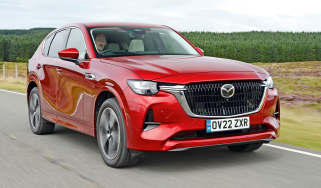
The Mazda CX-60 is a left-field but worthy contender in the premium mid-size SUV class


Our opinion on the Mazda CX-60
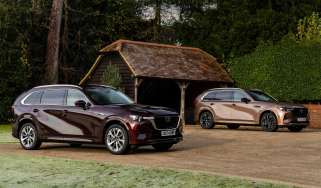
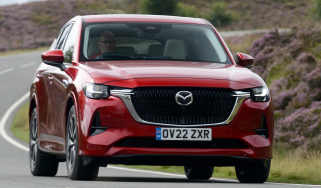
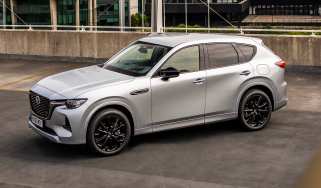
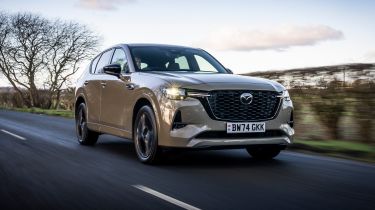
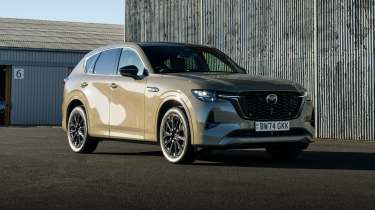
The CX-60 is an impressive debut for Mazda in the premium SUV market. Its stylish exterior look and quality feel throughout the cabin mean it should appeal to buyers in this ultra-competitive sector, while its efficient plug-in hybrid powertrain and large, practical boot space should fit the bill for family life, too.
It’s a shame that the CX-60 doesn’t offer the same excellent driving dynamics that we’ve come to expect from a Mazda model, but it has a solid breadth of ability that enables it to compete with close rivals. The relevance of the diesel-powered versions remains questionable, but the CX-60 is keenly priced and deserves consideration.
About the Mazda CX-60
Mazda has covered most of the automotive market with its models over the years, but the CX-60 was its first foray into the premium mid-size SUV market. Considering the ferocity of the competition in this sector, it was a clever move by Mazda to make this car its first to ever be powered by a plug-in hybrid powertrain.
Alternatively, if you don’t fancy having a plug, there’s also a much more traditional 3.3-litre, six-cylinder diesel engine. This setup does feature mild-hybrid assistance, but you don’t have to charge it.
Standard equipment is generous, too, with the entry Exclusive-Line trim featuring enough kit to keep things feeling premium enough to compete with traditional premium competitors from Audi, BMW, Lexus and Mercedes, as well as Land Rover and Volvo.
Used - available now

2026 Mazda
Cx-60
60,837 milesAutomaticPetrol2.5L
Cash £18,370
2025 Mazda
Cx-60
70,015 milesAutomaticPetrol2.5L
Cash £15,980
2026 Mazda
Cx-60
42,916 milesAutomaticDiesel3.3L
Cash £24,699
2025 Mazda
Cx-60
81,445 milesAutomaticPetrol2.5L
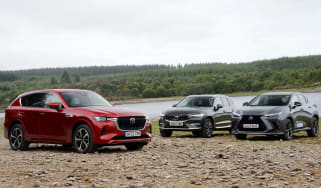
Cash £15,018In order to see just how well the Mazda CX-60 stands up to the competition, we’ve lined it up against other plug-in hybrid rivals such as the Volvo XC60 and Lexus NX in a group test. While it couldn’t quite topple the luxurious Lexus, the CX-60 did manage a respectable second place thanks to its large boot, lovely interior and competitive pricing.
Mazda CX-60 prices and latest deals
Perhaps surprisingly, it’s the plug-in hybrid models that are cheaper to buy, rather than the diesels. Prices start from around £47,000 for a CX-60 PHEV in Exclusive-Line spec, and moving up through the five trim levels eventually drives this figure up to at least £53,800 for the fanciest Takumi Plus. The diesel models are available with two power outputs, with the lesser of the two being rear-wheel drive and commanding a premium of roughly £100 over the PHEV. The more powerful engine four-wheel drive version carries a surcharge of over £2,500 over its less potent sibling.
If you’d like to save on your new car, you can build the perfect Mazda CX-60 via the Auto Express Buy a Car service. We also have a selection of CX-60 leasing deals to choose from, as well as a variety of used CX-60 models. We can also help you to sell your car.
Performance & driving experience
Pros |
|
Cons |
|
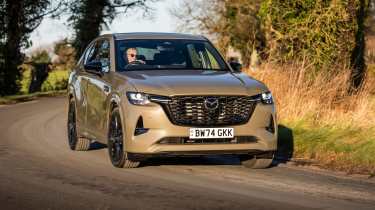
Mazda introduced an all-new platform and engine range for the CX-60, while this mid-size SUV was also the first of the Japanese manufacturer's models to feature a plug-in hybrid option.
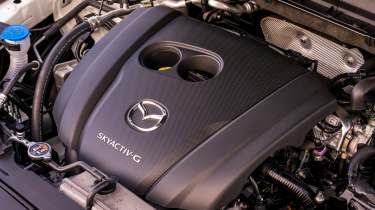
The CX-60 PHEV uses a 2.5-litre petrol engine paired with an electric motor and 17.8kWh battery for a combined power output of 323bhp and a healthy 500Nm of torque.
The only alternative in the CX-60’s limited engine lineup is a 3.3-litre, six-cylinder diesel, which is an unlikely choice given the growing demand for electrification. Nevertheless, there’s a 197bhp rear-wheel drive and a more powerful 250bhp four-wheel drive variant, both of which use an eight-speed automatic transmission just like the CX-60 PHEV.
While neither diesel feels astonishingly quick, they do gather speed at a respectable pace for such a bulky SUV. The engine sound is even surprisingly enjoyable during the process, too.
| Model | Power | 0-62mph | Top speed |
| CX-60 3.3d 200 Exclusive-Line | 197bhp | 8.4 seconds | 132mph |
| CX-60 3.3d 254 Exclusive-Line | 250bhp | 7.4 seconds | 136mph |
| CX-60 2.5 PHEV Exclusive-Line | 323bhp | 5.8 seconds | 124mph |
Performance, 0-60mph acceleration and top speed
For a family SUV, the CX-60 provides a decent turn of pace, particularly in plug-in hybrid form. The PHEV manages 0-62mph in 5.8 seconds with a top speed of 124mph, making the CX-60 PHEV a fair bit quicker than the fastest Lexus NX (also a plug-in hybrid), because that car covers the landmark sprint in 6.3 seconds.
The 250bhp diesel version needs 7.4 seconds to hit 62mph from a standstill. The slowest sprinter in the CX-60 lineup is the 197bhp diesel, which takes 8.4 seconds to travel from 0-62mph.
Town driving, visibility and parking
The CX-60 is a big car, so threading it through busier and narrower streets can be a bit tense at times. However, the reasonably thin A-pillars make for decent forward visibility. Unfortunately, the same can’t be said for seeing what’s behind you, but every model does at least get all-round sensors and a reversing camera as standard.
If you take shorter, in-town journeys more frequently than longer motorway runs, the plug-in hybrid will be the better option. There’s a slight downside to the PHEV at lower speeds, because it isn’t the smoothest operator. The electric motor also emits a distinct whine, which is noticeable because the noise from the 2.5-litre petrol engine is so well suppressed.
Country road driving and handling
The plug-in hybrid and more powerful diesel CX-60 models benefit from all-wheel drive, although Mazda states its layout is rear-biased, hinting at a sportier drive.
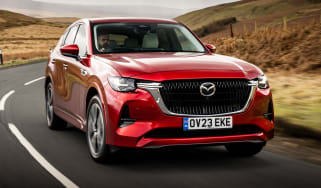
A suggestion of sportiness is all you get, however, because while the CX-60 handles well enough compared with some of its premium rivals, the plug-in model doesn’t offer the same driving dynamics we’ve come to expect from a Mazda. With a kerb weight of almost two tonnes, it feels a little compromised and isn’t that great to drive.
The steering is accurate and well-weighted, but if you venture out onto twistier B-roads, you’ll find the chassis of the CX-60 struggles to keep up with quicker steering inputs. There’s also a noticeable amount of body roll.
Motorway driving and long-distance comfort
The CX-60 has no issue getting up to motorway speeds and staying there, and although there’s still a persistent firmness to the ride quality, this is less pronounced when cruising. You will still become familiar with any major potholes or imperfections in the road, but some midlife revisions to the rear suspension have improved things a bit. Wind noise and tyre roar are also kept well under control.
“In EV mode, the plug-in hybrid is a little slow to pull away, and every so often there’ll be a pronounced lurch or thump from the transmission. Mazda’s premium rivals are streets ahead in this respect.” - Andy Pringle, chief sub-editor.
MPG & running costs
Pros |
|
Cons |
|
Buyers have the option of two very different engines for the CX-60: a 2.5-litre petrol plug-in hybrid or a 3.3-litre diesel unit with mild-hybrid technology. The least powerful diesel is able to return an impressive 56.5mpg on the WLTP combined cycle, while the punchier version officially claims 53.3mpg. However, CO2 emissions of 131g/km to 142g/km aren’t as noteworthy.
Similarly, the Japanese carmaker says its first plug-in hybrid will return up to 201.8mpg. However, our average fuel economy while living with the CX-60 PHEV stayed firmly between 40 and 50mpg. That being said, it’s exceptionally difficult for most plug-in hybrids to match their on-paper figures in the real world, so this isn’t a drawback that’s exclusive to the CX-60.
In comparison, the Lexus NX 450h+’s claimed economy is a whopping 282.4mpg. However, once again, its real-world average was much more modest in our testing, although it still outshone the Mazda at 70mpg.
| Model | MPG | CO2 | Insurance group |
| CX-60 3.3d 200 Exclusive-Line | 56.5mpg | 131g/km | 33 |
| CX-60 3.3d 254 Exclusive-Line | 53.3mpg | 138g/km | 38 |
Electric range, battery life and charge time
Mazda claims that the plug-in hybrid CX-60 can cover up to 39 miles on battery power alone. We averaged about 30 miles in our CX-60 PHEV long-term test car.
The plug-in Lexus NX has a bit of an advantage here, because it claims up to 45 miles. The BMW X3 PHEV runs rings around both of these cars, though, because it can officially cover up to 54 miles.
| Model | Battery size | Range | Insurance group |
| CX-60 2.5 PHEV Exclusive-Line | 17.8kWh | 39.2 miles | 38 |
| CX-60 2.5 PHEV Takumi Plus | 17.8kWh | 39.2 miles | 39 |
Insurance groups
While the CX-60’s fuel economy is pretty impressive, insurance costs will be less so. The plug-in hybrid model sits in either group 38 or 39 (out of 50), depending on your chosen trim level, which means premiums will be expensive. The 197bhp diesel in Exclusive-Line trim is the cheapest to insure because it sits in group 33.
This means the Mazda’s premiums will be similar to those of the Lexus NX line-up, because that Japanese rival sits in groups 32 to 43. Meanwhile, the BMW X3 is in groups 32 to 42.
Check if your car needs an MoT and view its complete history with our MoT History Checker...
Tax
Every CX-60 incurs the standard rate of VED road tax plus the luxury car tax, so you’ll be looking at a combined annual bill of £625 between the second and sixth years after the car is initially registered.
The PHEV is the best CX-60 for business buyers as it offers lower Benefit-in-Kind (BiK) company car tax rates. However, for the most significant savings, you’ll need to look towards a fully electric SUV, such as the BMW iX3.
Depreciation
Our market data shows that both the PHEV and diesel Mazda CX-60s should retain between 39 and 45 per cent of their initial value after 36,000 miles or three years. Considering the big Mazda’s starting price, this financial pinch will be felt. The BMW X3 comes with slightly less of a sting, though, at 51 to 57 per cent after the same period.
To get an accurate valuation on a specific model check out our free car valuation tool...
Interior, design & technology
Pros |
|
Cons |
|
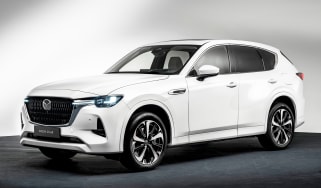
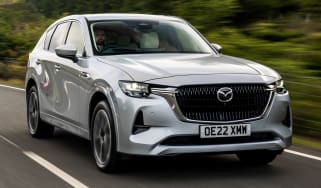
The CX-60 is positioned to take on premium mid-size SUV rivals, and at first glance, it shapes up pretty well. Mazda has followed its Kodo design philosophy with the CX-60, which is an approach that has previously helped to create appealing models such as the Mazda 3.
The entry Exclusive-Line model comes with 18-inch alloys, a 12.3-inch colour infotainment screen, heated seats, a heated steering wheel and leather upholstery, while moving up the range brings extras such as bigger 20-inch alloy wheels, a hands-free power tailgate, electrically-adjustable front seats, white Maple wood interior accents, Nappa leather seat trim and a 12-speaker Bose audio system.
Interior and dashboard design
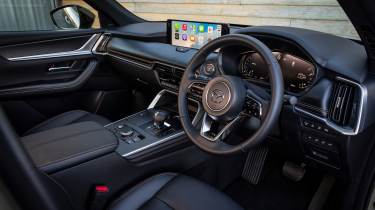
Mazda isn’t known for being entirely conventional, and the CX-60’s cabin is indeed a unique place to be. This is a good thing, though, as some clever use of textures and design keep things feeling bright, airy and high-end.
Standard equipment levels are good, too, although the finishing touches that come with the fancier Takumi and Takumi Plus trims make them a tempting upgrade and further underline the CX-60’s position as a premium SUV.
Materials and build quality
It’s inside the cabin where the CX-60 truly shines. The fit and finish is impressive, while the high-quality materials used leave you in no doubt that this is being pitched as a premium vehicle. Our long-term test car held up very well, and even the white upholstery withstood the rigours of family life.
Infotainment, sat-nav and stereo
Mazda has elected not to use a touchscreen in the CX-60’s infotainment set-up. However, while we sometimes complain about manufacturers taking their touchscreen tech too far, it also has its uses, such as when selecting functions or entering navigation addresses while the car is stationary, for example, as is the ability to touch and drag on the screen to preview a route.
Having to enter a postcode using the CX-60’s click wheel is a faff, with some simple processes taking longer to complete than we’d like. However, the rotary controller does have its uses. Being able to feel the adjustments you’re making by rotating the dial means it’s possible to make some changes without taking your eyes off the road.
Alongside the main screen, the CX-60 also has bright, customisable digital instruments that present all the necessary info clearly, while wireless Apple CarPlay and Android Auto connectivity are standard.
“The back seat looks pretty much unscathed after a year of having everything – and, after one very unfortunate bout of car sickness, I do mean everything – chucked at it by my daughter”. - Andy Pringle, chief sub-editor.
Boot space & practicality
Pros |
|
Cons |
|
It’s a fancy car to sit in, but Mazda hasn’t forgotten about crucial family practicality. The CX-60 provides a range of storage options such as a front centre console area with two cup holders, a good-sized glovebox, a roof-mounted sunglasses holder and seatback pockets. The boot also features a generous under-floor compartment, which means there’s extra space to store oddments (and charging cables if you opt for the PHEV model).
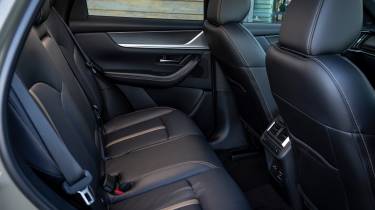
Installing a child seat is relatively straightforward, thanks to the CX-60's raised seating position, large rear doors, and easily accessible Isofix clips.
Dimensions and size
The CX-60 is a shade bigger all-round than the Lexus NX and Audi Q5, but the BMW X3 is a bit longer and wider.
| Dimensions comparison | |||
| Model | Mazda CX-60 | Lexus NX | BMW X3 |
| Length | 4,745mm | 4,660mm | 4,755mm |
| Width | 1,890mm | 1,865mm | 2,132mm |
| Height | 1,680mm | 1,670mm | 1,660mm |
| Wheelbase | 2,870mm | 2,690mm | 2,865mm |
| Boot space | 570-1,726 litres | 520-1,411 litres | 570-1,700 litres |
Seats & passenger space
Room upfront is fine, much as you’d expect in a mid-size SUV, while rear-seat passengers shouldn’t feel too shortchanged, either. There is plenty of foot space beneath the front seats, but the CX-60 can’t match the knee room offered by the Volvo XC60, or the excellent headroom provided in the Lexus NX (a problem made worse by the high-set middle rear passenger seat).
Boot space
With a 570-litre boot, the CX-60 offers a tremendous amount of luggage space, while the relatively low load lip is flush with the boot floor, making loading and unloading bulkier items that little bit easier. Folding down the rear seats (using the release levers in the boot) unlocks a sizable 1,726 litres of carrying capacity.
Towing
All versions of the CX-60 have a maximum braked towing limit of 2,500kg, which should be plenty for most day-to-day caravan or trailer-related needs. Mazda’s Mi-Drive tech also features a towing mode, which helps to optimise the car’s performance.
“If I’m honest, it’s a much larger car than our three-strong family really needs. It’s been truly luxurious on longer trips, with plenty of room for our daughter’s ever-expanding collection of soft toys alongside her on the back seat. I can count on the fingers of one hand the number of times I managed to fill the boot.” - Andy Pringle, chief sub-editor.
Reliability & safety
Pros |
|
Cons |
|
Mazda has a generally strong reputation for building reliable cars, but the most recent Driver Power owner satisfaction survey results show there’s room for improvement when it comes to impressing customers. While the CX-60 didn’t appear in the list of the best cars to own, Mazda only managed a middling 17th place out of 31 brands on the best manufacturer league table.
A five-star Euro NCAP safety rating is undeniably reassuring, though, with the CX-60 receiving some excellent individual scores: 88 per cent for adult occupants, 91 per cent for child passengers and 89 per cent for pedestrian safety.
Along with a full suite of airbags, standard active safety technology includes Lane-keeping assist and blind-spot Monitoring systems, along with a Driver Attention Alert, Traffic Sign Recognition and Intelligent Speed Assist, which works to help keep drivers from unintentionally exceeding the speed limit.
A new driver emergency assist function was also fitted to all CX-60s in 2026. This technology detects when the driver has lost consciousness, and it will automatically bring the vehicle to a stop where possible and safe to do so. During this process, the hazard warning lights will show, and the doors will then unlock when the car comes to a complete stop.
| Euro NCAP safety ratings | |
| Euro NCAP safety rating | Five stars (2022) |
| Adult occupant protection | 88% |
| Child occupant protection | 91% |
| Vulnerable road user protection | 89% |
| Safety assist | 76% |
Buying and owning
- Best buy: Mazda CX-60 3.3d 200 Exclusive-Line
The PHEV is worthwhile if you are a company car driver due to its lower BiK rating, but we’d recommend the diesel for private buyers. It’s nicer to drive, too.
We’d stick with the base Exclusive-Line trim because it includes all the equipment you need and keeps the price in check. It also has much smaller 18-inch wheels, which helps to improve the ride quality.
Mazda CX-60 alternatives
The premium mid-size SUV market plays host to some very popular names. The Audi Q5, BMW X3, Lexus NX, Mercedes GLC, and Volvo XC60 are good options, and can be had in plug-in hybrid forms. The X3 and GLC are also available with diesel power, while the NX is available in a regular non-plug-in hybrid form for those without access to a charger.
There’s growing demand for electric SUVs, too, with the Audi Q6 e-tron and BMW iX3 similarly sized alternatives.
Frequently Asked Questions
The Mazda CX-60 is a high-quality and spacious SUV that stands out reasonably well from the crowd. This car also offers pretty sensible running costs thanks to the option of either diesel or plug-in hybrid power. However, if you’re hoping for an element of driving fun, as is often the case with Mazdas, you will be left feeling disappointed.
Deals on the CX-60 and alternatives