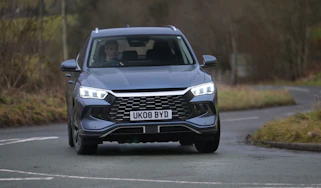
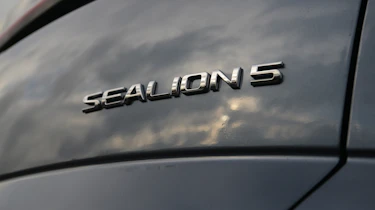
BYD Sealion 5 review
The BYD Sealion 5 is an impressively frugal plug-in hybrid SUV that costs less than many of its pure-petrol rivals

Our opinion on the BYD Sealion 5
Worthy of your consideration on price alone, there’s plenty to really like about BYD’s ninth new model in three years. The Sealion 5’s accomplished, efficient and refined DM-i plug-in hybrid system is among the very best of its type, while the spacious cabin, long kit list and premium-feeling interior will win it plenty of fans looking for an affordable, easy-to-live-with family SUV. It doesn’t handle as well as its European and Korean counterparts, but for many, that simply won’t matter.
About the BYD Sealion 5
The Sealion 5 is BYD’s challenger to mid-size SUV giants including the strong-selling Kia Sportage. But here’s the hook: this spacious, plug-in hybrid family car starts from less than £30,000.
Measuring just over 4.7 metres long, the Sealion 5 slots in at the top of the C-segment – alongside cars like the Sportage, plus the Hyundai Tucson, Skoda Karoq and Ford Kuga. Yet at that price, you’ll struggle to even find a pure-petrol alternative – let alone a fuel-efficient PHEV with a meaningful electric range.
So, the Sealion 5 is worthy of your consideration on price alone. But is there more to this Chinese newcomer than its bargain billing? Can it battle with the best when it comes to standard equipment, family-friendly features, tech, quality, refinement or driving dynamics? We’ve driven a top-spec Sealion 5 DM-i Design on UK roads to find out.
Performance & driving experience
Pros |
|
Cons |
|
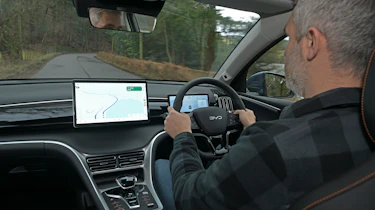
While some mid-size SUVs have a bit of sporting flair about them, the BYD Sealion 5 is very much a case of function over form. There are few thrills to be had here, unless you’re someone who becomes particularly excited about refinement. If that is the case, this car will put a smile on your face.
| Model | Power | 0-62mph | Top speed |
| BYD Sealion 5 DM-i Comfort | 209bhp | 7.7 seconds | 106mph |
| BYD Sealion 5 DM-i Design | 209bhp | 8.1 seconds | 106mph |
Performance, 0-60mph acceleration and top speed
The BYD Sealion 5 is only offered with one powertrain: a petrol plug-in hybrid with a combined 209bhp and 300Nm of torque. As mentioned, it never feels particularly fast, even if the maker does quote a respectable 8.1-second 0-62mph time for the top-spec Design model. The lighter (smaller battery) model cuts this to 7.7 seconds, and the top speed for both cars stands at 106mph.
Town driving, visibility and parking
The Sealion 5 is pretty uneventful to drive in town. There’s enough shove to get away from the lights in a brisk fashion, and the whole experience is smooth and peaceful enough. The base model gets a reversing camera while the Design gets a 360-degree unit, so parking is mostly drama-free, too.
Used - available now

2023 Audi
Q3
25,381 milesAutomaticPetrol1.5L
Cash £19,720
2025 Volkswagen
Taigo
29,283 milesAutomaticPetrol1.5L
Cash £17,490
2024 Volvo
XC40 Recharge
22,755 milesAutomaticElectric
Cash £24,530
2022 Toyota
C-HR
4,973 milesAutomaticPetrol1.8L
Cash £20,510During our test we were left thinking that the brakes could do with some fine-tuning. This might be due to the fact our car had done fewer than 1,000 miles, but the pedal felt both wooden and a bit grabby – none of which was improved by ramping up the level of regenerative braking; there are just two strengths, neither of which is particularly aggressive. If you like the idea of a one-pedal driving experience, you’ll need to look elsewhere.
Country road driving and handling
This SUV is very much focused on cost-effectiveness rather than excitement, so it can’t quite hold court when it comes to more spirited driving. The steering has a decent enough weight to it, but there’s something of a disconnect at the front axle. It feels very vague, and quite disconcerting at times – especially if you try to string together a series of quick direction changes.
Even with 209bhp and 300Nm of torque this isn’t a particularly fast car either, with seemingly little instant torque – even in the ‘Sport’ drive mode. In fact, the various settings do little to change the way the car drives; true to its slightly dowdy aesthetic, the Sealion 5 rewards a more relaxed approach.
Motorway driving and long-distance comfort
We found the BYD Sealion 5 particularly quiet at motorway speeds, with only a little wind and road noise making its way into the cabin. By and large, it’s a comfortable car; there’s a bit of fidget to the ride at lower speeds or over rough surfaces, but on the whole it’s easily a match for its European or Korean rivals in this regard.
MPG & running costs
Pros |
|
Cons |
|
We were really impressed with BYD’s DM-i plug-in hybrid system when we drove the Sealion 5 on UK roads. It blends its two power sources (petrol and electric) almost seamlessly. However, while this makes for smooth progress, unless you reset the EV trip computer, you’re never quite sure how far you’ve gone on electric power alone.
BYD quotes an electric range of up to 53 miles for the bigger-battery Design, while even the base car can allegedly cover 38 miles before the engine kicks in.
The weighted WLTP combined fuel economy number sits at 53.3mpg, and this is a much more realistic figure than the 400-odd mpg claims of the past. However, this will still largely depend on how often you’re able to plug the Sealion 5 in.
| Model | MPG | CO2 | Insurance group |
| BYD Sealion 5 DM-i Comfort | 53mpg | 22g/km | 27 |
| BYD Sealion 5 DM-i Design | 53mpg | 14g/km | 26 |
Electric range, battery life and charge time
It’s hard to say with any certainty how many miles our test car did before the engine kicked in, although the fact we didn’t even notice that initial transition is high praise for the Sealion 5’s composure and refinement on the move. The clever hybrid system juggles the two power sources almost imperceptibly; the petrol motor only makes itself known when you ask for full power, or when it fires into life at a set of traffic lights.
BYD quotes a range of between 38 and 53 miles depending on whether you opt for the Comfort or Design model – as the latter has a bigger battery. Neither offers DC fast charging however; a maximum charge rate of just 3.3kW means a full charge could take up to six hours.
| Model | Battery size | Range | Insurance group |
| BYD Sealion 5 DM-i Comfort | 12.96kWh | 38 miles | 27 |
| BYD Sealion 5 DM-i Design | 18.3kWh | 53 miles | 26 |
Insurance groups
Unusually, the range-topping Design actually sits slightly lower on the insurance group scale than the entry-level Comfort, in group 26 compared to 27 (out of 50). The Kia Sportage can potentially save you a lot more, though, as it sits as low as group 19. The Hyundai Tucson is even lower still, from group 16.
Tax
Being a low cost car means the BYD Sealion 5 avoids the dreaded luxury car tax surcharge. Company car buyers will also see a light Benefit-in-Kind reduction due to it being a PHEV. However, for the very biggest company car tax savings, you’ll be better off looking towards a fully electric SUV. BYD has no shortage of these on offer, such as the Atto 3 and Sealion 7.
Depreciation
Our market data shows that the BYD Sealion 5 will retain 46 to 47 per cent of its original value after three years or 36,000 miles. This is pretty much on par with its better-known rivals, as the Kia Sportage manages 45 to 52 per cent, while the Hyundai Tucson retains 47 to 52 per cent. The BYD is actually a slightly stronger investment than some rivals, too, as the Ford Kuga only holds 39 to 41 per cent.
Interior, design & technology
Pros |
|
Cons |
|
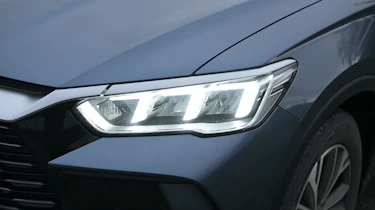
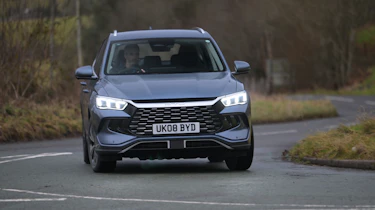
Both variants of the Sealion 5 are visually identical, and the base Comfort model gets its fair share of pricier-car kit such as LED lights front and rear, 18-inch wheels and a twin-screen infotainment system. There are four colours to choose from, although only Atlantis Blue is standard; black, grey or white paint is an £850 extra.
Stepping up to the Design adds an electric tailgate, heated front seats, wireless phone charging and 360-degree parking cameras.
Interior and dashboard design
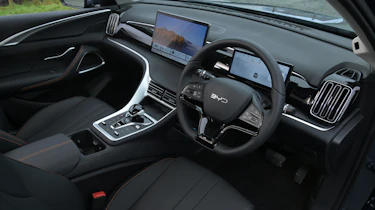
The cabin centres around a twin-screen infotainment system, although in the Sealion 5’s case, the main display doesn’t rotate as it does in some of the maker’s other models. This is no great shame; we’ve previously found this feature to be little more than a gimmick, more often than not defaulting to the landscape orientation anyway. Elsewhere, the general cabin design is straightforward and inoffensive.
Materials and build quality
Considering the price, it’s difficult to fault the BYD’s build quality. It’s our job to be picky, though, so we will say that the rear-view mirror is a bit flimsy, and the piano-black plastic on the gear selector doesn’t rival the tactility of some upper-end SUVs. However, on the upside there’s vegan leather on the seats and steering wheel, plus soft materials on the doors and dashboard.
Infotainment, sat-nav and stereo
The hardware and software buried within the Sealion 5’s infotainment system is slick and responsive, but some of the menus are still overcomplicated and it’s not always easy to find what you’re looking for. Wireless Apple CarPlay and Android Auto are standard, although on one occasion our car managed to inexplicably drop its connection despite maintaining a solid Bluetooth link – refusing to reinitiate until we’d deleted and paired our phone with the car again.
“Looks are subjective, but we think BYD could’ve taken a few more risks with the Sealion 5. It’s not the most daring design, though we thought the interior and tech offering was strong”. - Richard Ingram, deputy editor.
Boot space & practicality
Pros |
|
Cons |
|
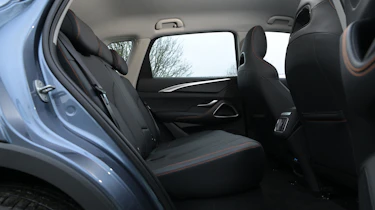
The cabin is vast, with enough room in the back for even tall adults to sit comfortably. You may even squeeze three abreast for relatively lengthy periods, thanks to the generous legroom and totally flat floor. The 463-litre boot is nothing to write home about in this area of the market, but the load lip is flat, and the space is square. There’s little in the way of under-floor storage, however.
Dimensions and size
BYD is pitching the Sealion 5 as a compact SUV, but in reality it’s longer than some mid-size rivals. At more than 4.7m nose-to-tail it’s more than 220mm lengthier than a Kia Sportage and more than 300mm longer than a Nissan Qashqai.
| Dimensions comparison | |||
| Model | BYD Sealion 5 | Kia Sportage | Nissan Qashqai |
| Length | 4,738mm | 4,540mm | 4,425mm |
| Width | 1,860mm | 1,865mm | 1,835mm |
| Height | 1,710mm | 1,625mm | 1,625mm |
| Wheelbase | 2,710mm | 2,680mm | 2,665mm |
| Boot space | 463 litres litres | 587 litres | 479 litres |
Seats & passenger space
While the BYD’s bulk compared to its rivals might put some people off – especially if you do most of your driving in town, and often have to park on tight or congested streets – the flip-side is it translates to a spacious cabin big enough for three adults to travel comfortably in the back. Those in the front certainly won’t have any complaints, either.
Boot space
Despite the Sealion 5’s generous exterior dimensions, this is a car that prioritises passenger room ahead of outright boot space. The 463-litre load area is below average for this class (a Sportage offers up to 540 litres with the rear seats up, for example), and while there isn’t much in the way of hooks or tie-down points, at least there’s no substantial load lip to contend with. Fold the seats (they split 60:40) and you’ll reveal a reasonable 1,410-litre maximum cargo area.
There is very little space under the boot floor, and no storage under the bonnet. You get a fixed parcel shelf (rather than a roller-cover), which is bulky and typically tricky to store. Only top-spec Design models come with an electric tailgate.
Towing
The Sealion 5 isn’t officially rated to tow, so you’ll need to look elsewhere if you need to hook up a trailer or caravan. We’d suggest looking towards the 2.0-litre diesel Skoda Karoq, as this can take on a hefty 2,100kg. If you’d rather stick with PHEV power, choose carefully as the plug-in Hyundai Tucsons can only manage 1,210kg.
“We’d have liked a slightly bigger boot, but what the BYD lacks in luggage space, it more than makes up for with its hugely roomy cabin. If you need to carry five adults in relative comfort, we’d have no qualms recommending the Sealion 5 over one of this car’s European rivals.” - Richard Ingram, deputy editor.
Reliability & safety
Pros |
|
Cons |
|
The BYD Sealion 5 hasn’t been assessed by Euro NCAP as yet, but the maker has a good track record in these tests so we expect a strong star rating when the scores are announced in due course.
That said, the Advanced Driver Assistance Systems (ADAS) in various Chinese cars have come under fire in recent years. Unfortunately, the Sealion 5 is another one that fails to meet European tastes and preferences. The incessant beeps and bongs are one thing, but the Driver Attention Warning (DAW)’s oversensitivity sees itself chiming every time you glance at the screen, or down at the array of buttons on the centre console. We found the naggy Lane Assist borderline unbearable too; BYD UK’s country manager, Bono Ge, told us this is something they’re working on, with fixes planned for the near future.
BYD didn’t set off any shockwaves in the most recent Driver Power owner satisfaction survey. Finishing in 16th out of 30 brands in the best manufacturer results, BYD owners were particularly happy with their cars’ powertrains, but the on-board tech was a real bugbear.
Every Sealion 5 comes with a generous six-year, 93,750-mile (150,000km) warranty, with the Blade battery covered separately for eight years. This should come as some peace of mind if this is your first BYD or, if coming from a petrol model, your first plug-in hybrid.
Buying, prices and deals
Best buy: BYD Sealion 5 DM-i Design
The entry-level BYD Sealion 5 Comfort starts from just shy of £30,000, but we think you might as well go all the way and bag the Design from £33,000. You’ll get the bigger battery pack and even more kit, so it’s worth this pretty modest price difference.
If you want to save on these list prices, though, be sure to build your new BYD Sealion 5 with the Auto Express Buy A Car service. We also have a range of Sealion 5 leasing deals to choose from, along with new Sealion 5 models in stock and ready to go.
BYD Sealion 5 alternatives
The BYD Sealion 5 resides in one of the most competitive areas of the new-car market: the mid-size SUV sector. That means it goes up against big-sellers like the Kia Sportage, Hyundai Tucson, Nissan Qashqai, Ford Kuga, Skoda Karoq and Volkswagen Tiguan.
There are a number of other Chinese cars vying for their piece of this lucrative market, too. These include the Geely Starray and MG HS Seal U. The Sealion 5’s own sibling, the BYD Seal U, is also worth a look.
BYD Sealion 5 pictures
Key updates of the BYD Sealion 5 review
15 October 2026: Latest driving impressions and depreciation data.
Frequently Asked Questions
Six years and 93,750 miles make the BYD Sealion 5’s warranty among the lengthiest and most comprehensive of any car on sale.
Deals on the Sealion 5 and alternatives