Mercedes GL500 vs Volvo XC90 vs Land Rover Discovery: 2006 group test
Everything about the new GL-Class is larger than life. But does the Mercedes out-muscle Volvo and Land Rover rivals?

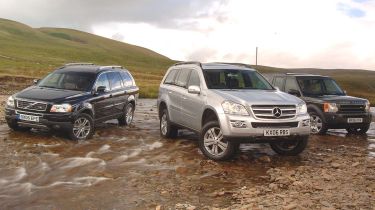
Full-size off-roaders have had a tough time of late. They certainly look at home in the beautiful Welsh countryside of our main picture, but in towns they have received some negative attention. Debates about their fuel economy and size continue, yet this segment of the market is still popular with buyers. However, the undisputed kings of SUV ownership aren’t us Brits, but US buyers – there are 29 million of them on American roads.
And the latest premium model to hit the market over there has now arrived on our shores, too. The new Mercedes GL-Class aims to follow the success of the smaller M-Class. Rather than offer only one premium off-roader, the German firm has decided to sell two. The cars share many mechanicals, but give customers a choice of size and interior space. Both are built in Alabama, yet the GL boasts seven seats. However, the big Merc isn’t the class’s only new arrival; the Volvo XC90 has proved a global hit since its 2003 launch, and has now been updated. What’s more, the firm has bowed to demand from US buyers and fitted its SUV with a 4.4-litre petrol V8.
But can either dislodge our current class favourite? With its famed off-road ability, the Land Rover Discovery should test the Merc’s talents in the rough, while the seven-seater layout is sure to score on practicality. Unfortunately, as we were unable to source a V8 Discovery for this test, we’ve opted for the more popular TDV6 diesel.
Used - available now


So read on to see which SUV has the best blend of space, practicality, on and off-road behaviour and running costs.
Verdict
The Mercedes GL500 is an impressive feat of engineering. It blends genuine off-road ability with fine on-road dynamics and performance that belies its size. Interior quality is a step above rivals’ and it’s huge inside, but its vast dimensions makes it hard to drive in some situations, and it’s very expensive.
Land Rover’s Discovery is as capable as the GL off-road, and although its handling and performance aren’t as impressive, it’s refined, versatile, robust and more suited to family life. Whether in diesel or V8 trim, it’s considerably cheaper, too, and remains our favourite. Although updated with an improved drivetrain, the XC90 narrowly fails to match its rivals. It falls short dynamically, but still has the cleverest seating layout and loads of useful features.
First place: Land Rover Discovery TDV6 HSE
Proudly wearing the most famous badge in the sector and made here in Britain, there’s plenty of reasons to love the Discovery. But it’s the chunky ‘Tonka Toy’ looks that attract attention – modern, tough and uncluttered, the Disco is equally at home on the farm or outside a trendy restaurant.
This classless image has always been a Land Rover strength, but there’s no doubt the latest Discovery has moved upmarket. The robust build inside and out is testament to this – although the cabin is more off-roader than executive car. The plastics look and feel a little cheap compared to the luxury atmosphere in the Mercedes.
There’s a double glovebox, and all the centre cup-holders and stowage trays have removable and washable plastic inserts. Some of the buttons on the dash are small, but the standard touch-screen sat-nav is within easy reach, and although you sit high, the driving position is comfortable.
In the back, the middle row offers slightly better legroom than the Volvo. There’s plenty of space across the bench, helped by the fact the Disco is the widest car here, and all three seats are very comfortable. The floor is totally flat, so the middle seat is much more supportive than that in the XC90. The Disco’s lofty height – only 3mm lower than the GL – means headroom is good, too. Both the outer chairs flip and tumble to provide access to the third row, where the seats are comfortable but closer together than those in the GL.
Legroom is also tighter, yet the Land Rover is roomier than the Volvo in this area. All five rear chairs fold easily to give a very practical load bay – and at 2,558 litres in total, it’s the biggest here.
The Discovery is also the most refined car on test. Even though it has a diesel engine, this HSE recorded a lower sound meter figure than the GL500 at both 30 and 70mph. There’s little road noise at speed, and the ride quality is excellent. The Land Rover’s air-suspension isolates the cabin well – put simply, it’s one of the best-riding SUVs you can buy. It’s relaxing and calming to drive, but you need to adopt this laid-back approach in corners, too; if you attack the bends, the British off-roader becomes very cumbersome.
Even weightier than the GL500, the 2.5-tonne off-roader feels very heavy and has slower steering than its rivals. Nevertheless, it’s stable, and thanks to the good controls and soothing road manners, you soon find yourself adapting to the Land Rover’s way of doing things.
Once in the muddy stuff, it’s very capable. As with the GL, it can raise its suspension to increase ground clearance, plus use its clever drivetrain and electronic Terrain Response system to offer more off-road ability than 99 per cent of customers will ever use. The diesel engine makes direct performance comparisons with the GL500 pointless, and the Discovery is never less than sluggish, meaning overtaking needs careful planning – but it’s a fine cruiser once up to speed.
The six-speed automatic gearbox does smooth the changes very well, though, and given the weight they have to deal with, the brakes perform strongly, returning consistent stopping distances while the pedal stays firm under foot.
With front and rear parking sensors, plus sat-nav and a full leather interior all standard, the Discovery is as well equipped as the GL and offers exceptional value for money in comparison.
Details
Price: £43,540
Model tested: Land Rover Discovery TDV6 HSE
Chart position: 1
Why The Discovery has been voted Best 4x4 Off-roader at Auto Express’s New Car Honours for two years in succession. Two engines are offered – a 4.4-litre petrol V8 or the diesel tried here in top HSE spec. At £43,540, it’s the cheapest car on test.
Economy
It came as no great shock that the diesel Land Rover was the most economical car, but the V6 oil-burner is by no means frugal. While the Disco had the longest range of our test trio, at 417 miles, its 23.1mpg average was well short of the maker’s 27.2mpg claimed combined figure.
Residuals
Thanks to their strong brand image, Land Rover models tend to be much sought after in the used car market – and the Discovery is no exception. The TDV6 performs better than the V8 petrol variant, and after three years it will be worth £22,423 – or 51.5 per cent of its price when new.
Servicing
With 130 outlets, the Land Rover dealer network is the smallest here, but its garages have fared well in our annual Driver Power satisfaction surveys. Three services cost slightly more than £1,000, and the Disco needs attention every 15,000 miles. But the basic three-year warranty covers unlimited mileage.
Tax
The diesel-powered Land Rover is probably the more likely choice as a company car in this line-up. It emits the least CO2 (274g/km), but still sits in the same 35 per cent category as its rivals. However, thanks to its lower price, it’s the cheapest option, costing £3,000 less than the GL.
Second place: Mercedes GL500
It’s hard to spot the logic in Mercedes’ decision. When many other manufacturers are simply making their off-roaders with seven seats, why has the German marque created two separate models?
The answer, according to company top brass, is that it gives the customer plenty of choice. That at least is true, since Merc’s four-wheel-drive model range consists of not only the M and GL-Class, but also the six-seat R-Class crossover MPV. It seems an expensive strategy, although it does guarantee the marque blanket coverage across the sector.
The three-pointed star’s flagship SUV doesn’t have a problem creating an impression, either. It’s vast – 250mm longer than either rival, with a wheelbase 160mm larger than the M-Class’s. Its styling and sheer size make it very imposing.
And that means it has a gargantuan cabin. In the middle row, the flat floor ensures that even the centre passenger has loads of legroom, and occupants get their own climate controls. Oddly, it’s only possible to gain access to the rear row from the right-hand seat, meaning in the UK passengers have to exit on to the road, rather than the pavement, when parallel parked. That curious set-up aside, the rear row provides the most roomy accommodation of this trio, and access is good. We can’t think of much this side of a private jet that can carry seven in such comfort.
What’s more, it has the biggest boot – a whopping 750 litres in five-seat mode – and the best party trick, too. Both the rear seats fold electrically at the touch of a button. OK, so it’s not a rugged feature, but that’s not what the GL is about. As the cabin design makes clear, this is a luxury SUV.
Virtually identical in layout to the M-Class, the dash features clear switchgear, high-quality materials and a robust finish. Neither rival comes close to the upmarket impression created by the Mercedes. Extensive seat and wheel adjustment, as well as good visibility, mean the driving position is great – although you can’t help but look and feel very small behind the wheel, which can make the GL intimidating to drive at first.
Fitted with Airmatic suspension as standard, the Merc is not only highly refined, but has a very relaxing ride. Even more impressive for a vehicle that weighs nearly two-and-a-half tonnes is the body control. It feels solid and stable, and the air-suspension maintains great composure in corners. Moreover, the GL has the best steering, yet manages to combine this with stunning off-road ability – it came close to matching the Disco in the rough.
And its engine is far more impressive. The 5.5-litre V8 delivers amazing acceleration given the GL’s size and weight. It covers 0-60mph in 6.6 seconds, bettering many hot hatches, the 7G-Tronic seven-speed gearbox offers slick, quick shifts and there’s the option of manual control with steering wheel buttons. But it was the Merc’s ability to stop from 60mph in only 34.7 metres that really surprised us.
Drive the GL500, and regardless of your opinion of large SUVs, you can’t help but be impressed by how capable, comfortable and well built it is, while for once this is a Mercedes that’s very well equipped. But given that it costs £20,000 more than either rival, this is the least we should expect – how the company thinks it can justify a £15,000 premium over the M-Class for what amounts to little more than an extra pair of rear seats and a bit more space is a mystery to us.
Details
Price: £65,720
Model tested: Mercedes GL500
Chart position: 2
Why: Topping a three-model line-up, the GL500 is the only petrol variant on sale. There are also GL320 CDI and GL420 CDI diesels. But even the base car is priced at £51,675, so the GL costs a lot more than the M-Class – as well as its rivals here.
Economy
With a 5.5-litre V8 engine and a kerbweight that’s the best part of 2.5 tonnes, it’s no surprise economy is not a GL strength. During its time with us, it averaged 15.4mpg, giving a range of 339 miles. The vast 100-litre tank makes for eye-watering bills at the pumps as well – filling up costs around £95.
Residuals
Our experts have yet to calculate residual values for the GL500 as it’s so new, but the smaller M-Class performs well – although it tends to be the diesel variants which hold their value the best. As a guide, the ML500 Sport is worth 46.1 per cent of its list price after three years.
Servicing
We were surprised that the new GL was the cheapest model to service. The first three visits to the dealership cost £855 – that’s £150 less than the Land Rover. Mercedes also has the largest network here, while the 30-year Mobilo Life recovery package continues to impress.
Tax
Emitting a huge 331g/km of CO2, the GL500 is the least eco-friendly of the three off-roaders tested. Due to its expensive list price, it is also the most costly alternative for company car drivers. High-band owners should prepare for an annual bill of close to £10,000.
Third place: Volvo XC90 V8 SE Lux
Few cars have arrived to such a fanfare as the Volvo XC90. When it first went on sale, demand far exceeded supply and waiting lists stretched for months. Auto Express loved it, too, making it Car of the Year in 2003 – the only time our ultimate accolade has ever gone to an SUV.
The cleverly thought-out cabin was key to its success, but the neat styling played a part, too. So it’s little wonder that the firm’s designers haven’t altered the looks much during the recent update. A mildly reworked grille, body-coloured mirrors and new side indicators, plus a fresh tail-lamp design, distinguish the latest version.
Inside, the straightforward cabin remains largely unaltered. But while the quality of the materials impresses, the overall ambiance isn’t quite as exclusive as the Mercedes’ driving environment. The interior is well thought-out, though, because despite its noticeably smaller dimensions – the XC90 is 290mm shorter, 56mm lower and 22mm narrower than the GL – it still offers useful accommodation.
The middle row chairs all slide individually, and while legroom isn’t as good as in the GL, there’s still plenty of head space. The centre chair also has a clever built-in child booster seat, and the middle stowage bin can be removed to allow youngsters to slide forward, level with the backs of the front seats. Once into the third row, the Volvo’s smaller exterior dimensions start to tell, because for adults the confines are a bit tight and it’s much less comfortable than the GL. The XC90 also has a smaller boot in each seat configuration, although as with the Discovery, the split tailgate is useful.
The driving position is lower and more conventional than either of its rivals’, and this perceived lower centre of gravity makes the Volvo more car-like to drive. But in reality, it hasn’t got any more grip, and suffers from more body roll in corners. The steering is light, too, yet Volvo seems to have ironed out the kickback that could be felt through the wheel in earlier models. But while it’s certainly easy to live with in town, out on the open road it doesn’t feel as accomplished as the GL, particularly because the ride is unsettled in comparison.
Stiffer anti-roll bars, firmer dampers and sportier steering sharpen the XC90’s driving experience in SE Sport trim, yet we reckon the SE Lux model here strikes a better balance. Nevertheless, with conventional springing, it’s no surprise that the ride isn’t quite as smooth as its air-suspended rivals.
The Volvo’s six-speed automatic is new, and a vast improvement on the old unit – shifts are now less obvious, and the drivetrain is impressively slick, if still not up to Mercedes standards. The same applies to the V8 engine. Surprisingly, the 4.4-litre powerplant needs to be worked hard to give its best, but it’s still tuneful and remains refined throughout the rev range.
With 311bhp, the Volvo is 77bhp down on the GL and generates 90Nm less torque, yet the XC90 is a massive 343kg lighter. On the road, it couldn’t make the most of this advantage. It was just over a second slower from 0-60mph, at 7.8 seconds, and didn’t have the GL’s penetrating mid-range pace. Nevertheless, Volvo’s first V8 offering is impressive.
Especially when you consider the price tag. It’s £19,395 cheaper than the GL500, and standard kit includes heated, memory and leather seats. In fact, you could move up to Executive trim or add every item from the options list and still undercut the GL.
Details
Price: £46,325
Model tested: Volvo XC90 V8 SE Lux
Chart position: 3
Why: Joining a new 3.2-litre petrol six-cylinder and the established D5 diesel in the XC90 range, the 311bhp V8 is offered in SE, SE Lux and Executive trim. We test the £46,325 SE Lux, but even the £53,965 Executive is much cheaper than the GL
Economy
Despite having a smaller capacity, Volvo’s 4.4-litre V8 has similar claimed economy figures to the Mercedes – but over our test route it proved more efficient, at 17.8mpg. Still, with the smallest tank here (80 litres), the Volvo has the shortest range, at 313 miles.
Residuals
Again, oil-burning XC90s tend to fare better second-hand. The V8 is in fact the worst model in the range for residual values, and the SE Lux loses £26,683 over the course of three years. That represents a retained figure of 42.4 per cent – five per cent worse than the equivalent D5 diesel.
Servicing
The Volvo was the most expensive car in terms of maintenance – the first three inspections cost a grand total of £1,070. Generous 18,000-mile service intervals mean you won’t have to shell out very often, but the XC90 comes with a meagre single-year recovery deal.
Tax
All three of these cars sit in the top tax band for business users, so the annual bill is dependant on the list price. High earners will pay £6,486 for a standard XC90, but our test car had nearly £8,000 worth of options fitted – driving the final tax cost up by more than £1,100.