What is the greatest MINI ever?
We rank and rate the best and worst Minis in exclusive 12-car shoot-out.

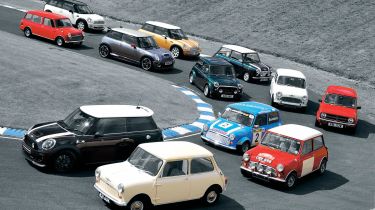
It's 50 not out for Mini! The famous British brand celebrates its golden anniversary this year, and what better way to commemorate the occasion than with a slice of Mini mayhem?
To mark the firm’s big year, we’ve gathered a glittering collection of cars from the past and present. From the incredible rally cars of the Sixties to the latest Clubman and John Cooper Works World Championship 50, they’re all here, but which of these golden wonders is our favourite?
Our countdown from 12 to one, reveals all…
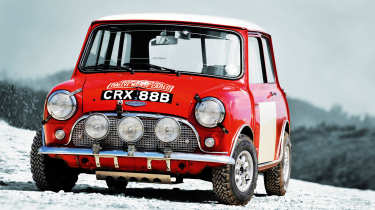
Ex-Works Monte Carlo Rally Mini
Monte Carlo Cooper was specially kitted out for endurance rallying, and boasts additional dials and controls. It still wears competition stickers with pride.
It’s fair to say the Mini Cooper – which won the hearts of millions of driving enthusiasts the world over – was never part of the plan. BMC created the Mini as a cheap-to-run family car. Nothing more, nothing less.
However, sales were initially slow, and when Grand Prix-winning team owner John Cooper told BMC bosses the model had the potential to be a great competition car, they jumped at the chance to broaden its appeal.
Working closely with Alec Issigonis, who was lukewarm on the idea of his urban runabout being converted into a performance car, Cooper created a faster, more agile Mini. Originally fitted with a 997cc engine – 147cc more than standard – the MkI Cooper also featured the world’s smallest disc brakes, which were developed by aircraft maker Lockheed.
Launched in 1961, the Cooper was pressed into competition action virtually immediately. But while it recorded some decent results, it was not an instant hit with BMC’s older driving stars. Many regarded it as a punishment, often pleading with the management to let them pilot the firm’s ageing Austin Healeys instead. All that changed in 1964, when young Irish hot-shot Paddy Hopkirk swept to victory in the Monte Carlo rally driving a 1,071cc Cooper S. This was the world’s most prestigious motorsport event, and the win transformed the Mini’s image overnight.
After the 1,071cc Cooper S came an even faster version – the 1,275cc S seen here. This particular car was built for ‘Flying Finn’ Rauno Aaltonen and was part of a six-car assault on the 1965 Monte Carlo. Although BMC emerged victorious, with Timo Makinen recording the Mini’s second straight victory, CRX 88B retired early on. Compared with today’s rally cars, the Cooper S is very basic, and the rudimentary roll cage and thin safety belts prove how brave the likes of Hopkirk, Aaltonen and Makinen were.
Just as the original Mini created the template for the modern small car, the Cooper S did the same for the hot hatch as we know it. Volkswagen and Peugeot may get credit for turning GTIs into money-spinners, but if you’re looking for the model that started it all – this is it.
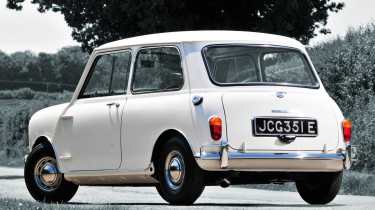
Original Mini Minor (1959)
Superb packaging gives space for four adults, although seats are tiny. Practical touches have become design classics, while on-road experience is sheer fun.
Used - available now

2024 Ford
Focus
11,819 milesAutomaticPetrol1.0L
Cash £18,076
2021 Ford
Focus Estate
7,352 milesManualPetrol1.0L
Cash £15,999
2021 Toyota
Aygo
18,079 milesAutomaticPetrol1.0L
Cash £11,990
2024 Toyota
Yaris Cross
8,000 milesAutomaticPetrol1.5L
Cash £21,999If you were to draw a family tree for the modern car market, 80 per cent of the motors would probably have a direct link to the incredible piece of automotive history you see here.
Although most of the original Mini’s celebrated engineering features had been seen before, it combined these technologies to create something genuinely groundbreaking.
Originally conceived as a short-term solution to the Suez oil crisis, the Mini was the brainchild of British Motor Corporation boss Leonard Lord. He commissioned Alec Issigonis – a maverick but hugely talented engineer – to come up with a solution.
The result became one of the 20th century’s most iconic designs – although Issigonis hated the notion of the car as a fashion item. He claimed the Mini looked the way it did because everything was functional.
Examine Mini number one, and it’s hard to argue against that view.
The famous external body seams were there because they made the car simpler to build, while the rubber cone suspension – which gave the Mini its go-kart handling – was the only set-up that fitted. The sliding windows allowed for the doors to be hollowed out for extra cabin width.
And it’s impossible not to be impressed by the interior packaging. Shorn of all luxuries – a heater was standard only on the DeLuxe – the Mini is an object lesson in how to build a car for a purpose. There’s genuinely space for four adults, while huge door bins and underseat storage can swallow vast amounts of kit.
Production continued for 41 years after Mini number one rolled off the Cowley line, and the MkI was built until 1967. The car enjoyed great highs and lows, surviving the axe on many occasions. And while other firms were soon building safer, more comfortable and faster rivals, none had the Mini’s charm or engineering brilliance. It is, quite simply, the most influential road car ever made.
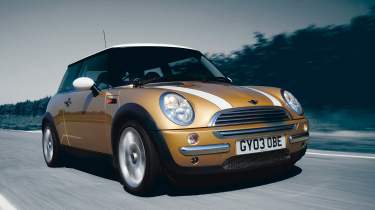
MINI Cooper MkI (2001)
With comfortable, well equipped cabin, 2001 car is a world away from original, although its retro styling both inside and out remains faithful to forebear.
Few brands, if any, command the loyalty and enthusiasm that the Mini generates in its followers, so relaunching the classic model was a massive undertaking. The job of coming up with a Mini for the 21st century wasn’t taken
lightly, and new owner BMW considered a host of designs for its long-awaited comeback – from clever space-saving models in the spirit of the original to retro reworkings of the existing vehicle.
Take one look at the end product and it’s clear which approach the firm preferred – and the resulting sales hit shows it got things right. With cute looks, a unique cabin, sharp dynamics and a premium price tag, the MINI was a car without a rival – and an instant success.
The savvy marketing campaign provided a huge list of cosmetic extras which were inspired by classic Mini features. This gave buyers the chance to make a real individual statement by choosing everything from Union Flag roof decals to bigger wheels and upgraded interior trim, just to give their car a personal touch. This approach has been copied by rival firms ever since, but the MINI got there first.
With its zippy engines, powerful Cooper and supercharged Cooper S models, as well as an economical diesel variant, there was a MINI for every occasion – but the newcomer wasn’t without compromise. Not only did it look like its famous predecessor, it shared the cosy rear seats and tiny boot.
Innovative aftermarket add-ons such as a clever and affordable all-inclusive servicing package set the MINI apart from its peers and helped to establish the brand’s now market-leading residual values. That explains why even the cheapest, earliest examples will still set you back £3,500 today.
The rebirth wasn’t universally popular with diehard Mini fans, but without the incredible showroom success of the 2001 car, models such as the later JCW, Clubman and Cabriolet wouldn’t even exist. The Oxford-built hatchback was also responsible for introducing a whole new generation of buyers to the Mini legend, which explains why this machine is the highest-ranked modern car in our rundown.
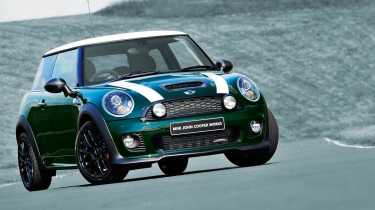
MINI JCW World Championship 50
Special-edition JCW 50 pays tribute to F1 title-winning team of 1959 and bears the signature of racing legend John Cooper. It also features raft of racy upgrades.
To celebrate its 50th birthday, MINI has launched a trio of special-edition models. The Mayfair and Camden go into production in August for one year only. With a host of unique trim and colour details, they will be available in Cooper, Cooper D and Cooper S guises.
But the birthday present that is sure to get enthusiasts really excited is the John Cooper Works World Championship 50.
Finished in the Cooper’s signature colour, Connaught Green, the flagship of the MINI range highlights just how far the brand has come over last 50 years.
Based on the current JCW, the Championship 50 has the same 1.6-litre 208bhp engine, but a raft of upgrades inside and out makes this a hot hatch for history fans.
With the signature of John Michael Cooper – son of the legendary John Cooper – on the right bonnet stripe, and a unique dash plaque, this MINI celebrates the Formula One title-winning Cooper Grand Prix team of 1959. A host of racy modifications means the 50 is more than just a nod to history, though. The black-painted 17-inch Challenge alloy wheels provide a menacing look, while the carbon detailing on the bonnet scoop, tailgate trim and mirror caps contrast with the green paintwork. To complete the changes, the car’s xenon headlights feature moody black reflectors.
Inside, the cabin feels special, too. The black leather seats edged in red piping are unique to the Championship 50 and nearly every option available on the standard JCW is fitted as standard.
That means luxuries such as a Harman Kardon audio system, DAB digital radio, Bluetooth, sat-nav, parking sensors and heated seats are all included.
The price of the Championship 50 has yet to be announced, but with only 250 examples being made, one thing’s for certain – it won’t be cheap. However, the cost is unlikely to stop this rare birthday car and future classic being eagerly snapped up by MINI fans.
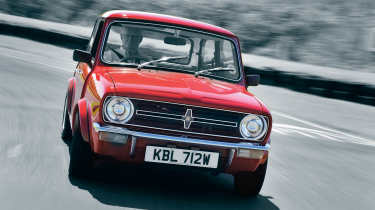
MINI JCW World Championship 50
Reworked Mini GT clubman has boxy nose, 1,275cc powerplant, a more luxurious cabin and fresh instruments.
Fans of fast Minis were in for a shock when the wraps were pulled off the 1275 GT in 1969. Designed to replace the much loved Cooper, the racy newcomer was the first model to feature the controversial Clubman body styling.
Walk up to the GT and it’s easy to see why buyers were put off. With its boxy nose treatment, the Clubman certainly lacks the charming and cheeky looks of the original car. But glance past its ungainly face and you’ll find it carries even more sporty cues than the famous Cooper. The flanks have distinctive stripes with eye-catching 1275 GT graphics, while 12-inch alloys were an option – early cars had smaller 10-inch rims.
The new body also featured a number of useful refinements which were soon adopted by the rest of the line-up, including the removal of the old-fashioned external door hinges. Better still, wind-up windows replaced the fiddly sliding items that had been a fixture since the Mini made its debut in 1959.
Inside, you’ll find even more updates to the Mini template. The standard car’s trademark central speedo was replaced by a three-dial binnacle in front of the driver, and two ‘eyeball’ vents at either end of the dash provided much improved ventilation. While the 1275 GT was more luxurious than the early cars, it still feels basic by modern standards, and the quirky sit-up-and-beg driving position remains the same.
Thankfully, the changes made to the Clubman failed to dilute the Mini’s ability to serve up bags of driving fun. The 1,275cc engine delivers a mere 59bhp, but thanks to a sharp throttle and short gearing the GT feels eager on the move. Dynamically the car seems alert, responding instantly to the steering wheel and slicing accurately through bends with undiminished speed. Only the unassisted disc brakes highlight the model’s age, because the pedal needs a hefty shove before you begin to slow.
When the Clubman was new, it failed to convince enthusiasts and was discontinued after 11 years. Today, though, the underrated GT would make a desirable addition to any Mini fan’s garage.
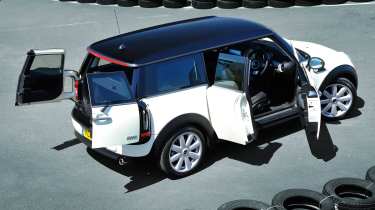
Mini Clubman
Funky Clubman builds on Sixties’ rear barn-door set-up With a unique side arrangement to allow easy access for those in the back. Attention to design and engineering detail is true to original car’s revolutionary concept.
MINI may have got its history a little confused with the name, as the Clubman is the spiritual successor of the Traveller and Countryman. As with its classic predecessors, it provides a different take on the MINI experience.
Like the Sixties original, the Clubman is bigger than the standard car on which it’s based. It is 240mm longer than the hatchback, and comes with an 80mm increase in its wheelbase. This means there’s more rear legroom and luggage space – but don’t be fooled, because the Clubman wasn’t conceived as a spacious family car. It simply offers a bit more flexibility.
The unique reverse-opening back door makes it easier to climb into the passenger compartment, while the long windows mean occupants get plenty of light. At the rear, the MINI’s designers have stayed true to history and the neat barn-style doors hark back to those of the original. From behind the wheel, the view out the rear is just the same, although the difference in size between the two cars is remarkable.
The MINI’s back doors represent far more complex engineering than in the Traveller’s day, though. Precise cut-outs are designed to accommodate the tail-lights, which are fixed to the back pillars. Crucially, just like the original, the Clubman provides an undiluted MINI driving experience: it handles and drives just like the hatch.
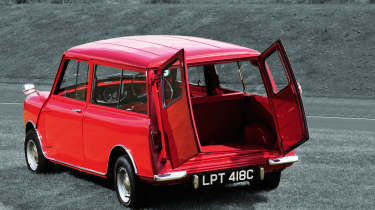
Mini Traveller
Minimalist, Colour-coded interior and dependable if diminutive engine give estate all the charm of the standard mini, but Traveller’s larger boot and barn-style rear doors ensure added practicality and versatility.
In the early Sixties, the idea of a trendy lifestyle estate was decades away, so this Mini was ahead of its time. It was designed to provide more practicality than the existing two-door models, and hit the roads in 1960.
Built on a slightly longer chassis – 2,104mm compared to 2,040mm – the Austin Mini Countryman and Morris Mini Traveller both featured a pair of barn-style rear doors, as well as more boot space than in the conventional car.
The beautifully restored example seen here was a joy to drive, and a quick look in the rear view mirror out through the back doors leaves you in no doubt as to the inspiration for BMW’s modern-day Clubman. With its light steering, the Traveller feels just like the saloon from behind the wheel, and it was this ability to provide extra space without ruining the driving experience that made the model such a hit.
Some luxury variants even got external wood panelling to give them the look of the ‘woodie’ estates of the Fifties. By the time production stopped in 1969, more than 200,000 examples had been
sold overall. Even more popular was the Mini van. In essence it was a Traveller without the side windows, and it was a big success. When the curtain fell on sales in 1982, more than half-a-million had been shifted. Even so, it is the fun of the Traveller and Countryman that lives on today in the form of the MINI Clubman.
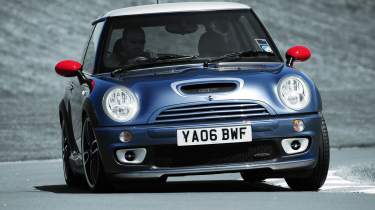
MINI GP Works
High-performance Works gp ensured the first-generation new MINI went out in style, thanks to sporty body mods, stripped-out cabin and potent powerplant.
When BMW halted production of the first-generation MINI in 2006, it wanted to make sure its baby went out with a bang.
The result was the wild Works GP edition, a stripped-out road racer that promised to be the most extreme MINI ever. It was exclusive, too, with only 2,000 examples being made, all hand-finished by Italian coachbuilding specialist Bertone.
Externally, the GP Works ditches the standard MINI’s cheeky styling in favour of a more muscular look. Deep side skirts, lightweight 18-inch alloys and a carbon fibre spoiler complement the standard Thunder Blue paint, while the roof is numbered to identify which of the 2,000 models you are driving. Climb aboard and the car’s sporty intentions are in no doubt. The rear bench has been removed to save weight, the driver and passenger sit in body-hugging Recaro seats and the dials get a special grey finish.
But you’ll find the biggest changes have been reserved for the GP’s mechanicals. The supercharged 1.6-litre engine pumps out 215bhp – an increase of 45bhp over the standard Cooper S – while the suspension is lowered, stiffened and fitted with lightweight aluminium components. There’s also a limited-slip differential and a special aerodynamic undertray.
On the move, the GP Works serves up undiluted driving thrills. The sprint from 0-60mph takes only 6.5 seconds, while the chassis tweaks mean few cars can match it for entertainment. Fast, fun and a true collectors’ item – the GP Works deserves its status as one of the greatest MINIs ever.
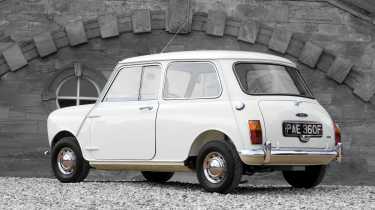
Mini MkII (1967)
It may have been touted as all-new, but 1967 MkII still features spartan principles of its predecessor, including sliding windows, simple door handles and a basic dash
After eight years of production, during which time the British public had fallen hopelessly in love with the Mini, BMC launched the MkII.
Yet it soon became clear that most of the updates were being introduced to make it cheaper to build rather than better. Thanks to over-optimistic initial sales expectations and a complicated production system, the MkI Mini had given BMC’s balance books a battering.
So, in 1967, the MkII arrived with a new look and a new price. The grille lost its famous ‘moustache ends’, while the rear screen was enlarged and new rectangular tail-lights added. The Mini also got its first power upgrade: a 998cc A-Series engine available alongside the existing 848cc unit.
Yet although the MkII was a more refined offering that – in 998cc guise – could take the UK’s expanding motorway network in its stride, it was still effectively the same engineering marvel that had appeared eight years previously. The MkII proved another big hit with buyers, with the Mini enjoying great sales figures. While the car’s rallying exploits were on the wane by 1967, there was a growing hunger for the model around the world.
But yet again, the Mini wasn’t contributing anything to the fortunes of its maker. Not only was it still earning peanuts for BMC, many of its buyers were trading down from the firm’s existing, costlier products.
Today, though, none of that really matters. As our beautiful example shows, the classic Mini remains a timeless piece of great design. The MkII may not be the default collectors’ item that the MkI is but, as a piece of Mini history, it’s right up there.
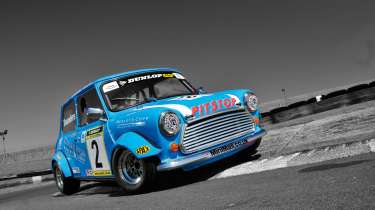
Mini Miglia
Eye-catching Miglia racer’s low ride height and super stiff suspension give it incredible cornering ability. Inside, carbon fibre dash and modern race instruments provide a touring car feel.
It may have been conceived as economical and affordable transport, but the Mini’s excellent handling meant it was also a hit in the world of motorsport. The rally exploits of the little Brit are legendary, and it was equally successful on the track.
Despite its tiny power output, the Mini won the British Touring Car Championship in 1961 and 1962. These giant-killing antics made it a favourite with race fans. While it was blown away by bigger cars on the straights, the Mini would out-corner its rivals, to the delight of the crowds.
The fun factor behind the wheel meant amateur competitors flocked to race Minis, too. A one-make Mini Seven Series arrived in 1966, and the more powerful Mini Miglia Series followed in 1970. Today, both these formulas continue to thrive, thanks to their winning combination of great racing and manageable running costs.
The Miglia racer appears to be no more than a sporty version of the other Minis in our line-up. But take a look inside, and the seam-welded roll cage, carbon fibre dash and modern race instruments reveal that it’s more akin to a miniature touring car than an everyday runabout.
Powered by a 1,293cc A-Series engine, it produced around 130bhp, which, allied to a tiny kerbweight of 660kg, means it can blast from 0-60mph in only 4.5 seconds. And despite having four gears, it’s still capable of a 125mph top speed.
The tiny 10-inch wheels are shod in slick Dunlop tyres and sit proud of the bodywork, while bulging plastic wheelarches cover them. And with its ultra-stiff suspension and low ride height, the taut Miglia hops around, carrying huge speed through corners.
The distinctive whine of the straight-cut gears is a famous racing Mini trait, and meant our stunning blue Miglia sounded great as it lapped the track for these pictures.
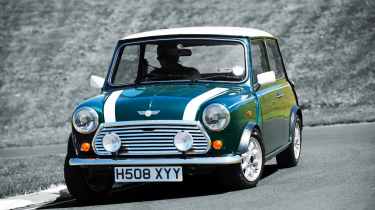
Rover Mini Cooper
Model shares the same cramped driving position as the original, and familiar Cooper badging ensures it looks the part.
The giant-killing exploits of Mini Coopers on the world rally scene have passed into motoring folklore, but its roadgoing namesake has had a turbulent history.
After a decade of sales success, British Leyland dropped the sporty model to cut costs, because racer John Cooper was still receiving a royalty on every car. As a result, fans would have to wait until 1990 before an official Mini Cooper rolled out of Rover’s Longbridge factory.
The newcomer lacked the original’s motorsport pedigree, but it retained the same boisterous spirit – and it certainly looked the part. Its familiar cheeky lines were enhanced with an eye-catching white roof, 12-inch Minilite-style alloys and retro chrome bumpers. Owners could customise their Cooper with bonnet stripes and racy extra lights at the front.
Inside, the later model shares the original’s remarkable packaging and cramped driving position, but it was much less adventurous mechanically. As with the standard car, it featured a carburettor-fed 1,275cc engine that developed a modest 61bhp – later examples boasted fuel injection and a 2bhp power boost.
On the road, performance is limited in either version, with the dash from 0-60mph taking a leisurely 11.5 seconds, culminating in a top speed of just over 90mph. But what the Cooper lacks in pure muscle, it makes up for in driving fun.
The unassisted steering is direct and full of feedback, while the wheel-at-each-corner stance gives incredible agility. As with all Minis, the Cooper has a firm ride, bouncing energetically even on smooth surfaces. You’re also treated to the familiar whine from the four-speed gearbox and a tuneful exhaust note.
The Cooper remained a fixture in Mini price lists until the car was phased out in 2000. By then, owners could specify a costly Cooper S Works featuring modern refinements such as a 90bhp engine, five-speed box, leather trim and even an airbag.
But like the 1990 model, it retained the same lovable character that made the 1961 original such a hit.
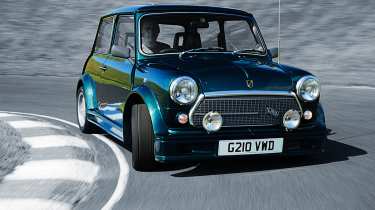
ERA Mini Turbo
With potent engine and sporty modifications, ERA MINI Turbo had all the ingredients for success, but appeal of fastest classic variant was hit by recession and sold in small numbers.
The Mini’s history is full of famous variants that have gone on to become classics in their own right. From the first Cooper to the Traveller estate, the many versions enjoy a wide and passionate following around the world.
Except, perhaps, for this one! You are looking at the quickest official production Mini ever built – the 1989 ERA Mini Turbo. Fast, good-looking and exceptionally well made, it was the spiritual successor to the Cooper and the 1275 GT.
Designed and engineered by Brit racing firm ERA, it was essentially a standard 1989 Mini fitted with the Metro Turbo’s 94bhp 1,275cc motor. It had a chunky bodykit, updated cabin and raft of suspension and braking modifications. Immaculately built throughout, the ERA Turbo was pitched as the ultimate no-hassle, no-risk special. ERA would take the standard cars and convert them, while Austin Rover would sell them through its dealers.
And, as the majority of parts were existing Austin Rover components, even servicing was simple. So, why didn’t the ERA become a big seller? Although Austin Rover marketed the car officially via its dealerships, the arrangement with ERA was complicated and, even with a £9,030 asking price, neither party was getting rich on the deal. Also, while interest in the car was strong, orders were hit by a global recession and after a mere 436 were produced, ERA and Austin Rover called it a day.
Today, unsurprisingly, the ERA is a real collectors’ item coveted by Mini fanatics the world over. Our version – owned by Keith Miller – is one of 346 models exported to Japan during the car’s two-year production run. Although time hasn’t been kind to certain aspects of the design, the Dennis Adams-styled bodykit and arch-filling alloys are real head-turners. And while the performance may seem tame by the standards set by the current crop of 200bhp pocket rockets, the combination of that torquey turbo and the Mini’s famously agile chassis is enough to quicken the pulse.
While ERA sales were modest, it proved to Austin Rover bosses that the Mini still had the potential to pull in new buyers. It paved the way for the highly successful Rover Mini Coopers of the late Nineties, and will hold its place in history as the fastest classic Mini ever.