New Cupra Raval narrows price gap to Renault 5 with new EV grant discount
Big-battery versions of the Cupra Raval now start from just £28,500 after qualifying for Band 2 of the Electric Car Grant

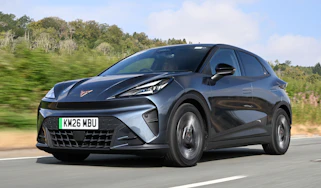
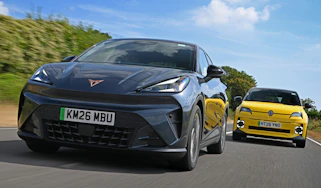
The Cupra Raval has just got even cheaper thanks to the Government’s Electric Car Grant (ECG). A £1,500 discount now means the majority of the line-up is now more affordable, however, base versions of the sporty Renault 5 rival still start from £23,785.
Like the larger Cupra Born, which costs over £13,000 more, the Cupra Raval now qualifies for the base Band 2 level of the ECG. There's a catch, though, as this is only when specified with the larger of the Raval's two battery configurations. In contrast, the Renault 5 also gets the Band 2 grant - even with its smaller battery - while the full Band 1 £3,750 discount is applied to 'Comfort Range' models, which feature a larger 52kWh unit.

Nevertheless, starting from a snip under £24,000, the Cupra Raval remains one of the cheapest electric cars you can buy. All Cupra Raval models sit on the same MEB Entry+ architecture as the upcoming Skoda Epiq and Volkswagen ID. Polo.
Cupra Raval prices and specs in detail
The entry-level Raval Origin is only available with the smaller 37kWh unit which features cheaper-to-produce LFP chemistry (Lithium Iron Phosphate); the higher-spec 52kWh battery utilises a NMC (Nickel Manganese Cobalt) composition.
With this set-up and a 114bhp electric motor driving the front wheels, the Origin is said to be capable of up to 186 miles on a single charge. That’s a lower range than the base version of the Kia EV2 (194 miles), though it should be more than you get in the taller, crossover-shaped Skoda Epiq.
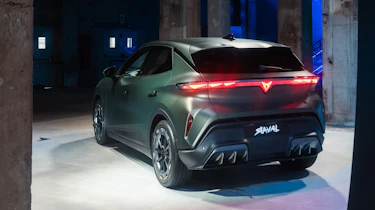
As standard, base Cupra Raval models get all the basics like 17-inch alloys, a 12.9-inch infotainment screen with Apple CarPlay and Android Auto, a digital instrument cluster, ambient lighting, and adaptive cruise control.
The plusher V1 (£26,995) and V2 (£29,580) trims can be specified with the same battery alongside a more powerful 134bhp motor, although their range is expected to be around the same as the Origin’s. The V1 looks to be the pick of the range, adding larger 18-inch wheels, tinted window, heated front seats, a heated steering wheel, front-and-rear parking sensors, a reversing camera and keyless entry. V2, on the other hand, takes things a step further with even grander 19-inch wheels, electric sports seats, a Sennheiser sound system and a smattering of copper accents.
Those two higher trim levels can also be had with the 52kWh battery at £28,495 and £31,080 for V1 and V2 respectively, thanks to the ECG. They bump the range up to around 279 miles, eclipsing the Renault 5’s 252-mile maximum. These versions of the V1 and V2 come with a 209bhp electric motor when specified with the larger battery. There’s also a ‘Launch Edition’ version of the V2, which costs £31,080 too, but gets extra safety kit, Dinamica bucket seats and an uprated sound system.
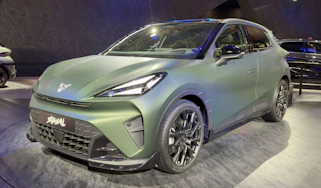
Above this is the £33,495 VZ and the £34,810 VZ Extreme. They come exclusively with the larger battery, but gain a 222bhp electric motor, which drops the range to around 248 miles. VZ Extreme comes with Cup bucket seats with 3D-knitted upholstery, 19-inch alloy wheels in Sulfur Green, performance tyres and a matte exterior paint finish.
As for charging, the 52kWh battery can be boosted from 10 per cent to 80 per cent in 23 minutes using a 130kW DC fast charger, while the 37kWh battery covers the same increment in 27 minutes with a 90kW maximum charge rate. These figures are shared with the equivalent Volkswagen ID. Polo and Skoda Epiq.
What performance does the Cupra Raval offer?
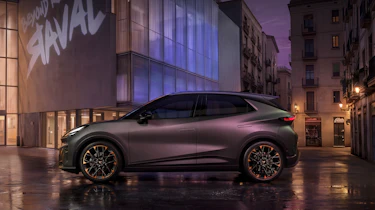
This might be Cupra’s baby EV, but performance is still a priority. Cupra says the Raval is “engineered to deliver a dynamic and emotional driving experience that differentiates it from other urban EVs”.
Unlike the ID. Polo, the Raval gets a ‘sport chassis’ which includes a 15mm lower ride height with tweaked suspension, a 10mm wider track and a bespoke steering tune to “enhance agility”. There’s even a unique ‘Sport’ mode for the traction control and a launch control system called E-Launch, which delivers a unique sequence of interior lighting, animations on the driver’s display and start-up sounds.
The top-of-the-range Cupra Raval VZ is said to be capable of 0-62mph in just 6.8 seconds, just under half a second behind the top-spec Alpine A110 GTS+.
We’ve already driven it, so read our full Cupra Raval review for the full verdict on whether or not it delivers the true EV hot hatch experience.
What about the Cupra Raval’s design?
The final Raval production car retains a lot of the styling cues from the Cupra Urban Rebel concept. Pretty much every new Cupra that’s arrived recently has stuck close to the design of its concept car and this has generally been a very good thing.
The Raval’s look is in keeping with the current generation of Cupra design typified by the three triangular headlights with matrix LED technology from VW, Cupra’s ‘shark nose’ front end and razor-sharp body creases. There is some science behind the Raval’s style, however, because the flush-fitting door handles, active aero grille, aero-optimised wheels and various vents all help give the Raval the lowest drag coefficient of any Cupra to date.
At the rear there’s a full-width light with an illuminated badge (which is paired with an illuminated badge on the front on some trim levels), plus a prominent diffuser and roof spoiler to ensure the Raval lives up visually to its sporty billing.
What technology does the Cupra Raval get inside?
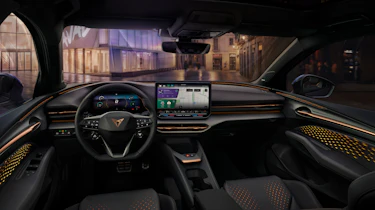
The interior of the Raval shares plenty of technology with its larger Cupra siblings and introduces some new features too. The 12.9-inch central touchscreen is taken from the Formentor and Born, while the 10.25-inch driver’s display is shared with plenty of models across the VW Group as well. The digital interface on the driver’s screen does, however, come with new graphics and customisation options, plus the Raval has a new Google Android-powered operating system with a simpler process for navigating the infotainment menus.
We’ve seen on other recent VW Group products that the parent company is back-tracking from touch-sensitive controls inside its cars. While the decision was clearly made too late for the Raval’s climate and audio touch-sliders under its central screen, the car does at least come with physical controls on the steering wheel.
There’s plenty of distinctive design inside the Raval with intricate detailing on the dash and Cupra’s familiar copper-coloured trim accents, but the Raval also gets something never fitted to any production car - projector lights on the doors. These work alongside the interior ambient lighting by projecting light to illuminate the area around the armrest on the door. They’re ‘dynamic’ too so they can be configured to show different patterns and colours.
As for practicality, the electric motor is located under the bonnet instead of the boot floor. This means the Raval actually has more boot space than the Born, despite being 278mm shorter. The Raval’s boot, with the boot floor removed, stands at 430-litres, 45 litres more than the Born’s, but if you specify the 12-speaker Sennheiser sound system, the subwoofer reduces boot space by around 20 litres.
Now you can buy a car through our network of top dealers around the UK. Search for the latest deals…