New Hyundai Bayon gets boxy transformation and hybrid power
Hyundai’s replacement for unloved small SUV is just around the corner, and it’s set to take on a whole new personality

The unloved Hyundai Bayon is being thrust into the modern era with what bosses describe as a “significant transformation” – including a distinctive new look and a frugal hybrid powertrain. The hope being it can finally challenge big-selling rivals such as the Ford Puma and Nissan Juke. Prices should start from around £25,000 when the car arrives early next year.
On sale since 2021, the supermini-sized small SUV has so far failed to win the hearts and minds of British new-car buyers. But big upgrades for the second-generation model aim to alter perceptions with substantial changes under the metal, and a bold new look inspired by the latest Tucson.
New Hyundai Bayon design and technology
Visually, the Bayon gets similar T-shaped daytime running lights to those found on its recently revealed bigger brother, although without the connecting lightbar. Instead, the edges are connected via a piece of full-width gloss-black trim – a design feature replicated at the rear. The LED headlights are set into the bumper, above swathes of black cladding that extends to the car’s wheelarches and sills, emphasising its new-found SUV style.
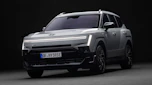
Higher up, the Bayon gets Range Rover-style black A, B and C-pillars, plus roof rails and the option of a two-tone roof. Unusually for this class of car, Hyundai is also offering the Bayon with an opening glass roof, designed to flood the cabin with natural light.
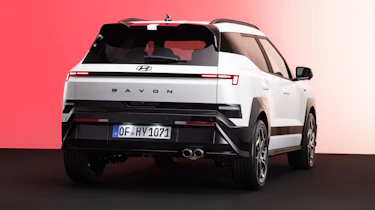
Big ‘Bayon’ lettering on the back prevents you mistaking Hyundai’s new crossover for anything else. The slim lighting signature is complemented by separate indicators nestled in the outer edges of the bumper, plus reversing lamps either side of the number plate. There’s also more black cladding. The N Line variant in these images adds a sporty bodykit, 18-inch wheels and twin exhaust pipes, plus plenty of changes inside, too.
While the new Bayon misses out on Hyundai’s latest Pleos Connect infotainment system, the single curved screen – blending the 12.3-inch digital instrument cluster with the central touchscreen display – is a big upgrade on what went before. There’s a row of shortcut buttons directly below the screen, but the climate controls are relegated to a flush haptic panel just ahead of the gearlever.
Our experience with the car ahead of its global reveal showed this to be a bit fiddly; we’d have preferred a set of proper toggle switches. Quality, however, was very good, with plenty of soft-touch surfaces, and most of the scratchy plastics hidden in places you don’t often interact with.
Unlike the new Tucson, which frees up space on the centre console thanks to a column-mounted shifter, the Bayon uses a traditional, almost retro, gearlever, with a row of buttons on either side giving access to things such as the heated and ventilated seats – another flagship feature usually reserved for high-end segments. Other big-car kit includes an optional Bose stereo and Hyundai’s Digital Key 2, which allows owners to use their phone to unlock and start the car.
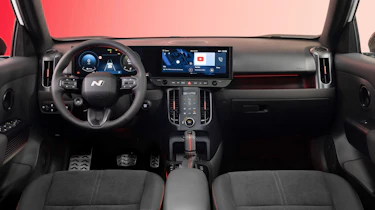
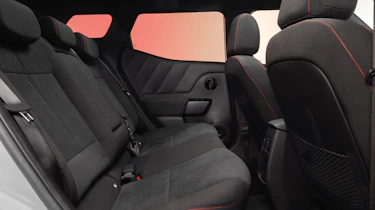
The N Line model we sat in had lots of sporty red detailing, including contrasting stitching on the cloth and suede seats, and the bespoke N Line steering wheel which is designed to mimic that offered in the electric Ioniq 5 N.
New Hyundai Bayon details and specs
Despite first launching via the Hyundai India website, the text accompanying those early images referred to the new Bayon as “a global SUV” that’s apparently been designed “for a world that never stands still”.
The outgoing Bayon is based on the same Hyundai-Kia K2 platform as the i20 and while it’s a little taller and chunkier than its supermini sibling, it’s much closer size-wise to the i20 than to the larger Kona SUV it sits below.
The new model grows by 65mm, while also being 35mm wider and 65mm taller. It will continue to be offered with a choice of 1.0-litre petrol engines – with either 89bhp or 113bhp – each with manual or automatic transmissions.
Joining the range later will be an auto-only 1.6-litre petrol-electric hybrid with 136bhp – aimed squarely at the updated Toyota Yaris Cross. This version will get adjustable brake-regeneration accessed via a set of paddles mounted to the steering wheel, and Hyundai is targeting CO2 emissions of less than 102g/km.
The brand hasn’t revealed specific performance data for the new engines, but expect the fresh HEV to significantly outperform the base ICE cars, which take up to 14.1 seconds to reach 62mph. It’s worth remembering that the latest, more grown-up Bayon, is likely to replace the next-generation petrol-powered Kona in the UK, so a wider breadth of ability is more important than ever.
Accompanying the longer standard kit list, will be a suite of driver-assistance systems. Among these will be Hyundai’s Highway Driving Assist set-up, a Surround View Monitor and Smart Cruise Control. Rear Cross-Traffic Collision Avoidance and Parking Collision Avoidance also feature.
New Bayon space and practicality
That extra length and added height will make the new Bayon more practical than before. Hyundai claims an increase in rear legroom, plus seat-backs that recline for added comfort. Continuing the premium theme, some versions will be offered with heated rear seats, depending on specification.
Behind those back seats, the new Bayon offers up to 440 litres of boot space. We say “up to”, because as is customary nowadays, the Hybrid sacrifices some of that load volume to accommodate its high-voltage battery. HEV variants get a 397-litre boot; figures for when the seats are folded haven’t been revealed.
Price and on-sale date
The key stat for the new Bayon, however, will be its price. The larger Kona kicks off at just over £27,000, so we don’t expect a huge increase over the current car’s price, despite the added kit and more mature design. The outgoing Bayon starts at £24,065 in Black Line trim.
Don't miss out! See more of Auto Express in your Google Top Stories. Click here...