Inside Jaguar's DNA: How the greatest ever Jags helped build the new GT
We take the chance to drive new GT alongside its iconic forebears, to see if the brand’s lineage remains intact

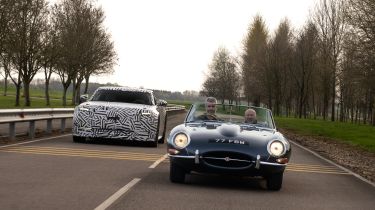
Jaguar’s ‘Copy Nothing’ strapline and associated ad campaign marked a new era for the brand – just before the covers came off the Type 00 concept in late 2024. It’s a mantra that will apparently inform everything the company creates over the next few years, as it looks to reposition itself as a luxury car maker “bigger than Bentley” in terms of outright sales volume.
You might ask therefore – as indeed, we did – why we’re sitting in an early E-Type, preparing to drive a still-camouflaged version of Jaguar’s new four-door electric GT; if this EV is a copy of nothing, why front the firm’s most iconic reference points from its illustrious 90-year history, alongside senior executives from engineering, brand and design?

“It’s OK to copy yourself, isn’t it?” remarks JEA (Jaguar Electric Architecture) chief engineer, Jon Darlington. “Instead of benchmarking stuff already out there, we went and drove cars from our back catalogue. It wasn’t about taking measures. It was about a feeling: what do you see, what do you feel? The process you are going to go through – driving these cars – is the process we went through.”
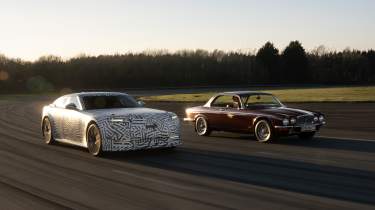
Even without peeling back the layers of black and white disguise, there’s no missing the long bonnet and swept-back shape of the new GT – not dissimilar to the stunning E-Type that’s been brought out for us to try.
“The team [at Jaguar] really understands good proportions,” Jaguar’s production design director, Andy Wheel, tells us. “That distance – from the front wheel to the A-post – that is something that instantly brings back all those messages about power, stance, poise; that position of the cabin relative to the wheelbase instantly tells you what kind of vehicle it’s going to be. When it’s amongst general traffic, it’s going to look so striking.”
But away from design, the primary reason that Darlington and his team pulled together the biggest hits from JLR’s archives during the early stages of development was to distil that aforementioned 'feel’ of what a Jaguar should be.
“We wanted to understand: what is that handshake with the car? How does the car handle? What is the power delivery like? It was all about subjective opinion,” the engineering boss tells us. “We’d never approached a car [in this way] before.”
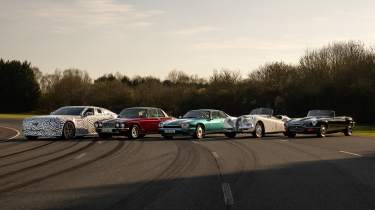
The first E-Type we’re driving is a beautifully maintained Series I – a primitive example conceived with no care for its ergonomic compromises. The flat floor, Moss gearbox and heavy clutch ensure this drop-top is a chore to get moving. There’s no synchromesh, making it difficult to find first without starting in second; the ever-present risk of grinding cogs on the downshift forces a blip of the throttle as you slow the car down, too.
But the engine is a gem. Only later E-Types were fitted with a V12, so this one uses the 3.8-litre straight-six ‘XK’ engine developing 265bhp. It pulls strongly, but it’s the way it cruises at 80mph-plus that impresses most. If Jaguar had found a way to prevent your forehead from sitting six inches proud of the shallow windscreen, you can very much imagine blatting from London to Le Mans in one hit.
It’s this effortless performance that Darlington and his team wanted to emulate in the new EV – all without losing the sense of connection that has infused every generation of Jaguar since the 1935 SS. He describes the original E-Type as a “visceral, connected car” that “transitioned into a GT” for its third generation – something we can attest to, having stepped straight from the Series I into a late Series III from 1974.
You might expect the last-of-the-line, V12-engined E-Type to have extra character. But if anything, the engine is more muted – aligning perfectly with its positioning as a grand tourer. It’s much easier to drive and, thanks to the factory-fit power steering, is far more approachable than its predecessor. Contrary to widely held opinion, this feels like our star of the show.
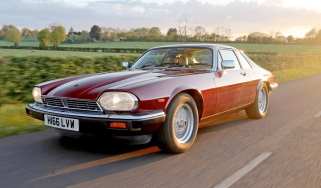
On the other side of the closed-off quadrant is a 1973 Jaguar XJ and a later, 1978 XJC – both with V12s and three-speed automatic gearboxes. It’s the two-door that’s of greater significance, with Darlington referring to it as “the bullseye car” when his team was nailing a brief for the forthcoming GT.
“You get the underlying character of the [XJ] Series I, but with greater control,” Darlington tells us. “You can drive [the XJC] with a bit more confidence because you’ve got that underlying reassurance with the car.”
Even on a passive set-up, without modern saloons’ or sports cars’ technological trickery, it’s noticeable how both cars flow down the road – even on more complex sections of Jaguar’s test track. The damping is particularly impressive; on dinky 15-inch wheels with huge sidewalls, there’s none of the sudden shock or vibration you get on contemporary cars with big rims and rubber-band tyres.
Referring back to the electric GT, Darlington says: “It’s taking that essence and saying: comfort is important, composure is important, breathing with the road is important… But we also need to make sure we stay controlled.
“You can have a really engaging car that has a level of roll to it, a level of compliance to it, but it’s still engaging. If we’d gone and measured a load of modern stuff, particularly performance EVs, that’s not really what you’d see,” Darlington adds.
While no one would argue with the relevance of cars such as the E-Type or XJ when looking at models that defined the company, there are a few notable omissions from the selection plucked by Jaguar Classic for us to try. Why no XJ220, for example? And surely the modern F-Type sports car deserves its place in the British manufacturer’s hall of fame?
“I think for us it was about getting back to something that really made sense,” Darlington tells us. “XJ220 doesn’t make sense; it’s quite extreme. It's a great car – but it's a great car above 100mph.
“That is a difficult thing to then go back and say ‘right, you know what? We’re going to make a car that doesn’t feel remotely special until you’re breaking the speed limit in most countries’. It’s an epic piece of kit, and it served a purpose.”
Darlington is much more complimentary about the F-Type: “It’s a fantastic sports car,” he tells us. “The posture is epically low – the posture in the four-door GT is exactly the same as in the F-Type. The hip-to-heel is exactly the same, so we have not ignored some of the more modern stuff.”
Yet even Jaguar’s die-hard fans would admit the maker had lost its way in recent years. Something had to be done to turn its fortunes around, and while a complete rebrand was among the more extreme business decisions since its sale to Ford in the nineties, it’s one that product marketing director, Tom Bury, hopes he can pull off.
“We’re extremely confident with the success we’ll have with this product,” he tells us. “EV is not an easy industry to be in. But electric is how we’ve made this a true Jaguar.”
Get even more from Auto Express, follow our channels...
• Google
• Reddit
• Whatsapp