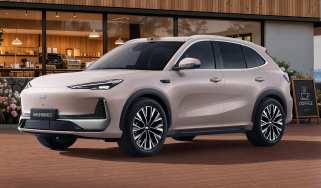
New Jaecoo 3 has the Ford Puma and Renault 4 in its crosshairs
Jaecoo is targeted the small SUV market with the new 3, and our exclusive images preview how it could look

Of all the Chinese car makers that have arrived in the UK in the past few years, none has made an impact with buyers quite so deeply as Jaecoo. This style-led brand from manufacturing giant Chery was brought over in tandem with its sister company Omoda in January 2025, and has since exploded in popularity, topped off by the Jaecoo 7 becoming the UK’s biggest-selling car in March.
This sales success has been largely driven by low asking prices, but is also backed up by attractive styling, high levels of standard equipment and a customer-friendly combination of petrol, hybrid and fully electric powertrains to cater for all tastes.

In order to make the most of this momentum, the manufacturer is powering ahead with a pair of new models that will top and tail its range in 2027 – the compact Jaecoo 3 and three-row Jaecoo 9 flagship. The latter, a cut-price rival to the Land Rover Discovery, will be derived from Chery’s global range, but the former will be more European-focused.
Chery Automobile chairman Yin Tongyue told Auto Express: “In China we like very big cars and very small cars, but in Europe and other parts of the world, you like them in between.”
This has allowed the wider Chery group to sign off a new range of B-segment models specifically developed for external markets, including the UK, across Jaecoo, Omoda and the new Lepas brand.
Desperate to get your hands on a Jaceoo? You can buy a new Jaecoo 5 for as little as £23,000 through our Buy a Car service...
What will the new Jaecoo 3 look like?
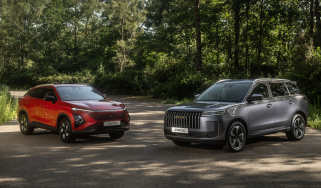
The first car to arrive will be the Jaecoo 3, a small crossover which will be around 4.2 metres long, putting it in direct competition with mainstream models such as the Ford Puma and Renault 4. However, the Jaecoo’s ability to offer both battery electric (BEV) and hybrid powertrains will mean the newcomer can challenge a very wide spectrum of rivals.
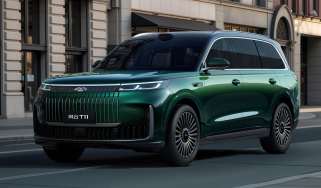
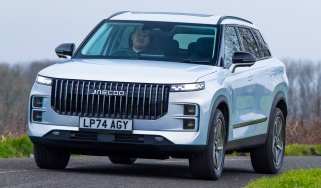
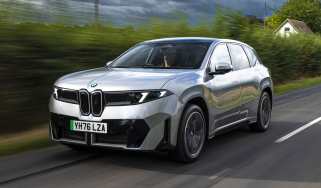
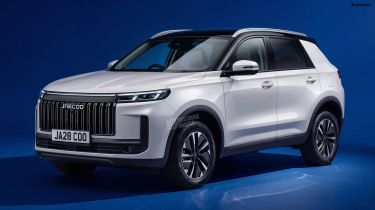
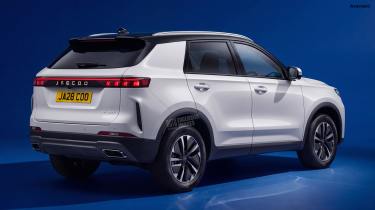
As our exclusive images illustrate, the Jaecoo 3 will retain the blocky, ‘mini-Land Rover’ look that’s played a key part in Jaecoo’s success both in Britain and abroad. Ironically, Chery has actually entered a joint venture with Land Rover to engineer and produce a new range of Freelander cars, too; we wonder if any of the British brand’s DNA will seep into Chery’s design studios?
We have limited insight into what to expect from the new model’s interior design or layout, but the Jaecoo 5’s 14.3-inch waterfall screen and centre console could well be integrated, with a new dash design optimised for European tastes. There will be seating for five, with decent levels of room in the second row, as well as flexible boot space.
What will power the new Jaecoo 3?
The Jaecoo 3 will run on Chery’s powertrain-flexible platform, so we can deduce it will be front-wheel drive with a flat battery pack in the BEV. The battery size should be around 40-45kWh, depending on spec, and a range of around 220 miles will be a minimum requirement to keep up with the next generation of rivals.
Hybrid variants will swap these BEV elements out for one of Chery’s SHS systems. These generally see a 1.5-litre four-cylinder petrol engine paired with an electric motor, offering fuel economy figures of around 55mpg.
It’s unlikely that a pure-petrol model will be introduced in Europe or the UK. We spoke with Chery’s top brass in China and the firm knows its petrol engines are outclassed by the competition in Europe. In a car of this size, a plug-in hybrid is also unlikely to be offered – although more PHEVs are emerging in the B-segment, so it’s not totally out of the question.
How much will the new Jaecoo 3 cost?
Price is arguably the most important factor and how Jaecoo positions the car could be key. At the lower end of this class, basic yet charismatic rivals are commonplace, and optimised for European buyers. The Fiat Grande Panda, for example, can be purchased for £18,035 and a Citroen C3 costs just over £19,000.
To make a similar impact in terms of value to Jaecoo’s larger models, pricing around £16,000 or £17,000 would be an ideal starting point – although how close the brand can get to this remains to be seen. What can’t be denied, though, is that this competitive area of the market is set to get even tougher, because we’re about to see an influx of new models from Europe and South Korea that are aiming to revolutionise our expectations of supermini-sized cars.
Models such as the all-new Cupra Raval, Skoda Epiq and VW ID. Cross all promise higher levels of engineering excellence and next-generation interior tech and design. Similarly ambitious Stellantis cars using the new STLA-Small platform – such as the next-generation Peugeot E-2008 and Vauxhall Mokka – will bring their own flavour to the class.
Right now, the Renault 4 and Renault 5 are both selling in high numbers, while Ford’s future tie-up with the French manufacturer will bring a new Fiesta and Puma.
Using the larger Jaecoo 5 as a reference, the all-electric variant has a near-£3,000 premium compared with the petrol, but we suspect the gap will be smaller for the Jaecoo 3. This figure is also much higher than the discrepancy of broadly £1,000 between base petrol and BEV variants of the rival Citroen and Fiat, and when compared with versions fitted with a mild-hybrid powertrain, the entry-level BEVs are cheaper.
Depending on the variant, some European models have the added advantage of the UK Government’s Electric Car Grant to help reduce prices further. The two bands offer discounts of either £1,500 or £3,750 if models meet certain criteria.
So, while Jaecoo has hit the ground running with its mid-sized models, the smaller classes could be a much tougher nut to crack – especially if the new cars are not underpinned by an unbeatable value proposition.
Don't miss out! See more of Auto Express in your Google Top Stories. Click here...