BMW X3 vs Honda CR-V vs VW Tayron vs MG HS vs Range Rover Sport: five top PHEVs head to head
The five top plug-in hybrid systems go head-to-head on UK roads, in the test no PHEV buyer can do without

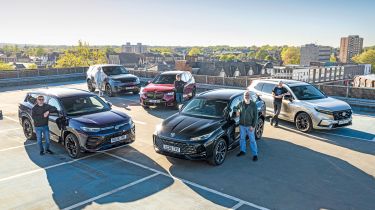
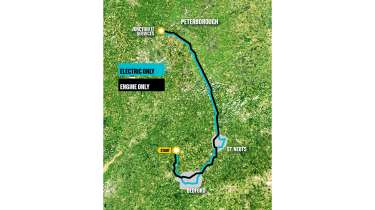
Bedford is beautiful on a sunny spring day – and our convoy of five plug-in hybrid SUVs, nose-to-tail over the town bridge spanning the River Ouse, does its bit to preserve the tranquillity. Our testing reveals these hybrids offer between 42 and 68 miles of pure electric motoring, without burning a drop of E10 petrol and generating local emissions, and with the only drivetrain noise the sonorous whine of electric motors. These are civilised civic companions.
Sixteen SUVs started this test to crown Britain’s best PHEV drivetrain and, after four heats over two days of testing, five have made the final showdown. Of them, the Honda CR-V posted the smallest EV range – 42 miles – on our test route through market towns in Bedfordshire and Cambridgeshire, plus draining stints on the A421 and A1M. But its well calibrated drivetrain beat Japanese rival Toyota’s for driving enjoyment, and the cockpit’s high-quality feel and practicality secured its shortlisting.
Also present is the BMW X3 30e, a regular on our long-term fleet since September 2025. Its sharp handling elevates it among the contenders – but will its firm suspension upset the applecart by riding like one? The BMW covered 53 miles before calling on its 2.0-litre engine, fewer than Volkswagen’s Tayron managed. The VW’s 1.5-litre four-cylinder has a 500cc deficit over the BMW, but helps post a big economy advantage when the battery goes flat. The Tayron’s efficiency, spaciousness and value for money also helped edge out the sweet-handling Audi Q3 with the same powertrain, although packing an extra 67bhp from its engine.
Used - available now

2022 MINI
Countryman
25,481 milesAutomaticPetrol2.0L
Cash £25,420
2027 Audi
A5
7,450 milesAutomaticDiesel2.0L
Cash £27,495
2023 BMW
X2
69,200 milesAutomaticDiesel2.0L
Cash £14,495
2007 Ford
Fiesta
106,000 milesManualPetrol1.6L
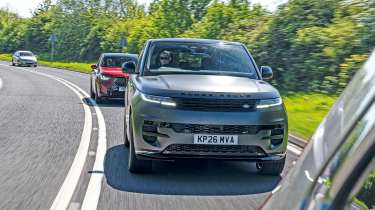
Cash £1,999Rolling through town in the Range Rover Sport hammers home its appeal. Its lofty driving position gives a brilliant view over obstacles, its opulent cabin feels hermetically sealed from the Bedford bustle and the meaty e-motor surges it into gaps in the traffic. The drivetrain's electric part offers the performance and eco chops to help protect the big SUV’s future: the Rangie managed more than 60 miles of zero-emissions motoring.
However, that was edged out by the cheapest car on test, the £32.5k MG HS. And the long-distance EV champion backed this up with 46 miles to the gallon when voltless, earning it the final space from our four heats. But which of our finalists is the best plug-in hybrid SUV you can buy right now? That’s what we set out to decide…
Packaging: any battery compromises?
Unlike our other PHEV SUVs, the Range Rover Sport P460e demands zero compromise in the way it drives or how it’s packaged. At nearly five metres long and two metres wide, its sheer size means that fitting the plug-in powertrain within its dimensions is a piece of cake, so boot space is unchanged compared with the non-PHEV versions.
The Sport’s 38.2kWh battery is bigger than the one offered in base versions of the upcoming all-electric VW ID. Polo. But the pack adds 300kg to the Range Rover Sport’s kerbweight, admittedly only a small relative increase, but it still means its total weight hits a ludicrous 2.6 tonnes.
At the lighter end of the scale, the 1.8-tonne MG HS still gains a few pounds when compared with the petrol and hybrid versions (up by 275kg and 160kg respectively), but the drive battery in the PHEV sits under the passenger compartment floor, so just like the Range Rover Sport, boot space isn’t compromised. That’s more than can be said for the Volkswagen Tayron. The German car’s 1.5 e-Hybrid set-up houses the battery in the boot, so although the passenger compartment floor remains at a sensible height that doesn’t stick your knees in the air, there’s no space for the seven-seat layout that is one of the main reasons that the Tayron exists in the first place.
It’s the same story with the Skoda Kodiaq iV that uses the same powertrain, although, of course, that car doesn’t have a smaller alternative like the Tayron has with the Tiguan.
Given that there’s no such thing as a seven-seat BMW X3, the only compromise for the German SUV is in total boot capacity, which is down from 570 litres in the diesel version to 460 litres for the 30e. And then we come to the Honda CR-V, which makes the German pair look a bit silly by offering more boot space as a PHEV (617 litres) than it does in plain hybrid guise (579 litres).
It’s not witchcraft, however, just a sign of a car maker doing some proper engineering to fit in the plug-in hybrid powertrain. The battery for the PHEV is fitted under the back seats, while the hybrid has its battery under the boot floor. Even with the battery moved to this new position, the CR-V still has a sliding rear bench that boosts the car’s versatility further. Top work.
On the move: Honda and Range Rover
The Honda CR-V proved to be one of the biggest surprises on our test. While we tend to think of Toyota/Lexus as the hybrid expert from Japan, it’s clear its rival has used its engineering expertise to create a hybrid system that has the measure of the Toyota C-HR’s plug-in hybrid powertrain. Of course, a bigger battery helps the CR-V’s driving range, while the smaller, lighter C-HR is more efficient when in petrol mode, but our figures showed the larger Honda less than 3mpg off its rival, and its powertrain is more refined.
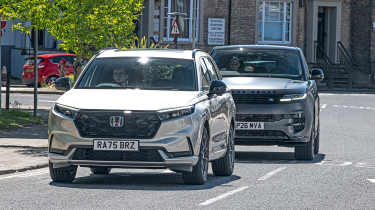
Honda has engineered virtual gearshifts into its e-CVT transmission that help to deliver a more pleasant experience when accelerating on engine power, so there isn’t the frenzied spike in revs you get with Toyota’s system (although admittedly the manufacturer has refined its eCVT gearbox over the years to be far less intrusive when using full throttle), and the distant purr of the engine helps the CR-V feel more like a petrol car.
Combine this with typical SUV traits of a tall driving position and light controls, as well as a cabin that feels well built with consistently good materials, and the CR-V impressed as we swept past prestigious Bedford townhouses or up the pace on the bypass beyond.
Tight towns aren’t your friend behind the wheel of the vast Range Rover Sport, and the plug-in hybrid's silent EV running means that you can startle unsuspecting pedestrians. As with many of the cars on test, warning sound-generation only seems to be of importance when reversing, so if the petrol engine’s dormant, it’s hard to make others aware of your presence.
The Rangie goes from furtive B-2 Spirit aircraft to actually looking like ‘the bomb’ when people finally spot the Stealth Edition’s matt-black looks. The PHEV loses none of the effortless torque of previous Range Rover generations, while taking their sense of calm, effortless refinement up a notch. This is one of the few cars on test that feels compromise-free from the introduction of plug-in power.
The electric part of the Sport’s powertrain offers a tantalising glimpse of what’s to come when the zero-emissions Range Rover arrives later this year. You can cruise around in total silence, while the air suspension does a great job of smoothing out every surface, whether you’re on tarmac, cobbles, or even a rutted country lane, because the car’s off-road ability remains intact. If you like your isolation, then you’ll love how the Range Rover Sport makes you feel.
A full charge of the Range Rover’s vast battery offered a predicted range of 65 miles, and that’s exactly what we achieved on our test run. However, once the battery is flat, Land Rover’s Ingenium straight-six is left to do all the hard work. Any engine bigger than two litres is designed more for performance than efficiency, and so it proved, with the Sport returning 31mpg when running on engine power alone, the poorest performer on the day. If ever there is a PHEV that highlights the benefits of keeping its battery fully charged, then the Range Rover Sport is it.
The stealthy, surprising MG
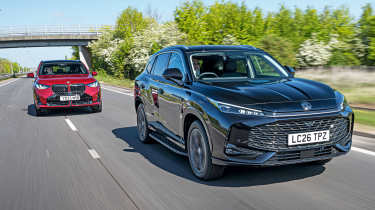
The only car to go farther than the Range Rover on electricity was the MG HS, despite it having a 13.5kWh (or a Toyota C-HR’s worth) deficit in battery capacity. MG’s second-generation hybrid tech emulates Toyota’s: once the battery runs down, the system preserves a buffer to power the car at most speeds, with the engine acting as a generator in urban areas before becoming more active on a motorway.
Not that you’d be conscious of the powerplant firing up in the first place. There’s excellent insulation in the MG’s cabin, so when the 1.5-litre unit is active, it just emits a distant hum from somewhere ahead of you, and is barely any more vocal when accelerating hard.
This combination of quiet petrol power with an EV bias means the MG HS delivers an impressively comfortable and refined drive – and as relative achievements go, it’s perhaps superior to the inherently quiet and calming Range Rover. Less impressive is the MG’s cornering ability, with lashings of body roll quashing any dynamic capers. But it pays back with a ride quality that’s better set up for UK roads than its Chinese rivals in this test – and some makers from other countries, too.
The Germans
If it’s fun that you’re after, then a plug-in hybrid SUV isn’t the first place we’d direct you. But if your family commitments and company-car scheme align and you still want to feel some driving pleasure, the BMW X3 fits the bill best. While the 30e has less boot space than the pure combustion-engined versions of the model, it doesn’t feel any less engaging, delivering the kind of dynamics that the German firm is so famous for.
As with the Porsche Cayenne e-Hybrid, the X3 offers well weighted controls that help you feel connected to the car and the road beneath you. It also delivers smart responses to your inputs and is relatively enjoyable to drive.
You sacrifice some comfort because of the firm suspension settings, but if you’re impervious to passengers’ complaints about the bumpy ride, you’ll be rewarded with an engaging and involving car. Whether negotiating Bedford’s busy city centre, cruising down its tree-lined avenues or getting up to speed on a dual carriageway, the BMW’s sportier edge meant it was the most satisfying driver’s PHEV in the final five.
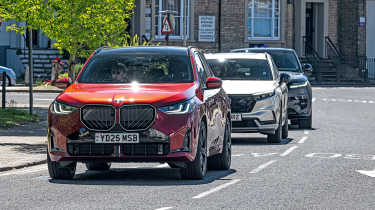
The powertrain delivers good responses when you need them, while BMW’s Efficient Dynamics mantra means that fuel-sipping frugality is hard-baked into the system from the outset. Maybe that’s why the X3 over-delivered on a predicted all-electric range of 49 miles at the start of our run, covering a total distance of 53.5 miles before the engine joined the party. Once active, there’s a greater reliance on the petrol part of the powertrain than in most other cars, although we still broke the 40mpg barrier in this mode.
One manufacturer that is weaning its PHEVs off petrol in favour of electricity is the Volkswagen Group. The company's first plug-in hybrid system, based around VW’s 1.4 TSI petrol and used in cars such as the Golf and Passat GTEs and the Audi A3 e-tron, was very much a petrol-electric powertrain that fell back to its combustion engine once the battery was flat. But the newer e-Hybrid set-up found in the VW Tayron and Audi Q3 in this test has a more balanced approach.
There’s a bigger 1.5-litre turbo petrol engine for starters, while battery size has increased, to around 26kWh capacity with a usable 19.7kWh. The big difference between the two cars is power; while the Q3’s 268bhp powertrain is available in the Tayron, the Audi isn’t sold with this VW’s 201bhp set-up.
In reality, the more powerful drivetrain is only really going to be of use if you’re expecting to tow or carry a full complement of passengers at all times. The 201bhp system feels more than responsive enough around town, while it delivers a longer all-electric range and better fuel efficiency when the battery is flat. It appears that the difference between gross and net battery sizes helps the e-Hybrid system to deliver better efficiency, with the spare capacity used to favour more electric driving at lower speeds.
In terms of driving, the Tayron falls between the X3 and softer cars like the MG and Honda, with well weighted controls offering a positive response, while the sensation of a free-running transmission makes it feel as if the VW could coast for days with minimal resistance from the powertrain. Initially, our testers thought the Audi had a more supple and controlled ride, but the Tayron R-Line Edition has standard-fit adaptive dampers and dialling the firmness back settles the VW down.
Final five, final thoughts
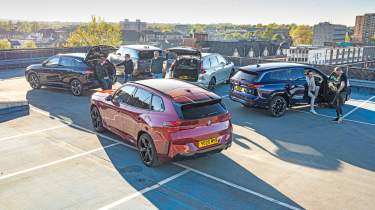
Bringing our top five together for a shootout on the streets of Bedford provided a snapshot of the plug-in hybrid market right now. We eliminated 11 cars on account of their efficiency, dynamics and refinement levels. If our test had just been based on empirical data, the Chery would have made the final cut: the Chinese place real focus on maximising their hybrid drivetrains’ electric potential.
Our final five show the breadth of choice that is available to consumers. There’s a £90,000 Range Rover, which is blissfully silent in electric vehicle mode and still creamy smooth thereafter. BMW’s X3 is the sporty choice of this quintet, although its four-cylinder whine is nothing like the six-cylinder salvos of bygone Beemers.
Volkswagen has come a long way with its plug-in hybrid technology since it first arrived around a decade ago, and it – and the refined MG – offer impressive efficiency regardless
of whether the battery is charged or flat. And the Honda CR-V’s engineering excellence makes it a car worthy of any family SUV shortlists – regardless of drivetrain. But who was our overall winner?
Verdict
Here's how we rate our top five PHEVs in the final reckoning. Jump to our 16-car megatest rundown to explore the full rankings and range test results.
5. Range Rover Sport
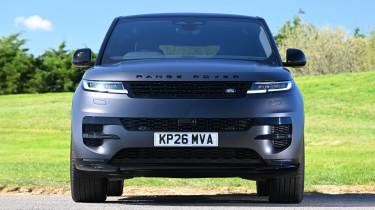
Outstanding on EV range and disappointing once the battery is flat, the mighty Range Rover Sport was a mixed bag on efficiency but the creamy-smooth driving experience and luxurious cabin go a long way towards justifying the price.
4. BMW X3
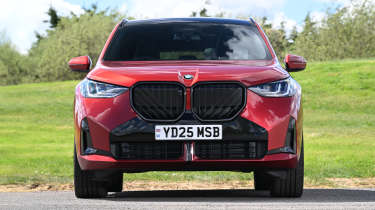
BMW has great PHEV form having been a trail-blazer for the tech over many years, and this shows in the X3’s highly impressive powertrain. Sharp and engaging to drive, the X3 stood out on the road and came within a whisker of breaking into the top three.
3. Honda CR-V
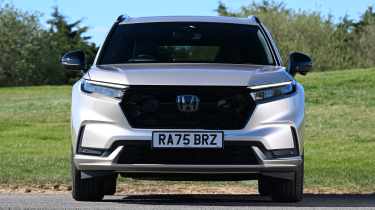
Probably the least enjoyable car to drive in our top five, the CR-V offers extremely clever PHEV technology allowing a smaller battery and less weight. It’s highly efficient, comfortable and well built, qualities that are certain to strike a chord with buyers in the PHEV space.
2. Volkswagen Tayron
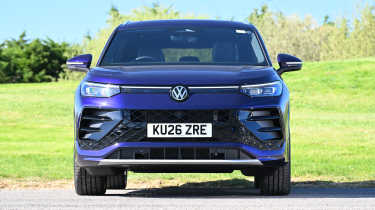
A fine performance from VW’s PHEV. The Tayron is strong on both EV range and hybrid efficiency, the most consistent performer in the test. With 40kW DC charging it’s also quick to top up. This, combined with VW’s interior quality and tech, make it a fine all-round package
1. MG HS
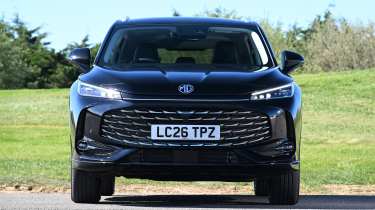
A massive 68-mile real world EV range – despite six of its rivals having bigger batteries – was always going to make the MG HS hard to beat. There’s plenty of performance when you do need the petrol engine and we managed 46.3mpg on our hybrid test run. Better still, the MG is a Chinese car with the expected value pricing but little compromise in terms of quality or annoying tech. It just works well, the stand-out PHEV on today’s market.
Did you know you can sell your car through Auto Express? We’ll help you get a great price and find a great deal on a new car, too.