Used Mercedes E-Class (Mk5, 2016-2023) review
Our full used buyer’s guide on the Mercedes E-class, covering the E-Class Mk5 that’s been on sale since 2016

Verdict
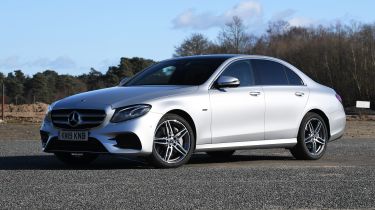
The most difficult thing about shopping for an E-Class is pinning down which model to buy. The range is incredibly complex, with petrol and diesel engines both available in regular, hybrid and plug-in-hybrid forms. Add in four different bodystyles, several trim levels (these came and went over time), plus a huge array of extra-cost options as well as option packs, and your head will be spinning just trying to work out what to go for. However, you can rest assured that whatever you buy, you’ll love it; the E-Class has scooped a slew of Auto Express awards since it arrived, including Premium Hybrid Car of the Year (2020, 2021), Executive Car of the Year (2020) and Large Company Car of the Year (2021). When you try one out, you will soon see why.
A new Mercedes E-Class is about to hit showrooms, and it’ll be the sixth take on a formula that was launched 30 years ago. The all-conquering W124 arrived in 1985, but it wasn’t sold as the E-Class until 1993; this was the first car to be marketed by Mercedes-Benz under that name.
The W124 set the standard in the executive sector, and while things are now a lot more competitive – and the class has shrunk as buyers have moved into SUVs – this is still a model that’s arguably as close to ideal as you can get.
Used - available now

2019 Mercedes
E Class
92,132 milesAutomaticDiesel2.0L
Cash £13,199
2018 Mercedes
E Class
98,650 milesAutomaticDiesel3.0L
Cash £11,999
2022 Mercedes
E Class
38,749 milesAutomaticDiesel2.0L
Cash £24,149
2023 Mercedes
E Class
34,388 milesAutomaticPetrol3.0L
Cash £40,295Luxurious, refined, safe, well equipped and supremely comfortable, the E-Class is one of those cars that it’s easy to think is overpriced, until you buy and run one. Then you’ll soon see that it’s worth every penny.
History
The E-Class Mk5 saloon arrived in January 2016, with 191bhp four-cylinder 2.0 E220d or 254bhp 3.0 V6 E350d diesel engines. An estate appeared in June 2016 in E220d guise; 148bhp E200d, E350d and 395bhp E43 AMG options were added that October.
A cabriolet was introduced in March 2017, with a coupe following a month later. Both came in E220d, E350d, 241bhp E300 (turbocharged 2.0 petrol) and 328bhp E400 4Matic (twin-turbo 3.0 V6 petrol) forms; a 429bhp V6 E53 AMG option was added in September 2018, for all four bodystyles.
Just before that, the 335bhp E400d replaced the E350d, and the E450 4Matic superseded the E400 4Matic. An August 2020 facelift brought design tweaks, extra driver-assistance systems, a redesigned dash and mild-hybrid tech for most engines.
Which one should I buy?
All powertrains give decent performance; the V6-powered models are especially enjoyable to drive because they’re so smooth and torquey. Every E-Class had a nine-speed auto gearbox as standard, with no manual option. The range kicked off with the SE, which featured 17-inch alloys (18-inch on hybrids), LED headlights, heated front seats, leather trim, DAB radio and nav, plus a 12.3-inch display as standard.
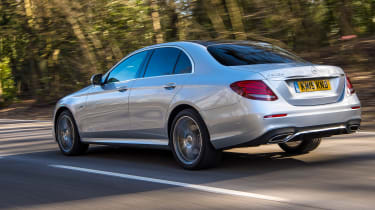
AMG Line trim brought 19-inch wheels, a bodykit, privacy glass and a black headlining. Premium added Surround View, matrix-LED headlights, seat memory, parking assist and wireless charging. To this the Premium Plus pack added an upgraded Burmester hi-fi, a panoramic glass roof and powered boot closing. The All-Terrain came with a factory-fitted electrically activated tow bar.
Alternatives to the Mercedes E-Class
The E-Class’s closest rival is BMW’s 5 Series, which as with the Mercedes, came in saloon and estate forms with superb powertrains. Most models have rear-wheel drive, but four-wheel drive is available for those who want it. All of these things are also true of the Audi A6, except that’s front-wheel drive unless you buy a quattro edition.
Less obvious options are the Lexus GS and its successor, the ES, which come in saloon form only, and solely with hybrid powertrains. We’d also check out the Volvo S90 and V90, which are great to drive, very safe and supremely comfortable.
The Jaguar XF still looks stylish and is worth considering, although it’s outclassed by the Mercedes in terms of its technology. You’ll get a lot more for your money, though.
What to look for
Four-wheel drive
The E220d saloon and estate were offered with 4Matic four-wheel drive from April 2017. All AMG cars came with 4Matic as standard.
E63
Launched in summer 2017, the E63 AMG came only in saloon and estate forms. The E63 had a 563bhp 4.0-litre V8; the E63 S had 603bhp on tap.
Soft-roader
In June 2017 the All-Terrain E350d arrived to take on Audi’s A6 Allroad. Sitting 39mm higher than the regular estate, it had 4Matic as standard.
Tyres
The SE, All-Terrain, E43 AMG, E53 AMG and E63 AMG all came with regular tyres and a can of sealant; AMG Line models had run-flats instead.
Reliability
Things to check include glitches with the air suspension, damaged paint (this was a bit thin on early cars) and slow-witted infotainment (software updates fix this). On diesels the exhaust sensors can fail, so put any potential purchase through an MoT to make sure it’ll pass.
Interior
The E-Class’s cabin reeks of quality, with superb fit and finish plus premium materials everywhere. The modern and hi-tech dashboard might initially seem daunting, but you soon get used to it.
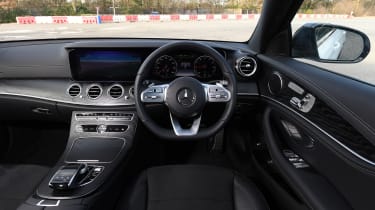
Comfort levels are high, with excellent seats and superb refinement, and practicality is good, too. There is plenty of rear and boot space; the saloon can stow 540 litres (400 for hybrids), while the estate will swallow up to 1,820 litres with the seats folded. If they’re in use, it’s a still-generous 640, or 480 in a hybrid. Coupes and convertibles are less practical, but more usable than you might think.
Prices
Expect to pay at least £12,000 to buy a fifth-generation E-Class; this secures an early E220d SE saloon or estate with at least 100,000 miles on the clock. We found nearly 2,400 cars for sale, two thirds of which were diesels; E350ds are priced from £18,000 for a 100,000-mile example. Plug-in hybrids are relatively unusual, with the E300de diesel starting at £22,000 for a 120,000-mile AMG Line on a 19-plate; the E350e costs from £18,000 for a 17-plate SE that’s done 100,000 miles.
Coupes and convertibles start at £18,000 and £23,000 respectively, while the unusual E43 AMG costs £29,000-plus for an early saloon. The E53 is more plentiful and is priced from £38,000, while the ludicrously fast E63 starts at £45,000 and the E63 S carries a £5,000 premium.
Visit our Find a Car service to get a great deal on a used Mercedes E-Class, or to check prices on a specific model head over to our Free Car Valuation tool.
Running costs
All E-Classes need to be serviced every 12 months or 11,500 miles. Work alternates between minor and major, with the former priced at around £390, while the latter is £430-£740 depending on which service it is and therefore what replacement parts are needed. A new air filter costs around £60 (fitted), for example, while a fresh fuel filter is about twice as much.
Also recommended is spending £125 every other year for new brake fluid, while the coolant must be renewed every 10 years at about £150. All engines are chain-driven, with no cambelts to replace. The ServiceCare programme spreads maintenance costs.
Recalls
With 55 so far, we think this E-Class holds the record for the most recalls of any used car we’ve ever covered. There have been nine campaigns because of seatbelt faults, two each because of potentially problematic airbags and glitches in the emergency-call system, plus one because crankshaft-manufacturing faults might lead to the need for a replacement engine.
Other potential issues include faulty headrests in the convertible, turbocharger oil leaks, chafed wiring looms and the exhaust working loose. Recalls were issued because of incorrect Isofix mountings being installed, fuel leaks and rear spoilers coming adrift altogether. Steering problems led to six separate recalls, there was another due to faulty timing chains, and software glitches led to no fewer than 10 different campaigns.
Driver Power owner satisfaction
Considering the E-Class was unveiled nearly eight years ago, 43rd out of 75 in the 2023 Driver Power new-car survey isn’t a disaster. Top-10 scores for the cabin quality and design, brakes and ventilation were the high points, while owners also like the infotainment, all-round visibility, gearbox and seat comfort. What they don’t like are the high running costs, poor value, iffy reliability and some switchgear placement.
Looking to sell your current car quickly and for a good price? Try our Free Car Valuation tool today!
What we said: Mercedes E-Class (2016-2023) review
The Mercedes E-Class is about as traditional as you can get in the executive saloon market - it feels a lot like a smaller S-Class, which is a good thing, as it sets high standards in the class for comfort and has an impressively sumptuous cabin.
While it's more expensive than its rivals, all versions are well equipped and, overall, the E-Class an efficient and stylish package that's well worth considering if you're in the market for a new executive saloon.
About the Mercedes E-Class
There was a time when Mercedes' line-up was based exclusively on this size of saloon, but today there are so many different models in the range that the E-Class faces the risk of being lost in the line-up. Fortunately, Merc knows that the E-Class is still one of the most important models in its range, so it gets a host of hi-tech gadgets, advanced engines and a plush fit and finish to maintain its appeal.
Refinement is also top notch, while the S-Class-inspired technology makes it safer and easier to live with. It’s not quite as fun to drive as a Jaguar XF or BMW 5 Series, but it’s close enough in a class where cruising ability and composure count. The entry-level diesel is now faster and more efficient than ever, too, which will be important for business users, while there's some scorching AMG-badged performance models for those who need more pace.
The current E-Class arrived in 2016, but while the W213 model is the fifth-generation to wear the E-Class badge, its saloon roots can be traced all the way back through to the Ponton Mercedes saloons of the 1950s. There are some illustrious models in the Mercedes saloon back catalogue, including the W114 and W124, but with every model, Mercedes has improved its executive saloon to keep it competitive in the sector.
The E-Class name first arrived in 1993, when the facelifted W124 model hit showrooms with the newly added E badge on its name, and almost 30 years later the E-Class is still one of the leading lights in the executive saloon class. Its main rivals are its German counterparts in the shape of the Audi A6 and BMW 5 Series, while the Jaguar XF is a strong contender, too. In addition, high-end versions can rival the Tesla Model S and Porsche Panamera, while cars like the Lexus ES and Volvo S90 offer something different in the class. At the very top of the tree, the AMG E 63 S is a super saloon that delivers supercar pace in a luxury four-door package.
Like the last model, the current E-Class is offered in four body styles: four-door saloon, estate (including the four-wheel-drive All-Terrain Edition), coupe and convertible. All versions borrow technology from the S-Class limousine, while the styling gains some influence from that model, too. The saloon really does look like a shrunken S-Class, and it could even be difficult to distinguish it from the C-Class from a distance.
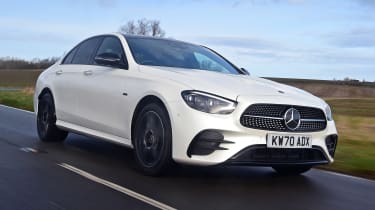
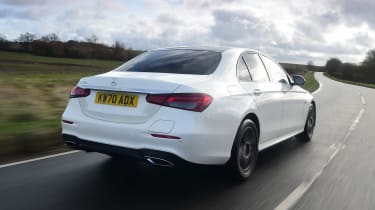
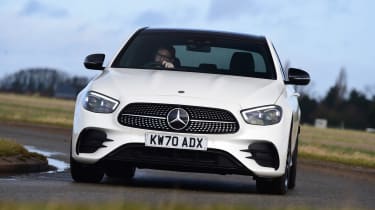
Mercedes facelifted the E-Class in 2020, with exterior styling tweaks including reshaped lights, a new radiator grille and a reprofiled bumper. At the rear of the saloon model, the previous rounded taillights have been switched for wider units. The E-Class also comes with the manufacturer's latest MBUX infotainment system as standard, with two 12.3-inch screens.
There’s a decent range of engines in the E-Class, with diesel, petrol and hybrid powertrains on offer. The E 220 d and E 300 d four-cylinder variants, along with the E 400 d straight-six unit make up the diesel range, while a single four-cylinder 2.0-litre, fitted to the E 200, covers the lower end of the petrol line-up.
Two hybrids are available with a 2.0-litre four-cylinder engine fueled by either petrol or diesel and mated to an electric motor. The E 300 e is the petrol version and the E 300 de is the diesel. Both offer an all-electric range of around 33-35 miles.
At the top of the standard petrol range is the E 450 4MATIC, followed by the beefy AMG E 53 and AMG E 63 S models. The AMG cars have straight-six or V8 twin-turbo engines respectively, with 4MATIC four-wheel-drive standard on both. All E-Class versions feature a nine-speed auto gearbox.
Engines, performance and drive
It's not the sharpest large saloon on sale, but the E-Class delivers when it comes to comfort and refinement. Steel springs with adaptive dampers are standard in the UK, while fully adaptive air-suspension is an option.
The standard coil springs and adaptive damper suspension set-up does a better job of soaking up bumps than the firmer Jaguar XF, but trails the BMW 5 Series for ultimate comfort. While it deals with big bumps well, broken tarmac and potholes send the occasional shake and shudder through the floor of the cabin. Cars with optional air-suspension ride serenely, offering lots of composure, plenty of comfort and good body control. While the car floats along nicely on faster, smoother roads, go for an AMG Line model, and the larger wheels mean the ride will feel a little unsettled on more jagged surfaces.
There are different driving modes to sharpen up the steering, throttle response and damping, but it’s best to leave the E-Class in Comfort and make the most of its cosseting, refined ride. Hit a corner quickly, and you’ll find body control soft in Comfort mode. Sport or Sport+ settings reduce roll, but also add an artificial weight to the lifeless steering. It’s not as agile as the sportier XF, but you can’t fault its grip and composure.
The impressive ride stems from the E-Class’ weight loss plan, having shed “around 100kg” over its predecessor depending on spec, according to Mercedes. Aluminium body panels have helped here, meaning the E-Class delivers a fluid ride even over poor road surfaces.
Combined with the impressive levels of refinement from the engines and the standard nine-speed automatic gearbox, which slurs changes nicely and responds sharply enough to pulls on the steering wheel mounted paddles, it’s easy to make relaxed progress.
Whereas the BMW 5 Series and Jaguar XF offer more for keen drivers, the E-Class puts the focus more on comfort and quality, delivering a relaxed drive at the expense of some handling performance that, for most people day-to-day, will be a welcome benefit.
You can still drive it hard and lean on the decent amount of grip available, but it doesn’t feel quite as natural as in some larger saloons. There’s always a reassuring, planted feel on the road though, while Mercedes’ clever safety systems – including the E-Class’ standard autonomous braking – offer peace of mind.
0-62mph acceleration and top speed
Mercedes’ 2.0-litre four-cylinder turbodiesel opens the E-Class range in the E 220 d. With 191bhp and 400Nm of torque on offer in the latter, this is now faster than the old E 250 d, but importantly the new 2.0-litre unit is much quieter than the clattery old 2.1-litre diesel.
The 0-62mph sprint takes 7.3 seconds, while top speed stands at 149mph, but it’s the smooth, subdued pulling performance that impresses most. Refinement is much improved, and the new four-cylinder diesel is easily a match for the 2.0-litre Ingenium unit in the Jaguar XF when it comes to a subdued idle and quiet cruising on the motorway. The nine-speed auto gearbox makes for low cruising revs of just 1,300rpm at 70mph, and the car's slippery shape also means there’s virtually no wind noise.
If you want extra performance, the E 400 d 4MATIC certainly offers that. With its 3.0-litre turbo diesel straight-six there’s a mammoth 700Nm on tap. This, combined with 335bhp, gives a seriously quick 4.9 second 0-62mph sprint. However, it’s how the E 400 d pulls from low revs with plenty of potency that demands your attention.
Squeeze the throttle and the engine pulls hard from as low as 1,200rpm. Also, it will happily plod along at 30mph in sixth gear and accelerate all the way up to motorway speeds with minimal fuss. There’s no real need to wring the engine out past 3,000rpm because of the effortless power delivery. Add in the supple ride quality and the E 400 d is simply one of the most relaxing and refined cars in which to cover long distances.
But, if you'd rather not have an oil-burner, then the capable E 450 4MATIC could be the answer - powered by a 3.0-litre six-cylinder petrol engine, it produces 362bhp and 500Nm of torque and reaches 0-62mph in 5.1 seconds.
The 429bhp AMG E 53 acts as a go-between for the standard E-Class models and the fire-breathing AMG E 63 S. It combines straight-six power with 48v mild-hybrid technology to help optimise performance. There’s plenty of grunt to be exploited in the mid-range, thanks to the 520Nm torque output. Acceleration is decent too, taking only 4.5 seconds to get from 0-62mph.
The top-of-the-line engine is the E 63 S, with a massive 4.0-litre V8 giving 604bhp. Performance is a step above the E 53, tackling the 0-62mph sprint in 3.4 seconds and pressing on, if you go for the optional £765 AMG Driver’s Package, to a top speed of 186mph.
It’ll be the E 220 d that makes up the majority of sales in the UK. However, Mercedes’ frugal E 300 e and E 300 de plug-in hybrids aim to be successful in the business market.
Combining a turbocharged 2.0-litre four-cylinder petrol or diesel engine with an electric motor, the cars offer brisk performance, with both producing over 300bhp and 700Nm of torque. The two hybrids will cover 0-62mph in less than six seconds and press on to top speeds in excess of 155mph.
On the road, the E 300 e shows how far electrification has come. If you’re careful, (and if you follow the car’s suggested economical route) you should be able to squeeze more than 30 miles of pure-electric driving, which is enough for most morning commutes. The car feels a little less keen to change direction thanks to the extra weight of its batteries, but the plug-in hybrid is still good to drive and very comfortable.
MPG, CO2 and running costs
Not only is the 2.0-litre diesel in the E 220 d faster and more refined, it’s also more efficient. Claimed combined fuel economy is 57.7mpg under WLTP testing, with CO2 emissions are now 128g/km.
Opt for the E 400 d and the vital figures aren’t quite as impressive, with a claimed maximum of 42.2mpg and CO2 emissions of 176g/km, but this is still fairly competitive efficiency compared to its rivals and good considering the level of performance on offer. However, you'll be spending even more time at the filling station if you choose the petrol E 450 4MATIC - its 3.0-litre six-cylinder unit returns just 31.4mpg on the combined cycle.
The E 53 AMG manages 30.4mpg and 215g/km of CO2, which again is impressive for such a powerful motor - but in the real world those figures will be some way off, especially if you're driving it as intended.
The E 300 e and E 300 de are the most efficient of the bunch, emitting between 33 and 40g/km of CO2, and remember that if you can make use of the 30-mile plus electric range then you won't use a single drop of fuel.
All cars get stop-start to help reduce tailpipe emissions, while other features such as clever aerodynamics further improve efficiency. The new E-Class has a drag coefficient of 0.23 Cd, which is actually 0.01 lower than the latest Toyota Prius, an already very aerodynamically advanced vehicle, showing how well the Merc slips through the air, using less fuel in the process.
Interior, design and technology
From the outside, the Mercedes E-Class takes styling inspiration from the larger S-Class, and it ditches its predecessor’s boxy design in favour of the limousine’s more svelte curves. While the design might not be to everyone’s tastes, the higher-spec AMG Line model has lots of kerb appeal. A facelift in 2020 brought some changes to the exterior, with redesigned lights, a new grille and reprofiled bumper.
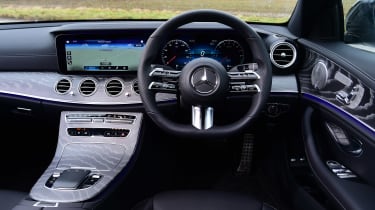
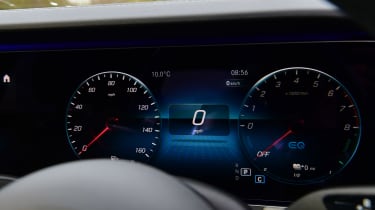
Step aboard, and the interior also takes its design cues from the S-Class, with a minimalist approach to the dashboard layout. The fascia flows across the cabin, featuring four circular air vents in the centre, while the twin 12.3-inch screens display crisp, sharp graphics.
There is a striking new steering wheel design, housing touch-sensitive controls for functions such as volume, cruise control and the digital driver information. It takes a little getting used to, but the systems it controls are still typically up to the mark.
You can’t fault the technology on offer, however. Self-parking is standard on the Sport trim, as is a reversing camera, LED headlights, Mercedes’ Active Brake Assist, sat-nav, climate and cruise control, heated seats and a wireless smartphone charging plate integrated into the storage tray in front of the centre console.
Upgrading to the Premium specification brings bigger 19-inch alloys and a 360-degree camera control, while the Night Edition Premium Plus versions add an inch to the wheel size, along with black gloss trim and a panoramic sunroof. Allied to the advanced tech inside, the E-Class’ interior puts the A6 and 5 Series in the shade, and beats the Jaguar XF, too.
Sat-nav, stereo and infotainment
Mercedes' MBUX infotainment is up there with the best systems in the class, featuring sharp graphics, quick responses to any inputs and the latest tech. The logical menu layout means it's easy to navigate your way through the different menus.
Practicality, comfort and boot space
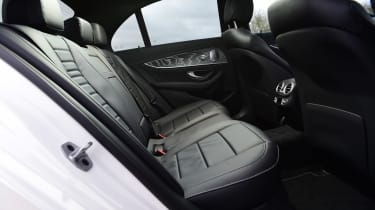
The E-Class is a full five-seater, and although the transmission tunnel restricts room in the middle slightly, the E-Class still offers enough space for five fully grown adults on shorter journeys. That’s thanks to the comfortable seats and, for the driver and front passenger, plenty of adjustment.
A softer chassis setup compared to rivals means the E-Class focuses on comfort more than sportiness, floating nicely over rippled roads. However, the big body and chunky C-pillars mean rear visibility over the shoulder isn’t the best – but with features like blind spot assist available, there’s enough safety tech to help out here.
That enlarged body means there’s lots of room inside, so the E-Class offers good storage. A deep central cubby between the front seats gives lots of space to stow items, while a large trinket tray in front of the multimedia controller gives a place to put mobile phones – in fact, this is where the wireless charging option is located if specified.
Decent sized door bins that run the length of the doors and a large glovebox give some extra storage, too.
Size
As mentioned, the E-Class has grown compared to its predecessor, so this new model is now 43mm longer than before at 4.9m.
Despite the space inside this fifth-generation E-Class is actually now narrower and shorter too, showing how Mercedes has cleverly optimised the layout inside to maximise passenger room and comfort.
It’s a similar length to all of its main rivals, with the Jaguar XF, BMW 5 Series and Audi A6 also all hovering around the 4.9m mark, but with a reversing camera as standard and an optional 360-degree monitor available, the E-Class should be easy to manoeuvre.
Leg room, head room & passenger space
The E-Class’ wheelbase has grown by 65mm, meaning more room between the axles for passengers – and you can feel this inside.
Legroom is good, and the practical roofline means even taller adults won’t suffer when it comes to headroom in the rear. Three big adults in the rear might feel a little tight, but it’s fine for shorter journeys.
Boot
A 540-litre boot puts the E-Class on a par with the Jaguar XF, making it the joint class leader. This is also 10 litres more than an A6 and 5 Series, while the square shape means you can make the most of the E-Class’ load bay.
Saloons aren’t normally the most practical models when it comes to swallowing luggage, as large hatchbacks generally offer a bigger opening.
However, the E-Class’ boot lid rises high out of the way and reveals a big aperture, so although there is a small loading lip to contend with, the Mercedes still offers enough flexibility.
It’s worth noting that the battery pack in the E 300 e and E 300 de does eat into boot space compared to the conventionally-powered models. Around 150-litres is lost overall, which is a sizeable chunk.
The rear seats split-fold in a 40:20:40 configuration for extra practicality when carrying longer loads, while this also increases overall luggage volume.
Towing
All E-Class models have a 2,100kg maximum braked towing capacity, with the exception of the E 200 petrol version which has a 1,900kg restriction.
Tell us which new car you’re interested in and get the very best offers from our network of over 5,500 UK dealers to compare. Let’s go…