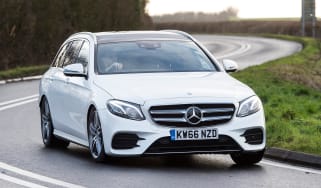
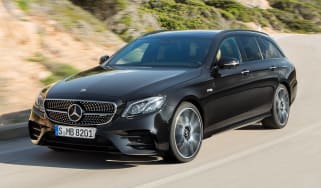
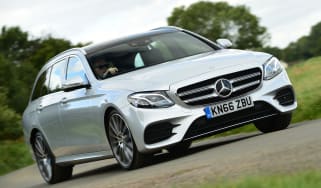
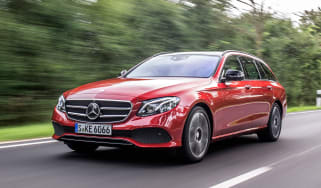
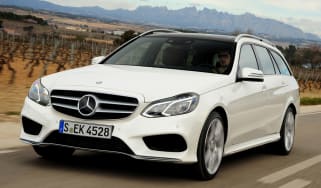
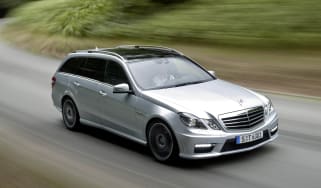
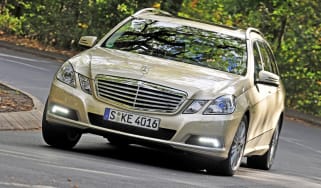
Mercedes E-Class Estate review
The E-Class Estate is big on comfort and tech, but it’s no longer a leader in the space race
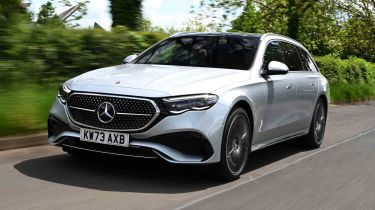

Our opinion on the Mercedes E-Class Estate
The Mercedes E-Class Estate is a technological tour de force, plus it remains one of the most desirable load luggers money can buy. It also offers exceptional comfort and refinement, and a comprehensive line-up of powertrains. The plug-in hybrid units are especially impressive, delivering a strong blend of performance and efficiency - although this does come at the cost of practicality, which is a shame given this car’s otherwise spacious estate body. The only other disappointment is the handling, which is composed and capable but lacks the driver appeal of the BMW 5 Series Touring.
About the Mercedes E-Class Estate
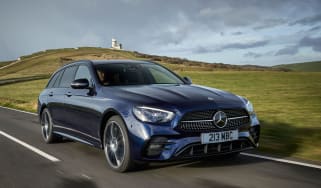
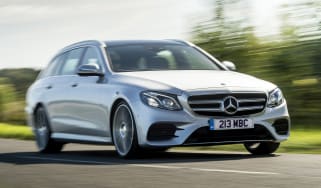
The Mercedes E-Class is the flagship of the German brand’s estate car line-up, sitting above the Mercedes CLA Shooting Brake and Mercedes C-Class Estate. There’s been a big estate of some sort in the firm’s line-up since 1965, but the first to wear an E-Class badge was the facelifted S124 in 1993. The current sixth-generation model was revealed in 2024 and uses Mercedes’ versatile MRA2 architecture that also underpins the smaller Mercedes C-Class and larger Mercedes S-Class models.
Since it initially arrived on our shores, we’ve tested a number of E-Class Estate variants on UK roads, ranging from the entry-level models right through to the most potent Mercedes-AMG E 53. If you’re more tempted by the standard saloon car, we also have a dedicated in-depth review of the non-load-lugging Mercedes E-Class saloon.
Performance & driving experience
Pros |
|
Cons |
|
Like the four-door Mercedes E-Class saloon, this estate is available with a wide range of engines. Not only are there traditional petrol and diesel options, but there are also plug-in hybrid versions of both. Plus there’s the high-performance Mercedes-AMG E 53 that aims to combine serious pace with plenty of space.
Used - available now

2022 Mercedes
E Class
27,179 milesAutomaticDiesel2.0L
Cash £22,570
2023 Mercedes
E Class
41,577 milesAutomaticPetrol3.0L
Cash £38,810
2019 Mercedes
E Class
94,376 milesAutomaticDiesel2.0L
Cash £14,995
2020 Mercedes
E Class
39,830 milesAutomaticPetrol2.0L
Cash £17,350All versions of the E-Class Estate use a nine-speed automatic gearbox, although the AMG model has been tuned differently to offer even sharper responses. Either way, in the best Mercedes tradition, it’s a smooth and unobtrusive transmission, slurring gears smoothly enough that you’ll barely be aware they’re happening.
Performance, 0-60mph acceleration and top speed
Kicking off the range is the E 200 petrol, which, despite its engine’s modest size, delivers a decent turn of speed. It’s a mild-hybrid, four-cylinder motor with 201bhp and a healthy 320Nm of torque helping it surge from 0-62mph in 7.8 seconds and onto a top speed of 144mph. Not too shabby for an entry-level model.
Even so, despite diesel becoming a dirty word, the E 220 d is arguably an even better fit for this type of car, its blend of pace and economy proving difficult to beat. The 2.0-litre unit is surprisingly refined, and while it has less power than the petrol (194bhp), it delivers a thumping 440Nm of torque. Its 0-62mph time of 7.9 seconds is a tenth slower, but plenty of mid-range muscle makes it a quicker car in everyday use.
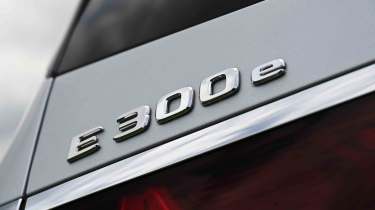
Next up is the plug-in hybrid E 300 e, which pairs the E 200’s petrol engine with an electric motor to boost total power to 309bhp. The set-up is well integrated to deliver seamless acceleration. Perhaps more impressively, this dual-fuel load lugger combines a rapid 6.5-second 0-62mph time with up to 68 miles of claimed range on electric power alone.
You get the same EV range with the E 300 de, which features much of the same electrical hardware. It’s not quite as refined as the petrol plug-in, but it’s only a tenth of a second slower to 62mph, so it feels similarly swift on the road thanks to both getting instant power from their respective electric motors. The E 300 de has better efficiency (on paper), which means it’ll run even further between stops at the pumps.
For those who like to talk softly but carry a big stick, the E 450 d is a great choice. Its smooth six-cylinder diesel engine features mild-hybrid technology to deliver 362bhp and 750Nm of torque. It also features the brand’s grippy 4Matic all-wheel drive system that helps put all that power on the road. As a result, the E 450 d can blast from 0-62mph in just 5.0 seconds, which is quick enough to frighten proper sports cars.
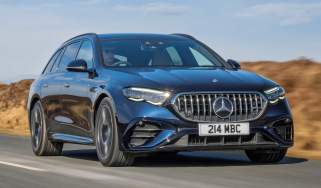
At the top of the range is the Mercedes-AMG E 53 Hybrid 4Matic+. Tuned by the brand’s AMG performance division, it combines a six-cylinder 3.0-litre petrol with plug-in hybrid electricals for a combined output of 577bhp and 750Nm of torque. Those figures are a match for the old 4.0-litre V8-powered E 63 model, as is the blistering 0-62mph time of 4.1 seconds. Yet while the six-pot petrol has a nice snarl when worked hard, it lacks the old car’s bellowing soundtrack and hot rod character.
| Model | Power | 0-62mph | Top speed |
| E-Class Estate E200 Urban Edition | 204bhp | 7.8 seconds | 144mph |
| E-Class Estate E300 e AMG Line Premium | 313bhp | 6.5 seconds | 141mph |
| E-Class Estate E220 d Exclusive Premium | 197bhp | 7.9 seconds | 143mph |
Town driving, visibility and parking
You probably don’t need us to tell you that the Mercedes E-Class Estate is a big car, so busy narrow streets may cause your blood pressure to rise at times. However, every variant is quiet enough to quickly soothe your jangled nerves. This is especially true in the hybrids, because these will use pure-electric power as much as possible to cut emissions.
The suspension is also fantastic at masking bumps and potholes, plus the automatic gearbox is smooth in slow-moving traffic. Light controls also make the E-Class a doddle to drive. So as long as you don’t need to park in a tight car park, the E-Class is excellent around town. That being said, an array of parking aids should mean you’re spared any bumper-grazing blushes.
Country road driving and handling
For keen drivers, the E-Class ranks below the agile and alert BMW 5 Series for fun on twisting back roads. The Mercedes handles accurately and serves up strong grip, but the steering is short of feedback, and the car feels big and heavy compared to its German rivals. There’s also more body roll in tight corners, although things improve once on an open A-road.
Motorway driving and long-distance comfort
As a result of its absorbent suspension and plush cabin, the E-Class excels on the motorway, and the low-drag bodywork helps to keep wind noise low and economy high. However, if we have one criticism, it’s that the diesel engine in the E 220 d is a little noisy under hard acceleration, but overall refinement is still superb. If you’re more interested in the PHEVs, we could hardly hear the engine in the E 300 e we tested.
“Find a more challenging section of road and the E-Class has a neutral balance, but there’s more roll through the corners than in the 5 Series, less overall grip, and a general feeling that it’s a little less agile. The very fast and light steering feels too quick for the body, which can struggle to keep up with more aggressive movements.” - Alex Ingram, special contributor.
MPG & running costs
Pros |
|
Cons |
|
On paper, the plug-in hybrid E 300 e and E 300 de are the most economical E-Class Estate models, although you’ll struggle to get near the claimed WLTP fuel economy figures in the real world unless most of your driving is within the EV range and you charge frequently. Even then, achieving the E 300 de model’s promised 122.9mpg will be tricky.
Of the traditionally powered models, the diesel-powered E 220 d comes out on top thanks to its impressive claimed fuel economy of up to 55.4mpg. The entry-level E 200 petrol provides a respectable 41.6mpg at the pumps, which, factoring in the lower cost of unleaded petrol compared with diesel, makes it a tempting choice for drivers who cover less than 12,000 miles a year.
The most powerful model without full-hybrid assistance is the E 450 d, which returns up to 44.8mpg according to WLTP figures. In terms of its blend of performance and economy, the 362bhp diesel is an impressive option. Better still, use a gentle right foot on long motorway runs, and you’ll likely see even higher fuel returns.
| Model | MPG | CO2 | Insurance group |
| E-Class Estate E200 Urban Edition | 41.5mpg | 155g/km | 41 |
| E-Class Estate E300 e AMG Line Premium | 122.9mpg | 53g/km | 50 |
| E-Class Estate E220 d Exclusive Premium | 55.4mpg | 134g/km | 44 |
Electric range, battery life and charge time
As you’d expect, the rapid Mercedes-AMG E 53 is the thirstiest member of the E-Class Estate family. Despite the plug-in hybrid powertrain’s ability to travel a decent distance in EV mode, thanks to its 21.2kWh battery, Mercedes claims the system is as much about explosive acceleration as it is efficiency. As a result, its claimed fuel figures have been recorded with the battery discharged, resulting in a lowly 30.7mpg.
One of the benefits of the Mercedes E-Class Estate plug-in models is their impressive electric driving range, which is primarily down to a sizeable 25.4kWh battery. For the petrol and diesel E 300 e and E 300 de, this results in a claimed EV range of up to 68 miles, while the flagship E 53 with the same battery promises a 61-mile range. Either way, you can expect a comfortable 50 miles in all-electric mode, even in colder and wetter weather.
The battery can be charged at a maximum rate of 55kW (60kW for the AMG E 53), which allows a 10-80 per cent top-up from a public charger capable of delivering such speeds in around 20 minutes. Most will prefer to charge at home using a cheaper overnight tariff, though.
If you use a typical 7.4kW wallbox charger, Mercedes quotes a 10-100 per cent charge will take three hours. Most other manufacturers quote a 0-100 per cent charge time, so we anticipate it’ll take around four hours to fully replenish a flat battery.
| Model | Battery size | Range | Insurance group |
| E-Class Estate E300 e AMG Line Premium | 25.4kWh | 66 miles | 50 |
| E300 de AMG Line Premium Plus | 25.4kWh | 65 miles | 50 |
| E-Class Estate E53 Premium | 21.2kWh | 58 miles | 50 |
Insurance groups
No Mercedes E-Class Estate will be cheap to insure, with the vast majority of the line-up sitting in the very highest insurance group. In comparison, the Audi A6 Avant is far cheaper to cover, sitting between groups 31 and 40 (out of 50).
Tax
Every E-Class Estate model retails for well over £40,000 when new, which means private buyers will face an annual luxury car tax surcharge on their VED road tax bill between years two and six after the car is first registered.
The 300 de plug-in hybrid diesel has the lowest Benefit-in-Kind tax (BiK) rating in the E-Class Estate range at 10 per cent, followed by the 300 e plug-in hybrid petrol, and 21 per cent for those lucky enough to have the E53 on their company car list. There's a significant jump to 32 per cent BiK for the 220 d, while the rest of the E-Class Estate line-up is in the highest 37 per cent bracket.
Company car drivers will be better off looking towards fully electric estate cars like the Audi A6 Avant e-tron, BMW i5 Touring, or even the Volkswagen ID.7 Tourer if they want the biggest BiK savings, since these all start in the 4 per cent bracket.
Depreciation
According to our expert data, the Mercedes E-Class Estate should hold on to between 43 and 49 per cent of its initial value after three years or 36,000 miles, with the AMG 53 being the worst performer in this regard. In comparison, the Audi A6 Avant and BMW 5 Series Touring retain between 42 and 46 per cent of their respective original values over the same time period.
To get an accurate valuation for a specific model, check out our valuation tool...
Interior, design & technology
Pros |
|
Cons |
|
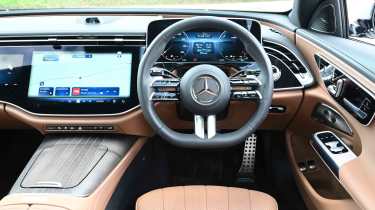
The Mercedes E-Class Estate features exactly the same interior as the saloon, which takes its cues from other Mercedes models. There’s loads of cutting-edge tech on display, and it’s packaged into an interior that aims to combine modern design with an air of traditional luxury.
Between the driver and passenger is a wide centre console that helps to create a nicely cocooning feel, while the sweeping dashboard design is more closely related to the electric Mercedes EQE than what you’ll find in the traditional Mercedes C-Class and Mercedes S-Class saloons.
The Mercedes E-Class Estate features excellent seats that are very comfortable and supportive, with all models getting four-way electric lumbar adjustment. You will have to upgrade to the AMG Line Premium model to gain a memory function on the front seats, but while the powered adjustment makes it easier to find the perfect seating position, it doesn’t affect the overall comfort of the seats.
All the basic equipment you could need is included as standard, including climate control, smartphone connectivity, keyless go, sat-nav with live traffic info, and artificial leather upholstery called Artico. A natural leather alternative is available, while plusher Nappa leather is reserved for Exclusive Premium Plus models.
Interior and dashboard design
The slickly designed Mercedes interior certainly looks the part, with the use of gloss black trim and natural wood finishes adding serious premium appeal. At night, the cabin is bathed in comprehensive ambient lighting, which on AMG Line Premium Plus and Exclusive models can be programmed to automatically change depending on the driver mode selected.
Materials and build quality
As in other Mercedes models of late, the quality of the fit and finish of the E-Class isn’t quite up to the brand’s historically high standards. When we poked and prodded various areas of the cabin in our test cars, we often found bits of trim that would flex, along with the odd creak and rattle.
Infotainment, sat-nav and stereo
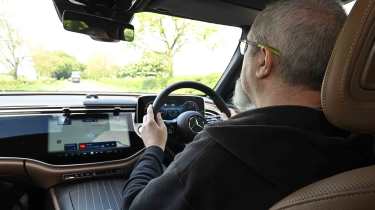
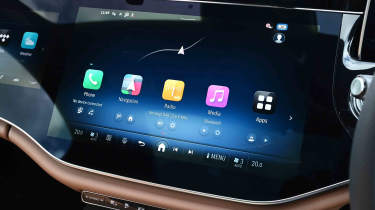
Like the all-electric EQE and Mercedes EQS models, the E-Class estate is available with a full-width digital dashboard. Called the Superscreen, it costs around £1,500 and combines a central infotainment screen of 14.4 inches between a pair of 12.3-inch displays – one for the driver and another for the passenger. What Mercedes calls a ‘visual shield’ helps block the passenger display from being seen by the driver, helping to reduce distraction on the move.
As you’d expect, it’s packed with features, with front-seat passengers able to use their own screen to independently access music and apps. The set-up even contains a camera on top of the dashboard for video conferencing and selfies.
Despite its complexity, the set-up is surprisingly easy to use thanks to Mercedes’ Zero Layer concept, which allows you to access the most frequently used functions without having to delve through multiple sub-menus. Either way, like it or loathe it, there’s no denying this eye-catching set-up will be a conversation starter for first-time passengers.
Standard versions of the E-Class Estate go without the passenger-side display, but do get the 14.4-inch infotainment and 12.3-inch instrument cluster ahead of the driver. Smartphone connectivity is also included in all versions of the E-Class, so you’ve got Apple CarPlay and Android Auto as standard, even without the Superscreen option.
“The heavily perforated steering wheel feels good in the hands, and while some find the touch-sensitive controls on the four wheel spokes are a little fiddly, they’re grouped into specific functions, so it doesn’t take long to get familiar with the layout.” - Alex Ingram, special contributor.
Boot space & practicality
Pros |
|
Cons |
|
People primarily buy estate cars for the sheer level of space on offer, and while the E-Class is by no means a small vehicle, a number of rivals have it pipped on its capacities.
Dimensions and size
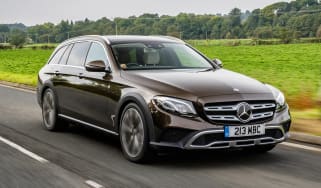
At a whisker under five metres long and nearly two metres wide, the Mercedes E-Class Estate is a big car, even for a full-sized family wagon. The upshot of this is that it offers plenty of space inside for people and their luggage, but the cheaper Skoda Superb Estate outshines it in both combustion and PHEV forms.
| Dimensions comparison | |||
| Model | Mercedes E-Class Estate | BMW 5 Series Touring | Skoda Superb Estate |
| Length | 4,949mm | 5,060mm | 4,902mm |
| Width | 1,880mm | 1,900mm | 1,849mm |
| Height | 1,461mm | 1,515mm | 1,482mm |
| Wheelbase | 2,960mm | 3,000mm | 2,841mm |
| Boot space | 615 litres (490 litres in PHEV) | 570 litres | 690 litres (510 in PHEV) |
Seats & passenger space
Up front, the front seats are comfortable and supportive, and finding the perfect driving position is child’s play thanks to the wide range of seating adjustments. Entry-level Urban models feature heated seats, while all other models benefit from heating and cooling. The high centre console helps give a cosy feel, but there's still plenty of space thanks to the car’s overall width. In fact, when tackling a long trip, few places are as welcoming as the front seats of an E-Class.
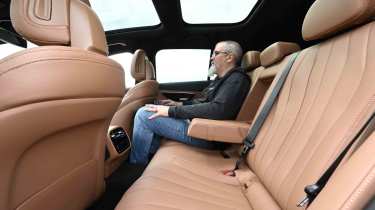
Those in the rear will have little to complain about either. Three adults can comfortably be seated on the rear bench, although the middle passenger will have to straddle a large central tunnel and contend with a slightly raised seating position, so they won’t want to be there for more than short trips.
Occupants of the outer seats fare better, with more legroom than in a BMW 5 Series Touring. Headroom is good too, the estate’s extended roofline making it less cramped than the sleeker saloon equivalent. These seats can also be used for accommodating child seats, with the easily accessible Isofix mounting points hidden behind some rubber covers.
You’re not short of handy storage either, with that large centre console housing a cubby and a pair of cup-holders beneath a sliding panel, plus a deep compartment underneath the centre armrest. A large glovebox provides further space for odds and ends, as do the large door bins front and rear. Rear-seat passengers also get a fold-down centre armrest that contains another two cup-holders.
Boot space
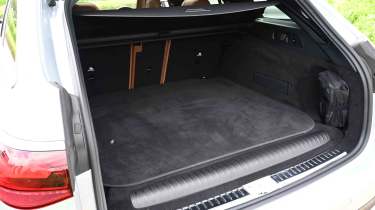
As you’d expect from a Mercedes estate, the E-Class boasts a decent amount of luggage space - although those wanting to maximise carrying capacity should steer clear of the plug-in hybrid models. The need to house the battery beneath the boot floor means there’s only 490 litres of space with the seats up. Irrespective of its lower cost, though, the Skoda Superb iV PHEV manages 20 litres more than the Mercedes.
There’s better news in the E 200, E 220 d and E 450 d, which offer 615 litres of space with all the seats up, growing to 1,830 litres when folded. Regardless of powertrain, the E-Class Estate features a handy 40:20:40 split-fold rear seat, a wide boot opening with a low load lip, and a powered tailgate.
Towing
Whichever engine you choose, the Mercedes E-Class Estate will be a handy towing car, thanks to a maximum braked trailer limit of 2,100kg. Mercedes offers an optional folding towbar for around £700, which also comes with a special setting for the electronic stability programme that takes account of any trailer or caravan movements for safer and more stable behaviour in emergency situations.
“The back seats feel as sumptuous as those up front, with even the central seat feeling like a relaxing place to sit – not always a given, even in a car this large. There’s loads of space, and headroom is especially impressive, but the wide, long cabin gives occupants lots of room to stretch out in all directions.” - Alex Ingram, special contributor.
Reliability & safety
Pros |
|
Cons |
|
Mercedes has a long and enviable reputation for safety, introducing the car-buying public to crumple zones and airbags. Today, it leads the way with advanced driver aids, so it’s no surprise to find the E-Class Estate score so strongly in Euro NCAP testing. When the safety specialist assessed the E-Class saloon in 2024 (its result applies to the E-Class Estate also), it awarded it a five-star rating for safety. It scored 92 per cent in the Adult Occupant category and 90 per cent for children, plus an impressive 87 per cent score for safety tech.
The standard kit includes adaptive high beams, traffic-sign assist, adaptive cruise control, parking assist, pedestrian protection and a reversing camera. Spend an extra £1,700, and you can add the Driving Assistance Package Plus, which adds stop and go functionality to the adaptive cruise control, as well as active assistance with lane keeping and steering inputs during emergency manoeuvres. Another neat feature is the ability to use the sat-nav to automatically slow the car for corners, roundabouts, junctions or other fixed road hazards if the car senses the driver hasn’t adjusted their speed appropriately.
Mercedes finished ahead of all others in our 2026 Driver Power manufacturer rankings, coming first out of 30 brands. Owners rated the interior design, fit and finish, driver enjoyment, and front-seat comfort of their cars, although they would like the running costs to be lower.
| Euro NCAP safety ratings | |
| Euro NCAP safety rating | Five stars (2024) |
| Adult occupant protection | 92% |
| Child occupant protection | 90% |
| Vulnerable road user protection | 84% |
| Safety assist | 87% |
Buying, prices and deals
Best buy: Mercedes E-Class Estate E 220 d AMG Line Premium
As you’d expect, given its status within the Mercedes range, the E-Class isn’t a cheap car. Prices start just over £60,000 for the E 200 in Urban Edition trim, and the line-up steadily climbs all the way up to between £94,500 and £100,500 for the AMG E 53.
If you’re buying a brand-new Mercedes, odds are that you’re willing to pay a bit more in order to get the most luxurious experience. AMG Line Premium trim adds enough kit to this executive estate to make it into more of an occasion, but it doesn't push the price up so far that it’ll devastate your bank account. While the petrol and diesel PHEVs offer temptingly low running costs, the more traditional E220 d still does a great job of combining efficiency, performance and refinement.
Fortunately, you can save money by building your perfect Mercedes E-Class Estate through the Auto Express Buy a Car service. We also have a selection of used Mercedes E-Class Estates to choose from, and we can even help you sell your car.
Mercedes E-Class Estate alternatives
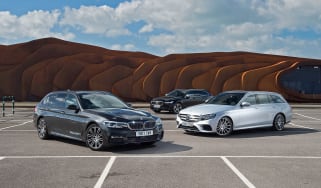
The market for large and luxurious estate cars has been particularly hard hit by the massive growth in upmarket SUV sales. Today, one of the E-Class’s toughest rivals is the BMW 5 Series Touring, which has a fractionally smaller boot but delivers a more engaging driving experience without sacrificing comfort and refinement. The latest Audi A6 Avant is cheaper than the E-Class Estate and comes with a healthy amount of high-end equipment, but it's more on the lifestyle side of the premium estate car market because the boot isn't all that big.
If you’re not too bothered about badge snobbery, our favourite estate car, the Skoda Superb Estate offers its fair share of upmarket qualities but at a much more sensible price. Embarrassingly for Mercedes, the Skoda has an even bigger boot than the E-Class Estate, making the Superb Estate the most spacious in its class.
For those considering an electric car, the BMW i5 Touring and Audi A6 Avant e-tron are two tempting, zero-emission options from two long-standing Mercedes competitors.
Key updates of the Mercedes E-Class Estate review
26 August 2026: General update with the 2026 Driver Power customer satisfaction survey results.
Frequently Asked Questions
Mercedes offers a standard three-year warranty on its cars, and like BMW, there is no mileage limit. Roadside recovery is also included for that three-year period, and you can renew it for 12 months at a time until the car is 30 years old if it's serviced annually at an authorised Mercedes dealer.
Deals on the Mercedes E-Class Estate and alternatives
More reviews
Car group tests
In-depth reviews
Road tests
Used car tests
Which Is Best
Fastest
- NameE450d 4M AMG Line Premium 5dr 9G-Tronic [Pan Roof]
- Gearbox typeSemi-auto
- RRP£83,245