New Ferrari Amalfi 2026 review: brand's entry-level sports car is anything but basic
The Amalfi is technically the starting point of the Ferrari range, but it's still fully qualified to wear the prancing horse


Verdict
The Ferrari Amalfi is supposed to be the baby of the Italian maker’s model range, yet it’s so much more than that. Ferocious performance meets an engaging but approachable personality, matched with a more usable, ergonomic interior. There’s nothing basic about Ferrari’s entry-level sports car – and that includes the £200k starting price.
Context is everything. Whether it’s knowing how much one loaf of bread costs compared with another, or understanding that a longer route to work will take less time due to prevailing traffic conditions. This kind of extra information allows us to frame our judgements in an educated and more effective manner.
So when a car is labelled the ‘baby Ferrari’, it’s all relative. The Amalfi – a so-called “evolution” of the outgoing Roma – is still a £202k, near-200mph 2+2 with the ability to sprint from 0-62mph in 3.3 seconds. This, then, is no diluted, half-fat prancing horse.
Replacing the Roma in the Italian maker’s product range, the car you see here ushers in significant enough changes to warrant not only a new look, but a new name too. Pulled in line with models such as the forthcoming Testarossa, it gets a cleaner front end with slim lights, connected via a narrow black bar spanning the entire nose. The rear has been tidied up, too.
Used - available now

2023 Peugeot
508
43,132 milesAutomaticPetrol1.6L
Cash £14,497
2023 Tesla
Model Y Premium
32,010 milesAutomaticElectric
Cash £26,750
2023 Volvo
XC40 Recharge
91,608 milesAutomaticElectric
Cash £19,830
2023 Tesla
Model Y Premium
49,826 milesAutomaticElectric
Cash £23,450But it’s inside where you’ll find the most obvious visual updates. Gone is the slightly awkward portrait touchscreen, replaced by a better-integrated landscape display – now with Android Auto as well as Apple CarPlay connectivity. Also new for the Amalfi, is a revised steering-wheel panel with physical switches and a big red starter button. It’s much more tactile and infinitely more ergonomic; Ferrari says you can retro-fit it to your Roma (or any other model with the old-style wheel) for around £5,000 all-in.
Under the metal, the familiar front-mid-mounted 3.9-litre twin-turbo V8 has been upgraded to deliver 631bhp (up from 612bhp) and 760Nm of torque – all sent to the rear wheels via an eight-speed dual-clutch transmission. The Amalfi also gets a series of hardware changes, including a new ECU, new lightweight camshafts, and a redesigned engine block.
Elsewhere, Ferrari has installed a hidden, integrated spoiler which raises and lowers automatically, adjusting by as much as 50 degrees to develop up to 110kg of downforce at 155mph. The Amalfi features Ferrari’s latest electronic differential, Side Slip Control (SSC 6.1) and an innovative brake-by-wire system – but more on those in a moment.
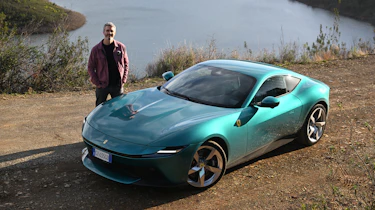
Ferrari says this new Amalfi “embodies the sporty lifestyle” and that it’s a “high-performance sports car that can be used every day”. And in practice it has a decidedly different character to models that might otherwise be considered close rivals – cars such as the latest Aston Martin Vantage, Bentley Continental GT, or Porsche 911 Turbo S.
The engineers we spoke to said they’d targeted an “engaging, intuitive driving experience”, and the Amalfi, like its Roma predecessor, is certainly more approachable than the Aston, which has more of a muscle-car character. The Ferrari, while undeniably rapid under full throttle, doesn’t feel like it’ll bite you on the exit of every corner.
Yet, thanks to the Side Slip Control system, you can manipulate the Amalfi into being quite playful. The familiar Manettino switch lets you flick through from Wet, to Comfort, Sport and Race, or, if you’re feeling brave, ESC off. Each setting allows for a little more movement in the chassis, and a little less grip at the rear end, allowing the driver to build in confidence before placing their fate in the lap of the gods.
Our drive through the hills in southern Portugal was accompanied by a subtle but ever-present exhaust note that Ferrari claims is enhanced by a “new proportionally controlled bypass valve with dedicated maps” allowing it to “adapt” to different driving conditions. Again, it’s not as outright raucous as the bellowing V8 soundtrack of a Vantage, but the almost metallic ring gives the Amalfi plenty of personality whatever the conditions.
Performance is staggering actually, and about as far from ‘entry-level’ as you could possibly expect. The engine is flexible enough that you can do most of the hard work in third or fourth, but the ratios aren’t so closely spaced that you’re constantly changing gear or fighting flat spots before the turbos have had a chance to come on song. Regardless, switching cogs is a pleasure thanks to the fixed carbon-fibre paddles behind the (also part-carbon) steering wheel. Hearing and feeling the revs rise as you change down into a tight bend is a visceral treat we’ll miss when the world fully transitions to EVs.

The steering is another area that adds to the driving experience. It’s an electrically assisted rack, but pleasingly direct and offering more feel than most modern sports cars. New for the Amalfi, however, is the introduction of a controversial brake-by-wire system. There’s still a fail-safe physical connection to the discs and pads should all else fail, but most of the work is done electronically. It’s a bit twitchy to begin with, especially around town, but up the pace and there’s a fantastic delicacy to it. Ferrari says it improves braking efficiency, reduces pedal travel and “enhances modulation”. On this evidence, we wholeheartedly agree.
The Amalfi rides well, even without switching to Ferrari’s aptly named ‘Bumpy Road’ mode; our route was challenging in more ways than one, and in areas featured tarmac as bad – if not worse – than you might ordinarily encounter in the UK. We’ve not tried the car in the wet, but again, the various drive-mode settings allow the driver to tailor the coupe’s behaviour as necessary.
Our only real complaint with regards to the way the Amalfi drives, therefore, is the amount of road noise its huge 285-section, 20-inch rear tyres generate at motorway speeds. Perhaps that’s the trade-off you make buying a so-called sports car, rather than a dedicated GT.
Elsewhere, the Amalfi feels like a worthy evolution over the Roma when it comes to interior quality and ergonomics. The seats are still a little firm to be considered truly comfortable, but they hug you and hold you in place during more spirited driving. The new infotainment system is a big upgrade, and as before, owners can option a (probably unnecessary) separate screen for the passenger. The big central rev counter and clear graphics in the driver’s instrument binnacle put key information exactly where you need it.
The rear seats are still useless for all but the smallest children, and even then, if they’re in a bulky car seat rather than a slimmed-down booster, you might struggle to squeeze more than a couple of soft bags in the back. The 273-litre boot swallowed our luggage and camera kit – with more than enough space for a weekend away.
From superminis to supercars, our dealer network has 1,000s of great value deals in stock right now! Find your new car…
| Model: | Ferrari Amalfi |
| Price: | £202,459 |
| On sale: | Now |
| Powertrain: | 3.9-litre V8 twin-turbo petrol |
| Power/torque: | 631bhp/760Nm |
| Transmission: | Eight-speed automatic, rear-wheel drive |
| 0-62mph/top speed: | 3.3 seconds/198mph |
| Economy/CO2: | TBC |
| Size (L/W/H): | 4,660/1,974/1,301mm |