New Audi Q9 2026 review: gigantic size but limited substance
If you thought that the Audi Q9's enormous size automatically meant acres of space inside, we have some bad news for you


Verdict
Some may consider the Audi Q9 as a cynical attempt to woo Americans, but it’s a well rounded luxury SUV and certainly a much more versatile pinnacle to the Audi range than the old A8 limo. However, it’s almost as if the Q9 isn’t quite big enough, because there still isn’t sufficient legroom for adults to sit comfortably in the third row. Plus you could add many of this car’s standard luxury gadgets to the already excellent Q7 and you’d be quids in. The smaller SUV will also be easier to park.
You know how a blue whale or a London bus have become used to gauge size? Well, the new Audi Q9 could be the next yardstick, given that at more than 5.3 metres in length, it is even bigger than the BMW X7, Range Rover Long Wheelbase and Mercedes GLS.
1It comes as standard with seven seats, or you can upgrade to a more luxurious six-seat version with range-topping Vorsprung trim. This latter variant will no doubt appeal to the chauffeur driver market as a more versatile replacement for the now departed Audi A8. But it’s the seven-seater version set to make up the majority of Q9 sales that we got the chance to drive
Used - available now

2027 BMW
iX1
33,368 milesAutomaticElectric
Cash £24,764
2019 Mitsubishi
Eclipse Cross
79,000 milesAutomaticPetrol1.5L
Cash £9,495
2020 Land Rover
Range Rover Evoque
44,437 milesAutomaticDiesel2.0L
Cash £14,295
2015 Mercedes
C-Class Coupe
39,000 milesAutomaticDiesel2.1L
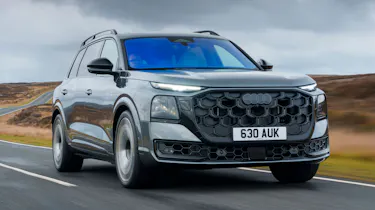
Cash £8,995From the outside, you’ll have to do a double take to check it’s not a Q7, since the pair sport similar silhouettes. There are subtle differences, such as a wider grille that looks like it has almost fulfilled the designer’s desire for 100 per cent coverage of the front of the Q9. It also has more prominent roofbars, and at the back, the number plate moves from the tailgate to the bumper.
Under the skin, the Q9 features a quattro four-wheel-drive system and standard adaptive air-suspension with four-wheel steering. For now, the only engine option is a 295bhp 3.0-litre turbodiesel with mild-hybrid technology and an eight-speed automatic gearbox.
It’s a fine engine that’s very smooth and refined, and its surfeit of torque can easily overcome the car’s 2.5-tonne weight. The 0-62mph time of 6.5 seconds may be slower than its X7, GLS and Range Rover rivals, but the Q9 still has plenty of mid-range punch for overtakes or merging with traffic on the motorway.
While the Q9 is slightly narrower than a Range Rover and can be more easily threaded through town traffic, the Audi’s extra length is a hindrance when parking. True, the Q9 has four-wheel steering, but it’s very subtle compared with the Range Rover, so it’s harder to slot into a standard parking space than its rival.
The Q9's mild-hybrid system restarts the engine quickly when you need to nip into a gap in traffic, but the gearbox can be a touch jerky if you are a little clumsy with the accelerator. The steering is light in its ‘balanced’ and ‘comfort’ modes, and the ride deals with bumps and sleeping policemen with ease. Our test car came with optional 23-inch wheels, but we’d recommend sticking with the standard 22-inch wheels on the Edition 1, because the larger wheels tend to exacerbate the fidgeting sensation you get over rough surfaces.
We found the Q9 much more at ease out of town, where the prevailing wet and sleety conditions of our Yorkshire Dales test route favoured its quattro 4WD system, which could deploy the V6 diesel’s power without fuss.
The standard adaptive air-suspension also gives the Q9 a stoic demeanour on undulating country roads, with tighter control of body movements than a Range Rover, especially in the Audi’s dynamic driving mode. Remarkably, ride comfort over bumps at speed was still good in its firmest setting, and highly soothing in its softer modes.
The steering weight increases in dynamic mode, and while it isn’t excessively heavy, we preferred the standard balanced setting, which builds weight more progressively as you increase steering lock. The brakes, as you’d hope in an SUV weighing well over two tonnes, are powerful and can easily wipe off speed before a bend. The pedal is firm but easy to modulate, giving you great confidence to drive this vehicle swiftly on twisty B-roads.
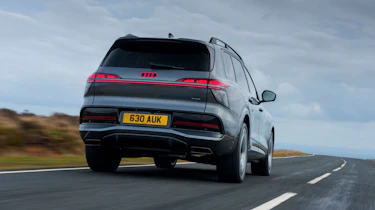
Where this car is happiest is driving along a motorway, where noise from the engine largely disappears into the background. You get some hum from the tyres (probably increased by the larger optional wheels), but it isn’t oppressive.
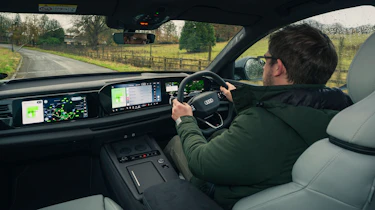
Inside, the Q9 opts for a new-age Scandinavian-cool vibe – despite its German roots – rather than old-world aristocratic luxury. Ambient lighting is incorporated practically everywhere you look, including around the enormous standard opening sunroof and below Audi’s ‘Digital Stage’ of screens. Physical controls are in short supply, and this takes some getting used to.
The triple-screen craze continues in the Q9. There’s a crystal-clear 12.3-inch ‘Virtual Cockpit’, a 14.5-inch touchscreen housed in a single curved panel and a 12.3-inch display for the front passenger. Audi’s latest infotainment system runs on Android technology, which is highly customisable and more intuitive than the brand’s previous software. Owners can add apps, but wireless Apple CarPlay and Android Auto are also available.
Those up front have plenty of space, and electric front-seat adjustment with memory settings is standard. The second row is similarly generous with headroom, legroom and shoulder room, whether you choose the standard seven-seat or optional six-seat configuration. The second row is also heated and electrically adjustable, so you can recline for comfort on a long trip or offer those in the third row a little more legroom. Slightly disappointing is that the front seat runners intrude into the rear footwells, which isn’t ideal for a chauffeur car.
Getting into the third row takes a bit of time, because you have to wait for the front seat to move out of the way as part of the sequence – not ideal in the pouring rain. Once back there, you’ll find heated rear seats, cup-holders, armrests on either side of the car, USB-C charging points and some air vents.
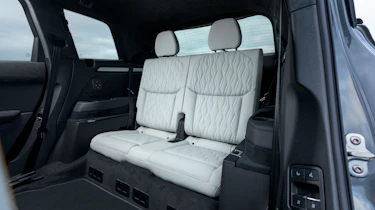
Headroom and shoulder room are excellent for even six-foot adults in the third row, but you’ll still need to ask those in the second row to move forward as you do in the cheaper Audi Q7 in order to have enough legroom. The floor is quite high, so your knees are at an odd angle, and you can’t slide your feet under the seats in front of you.
The Q9’s extra length is most beneficial for luggage capacity. With five seats in place, the Q9 can swallow up to 850 litres of stuff – 100 litres more than the BMW X7 – and even with all three rows in place, you still have a really big boot that’ll easily handle a family’s weekly shop.
At the moment, there’s no plug-in hybrid like you’ll find with the Range Rover, and because the starting price is well over £100,000, it’ll be an expensive car to tax whether you’re a private owner or company car driver. Officially, it does 36.2mpg, although our hilly test route in the Dales in appalling conditions only yielded a figure of 27.2mpg. We suspect you should achieve better in more typical driving, especially on a longer motorway jaunt.
Our preferred Edition 1 trim comes very well equipped with 22-inch Audi Sport alloy wheels, a panoramic glass roof, matrix LED headlights and a Bang & Olufsen 3D sound system. We’d avoid the Vorsprung trim because it has automatic doors, which we found regularly stopped during opening because the car thought there was an obstacle. We ran out of patience with them while getting wet in the rain.
| Model: | Audi Q9 3.0 TDI Vorsprung |
| Price: | £113,250 |
| On sale: | Now |
| Powertrain: | 3.0-litre turbocharged 6cyl diesel |
| Power/torque: | 295bhp/630Nm |
| Transmission: | Eight-speed automatic, four-wheel drive |
| 0-62mph/top speed: | 6.5 seconds/149mph |
| Fuel economy: | 36.2mpg |
| Size (L/W/H): | 5,307/2,205/1,768mm |