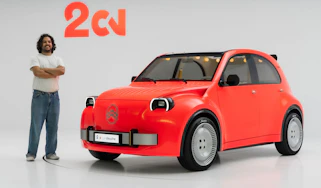
New Smart #2: pint-sized EV arrives with 180-mile range for £20k price
Smart has finally returned to its roots with a successor to the iconic ForTwo city car

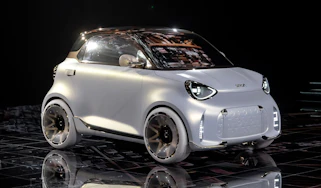
This is the all-new, pint-sized Smart #2: the antithesis of the big, bloated SUVs constantly clogging up city streets these days. It will cost less than £20,000 and, at just 2.74 metres long, is set to be the smallest car in Europe when it arrives next year.
The tiny two-seater EV is the successor to the innovative, ultra-compact Smart ForTwo, originally known as the City Coupe, marking the quirky brand’s return to the city-car space after its reinvigoration by new owners Geely and launching three SUVs back-to-back.

Created in just two years, the #2 is underpinned by an all-new, purpose-built architecture engineered by Smart that gives it a 180-mile range – more than twice the range of the old electric ForTwo EQ – and “unmatched urban agility”, the brand boldly claims. The proof is a turning circle of only 6.95 metres, which is a lot tighter than the latest Fiat 500 or MINI Cooper’s, and a typical London street curb-to-curb.
Before anyone brings it up, there are even tinier four-wheeled runabouts, such as the Fiat Topolino, Citroen Ami and Microlino. However, these are classified ‘quadricycles’, with none of them able to reach 60mph or go nearly as far as the Smart, which is a proper car, like its rivals the Renault Twingo, Honda Super-N and new Dacia Spring.
In fact, this is supposed to be a “fully capable electric vehicle”, just one that happens to be incredibly small. Five-link independent rear suspension and the back tyres being wider than the front ones will help with handling and stability, so the Smart #2 should be able to handle itself outside of the city limits as well.
How has the design evolved from the old Smart ForTwo?
Styled by the Mercedes global design team, Smart’s European boss Wolfgang Ufer told us the new #2 needed to be instantly recognisable as an evolution and relation of the old ForTwo, plus connect to the brand’s other models, yet still have a personality of its own.
The ForTwo is Smart’s icon, with Ufer comparing the challenge of evolving it to Porsche launching the next 911 or Mercedes a new G-Wagon. As with with them, the #2 needed to represent the legacy of the brand, without being retro, while also looking ahead.
The shape is pretty much identical to its predecessors, while the pronounced wheelarches, surprisingly butch front-end styling and the wheels being pushed right out to the corners of the car to maximise interior space are also traits carried forward.
Even under the metal, the #2 uses an evolution of the ‘Tridion Cell’ concept that was a signature part of the ForTwo. In effect it’s a reinforced roll cage made from high-strength steel that encases the passenger compartment, allowing this little car to complete the industry famous, collision-avoidance Moose test at nearly 50mph.
The design has clearly progressed though, with sharper creases in the stubby bonnet, a floating roofline similar to Smart’s other new models and a set of huge circular tail-lights. Smart’s new design philosophy is ‘Love, Pure, Unexpected’ emphasising expressive styling, clean minimalist lines and interesting details.
What’s the interior like?
While the exterior will give some people deja vu, the #2’s interior is very different compared with the old ForTwo. The sense of quality and premium feeling is obvious as soon as you step inside, which is something that Chinese customers demand, but Smart is only too happy and able to deliver.
There’s no stripped-out, bargain-basement version of this car, according to Ufer, with the flowing S-shaped dashboard in every #2 featuring a 10.1-inch touchscreen and an 8.8-inch digital driver’s display. There are some fun details, too, such as the over-sized grab handles on the doors, easter eggs of the car’s mixed heritage from Germany and China, and huge turbine-style air vents, which are a very Mercedes touch.
That slot across the dashboard is not another air vent, it’s the ‘Smart Pillar’ that can be used for various handy accessories. Meanwhile, top-spec models add a glass sunroof and a bespoke seven-speaker Sennheiser sound system.
The #2 is only a two-seater, like the ForTwo before it, but it features a somewhat unusual bench-seat arrangement. This allows occupants to cozy up to one another – not that it was difficult before in a car so small – and people can slide across easier to get out if they’ve parked too close to another car.
We like that the central display isn’t too big or mounted somewhere on the dashboard that would affect the driver’s view of the road ahead. Plus there are a smattering of physical buttons, including the three-spoke steering wheel, but the climate controls are on the touchscreen, unfortunately.
Because #2 doesn’t have to worry about rear-seat space like the Fiat 500, it offers an impressive 305 litres of boot space. That’s 120 litres more than its Italian foe, and only about 20 litres less than the much larger Renaut 5 boasts. There’s a split tailgate, with the pop-out glass making it easy to chuck bags and small items in, and underfloor storage space for the charging cable.
How much range will it offer?
Powered by a 35.8kWh LFP battery, the #2 offers up to 180 miles of range, which is considerably further than the Honda Super-N (126 miles), Dacia Spring (155 miles) or Renault Twingo (163 miles) can supposedly do. Although, they are larger, more practical cars.
More importantly, the #2 offers more than double the range of the old ForTwo EQ, which was good for up to 84 miles at most. Improving on this was key for Ufer and the Smart #2’s product manager, Marco Sina, and should help make this a more usable car outside of the city than its predecessor.
The maximum charging speed of 65kW is very slow by 2026 standards, however, because of how small the battery is, a 10 to 80 per cent top-up takes just 20 minutes. Similarly, while the electric motor driving the #2’s rear wheels produces a mere 80bhp, the car weighs just over 1,100kg so should still be nippy away from the lights. Even so, it’ll take 11.6 seconds to get from 0-62mph.
How much will the Smart #2 cost?
The Smart #2 will go on sale in the UK early next year, with prices starting from less than £20,000, we’ve been told – much closer to the Twingo and Super-N than we originally thought. However, it will not be eligible for the UK’s Electric Car Grant (ECG) or other types of EV incentives in Europe because the two-seater tearabout is going to be made in China, not France like its ancestor was.
Disappointing as that is, the #2 is set to be one of the most affordable electric cars on the market when it arrives, which the brand hopes will allow it to maintain the enormous customer base that the ForTwo had. Ufer highlighted that the old car appealed to all demographics, young and old, plus the occasional billionaires that want something easier to park in town than their Ferraris and Bugattis.
There’s going to be three trim levels to choose from: Pure, Premium and a special Couture Edition, just 999 examples of which are earmarked for Europe. Entry-level Pure models will feature both displays we mentioned earlier, LED lighting all-round, adaptive cruise control and Smart’s semi-autonomous Pilot Assist driver-assistance system.
We expect Premium trim will be the most popular because it adds a sunroof, Sennheiser stereo, heated seats with artificial-leather upholstery and more driver-assistance tech such as blind-spot detection and rear cross-traffic alert. Plus it unlocks more customisation options including two-tone paint finishes.
Finally, the Couture Edition is finished in Atelier White matt with a platinum gold roof and its 16-inch alloy wheels also have gold accents, as a tribute to the Concept #2 revealed earlier this year. It also features a numbered interior badge, plus all the extra luxuries that come with Premium-spec models.
Did you know you can sell your car through Auto Express? We’ll help you get a great price and find a great deal on a new car, too.