Toyota Verso 2.0 D-4D Icon
Sharp styling and an improved diesel aim to give the reviews Toyota Verso the edge

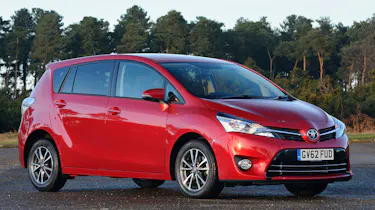
A new face and cleaner diesel engine have revived the Verso’s flagging fortunes, while the independently folding middle seats create a perfectly flat load area. Overall space isn’t quite a match for the Scenic, though, while road tax and servicing will both cost more.
Over the years, cars like the Verso have garnered Toyota a reputation for making the automotive equivalent of ‘white goods’ kitchen appliances – they do the job they’re intended for, but fail to ignite enthusiasm.
However, Toyota has recently been giving its mainstream models a style makeover. The Verso now looks similar to the all-new Auris that was launched at the start of the year. It gets a sharp new nose with angular lights, a large lower grille under the front bumper and piano-black trim. It certainly looks better than its predecessor and more distinctive than the rounded Renault or gaping-mouthed Mazda.
But apart from some extra bootlid trim and new tail-light lenses, the rest of the Verso is unchanged. That’s not a bad thing, though, as the distinctive body line that kicks up ahead of the rear arches is a neat touch that gives the car some much-needed styling flair.
Toyota claims to have changed 470 parts in the process of updating the Verso, but the revisions inside are minimal. The biggest change is the new centre console, which adds silver trim and new-look heater controls.
Used - available now

2025 Vauxhall
Astra
1,785 milesManualPetrol1.2L
Cash £16,615
2020 Mercedes
E-Class Cabriolet
34,638 milesAutomaticDiesel2.0L
Cash £28,731
2023 Mercedes
GLE Coupe
86,662 milesAutomaticDiesel2.9L
Cash £35,699
2026 Mazda
2 Hybrid
12,389 milesAutomaticPetrol1.5L
Cash £16,557Elsewhere, the centrally mounted speedo and rev counter get a new white-on-black colour scheme, but the trip computer, climate and window controls make do with the same orange backlighting as the old car. Everything feels well put together and material quality is better than in either rival.
The rest of the cabin is largely unchanged, but you get plenty of neat storage touches. There’s a big two-level bin between the front seats, a double-height glovebox, deep door pockets and two under-floor compartments in the rear footwell. Yet the Grand Scenic goes one better, with similar storage compartments in the front, too.
Get behind the wheel, and the first thing you notice is how high up you’re sitting. The steering wheel is positioned low in relation to the seat, so it feels like you’re driving a bus, while the tall stance gives a good view of the road ahead.
The Verso and Scenic have offset instrument pods, but it’s easier to glance at the Toyota’s dials while driving, as they’re positioned closer to your line of sight. Both cars also come with a second wide-angle rear-view mirror to help you keep an eye on the back seats, but again, the Verso’s is placed close to the main mirror, so it’s easier to use.
In the back, the seat layout is unchanged. All three middle-row seats slide back and forth and recline independently, although the shoulder-mounted levers make reclining them difficult. Unlike in the Mazda, the three seats are the same size and the floor is flat, so there’s enough space for three adults in the back. Slide the outer seats forward, and you can access the rearmost seats. But like the Mazda’s, they’re only really suitable for kids.
The seats fold out of the boot floor with the tug of a canvas strap, and they’re just as easy to fold down. Other useful touches include under-floor storage for the retractable boot cover and a completely flat boot floor when the middle row is folded. However, maximum boot capacity of 1,696 litres is 167 litres down on the Scenic’s, while the rear wheelarches intrude, giving the Verso a narrow load area.
On the road, it’s clear Toyota has tried to make the Verso as easy to drive as possible. The light steering and gearshift are a breeze to use, but while Toyota claims improved dynamics, the car still trails the Mazda for handling.
Yet that’s not what MPVs are about, and when you’re taking things easy, the Toyota is an excellent choice. The 2.0-litre diesel is smooth and refined, but delivers punchy performance compared to its smaller-capacity rivals. It can’t match the stop-start-equipped Scenic for emissions, but on-test economy of 46.7mpg was respectable, and the engine is powerful enough to cope with a full load.
The Verso sits between its rivals on price. There aren’t as many options as on the Scenic – you have to upgrade from Icon to Excel spec for heated leather seats, for example. And while you do get the excellent Touch multimedia system and digital radio as standard, you’ll have to pay £650 for the sat-nav upgrade.
Emissions and economy also fall between the other cars’ figures and running costs are reasonable. So can that help the Verso overcome its practical shortcomings?