Volvo EX60 review
The Volvo EX60 has the weight of the world on its shoulders, but as an electric alternative to the huge-selling XC60, it excels


Our opinion on the Volvo EX60
The Volvo EX60, while comparable to cars such as the latest BMW iX3 or Mercedes GLC, feels like a unique proposition in this hotly contested class. Safe and predictable, but carefully considered and dripping with style and cool details, there really is lots to like. The flagship P12 with that headline 500-mile range isn’t available for another few months, but in reality, most people will probably go for the accomplished base car; the single-motor model offers plenty of range and performance, but in a more affordable package.
About the Volvo EX60
Volvo recently announced that the XC60 mid-size SUV had officially outsold the iconic 240 to become its most popular model of all time. As of June 2025, Volvo had built more than 2.7 million of them, plus several thousand more since.
Knowing this draws the importance of this new EX60 – the all-electric alternative to the XC60 – into particularly clear focus. And even more so when you consider the flurry of premium SUV rivals such as the BMW iX3 and Mercedes GLC that have been launched in recent months.
On paper, these three cars are incredibly close competitors. Each has a well earned upmarket image, loads of tech and headline range figures north of 400 miles. Yet in reality, when you sit inside them, drive them and experience them, they feel wildly different.
Used - available now

2024 Audi
S3 Sportback
41,498 milesAutomaticPetrol2.0L
Cash £34,287
2023 Tesla
Model Y
24,157 milesAutomaticElectric
Cash £24,475
2022 Toyota
Corolla
23,352 milesAutomaticPetrol1.8L
Cash £16,675
2022 Land Rover
Range Rover Sport
49,816 milesAutomaticPetrol3.0L
Cash £35,475Sandwiched between the ageing EX40 and the tech-filled EX90 flagship, the EX60 is priced from £56,860. That’s about £3,600 more than the recently announced, single-motor iX3 – a gulf that grows to more than £7,500 when comparing top-spec, twin-motor models. The Mercedes is dual-motor only for the time being, and as a result starts at more than £60,000 – only a couple of hundred pounds more than the cheapest all-wheel-drive Volvo. More affordable GLCs are on the way.
The basic EX60 P6 Plus does come pretty well equipped, however. Every car gets at least 20-inch wheels, a full-length glass roof and a list of safety kit longer than your right arm. Inside, you get that 15-inch central screen, three-zone climate control and heated seats front and rear. Throw in 360-degree parking cameras, a Bose stereo, wireless phone charging and a Google-powered infotainment system with Gemini conversational AI, and there’s really very little reason to step up to the Ultra spec tested here.
Doing so will cost you £5,500, throwing in hi-definition pixel-LED lights, 21-inch wheels (our car’s 22s were £795 extra), dark-tinted windows and an electrochromatic glass roof that can switch from transparent to opaque at the flick of a switch. You also get ventilated front seats, plus a Bowers and Wilkins 28-speaker stereo with Dolby Atmos. If you’re an audiophile, that system could be worth the extra on its own.
Volvo EX60 prices and latest deals
Despite being a brand-new car, there’s already a selection of deals available via the Auto Express Buy a Car service. At the time of writing, lease offers for the basic P6 Plus started at just over £700 per month – around £70 (give or take) more expensive than the BMW iX3.
Performance & driving experience
Pros |
|
Cons |
|
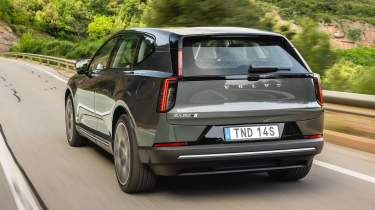
We know the Volvo does things differently to its clinical German rivals, but driving the EX60 pushes the cars even further apart. The BMW remains the sharpest model in this class, while the Mercedes’s rear-wheel steering offers it an advantage around town. But for a safe, calming, no-fuss drive, the Volvo excels; it’s controlled but compliant, quick but quiet, and manoeuvrable without sacrificing the kind of versatility Volvos are famous for.
Through corners, the EX60 holds its own, even if it doesn’t offer that last degree of polish or agility you’ll find in the iX3. The steering is well weighted but with that usual cliche that it’s not brimming with feel – the trade-off being that it never feels twitchy or on edge. You can alter how ‘firm’ it feels in the infotainment sub-menus, but in our experience, the standard setting is the most natural.
We also really rate the EX60’s multi-stage regenerative braking set-up – accessed via the control panel on the side of the central screen. You can opt for high or low-strength one-pedal drive, an adaptive setting, or turn it off completely for a near-frictionless coast. It all works really well; if you favour a safe, predictable experience over outright driver thrills, the Volvo nails its brief.
We didn’t get a chance to drive the flagship P12, but all-told, this model isn’t worth waiting for unless you absolutely have to have the longest range possible.
| Model | Power | 0-62mph | Top speed |
| Volvo EX60 P6 RWD | 369bhp | 5.9s | 112mph |
| Volvo EX60 P10 AWD | 503bhp | 4.6s | 112mph |
| Volvo EX60 P12 AWD | 671bhp | 3.9s | 112mph |
Electric motors, 0-60mph acceleration and top speed
Every version feels fast; the base P6 uses a 369bhp rear-mounted motor good for 0-62mph in 5.9 seconds. In our opinion, this powertrain arguably suits the car’s character best. The dual-motor P10 has 503bhp and cuts the 0-62mph time to just 4.6 seconds, yet while it doesn’t overwhelm the chassis or suspension, it feels largely surplus to requirements in something so focused on comfort. Frustratingly, you can’t option the ‘Four-C continuously controlled adaptive dampers’ on the P6, but they come as standard on the P10; these really help the EX60’s low-speed ride, without sacrificing control at the top end.
We’ve not yet driven the flagship P12, but suffice it to say, no Volvo needs 671bhp or a 3.9-second 0-62mph time; we’d save ourselves £5k and opt for the otherwise equally accomplished P10 instead.
Town driving, visibility and parking

Being a premium car with plenty of bells and whistles, the EX60 is fully-laden with cameras and sensors, so driving one through town is no trouble whatsoever. It doesn’t feel as dimensionally challenging as the BMW iX3, whose width is accentuated by the otherwise clever Panoramic Vision iDrive display.
P6 cars, without the adaptive damping technology found on the higher-spec P10 and P12, do fidget a little around town, but if the EX60 was your only experience of a modern Volvo you’d deem it plenty comfortable enough for day-to-day driving. The more expensive models smooth things out further, and offer a ride quality akin to the most comfortable cars in this class – and many in the segments above.
Country road driving and handling
If pin-sharp handling is a priority, then the BMW iX3 is our top pick in the premium mid-size electric SUV category. Yet if you prefer to strike a better balance of performance versus comfort, the EX60 is a stellar choice.
The EX60, even in base P6 guise, feels fast, controlled and comfortable. The steering is well weighted, and while there is a bit of movement in the body during fast cornering, it never feels unwieldy or difficult to drive. The excellent and intuitive one-pedal drive function takes a lot of the strain during lower-speed stuff, too, and should lessen wear on consumables such as brake pads and discs.
Motorway driving and long-distance comfort
The Volvo EX60 is incredibly refined – not only in isolation, but in the context of this car’s rivals. Even on the 22-inch wheels of our test model, road noise was almost non-existent; wind noise was also kept in check, and there weren’t any noticeable squeaks or rattles, despite being a very late-stage pre-production prototype.
Factor in the Volvo’s smooth ride, long range and fast charging speeds, and the latest EX60 should prove a very accomplished motorway companion.
“We didn’t find the need to regularly switch off any of the ADAS features in the EX60; each one seemed to work in harmony with the driver – exactly how you want it.” - Richard Ingram, Deputy Editor
Range, charging & running costs
Pros |
|
Cons |
|
Charging is another EX60 strong point, even if it can’t quite match the iX3’s 400kW peak rate. Being based on Volvo’s electric-only SPA3 platform, all cars use an 800-volt electrical architecture that allows owners to add over 200 miles of range in 10 minutes. Entry-level, single-motor P6 models are pegged at 320kW, but the smaller 83kWh battery means a 10 to 80 per cent top-up is achievable in just 18 minutes.
P10 (95kWh) and P12 (117kWh) versions can replenish their batteries at up to 370kW; the faster speeds mean even these cars can complete the same charge in less than 20 minutes. Range varies between models: the P6 can do 380 miles (WLTP), while the P10 boosts this to 410 miles, despite adding an extra motor to the front axle. The forthcoming P12, due in 2027, is the only version capable of Volvo’s headline 503-mile maximum.
On our test, we managed efficiency of around 3.2 miles per kWh, but while the weather was warm, the challenging route through the hills above Barcelona wasn’t the most forgiving. Still, that figure should be good enough for 300 miles or more in real-world driving. A heat pump is standard on all models, helping to protect range in colder conditions.
| Model | Battery size | Range | Insurance group |
| Volvo EX60 P6 RWD | 83kWh | 380 miles | 41 |
| Volvo EX60 P10 AWD | 95kWh | 410 miles | 43 |
| Volvo EX60 P12 AWD | 117kWh | 503 miles | 45 |
Insurance groups
Despite the huge power hike for the all-wheel-drive cars, insurance costs shouldn’t vary hugely between models. The base car falls into group 41, while the top-spec, near-700bhp P12, is in group 45.
Given all cars fall into groups one to 50, that is close to the top end – though pretty much par for the course in this part of the market. The BMW iX3 is rated between group 40 and group 44 depending on battery, motor and trim combination.
Tax
All Volvo EX60s cost more than £50,000, and are therefore subject to the higher road-tax (VED) premium of £640 per year for the first six years. However, if you’re looking to run one as a company car, the EX60’s zero-emission status will make the Benefit-in-Kind payments particularly attractive.
Depreciation
The Volvo EX60 has pretty strong residual values; anything over 50 per cent is considered particularly favourable, so numbers in the 53 to 58 per cent bracket are very decent indeed. If you want to hold on to as much money as possible, the basic P6 Plus has the most robust values, while the P12 Ultra will hold onto the least of its original purchase price after three years or 36,000 miles.
These numbers are very similar to the BMW iX3’s (56-58 per cent), while the latest Mercedes GLC isn’t quite as attractive, at 50 to 54 per cent depending on model.
Interior, design & technology
Pros |
|
Cons |
|
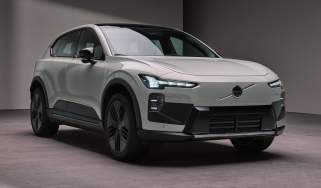
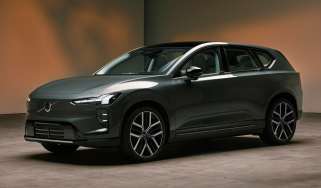
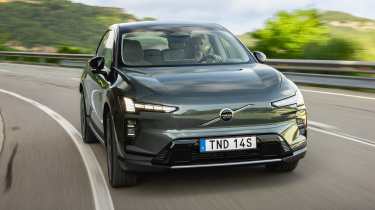
It’s taken time to warm to BMW’s polarising ‘Neue Klasse’ aesthetic, and the GLC’s illuminated grille – with its 942 backlit LED squares – continues to split opinion. In contrast, the Volvo’s classy, understated look transcends time, and will no doubt still look fresh long into the future.
It’s the same story in the cabin. While the Merc gets a huge 39-inch triple-screen display that spans the entire dashboard, the EX60 plays it safe with a conventional layout and no wild design flourishes. It’s classy, in a typically Scandinavian way. If you’ve bought (and loved) Volvos in the past, the new EX60 will be right up your street.
Interior and dashboard design
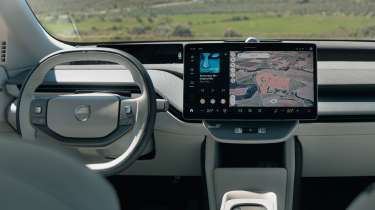
While fairly minimalist, the Volvo EX60’s cabin offers an intuitive layout, with a select few physical buttons on the steering wheel – including one shortcut button that can be customised to suit – plus a column-mounted gear shifter behind the small, squared-off steering wheel. Behind it, sits a fully-digital instrument cluster, while in the centre is a wonderful 15-inch OLED touchscreen.
There are no dash-spanning displays or unnecessary screens for the passenger. Ultimately, while the Volvo does things differently; the Scandi-cool cabin, especially in the light colour of our demonstrator, has a much calmer and more resolved vibe than either of its German rivals. Depending on your viewpoint, the interior alone could sway your purchase decision one way or the other.
Materials and build quality
Quality, on the whole, is pretty good, although some of the plastics on the lower dash feel a bit hollow, and the pull-out cup-holders on the centre console a little flimsy. Refinement is first rate, however. Despite the frameless windows and 22-inch wheels of our test cars, the new EX60 is, without doubt, one of the quietest cars in its class. We also loved the optional wool blend (£645) upholstery in the P6 model we tried, even if the standard-fit Nordico leather alternative gives a more traditional premium feel.
Infotainment, sat-nav and stereo
In the centre is a Google-powered 15-inch OLED touchscreen running Volvo’s latest – and importantly, upgraded – software stack. The graphics are sharp, and the screen is responsive, plus the widgets that change depending on whether you’re moving or stationary are a genuinely useful innovation that feel instantly intuitive the moment you select drive using the column-mounted shifter.
That main screen is complimented by a subtle but effective 11.4-inch digital instrument cluster. But while it’s perfectly functional, with full-screen mapping, plus key info presented at a glance, it does look like a bit of an afterthought – especially compared with BMW’s innovative and well integrated Panoramic Vision layout in the iX3.
“We love how some of the shortcut buttons alter depending on whether you’re stationary or moving. The one-pedal drive setting, for example, switches to the door-mirror control when you’re parked up.” - Richard Ingram, Deputy Editor
Boot space & practicality
Pros |
|
Cons |
|
If you’re more interested in the practicalities of running this new EX60 day to day, then the good news continues. Thanks to the EV-native SPA3 platform, there’s plenty of space inside for adults – both in the front and the back. The boot’s a decent size, and there are some nifty features that should make living with the car a pretty pleasant experience.
Cabin storage could be better, however. There’s no conventional glovebox, and the central armrest is compromised due to the extending cup-holder arrangement. There is a large cubby just below the main screen, but it’s not as useful as you might hope. Still, the EX60 is an easy match for its main rivals when it comes to family-friendly practicality.
Dimensions and size
As you might imagine, the Volvo EX60 very closely matches its main German rivals for overall footprint. It’s actually marginally longer than a BMW iX3, but ever so slightly shorter than the Mercedes GLC Electric.
The same is true for width, although we thought the BMW’s full-width Panoramic Vision iDrive infotainment display made it feel wider than the Volvo – particularly around town. There’s really nothing to split the trio when it comes to height; all three will comfortably fit into a standard multi-storey car park, which usually have a two-metre restriction.
Dimensions comparison | |||
| Model | Volvo EX60 | BMW iX3 | Mercedes GLC Electric |
| Length | 4,803mm | 4,782mm | 4,845 mm |
| Width | 1,908mm | 1,895mm | 1,913mm |
| Height | 1,635mm | 1,635mm | 1,644mm |
| Wheelbase | 2,970mm | 2,897mm | 2,972mm |
| Boot space | 523 litres | 520 litres | 520 litres |
Seats & passenger space

There’s enough space in the back for tall adults to get comfortable; even with the standard-fit panoramic roof, there’s lots of headroom, plus the flat floor and recessed centre console prevent the middle seat being redundant. Optional, built-in booster cushions further add to the car’s family-first billing.
One thing we did take issue with, is the door pulls. Perhaps you’d get used to them over time, but during our drive – no matter how many times we got in or out – we found the awkward positioning made closing the doors from the inside harder than it needed to be. The latches for opening the doors are also a little unconventional, but easy enough to operate.
Boot space
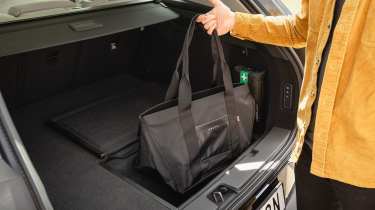
The 523-litre boot is three whole litres bigger than the BMW’s, but it’s the clever split-fold boot floor that truly elevates the EX60 in the practicality stakes. It means you can load heavy items – or fit a dog carrier or other Volvo-approved accessory – on one side, and still access the compartment under the floor. Perfect if you want to stow a pair of mucky boots, or grab the car’s charging cables without heaving everything out of the way. There’s also a 58-litre frunk in the nose.
The rear seats split and fold in three parts; doing so reveals up to 1,647 litres of boot space. That’s a decent volume, but the slightly sloping roof compromises outright carrying capacity; the BMW iX3 is around 100 litres bigger in this regard.
Towing
All EX60 are rated for towing, and the instant torque on offer should make them pretty adept at pulling a trailer or small caravan. The rear-drive P6 can haul two tonnes, while the all-wheel drive P10 and P12 up this to 2,400kg.
“Maybe Volvo’s done its research and has deemed a glovebox unnecessary in this day and age. But we reckon you’ll miss it – especially as there isn’t any storage under the main central armrest.” - Richard Ingram, Deputy Editor
Reliability & safety
Pros |
|
Cons |
|
This is a Volvo; safety is an absolute non-negotiable for the Swedish brand. But the great thing is, the EX60 doesn’t shout about it with nannying driver-assistance systems that take the joy out of driving. Everything appears to work in harmony, for a calm, relaxing experience.
Learning from previous mistakes, whereby seemingly simple tasks were hidden deep in the cars’ touchscreens, Volvo has promoted a number of functions such as the lane-keep assist and other driver-assistance systems into an easy-to-access screen that enables easy deactivation of core features that might cause disturbance or annoyance during everyday driving. There’s even a shortcut button on the steering wheel, which in our test car had been programmed to switch off the speed-limit warning.
The Volvo EX60 hasn’t been tested by Euro NCAP yet, but the maker will be hoping for a full five-star score when it’s assessed, likely later in 2026. Every car comes with blind-spot monitoring, cross-traffic alert with autobrake, and rear-collision mitigation. The EX60 also features a so-called ‘Driver Understanding System’ with eye tracking and hands-on steering wheel detection.
Volvo has a mixed reputation for reliability and customer satisfaction, finishing mid-table (13th out of 31 manufacturers) in our most recent Driver Power survey. An underwhelming three-year, 60,000-mile warranty is competitive amongst its premium rivals, but lags behind anything from China or the Far East.
| Euro NCAP safety ratings | |
| Euro NCAP safety rating | N/A |
| Adult occupant protection | N/A |
| Child occupant protection | N/A |
| Vulnerable road user protection | N/A |
| Safety assist | N/A |
Buying & owning
- Best buy: Volvo EX60 P6 Plus
While we’d recommend the base EX60 P6 Plus to most people, there are nuances that will dictate which car suits you best. The P6, for example, has a decent (but not standout) 380-odd-mile range; if you need more than that, you’ve no choice but to upgrade to the P10 or P12. This not only adds more range, but an extra motor, bigger battery and, of course, more cost.
What’s more, the P6 is the only version to come with a passive suspension set-up, making it slightly less compliant around town. The differences aren’t huge, however; this shouldn’t be a dealbreaker if you can’t justify stepping up to the pricier P10.
We loved the wool-blend interior on the P6 model we tried, but it won’t be to all tastes. Equally, the light-coloured cabin of our P10 test car looked great and created a cool, calming aura, but it’s less likely to stand up to heavy family use than the darker colour schemes that come as standard.
Volvo EX60 alternatives
We’ve lost track of the number of times we’ve mentioned the BMW iX3 and Mercedes GLC in this review, but there’s good reason for that. These are the Volvo EX60’s closest rivals, and all three have been revealed and gone on sale within months of each other in early to mid-2026.
Before the EX60 and GLC arrived in Europe, we pitched the iX3 against some of its other core competitors, where it pipped models such as the Audi Q6 e-tron, Tesla Model Y and Lexus RZ to win. Despite their differences, we can’t wait to get the Volvo, BMW and Mercedes side by side for the ultimate premium electric SUV face-off.
Frequently Asked Questions
The Volvo EX60 is a very good car. It’ll appeal to a diverse range of people, with its classy styling and cool cabin likely to win plenty of admiring glances.