New Audi Q7 on sale now and it costs almost £10,000 more than before
The latest evolution of the seven-seat Audi Q7 SUV has arrived just ahead of the next-generation BMW X5

The Audi Q7 was the firm’s first SUV when it arrived back in 2005 and now a new, third-generation model has just gone on sale here in the UK.
At launch, just one diesel engine will be available and the car will come only in seven-seat form. Pricing kicks off at £81,665 for the Q7 in S Line trim – around £10,000 more than the old Q7 – but the new car is bigger and comes with more kit as standard.
The new Q7 is the flagship model within Audi’s now extensive SUV line-up, but it won’t be for long, because Auto Express recently found out the gargantuan Q9 is coming to the UK next year to sit above it as a rival to the BMW X7 and Mercedes GLS.
Meanwhile, the Q7 will have its work cut out because there’s a new generation of its long-time rival, the BMW X5, due this year and the Mercedes GLE has been facelifted too with pricing for it starting from £79,995.
You can specify the Q7 in S line trim, or there’s the Edition 1 that costs from £88,965, and the Vorsprung from £101,665. As standard the Q7 gets grey-painted 20-inch alloy wheels, S line body trim with a roof spoiler and matrix LED headlights with what could be the world’s most advanced turn signals; at night these project arrows onto the road when you turn on the indicators. S line also gets a powered bootlid, three-zone climate control, dark brushed aluminium interior trim and heated front sport seats.
The Edition 1 features 22-inch rims, a customisable design for the headlights and tail-lights, a black exterior styling pack, dark chrome exhaust tips and red brake calipers. Inside, you get heated armrests to go with your heated steering wheel, red stitching on the Nappa leather upholstery and massaging functions for the front seats with heating for the second and third rows.
Key features in the range-topping Vorsprung include 23-inch wheels, digital matrix headlights with more signatures available for the rear lights, exterior ambient lighting on the grille and rear Audi badge, a panoramic roof with adjustable opacity and powered doors. There are also carbon-fibre accents inside with an uprated Bang & Olufsen sound system, a head-up display, remote park assist and 360-degree exterior cameras.
Powertrains and chassis
At launch, the Q7 will be available exclusively with good old-fashioned diesel power, with petrol and plug-in hybrid versions coming later. An extra-powerful SQ7 should join the line-up at some point, too, probably packing a 4.0-litre twin-turbocharged V8 engine.
In the UK there’s only the 295bhp 3.0-litre diesel V6 (a 242bhp version is available in other markets), which produces 630Nm of torque, and is paired with an eight-speed automatic transmission. Plus, this being an Audi, quattro all-wheel drive is standard, helping towards a 0-62mph time of 6.2 seconds.
Audi has also added its latest mild-hybrid tech to the engine to help improve efficiency, boost performance slightly and make the driving experience smoother, particularly in terms of the torque delivery. Supposedly, this set-up will deliver up to 40mpg, which is a slight improvement on the roughly 35mpg the previous diesel model could return.
The Q7 comes as standard with adaptive air suspension along with a limited-slip differential for better traction and agility – exactly what you want in a wood-lined, seven-seater SUV. Considering the mammoth three-metre-long wheelbase, the rear-wheel steering on offer might be more useful, because this helps improve both manoeuvrability at low speeds and stability on the motorway.
If you don’t want to wait for the plug-in hybrid Q7, then why not check out the Auto Express Buy A Car service where you’ll find great deals on one of the Audi's main rivals - the excellent Range Rover Sport P460e plug-in hybrid.
What does the new Audi Q7 look like?
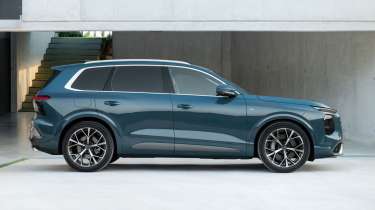
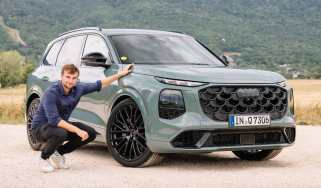
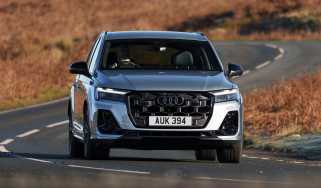
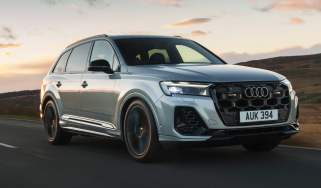
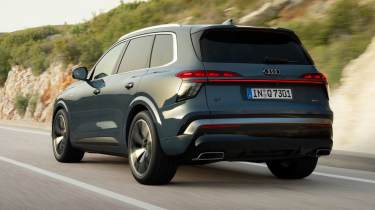
Audi wanted the new Q7 to look big, bold and very commanding, as befits a premium SUV, but a bit sporty at the same time. Up front, the bonnet is taller and more square than that of the outgoing model, while the recently redesigned four-ring badge sits higher up and the carefully sculpted, but almost bulging, wheelarches help to make this car look muscular and imposing.
The brand’s signature single-frame grille is present, of course, but is now illuminated. It’s backlit, to be specific, with light shining indirectly onto the segments of the honeycomb pattern from behind, which creates a much more subtle effect than the sort of glowing light strip that BMW and Mercedes like to add to their cars.
The super-slim customisable daytime running light units, with the pixelated LEDs we’ve seen on other Audi products, have made their way on to the new Q7 as well, while the enormous main headlights are below, flanking the grille and emphasising the car’s width.
At the rear is a full-width lightbar, as you’d expect, that divides the tailgate and connects the OLED tail-light panels, which are not just customisable, but also supposed to improve safety. The hazard lights, meanwhile, display warning symbols to alert other road users. The design also changes when a car is performing an automated parking manoeuvre or if another vehicle gets too close while you’re stationary, in heavy traffic for example.
Rolls-Royce-style automatic doors
Getting into the new Q7 is effortless, because for the first time it features automatic doors, just like a Rolls-Royce Phantom, while LED modules project animations that unfurl on the ground as if a carpet is being rolled out for you and your passengers.
Parents concerned about their children pranging other cars with these highly advanced new doors can rest assured that they come with plenty of tech in an effort to prevent this. The exit warning system can stop the rear doors from opening (or opening any further if already started) if the car detects a potential collision with another car, a cyclist or a pedestrian.
Audi Q7: interior and tech
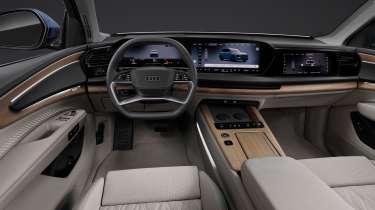
The interior of the new Q7 is very similar to those in Audi’s other SUVs and more conservative than what we’re expecting from the next X5, because that will get BMW’s radical Panoramic iDrive set-up, which stretches the driver’s display across the base of the windscreen. However, some people may prefer the Q7’s more conventional cabin design.
The ‘Digital Stage’ dashboard, as Audi calls it, includes a crystal-clear 12.3-inch instrument display and a 14.5-inch touchscreen housed within a single unit that gently curves towards the driver and uses indirect lighting to create a subtle floating effect. Next to that is a separate 12.3-inch passenger screen.
Audi’s designers wanted to make the cabin a place to focus and relax, but presumably in the pursuit of clean lines and precision, they have included very few buttons, with the exception of a smattering on the steering wheel and a handful on the centre console. More eyebrow-raising than that, however, is the decision not to add any controls for the air vents; they’re adjusted by using the touchscreen, as in a Tesla.
While we may need some time to come around to Audi’s thinking on that, we wholeheartedly support the brand’s decision to use as little glossy black plastic as possible inside. Modern Audis are normally full of the fingerprint-prone and easily scratched material, but the new Q7 features wood trim, fabric textiles and leathers to create a more sophisticated and inviting environment.
Among the smaller details we particularly like are the leather airbag cover on the steering wheel, and the cup-holders that have been designed to accommodate the enormous tumbler bottles that are so popular these days. Meanwhile, the wireless charging pads have MagSafe built-in, which means iPhone owners can throw their device down on to them and know they’re going to be topped up.
How practical is the new Audi Q7?
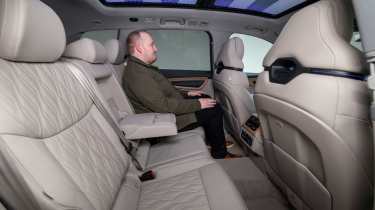
In the UK, the new Q7 will be available with a choice of five-seat and seven-seat layouts. The model we got access to in a studio, before the car’s world premiere, featured the optional third row and we found there was a frankly ridiculous amount of headroom all round.
One thing we noticed, however, is that there is a large hump in the floor that might make seating three adults across the second row a little difficult. Children and teenagers will have no problems, though, and they’ll appreciate the USB-C charging ports in the backs of the front seats to keep their devices topped up.
Opt for the seven-seat version, and the middle-row seats fold down and slide forward electronically – a very easy process, but not a particularly quick one. Fortunately, they can be controlled by the touchscreen as well, so everything can be ready and waiting for the kids when you pick them up from school. The second-row seats have also been designed so that child seats don’t block them from moving.
We did try the rearmost seats, and found that there’s not enough legroom for six-foot-tall adults to sit comfortably back there. But the seats are heated, which will be a treat for anyone who can squeeze in.
When it comes to luggage capacity, the five-seat Q7 has a 670-litre boot, which expands to 806 litres with the back bench slid forward, or 2,075 litres when the rear seats are folded down. The seven-seater offers 581 litres with the rearmost seats tucked away, 722 litres with the middle-row pushed forward, and a still impressive 1,980 litres with just the front ones in place. One particularly handy feature sees the parcel shelf fit under the boot floor.
And if somehow that’s still not enough space for you, you might want to hang on for the all-new, even larger Q9 that’s coming soon.
Did you know you can sell your car through Auto Express? We’ll help you get a great price and find a great deal on a new car, too.