Mitsubishi ASX vs Nissan Qashqai vs Skoda Yeti: 2010 group test
Mitsubishi has joined the battle for crossover supremacy with its new ASX. can it conquer Skoda and Nissan rivals?

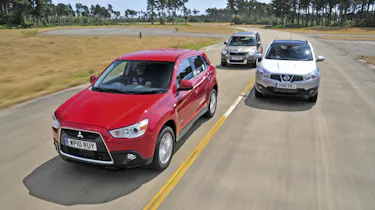
Mitsubishi has a strong SUV pedigree, having unveiled its legendary Shogun off-roader in 1982. However, the firm is a late arrival at the crossover party, so expectations are high for its all-new ASX (Active Sports Crossover) model.
Designed to topple the class leaders, the car breaks new ground for the company. It’s powered by an advanced 1.8-litre diesel with stop-start technology, and promises to mix strong performance with excellent economy. Meanwhile, the bodywork takes cues from the brand’s legendary Evo super-saloon, while the chassis is borrowed from the rugged Outlander 4x4.
On paper, this looks like a recipe for success. The Japanese contender faces some stiff competition, though. First into the ring is the excellent Skoda Yeti.
Our reigning class champion, it blends impressive quality with a great driving experience, flexible interior and distinctive styling. Figure in a range of superb diesel engines, such as the 2.0-litre TDI tested here, and it presents a tough challenge to the ASX.
The car that kickstarted the crossover craze in 2006 is the capable Nissan Qashqai. It recently underwent a facelift, and with a perky 2.0-litre diesel engine, it’s still at the top of its game. So which of our contenders will emerge from this bruising encounter on top?
Verdict
The ASX is one of the finest Mitsubishis to date. The car scores with its impressive diesel engine, roomy cabin, long spec tally and low running costs.
However, the crossover sector is one of the toughest to crack – and the Japanese model takes the bronze medal in this test.
This has more to do with the excellence of its two rivals than any major failings in the ASX package – overall, there isn’t much to separate our trio.
That’s why we found it so difficult to pick a winner. Even though it’s now nearly four years old, the Qashqai is still a superb choice. The recent facelift has freshened up the looks, while the original car’s great driving dynamics, practicality and
strong build quality remain.
But it can’t quite match the Yeti for overall appeal. While we had to sacrifice around 30bhp and a sixth gear ratio to get the Skoda within our budget, it didn’t feel like a poor relation. It features the most comfortable cabin, a widely adaptable seat layout
and a massive boot.
Plus, on top of all this, the detailing and interior quality rival models from the class above. So it’s another well deserved victory for the Skoda.
First place: Skoda Yeti
It’s easy to see why the Skoda Yeti is our current crossover class champ. The car delivers distinctive, rugged looks and a versatile and high-quality interior. Plus, it represents excellent value for money.
Many buyers are likely to be won over by the styling alone. A large wraparound screen and tapered glazing on the front doors provide the Yeti with a dynamic appearance that is less conventional than its rivals.
Used - available now

2023 Audi
Q7
53,829 milesAutomaticPetrol3.0L
Cash £29,768
2022 Kia
XCeed
55,428 milesManualPetrol1.5L
Cash £12,842
2024 MG
MG4 EV
23,500 milesAutomaticElectric
Cash £14,862
2021 Volkswagen
Polo
50,674 milesManualPetrol1.0L
Cash £11,511With its chunky bumpers, sill plates and raised ride height, the car gives the impression that it’s the most capable of our trio over rough terrain – even though it’s two-wheel drive.
There’s plenty of neat detailing, too, such as the bold grille, extra driving lights, black door pillars and flared wheelarches.
Open the door, and what strikes you instantly is the sheer quality on offer, with switchgear borrowed from Skoda’s executive Superb. The cabin is also the most flexible on test, with individual rear seats which slide back or forth to boost passenger legroom or luggage capacity as required.
Plus, it’s possible to remove the rear chairs completely, freeing up a van-like 1,700 litres of space. When the seats are in place, that high roof means rear passengers will have no issue with headroom.
The Skoda continues to convince on the road, as it drives more like a hatch than a top-heavy off-roader. The suspension can feel firm over bumpy surfaces, but the upshot is very little body roll and huge grip in bends.
Skoda’s pricing structure does the Yeti no favours in this test, though. While our £17,310 110bhp SE is £1,200 and £1,500 less than the Mitsubishi and Nissan respectively, it has a 30bhp power deficit. Buyers who want a similar output have to pay nearly £20,000 and above, and the 138bhp and 168bhp TDI Yetis are 4WD only.
As a result, this car trailed its opponents at the test track, with a 0-60mph sprint time of 12.2 seconds. The 2.0-litre unit is still flexible and quite refined, even though its five-speed box has one less ratio than rivals, but the Skoda isn’t a contender in a straight line.
Thankfully, the brakes are more positive than the other models’, while the superior handling means it’s easier to maintain speed.
The less powerful engine doesn’t have stop-start, but still emits the least CO2, at 140g/km. Combined economy of 52.3mpg impresses, too, although as the engine has to be worked hard, owners will do well to achieve that.
Second place: Nissan Qashqai
Nissan’s Qashqai kickstarted the crossover sector in 2006. Its blend of car-like driving experience, chunky SUV-inspired looks and perky engines helped tempt a legion of buyers away from traditional family hatchbacks.
Now the British-built machine has been given a mid-life refresh in a bid to win it a legion of new fans. The facelift has made the Nissan look better than ever. Along with the new grille, the headlamps, bonnet and wings have been redesigned.
The result is a less clumsy face than before. The combination of shallow windows, muscular detailing and chunky cladding also gives it a purposeful appearance.
Inside, the Nissan offers the most comfortable driving position of the three, sitting low and relaxed, although you still get a commanding view of the road. Cabin revisions include revamped instruments and a new trip computer display.
The quality of materials isn’t a match for the Skoda, but the plastics are better than those in the ASX. Switchgear placing is still a little haphazard, though, and the overall design isn’t as fresh as the exterior.
Dark seat materials, a low roofline and those shallow windows mean rear passengers will feel rather claustrophobic. The boot is also the smallest here, with only a 410-litre capacity.
On the road, the Nissan’s soft suspension does a great job of absorbing any bumps or broken surfaces. It’s not as firm as the Skoda, and there is slightly more lean through corners, so it doesn’t inspire quite as much confidence.
However, compared to the Mitsubishi, it offers a very car-like driving experience, with sharp turn-in and great control. The slick six-speed gearbox is a highlight, while the steering provides plenty of feedback.
The most impressive feature is the engine. At the track, the Nissan sprinted from 0-60mph in only 9.8 seconds. It was also the quickest in-gear, apart from the 50-70mph test in sixth, where the longer ratio hampered progress slightly.
Noise under acceleration was noticeable but not intrusive, and when cruising, the Nissan was the quietest car of the three.
The Qashqai’s predecessor was a favourite of ours, and with the recent revisions, the latest model is definitely the best yet. But is it good enough to regain its place at the top of the pile?
Third place: Mitsubishi ASX
For many buyers, Mitsubishi means only one thing: the Evo X. The scorching rally-bred saloon dominates headlines, but sells in relatively small numbers. Bosses hope the ASX will attract a wider audience to the brand – and, crucially, bring more customers into showrooms.
The newcomer hasn’t forgotten its roots, because the chunky SUV clearly shares its DNA with the four-door. The nose has the same aggressive grille, while the bold, swept-back headlights are familiar, too.
The rest of the ASX isn’t quite as interesting – the body looks dull next to the distinctive Yeti and sleek Qashqai, with little to break up the slab-sided panels. It’s neatly designed and well proportioned, and the raised ride height and black cladding on the bumpers give the car a rugged, off-roader appearance. But ultimately, it fails to turn heads.
A similarly low-key approach has been applied to the interior. In general, quality is a marked improvement on previous efforts from Mitsubishi – soft-touch materials have been added to the upper part of the dashboard and the doors.
Yet there are some hard and shiny plastics, and the switchgear could do with an update. In particular, the bank of switches to the right of the wheel is not only hard to find – especially after dark – but feels cheap. There’s no space for an integrated sat-nav, either, so the only option for buyers is an aftermarket dealer-fit device.
The rest of the dashboard is well laid out, while standard equipment is plentiful – our mid-spec ASX 3 gets cruise and climate control, as well as Bluetooth. The seats are comfortable, too, although the dark fabric is a little sombre.
Passengers in the rear are treated to an abundance of room, and the high-set front seats allow lots of space for feet to be slid underneath. With the rear bench in place, there’s a useful 442-litre luggage capacity – that’s 26 litres more than in the Yeti. And while the back seats can’t be taken out completely, the ASX benefits from a split-fold rear seat and useful ski hatch. We just wish Mitsubishi included straps or netting to secure smaller items.
The 1.8-litre diesel is fired up via the starter button next to the steering wheel – although the pre-heat process for the glow plugs seems to take longer than on its rivals. When idling, the powerplant is the quietest here, whether you’re sitting in the car or standing next to it. At a standstill, the idle speed drops to a very low 600rpm – which helps to boost fuel economy.
That last part is significant, as the ASX is the first car in the world to use a diesel engine equipped with variable valve timing. It’s part of a series of tweaks aimed at making the car environmentally friendly. Mitsubishi has also fitted its first-ever stop-start system – called Auto Stop & Go – as well as regenerative braking, while low-viscosity oil and low-rolling-resistance tyres feature, too.
Unfortunately we were unable to record full fuel economy figures, but Mitsubishi claims the newcomer will return 51.4mpg – only 0.9mpg less than the Yeti. It also promises to be nearly as clean as the Skoda. The ASX emits 145g/km of CO2, so road tax is £125 a year – £15 more than for the Czech machine.
Our only criticism is that the stop-start could fire the engine more quickly when the traffic lights turn green. Once you’re up and running, and on more challenging roads, the soft suspension means the Mitsubishi doesn’t handle as well as the nimble Skoda, with body roll proving an issue in tighter bends. But apart from the lean and some occasional wallow over bumps, the ride is comfortable enough.
The six-speed manual is notchy, which discourages you from making the most of the engine’s power band, and while the steering wheel feels and looks great, it doesn’t offer as much feedback as the Yeti or Qashqai through corners. Most disappointing of all was the model’s braking performance. It took 54.3 metres to come to a halt from 70mph at the test track – over 4.5 metres more than either opponent.
Nevertheless, the ASX has a broader appeal than any Mitsubishi before it, with plenty of space, a great engine and a step up in interior quality. It’s also impressively green and well equipped, and is a credible rival for the class’s establishment.