New Isuzu D-Max EV review: electric pick-up costs and carries a lot
The Isuzu D-Max EV might cost a lot, but compared to electric pick-up truck rivals, there's no compromise when it comes payload or towing capabilities.


Verdict
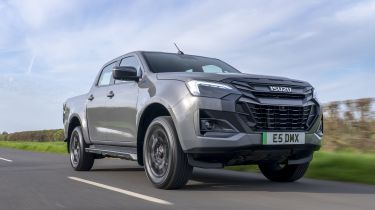
Looking at the numbers, the Isuzu D-Max EV appears to offer less than the diesel model for a lot more money. However, unlike rival electric pick-ups, it doesn’t compromise on payload or towing capability. The short range and slow DC charging speeds won’t be an issue for the type of buyers that Isuzu is targeting, and on the road the D-Max EV offers a responsive and effortless drive that delivers better comfort than the diesel can muster.
One area of the market that’s taking its time with electrification is the pick-up truck sector. Battery power doesn’t sit too readily with the kind of work that these practical commercial vehicles often undertake, but the new Isuzu D-Max EV is attempting to change that outlook. It’s not the first electric pick-up on the market, but it is the first one to offer zero compromise when it comes to delivering the same capability as its diesel equivalent.
Engineers have given the D-Max EV a new rear suspension system, replacing the leaf springs of the diesel with a pseudo MacPherson strut set-up that is designed to cope with the weight of the battery while still delivering a big payload capacity. As a result, this is a full one-tonne pick-up, with a payload weight of 1,015kg for the Double Cab, or 1,060kg for the Extended Cab, while the D-Max EV also has a 3.5-tonne maximum towing capacity, just like the diesel. All of this means it qualifies as a commercial vehicle, with the VAT and Capital Allowance benefits that entails, as well as the low Benefit-in-Kind tax rate for EVs.
Used - available now

2015 Mercedes
S-Class Saloon
109,591 milesAutomaticDiesel3.0L
Cash £14,995
2024 Cupra
Leon
31,400 milesAutomaticPetrol1.5L
Cash £18,595
2024 Land Rover
Defender 110
39,256 milesAutomaticDiesel3.0L
Cash £52,720
2025 Land Rover
Defender 110
24,401 milesAutomaticDiesel3.0L
Cash £59,990For reference, the KGM Musso Electric can only muster a payload weight of 730kg, while its towing capacity is 2.3 tonnes. Figures for the forthcoming Toyota Hilux BEV are still to be homologated, but initial numbers were even poorer than they are for the KGM, so the D-Max EV has a clear advantage over these rivals.
The EV uses the same body-on-frame construction as the D-Max diesel, so the only significant changes are to the rear suspension and powertrain. There’s a relatively modest 66.9kWh battery mounted between the frame rails, while the power system is located under the bonnet, so there’s no storage in the nose. The D-Max EV has permanent four-wheel drive from two electric motors, one on each axle, while there’s a 30:70 front and rear power split. The 62bhp/115Nm front and 139bhp/233Nm rear motors combine for a total output of 200bhp and 348Nm, while the D-Max features the Rough Terrain Mode that was introduced on the diesel truck last year to boost its off-road credentials.
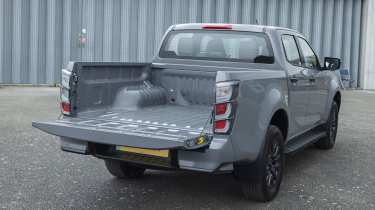
The relatively small battery and the D-Max’s overall size combine to deliver what can only be described as a modest range. Isuzu quotes a maximum of 163 miles on the combined cycle, although the company claims that the city driving range of 224 miles is a more representative figure for the type of driving that it expects most users to be doing. The company’s own research shows that the type of buyers who will be interested in the D-Max EV - including organisations such as the National Trust, National Grid and other energy infrastructure firms - need to do far fewer miles than this in the course of a day’s work.
During our brief hour-long drive of the D-Max EV on UK roads, with a mix of country lanes, urban stop-start traffic and a short motorway run, we saw the trip computer return 2.5 miles per kWh, which is good for 167 miles of range. But as mentioned, keep your speeds down, and you’re likely to get closer to the city driving range.
Charging is another area where there’s some compromise. The maximum DC rate is 50kW, which isn’t very impressive when compared with the rest of the EV market. But again, Isuzu has buyers in mind that will have 11kW three-phase AC charging at their disposal. The D-Max is able to make use of this power source as standard, and this means a full charge will take 10 hours.
On the road, the D-Max EV is far more responsive than the diesel truck, courtesy of the instant torque that’s on offer. A 0-62mph time of 10.1 seconds is around three seconds faster than the 1.9 model is capable of, while the truck pulls away with zero fuss and plenty of power. There are low-rolling resistance tyres fitted as standard, but even being aggressive on the throttle out of junctions doesn’t result in any loss of traction.
There’s something quite eerie about driving an electric pick-up quickly, because there’s no noise to disrupt the cabin, just fuss-free power. The D-Max’s ride is also well judged. It’s still on the bouncy side of comfortable, but the rear end is far more settled than the front, which is the opposite reaction you get from the diesel D-Max when it’s unladen.
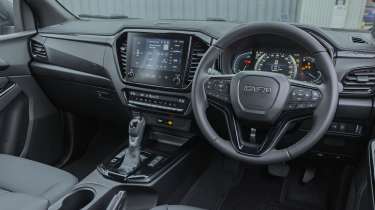
The improved responses and quiet comfort are major plus points of the D-Max EV, but in most other ways it’s identical to the diesel. That does mean you get plenty of warning beeps from the assorted safety systems on board, although the new driver inattention alert wasn’t as sensitive as some rival systems are. The infotainment screen is still a bit too haphazard in its layout when compared with the best systems out there.
Perhaps the biggest stumbling block to the D-Max EV experience will be price. The Extended Cab in eDL40 guise is just under £60,000, while the Double Cab version is £1,000 on top of that. At the top of the range is the eV-Cross driven here, which is £62,500. Those prices are excluding VAT and are nearly £20,000 more than the standard diesel auto equivalents, not to mention considerably more than KGM’s electric Musso. However, Isuzu believes that the D-Max EV offers something unique in the class, courtesy of its payload and towing weights that match the diesel variant. For that reason alone it expects buyers to be drawn in.
| Model: | Isuzu D-Max EV eV-Cross Double Cab |
| Price: | £62,495 (ex.VAT) |
| Powertrain: | 66.9kWh battery, 2x electric motors |
| Transmission: | Single-speed automatic, four-wheel drive |
| Power/torque: | 200bhp/348Nm |
| 0-62mph/ top speed: | 10.1 seconds/84mph |
| Range: | 163 miles |
| Max. charging: | 50kW (20-80% in 60 mins) |
| Size (L/W/H): | 4,373/1,828/1,573mm |
| On sale: | Now |
Our dealer network has 1,000s of great value new cars in stock and available now right across the UK. Find your new car…