Used Kia Niro (Mk1, 2016-2022) review and buyer's guide
A full used buyer’s guide on the Kia Niro covering the Niro Mk1 that was on sale between 2016 and 2022

Verdict
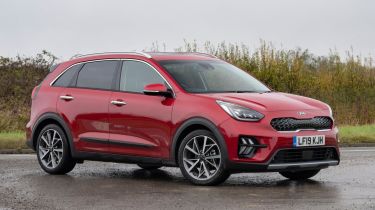
The Kia Niro and e-Niro have won a slew of awards since they were introduced, and we were among many publications to lavish praise on these multi-talented family cars. In 2019 DrivingElectric named the e-Niro its Electric Car of the Year; the same year it was our Affordable Electric Car of the Year. So it was no surprise that when we pitted a Niro PHEV against a plug-in hybrid MINI Countryman, the Kia came out on top; the result was the same in our head-to-head against the Hyundai Kona. When we ran an e-Niro on our fleet, we concluded: “The Kia e-Niro is a great family car that happens to be electric. It’s better to drive than many petrol cars, and way cheaper to run.” Overlook the Niro at your peril.
Widespread electrification has been a long time coming, with most mainstream car makers slow to introduce new products.
The market is now awash with hybrids, plug-in hybrids and electric cars, but six years ago it was a different story, with Kia at the vanguard with its Niro.
Designed from the outset as an electrified family car, the Niro showed other car makers how to do things. Whichever powertrain was chosen, the car was packaged efficiently, with a long range, lots of standard equipment and a decent level of reliability included for good measure.
Used - available now


Of course this shouldn’t have surprised anyone because these have been Kia strengths for years. And even now, despite many alternatives reaching the market, the Niro remains a very desirable used buy.
History
The Kia Niro went on sale in July 2016 in hybrid form only, with a 106bhp 1.6-litre engine and a 43.5bhp electric motor; they had a combined power output of 139bhp.
In September 2017, a plug-in hybrid (PHEV) was added to the range. This was treated by Kia as a standalone model within its line-up, but the trim level was based on the Niro 3.
The final variant was added in April 2019: the pure-electric e-Niro, available with just a single high-spec trim level.
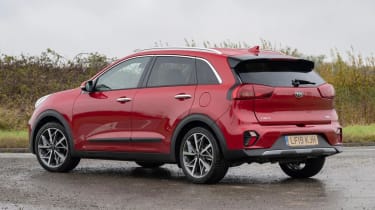
A facelift for the hybrid and PHEV in July 2019 brought improved infotainment, extra driver-assistance systems, a design refresh plus an upgraded interior. In summer 2020, the e-Niro range was widened to include 2, 3 and 4+ trim levels.
Which one should I buy?
If your journeys are generally fairly local, any Niro is desirable, but for longer or faster trips, the PHEV or e-Niro are better suited, although the latter is more expensive. Indeed, unless you have a cheap energy deal it might be that the e-Niro is too costly to run, so do the maths before buying.
All Niros are packed with kit, the entry-level 2 having 16-inch alloys, dual-zone climate control, voice recognition, adaptive cruise control, auto headlights and wipers, privacy glass and rear parking sensors.
The PHEV 2 also has front sensors, which are standard on the Niro 3 along with 18in wheels, navigation, leather, plus heating for the steering wheel and front seats.
The Niro 4 has LED headlights, heated outer rear seats, a sunroof and a JBL hi-fi.
Alternatives to the Kia Niro
Whereas the current Niro has lots of competition, the original was up against few hybrid, plug-in hybrid or electric rivals.
For example, the BMW 225xe Active Tourer PHEV is more of an MPV than an SUV, but the Hyundai Kona Electric was a direct rival to the e-Niro. The MINI Countryman was another PHEV of the time, while the Mitsubishi Outlander PHEV is readily available thanks to lots of fleet sales.
The Toyota C-HR is a self-charging hybrid that’s plentiful and hugely competent; this is closely related to the Lexus UX, which is more luxurious and more expensive.
More recent arrivals include the Toyota Yaris Cross and the Renault Captur E-Tech, which are hybrids rather than PHEVs. Electric alternatives include the Peugeot e-2008, the Volkswagen ID.3 and the Citroen e-C4, plus the bigger Skoda Enyaq.
What to look for
Real range
Kia claimed a maximum EV range of 30 miles for the PHEV. This isn’t usually achievable, with owners getting about 25 miles.
Headlights
One of the hottest topics in forums is the poor halogen headlights. It’s possible to fit Osram Nightbreaker bulbs, which are better.
Battery
The 12-volt battery can go flat, because of a current drain. This could be from the fuel pump, the audio system, the boot light or the door locks.
Towing
In some markets the Niro hybrid was available with a towing pack. UK buyers were denied this, but dealers could install a tow bar to take a bike rack.
Common faults
The Niro and e-Niro were rated separately in our 2022 Driver Power new-car survey, but both ranked highly, with good scores for reliability and build quality. Add in the fact that many used examples will have some of their seven-year/100k-mile warranty left, and you’re on to a winner.
Interior
There’s very little to separate the Niro’s dashboard from the e-Niro’s, the key difference being that the latter has a rotary selector for the gearchange. Other than that, all Niros have a clearly laid-out dashboard that’s finished to a high standard, with a responsive infotainment system and configurable instrumentation.
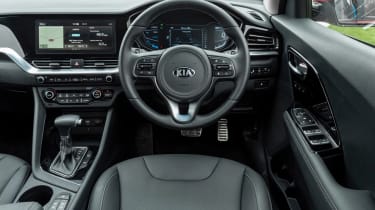
Cabin space is also good, with plenty of room for four adults plus a child. The Niro has an acceptable 382/1,380 litres of boot capacity; in the PHEV this falls to 324/1,322 litres, while the e-Niro boosts it to 451 or 1,405 litres.
Running costs
No matter what powertrain it has, every Niro will need to be serviced every 12 months or 10,000 miles. The hybrid and PHEV editions cost the same to maintain, while the e-Niro is a little cheaper.
Included in the costs is fresh brake fluid every two years; while the coolant doesn’t have to be replaced until 100,000 miles, then it needs to be renewed every 20,000 miles. All Niro engines are fitted with a timing chain so there’s no cambelt to replace, and to help spread the cost of maintenance, service plans are available.
Recalls
The Niro has been recalled twice so far, the first time being in August 2018, when 5,012 cars were affected. These were all built between November 2016 and September 2017, and they left the factory with poorly made actuators in the clutch housing. As a result, there was a chance that the oil seal within the transmission could become damaged, leading to fluid leaks, which in turn could lead to electrical short circuits. The solution was to repair or replace the actuator.
The most recent recall came in May 2019 and this time 5,021 Niros were affected, once again made between November 2016 and September 2017. This time the problem was overheating within the Power Assembly Relay inside the battery packs of hybrid and plug-in hybrid Niros. New relays were fitted if necessary.
Driver Power owner satisfaction
The Niro has had a superb run of results in our Driver Power new-car surveys. On its debut in the 2018 survey, it finished in second place out of 75 entries, then it came 10th in 2019, fourth in 2020, 15th in 2021 then 12th in 2022, with the e-Niro coming 20th separately. The low running costs are the Kia’s star attraction, but owners also like the good ride quality, the fine reliability and standard safety kit.
Kia Niro (2016-2022) review: What we said
Extracts from our 2022 in-depth review of the Kia Niro
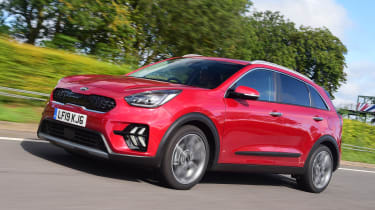
Like its Hyundai Ioniq sister model, the Kia Niro offers three levels of electrification, and arguably it gets better with the more electric input there is. The standard hybrid can't match the better-developed Toyota Prius for smoothness or efficiency, but the plug-in version has a decent all-electric range, while the e-Niro is an EV class leader for how far it can go on a single charge.
The other draw of the Niro is its SUV-style body. That means it's pretty practical, if not all that pretty, while the hybrid/electric drive system doesn't compromise interior space in any way, either. If only the Niro was a bit more special to drive.
About the Kia Niro
2016 saw the Kia Niro first arrive in the UK, but the range has expanded and there are now hybrid, Niro PHEV and electric e-Niro models for sale. The hybrid version was the first to appear in 2016, with the plug-in PHEV arriving in 2017 and the full electric model debuting in 2019.
This template of three alternative fuel options in one body is one that's used by the Hyundai Ioniq, which is the sister car to the Niro, albeit in a hatchback body, rather than an SUV one. Beyond that, the three versions of the Niro each have their own rivals. For the hybrid these include the Toyota Prius and a number of small diesel hatchbacks and crossovers, led by the likes of the Peugeot 3008 and Volkswagen Golf, the PHEV version has to go up against the Prius Plug-in and MINI Countryman S E, while the all-electric version shares running gear with the Hyundai Kona Electric, and takes on the Nissan Leaf, VW ID.3 and Renault Zoe.
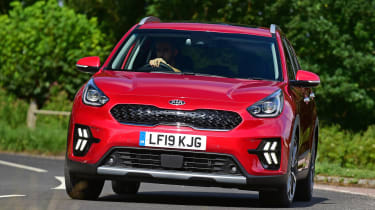
One aspect of the Niro that is likely to appeal to buyers is its SUV style body. It's more upright and conventional than cars like the Prius, and this alone could sway buyers into the Kia if they're not fans of the Toyota's futuristic shape. In an effort to distinguish the electric e-Niro from the hybrid versions, this model gets a smooth body-coloured nose incorporating a charging socket, replacing the grille seen on the hybrids, but is otherwise identical to its hybrid siblings.
The hybrid models feature a 104bhp 1.6 GDi (Gasoline Direct Injection) petrol engine and a 43bhp electric motor for an overall combined output of 139bhp (accounting for power losses between the two drive systems). Both the self-charging and plug-in hybrid models feature a six-speed twin-clutch DCT gearbox.
Power for the electric motor comes from a lithium-ion polymer battery, which is rated at 1.56kWh in the standard hybrid and 8.9kWh in the plug-in version. While the hybrid version runs on electric power as and when it can, the plug-in has an estimated electric-only range of 30 miles. If you do lots of short trips and keep the battery topped up, then that means you could bring your petrol station visits down to a bare minimum.
The e-Niro also uses li-ion polymer batteries, but they are far larger, at 39kWh for the short-range model and 64kWh for the longer range version, which are the same as the Kona Electric. As with the Kona, the bigger battery comes with a more powerful 201bhp electric motor, compared to 134bhp for the small battery. Claimed range for these two is 180 miles for the standard car and a generous 280 miles for the large capacity version.
The Niro range comprises 2, 3 and 4 trims, while the plug-in version does without the top-spec 4 specification. A 'Connect' version is also available, offering sat-nav, extra USB ports and Kia's UVO connected services app over the 2 equipment level.
The e-Niro 39kWh version is only available in combination with the 2 trim level, while the more powerful 64kWh variant comes with 2, 3 and 4+ equipment lines.
Engines, performance and drive
Kia has tried to make the Niro as normal to drive as it is to look at, but as in all hybrid models, there’s eerie silence when you twist the key in the ignition. Slot the gear selector into Drive, squeeze the throttle and the car glides forward on electric power alone. Pick the plug-in version and you can continue for up to 30 miles without using the petrol engine at all.
However, stick with the standard Niro hybrid and you'll find it harder to stick in EV mode. You don't have to press the pedal particularly hard for the 104bhp 1.6-litre four-cylinder petrol engine to burst into life to assist the 43bhp electric motor. The internal combustion engine is more intrusive when compared to a Toyota Prius’s, particularly at high revs, when it takes on a coarse note and sends vibrations through the car.
That’s partly down to the car’s six-speed twin-clutch gearbox, which delivers slightly lazy and jerky upshifts. Even so, once up to speed, the Niro will cruise for short periods up to 70mph on battery power alone - the on-board displays can be set to show you how power is being managed between the battery, electric motor, engine and the road.
You have to work the Niro’s power unit hard to maintain a decent pace, while the stiff suspension set-up results in the Kia following bumps at lower speeds and fidgeting on the motorway. The plug-in version is quicker on paper, though it feels pretty evenly matched with the standard hybrid model.
The Niro can’t match a Prius for driver involvement, which is something we never thought we'd say about a Prius, but the Kia's steering is direct and the handling is safe and predictable. Selecting Sport mode sharpens the throttle response, delivers a more aggressive shift strategy for the gearbox and adds weight to the steering, although it’s all rather at odds with the car’s otherwise sensible character.
Engines, 0-60 acceleration and top speed
Moving through the Niro range from the self-charging hybrid model, through to the plug-in hybrid and all-electric cars sees incremental improvements in performance. The 139bhp hybrid manages 0-62mph in 11.1s, while the PHEV variant betters this time by 0.7s.
The e-Niro 39kWh version provides a decent turn of pace, with 0-62mph covered in 9.5s, although the more powerful 64kWh car is capable of covering the same benchmark in 7.5s.
MPG, CO2 and running costs
With prices starting from around £25,000, the Kia Niro is priced to compete against the Toyota Prius. Buyers have the choice of the Niro self-charging hybrid, plug-in hybrid or e-Niro all-electric models, with each offering a different proposition in terms of cost of ownership.
Kia claims the hybrid model will deliver up to 58.9mpg on the combined cycle and 110g/km of CO2, which is probably decent enough efficiency to suit most families. Business users, or those with means to charge a vehicle from home, may be drawn to the plug-in hybrid version.
The PHEV model is able to run solely on electric power for up to 30 miles (on a single charge), so if you're able to keep the battery regularly topped up you should see overall economy of around 200mpg. CO2 emissions of just 31g/km mean that company car users will incur an 11% Benefit-in Kind rate for 2021/22, rising to 12% for the following financial year.
Although more expensive to buy, the battery-powered e-Niro should give you lower day-to-day running costs.The 39kWh version is good for around 180 miles before you'll need to plug-in and recharge. Using a 7.2kW home charger will take just over six hours to return the battery to 100% from empty. The 64kWh variant offers a more practical 282-mile range, but takes a little longer to replenish itself - just over nine-and-a-half hours, using a 7.2kW charger.
Interior, design and technology
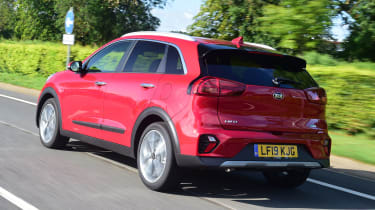
With its traditional compact family hatchback proportions, subtly raised ride height and tough-looking black wheelarch surrounds, the Kia Niro follows a template set by fashionable, conventionally powered crossover models.
It lacks the instant head-turning appeal of a Prius, but this more conventional shape gives the Kia plenty of showroom appeal. Its smattering of off-roader styling cues and less adventurous design approach will be a big draw to buyers who want hybrid efficiency without shouting about it. Better still, the plug-in variant is even more discreet – with the only clues to its 30-mile EV range being an additional filler cap by the nearside front wheel.
Go for the e-Niro, and the big indicator of its purely electric drive is the removal of the hybrid's grille. That leaves a blank piece of bodywork - much like Hyundai has done with its Ioniq and Kona Electrics - and there's a charging socket hidden behind the offset panel in the nose.
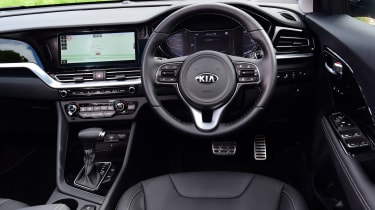
The subtle design continues inside, where the Niro feels far more mainstream than a Prius. Yet what it lacks in flair, the interior makes up for with solidity. Everything seems robustly built, while most of the materials have a high-quality look and feel.
For instance, soft-touch plastic covers the top of the dashboard, and the use of gloss black trim inserts and metal-effect air vent surrounds helps give the cabin an upmarket lift. One eco-minded feature is that you can set the climate controls to focus solely on the driver if you're travelling one-up - this is an eco feature that was first seen on the Kia Soul EV.
Sat-nav, stereo and infotainment
The entry-level Niro 2 includes an 8.0-inch touchscreen, while the Niro 3 features an upgraded 10.25-inch display with sat nav. Both are pretty easy to operate, with clear graphics and straightforward destination inputs. The screen also incorporates a row of shortcut buttons beneath the display, which means it’s easy to navigate between the assorted menus for the system settings, audio input, phone and the car’s energy flow.
A further clue to the Niro’s petrol-electric underpinnings is the unique instrument cluster, which features a full-colour 4.2-inch TFT screen and a power meter in place of the traditional rev counter. The 4 trim level and all e-Niro versions include a larger 7.0-inch display.
This set-up allows you to monitor the energy flow between the batteries, electric motor, engine and wheels, plus it generates numerous fuel use statistics. And as a bit of fun, there’s a neat graphic that ‘grows’ a tree as you drive more efficiently.
All Niro versions include two USB sockets and Apple CarPlay and Android Auto as standard. The Niro 3 adds a wireless phone charging pad, while the 4 trim has a JBL sound system with subwoofer in the boot.
Practicality, comfort and boot space
By designing the Niro around a compact crossover template, Kia has delivered decent practicality. In terms of size, it sits somewhere between the Kia Ceed hatchback and Kia Sportage crossover, so it fills a niche of its own in some ways. However, if you want the plug-in PHEV variant, you'll have to make do with the smaller boot, as the batteries take up some luggage space.
Size
The Niro is 4,355mm long and has a wheelbase of 2,700mm. That's the same wheelbase as a Toyota Prius, but the Prius is around 200mm longer overall. As you would expect, that crossover shape means the Niro is taller and wider than the Prius, at 1,545mm and 1,805mm respectively. The Niro PHEV is exactly the same length, height and width as the standard car.
Leg room, head room & passenger space
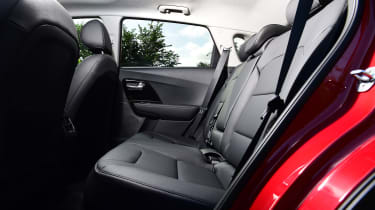
Occupants sitting in the rear of the Niro benefit from decent headroom thanks to the car's squarer crossover shape. Up front, the driver gets a wide range of seat and wheel adjustment. The only real ergonomic niggle is the foot-operated parking brake, which sits uncomfortably high and near your left shin when it's disengaged.
Boot space
The upright tailgate opening isn’t as large as the hatchback Toyota Prius’s, but the Niro's 382-litre boot capacity is competitive alongside rivals like the Volkswagen Golf. A Prius is bigger, however, claiming 445 litres with the rear seats in place. Folded down, however, the 1,380-litre load bay is 10 litres bigger than its main rival. Go for the PHEV plug-in and you'll lose around 80 litres of boot space - both seats up and seats down.
Elsewhere there’s decent storage, including a spacious glovebox, but it can’t quite match the neatly packaged Prius for cubby space. Like its rival, there's no spare wheel, just a bottle of sealant for minor punctures.
Head over to our Find a Car service to get a great deal on a used Kia Niro or use our Free Car Valuation tool for a price on a specific car.