Lexus ES review
The Lexus ES is spacious and luxurious, but can't compete with the best from BMW and Audi when it comes to range, charging and performance


Our opinion on the Lexus ES
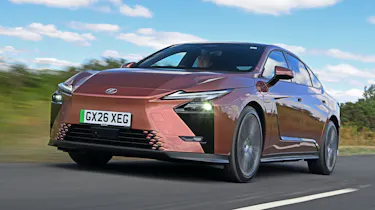
It might be all-new and all-electric, but the ES comes with many traits we’ve enjoyed in previous models from Lexus. The ride is excellent, as is the cabin’s build quality, while the interior ergonomics are good, despite many functions being operated through the huge new touchscreen. The limited choice of drivetrains is disappointing, though, especially considering the average range, charging and performance figures.
About the Lexus ES
Although it’s existed in other markets since 1989, the Lexus ES first arrived in the UK in 2019 as a replacement for the GS to rival the likes of the BMW 5 Series and Mercedes E-Class.
That car was a hybrid and while this new, eighth-generation ES will still be available as a hybrid in the US, Britain will only get the car in all-electric single-motor 350e form. Lexus claims this version will account for 75 per cent of global sales, although if there is demand for the dual-motor electric 500e in this country, then that could reach UK showrooms, too.
Unlike some of its rivals, including the BMW i5 and Audi A6 e-tron, there’s no estate, with the Lexus ES only coming in a saloon bodystyle.
Performance & driving experience
Pros |
|
Cons |
|
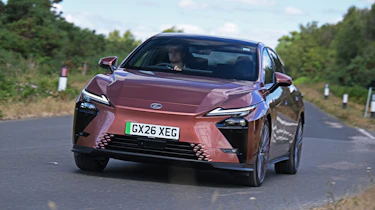
Instead of the dedicated electric-only e-TNGA architecture of the Lexus RZ and Toyota bZ4X, the ES sits on a variation of the multi-fuel TNGA-K platform that’s been around since 2017 and used by the old Toyota Camry and Toyota RAV4. Despite that, the ES 350e gets the same front-mounted electric motor and 77kWh battery pack as the RZ 350e, so the saloon’s performance is pretty similar to that of the crossover.
Performance, 0-60mph acceleration and top speed
With 221bhp and a relatively lowly (for an EV) 269Nm of torque, the ES isn’t as quick in a straight line as many of its rivals. However, the Lexus never feels slow, and it puts its power down well, with motorway overtakes not requiring much planning. Compared with a lot of front-driven EVs, it doesn’t struggle too badly with torque steer, either.
| Model | Power | 0-62mph | Top speed |
| Lexus ES 350e Premium | 221bhp | Eight seconds | 99mph |
Town driving, visibility and parking
The Lexus ES’ kerbweight of 2,150kg makes it lighter than the BMW i5 and Volvo ES90, but this is still a significant figure and it comes into play even at low speeds. The softly sprung suspension can cause a bit of wobble if you’re too eager with the steering – or the brakes and accelerator, for that matter.
Used - available now


Given the Lexus ES’ laid-back nature, we’d definitely recommend the smaller 19-inch wheels over the 21-inch designs, which are optional on higher Premium Plus and Takumi trim levels. On the smaller rims, the ride is a little more forgiving over potholes and speed bumps.
The incorporation of the battery in the multi-fuel platform means the driving position is fairly high-set. There’s enough adjustment in the seat to get comfortable, however, and it does mean visibility is pretty good, too. On mid-spec Premium Plus trim you get a digital rear view mirror, which works as well as any other we’ve tried. The digital side view mirrors available on the old ES haven’t been carried over to this new model.
Country road driving and handling
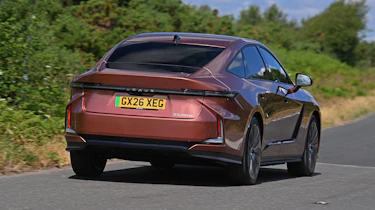
While the ES shares plenty with other Toyota and Lexus models, the front suspension and steering rack have been developed uniquely for this car, and there’s an all-new multi-link rear suspension set-up, too. While the steering isn’t brimming with feedback, the car’s front end feels sufficiently responsive. At higher speed, the steering is surprisingly stiff no matter which driving mode you’re in, although the weight feels in keeping with the ES’s size.
There’s enough grip to cope with enthusiastic driving, but if you’re after an engaging electric executive car, the BMW i5 and Audi A6 e-tron are considerably better choices.
Motorway driving and long-distance comfort
The ES is well suited to relaxed cruising. The ride on the smaller wheels is sumptuous at higher speeds, and you get the sense the suspension is undulating with the road rather than working against it.
“The level of sound deadening and quietness in the Lexus ES is excellent. Its composure on the motorway makes it an excellent long-distance cruiser.” - Alastair Crooks, senior news reporter.
Range, charging & running costs
Pros |
|
Cons |
|
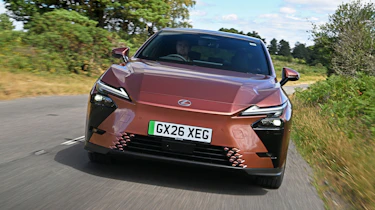
There’s a 77kWh battery powering the single-motor ES, with the dual-motor in other markets getting a smaller 75kWh pack. Even with the larger unit, range stands at 361 miles, falling to 357 miles if you go for the Premium Plus and 326 miles for the Takumi. That steep drop-off for the latter is mainly down to the larger 21-inch wheels.
Starting off in a Takumi-spec ES, we saw a claimed 331-mile range with the battery at full charge. A useful feature is the range estimate before you turn on the climate control, which told us we’d have to pay a penalty of 26 miles if we wanted the air-conditioning on.
On the move, the efficiency fluctuated quite a lot depending on the style of driving; cruising on a motorway saw a miles per kWh figure north of 4.5, while country driving and occasional doses of hard acceleration saw this drop below three miles per kWh. After a day of driving on a variety of roads, we found the larger-wheeled ES returned a real-world range of 290 miles; with small wheels we think 320 miles on a single charge would be easily achievable.
When you compare the entry-level versions of the BMW i5 (356 miles) and Audi A6 e-tron (384 miles), the Lexus’ range looks pretty reasonable. However, the Audi can be had with a larger battery that ups its range to 463 miles, while the Volvo ES90, Mercedes EQE and even the DS No8 will all cover more than 400 miles on a charge, too.
The ES tops out at just 150kW when charging (most rivals sit above 200kW), meaning that despite having a relatively small battery for its size, a 10 to 80 per cent top-up will take 30 minutes.
| Model | Battery size | Range | Insurance group |
| Lexus ES 350e Premium | 77kWh | 361 miles | |
| Lexus ES 350e Takumi | 77kWh | 326 miles |
Tax
You’ll be hit with a luxury car tax as all versions of the Lexus ES sit above the £50,000 mark, adding £440 to your annual VED road tax bill between the second and sixth year of ownership.
Depreciation
On average, the Lexus ES is expected to hold on to 40 per cent of its value after 36,000 miles and three years, with not much variation across the line-up. That’s slightly worse than the old Lexus ES hybrid, but things look a bit better when you compare it to the BMW i5, which only holds on to 34 per cent on average. The Audi A6 e-tron fares much better, with 46 per cent.
Interior, design & technology
Pros |
|
Cons |
|
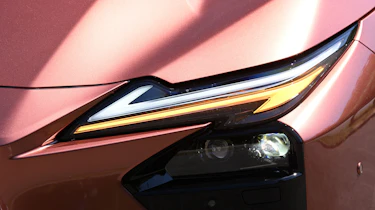
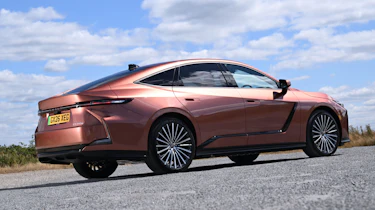
The all-electric Lexus ES has a slightly cleaner look than the hybrid model available in other markets thanks to a blanked-off front fascia, but otherwise there’s little difference between the pair. The spindle grille that Lexus has used on its models over the past decade or so is obviously missing, but the angular face, sleek bodywork and overall neatly proportioned styling all earned plenty of positive comments from passers by when we tested it. Also attracting plenty of praise was the optional ‘Sonic Copper’ paint finish.
Interior and dashboard design
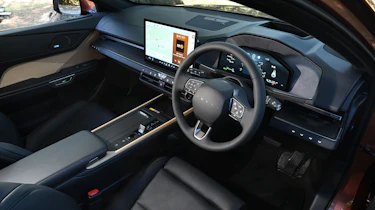
The interior of the Lexus ES is a departure from the older models in the line-up. There’s a new steering wheel which replaces the Lexus logo with some script, and for us that’s a shame because it looks fairly generic as a result. It does gain some fresh buttons that have a high-quality feel to them, though.
The Takumi offers a party piece in the shape of rear seat adjustability, and while this is not on offer in the lower-spec Premium and Premium Plus versions, they are also plush. Premium Plus gets Lexus’ excellent semi-aniline leather upholstery and some interesting bamboo trim which livens up the cabin’s design.
Materials and build quality
The interior quality as a whole is superb, as we’ve become accustomed to with Lexus. The physical switchgear, while less abundant than in previous models, is well damped and feels robust. The levels of standard kit are decent, too, with the basic Premium model having a panoramic roof, heated and ventilated front seats and a 10-speaker audio system with ‘active sound control’ to filter out road noise.
Infotainment, sat-nav and stereo
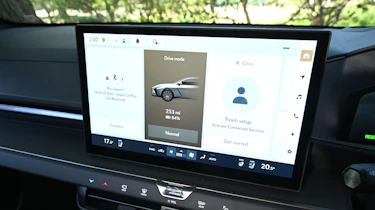
The ES gets Lexus’ next-generation infotainment system, which is operated via a 14-inch touchscreen that’s mounted high on the dashboard. The system integrates Apple CarPlay and Android Auto very well, keeping a bank of shortcut widgets – such as settings and charging – always visible, with climate controls below. It’s quick to respond to inputs and the resolution is crystal clear. We also like that the various menus and controls take up a large amount of screen space, making them easier to operate while driving. The new customisable driver’s display is easily visible, too, and it comes with an interesting suede background.
The mid-spec Premium Plus features a 17-speaker Mark Levinson sound set-up, which to us didn’t provide much more clarity over the perfectly fine standard system. It also has two wireless smartphone chargers on the centre console.
“At first the bank of climate controls look touch-sensitive, but they respond with a satisfying click, so there’s no issue with using them on them on the move.” - Alastair Crooks, senior news reporter.
Boot space & practicality

Pros |
|
Cons |
|
Considering the Lexus ES has to accommodate a hybrid powertrain as well, the all-electric saloon uses its space pretty efficiently, although an SUV such as the BMW iX3 or Audi Q6 e-tron might be easier to live with if storage space is crucial.
Dimensions and size
Lexus calls the Mk8 ES a ‘classic saloon’, but in terms of size at least, it could be interpreted as a limousine. It’s much larger than the old car, at 5.1 metres long, and actually only 90mm shorter than the now-axed LS flagship. It’s also 85mm longer and 45mm taller than a BMW i5, while the Audi A6 e-tron, Mercedes EQE and Volvo ES90 are also smaller than the Lexus.
Dimensions comparison | |||
| Model | Lexus ES | BMW i5 | Volvo ES90 |
| Length | 5,145mm | 5,060mm | 5,000mm |
| Width | 1,920mm | 1,900mm | 2,054mm |
| Height | 1,560mm | 1,515mm | 1,554mm |
| Wheelbase | 2,950mm | 2,995mm | 3,102mm |
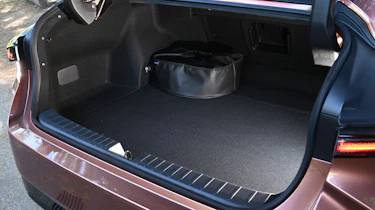
| Boot space | 517 litres | 490 litres | 424 litres |
Seats & passenger space
The Lexus’ extra size on the outside equates to a spacious interior, while the long wheelbase – which is an increase of 80mm over the old ES – opens up more legroom than is on offer in its German competitors. However, there is a hump in the middle of the floor due to the compromised multi-fuel platform.
Top-spec Takumi certainly capitalises on the ES’s new-found limousine-like capacity. It gains an electric sunshade for the rear window, plus heating and ventilation functions for the reclinable rear seats (which don’t encroach on the boot space). There’s also a control panel embedded in the fold-down centre armrest, which can electrically extend the ‘ottoman-style’ leg rest and fold forward the front passenger seat for maximum space and comfort.
Boot space
As the electric motor sits under that long, swooping bonnet, there’s no additional frunk. However, the Lexus makes up for it at the back. Overall boot space is far greater than on the Volvo ES90 and it even beats the BMW i5, as well as the Audi A6 e-tron (502 litres) and Mercedes EQE (430 litres). The boot opening for the Lexus ES is like that of a traditional saloon, rather than a broader hatch, as is the case with the Volvo.
“In Takumi specification especially, the Lexus ES seems like a car that caters to rear-seat passengers just as much as the person in the driver’s seat.” - Alastair Crooks, senior news reporter
Reliability & safety
Pros |
|
Cons |
|
The Lexus ES in its current form is too new to feature in our Driver Power survey, so we don’t know what owners think of the electric executive just yet. What we do know, however, is that Lexus drivers as a whole love their cars. In 2026 the brand came an impressive fourth in our manufacturer rankings, sitting just ahead of BMW. The brand performed well in the ‘Interior and Practicality & Bootspace’ categories, while solid build quality was a consistent theme. We expect the ES to continue this theme.
The safety experts at Euro NCAP haven’t tested the Lexus ES 350e, but there’s a generous suite of standard driver assistance features and safety tech, such as blind-spot monitoring and cross-traffic alert, plus Lexus’ proactive driving assist and pre-collision avoidance, which can detect pedestrians and cyclists as well as other vehicles.
The ES makes do with Lexus’ standard three-year/60,000-mile warranty, although this can be extended to 10 years or 100,000 miles if you service the car through an official dealer throughout that time.
| Euro NCAP safety ratings | |
| Euro NCAP safety rating | N/A |
| Adult occupant protection | N/A |
| Child occupant protection | N/A |
| Vulnerable road user protection | N/A |
| Safety assist | N/A |
Buying, prices and deals
Best buy: Lexus ES Premium
Pricing for the Lexus ES seems pretty competitive. The entry-level £59,345 Premium is almost £10,000 less than the cheapest Volvo ES90 and BMW i5, and it undercuts the £62,590 Audi A6 e-tron Sportback. The mid-range £68,245 Premium Plus and the Takumi (from £72,545) don’t look quite as good value. Although the Takumi’s adjustable rear seat technology sets it apart from rivals, it’s tough to justify its price over the basic Premium car.
Lexus ES alternatives
The main alternatives to the Lexus ES in its new electric form are from the same group of manufacturers that rivalled the car when it had a combustion engine. From BMW, there’s the 5 Series-based i5, while there’s also the Audi A6 e-tron, Mercedes EQE and Volvo ES90, which replaces the old S90.
Beyond these obvious choices, there are other rivals in the shape of the Genesis Electrified G80, Polestar 5 and if you’re willing to look for a used option, the Porsche Taycan and Audi e-tron GT.
Lexus ES pictures
Key updates of the Lexus ES review
1 October 2026: Conversion from a road test to an in-depth review.
Frequently Asked Questions
While the Lexus ES shares a platform with the Toyota Camry, it has been heavily revised both in terms of its technical underpinnings and design.
Deals on the ES an alternatives