New Polestar 2 will ‘beat’ BMW i3, according to dynamics boss
The new Polestar 2 is set to morph into a true sports saloon – with strong emphasis on the sporty side of things
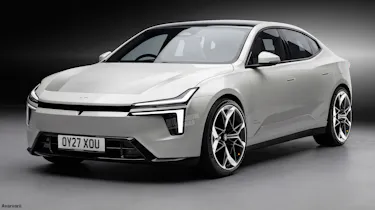
The all-new Polestar 2 will “beat” the forthcoming BMW i3 when it arrives in 2027, according to the firm’s head of driving dynamics, Joakim Rydholm. Despite sitting on a totally different platform, the next-generation 2 will use lessons learned in the development of the maker’s new halo car: the Polestar 5 grand tourer.
Asked if the new Polestar 2 can be competitive in a market being flooded by new entrants, Rydholm told Auto Express: “That’s no doubt. This is part of the game; together we lift the car industry. That’s the way it works.

“We will beat [the new i3]; that we must,” he said during an exclusive interview. “We have learned a lot of things during [the development of Polestar 5]; the active dampers, the steering – that’s something you bring with you, and we have in mind when we do the next projects.”
Due for reveal next year, the new Polestar 2 has big shoes to fill, replacing the car that put the brand on the map after it separated from Volvo in 2017. The second-generation saloon will kick off the company’s next chapter, being the first Polestar model to replace an existing car. It won’t hold back when it comes to design, either, as it’s set to take on a sportier flavour to help it stand out in an increasingly crowded class.
What will the new Polestar 2 look like?
The new 2 will be the first model shaped by CEO Michael Lohscheller and new design chief Philipp Römers. Polestar poached Römers from the Volkswagen Group, where he designed the Audi e-tron GT and Volkswagen Golf Mk7 – both cars with handsome proportions.
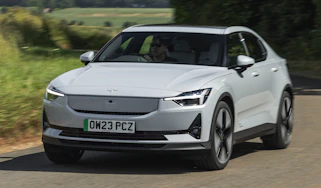
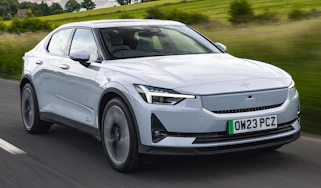
Speaking exclusively to Auto Express earlier this year, Römers said the 2’s stance is set to change dramatically. The current car is a jacked-up notchback peppered with SUV-style cladding, elements we expect to be diluted on the replacement car. This was confirmed in a recent teaser image showing the new model behind a frosted screen with the number ‘2’ emblazoned on it.
The picture shows a car that looks much lower to the ground. We asked Römers directly if the ride height would be reduced for the Mk2 Polestar 2 and he answered intriguingly: “The new design language, the strong evolution we are doing, it would change a few things. But today’s design is a good car, as you know.”
The new 2 will therefore tread a line between evolution and revolution. “The Polestar 2 is a very successful car,” Lohscheller told us. “We have [more than] 180,000 cars on the road, so I don’t think we will have a revolution.”
Since these conversations, Römers and his team have revealed a separate teaser of the Polestar Formula 2030 – a radical concept car set to “showcase” the maker’s future, while “respecting brand-defining elements like the familiar dual-blade headlights”.
Thanks to the next 2’s lower ride height, we can expect an altogether sportier saloon that’s also “a little longer” according to Loscheller. Today’s car measures just over 4.6 metres: a 100mm stretch would make it roughly the same length as the brand-new BMW i3.

“[The new 2] will keep all the great things and add a few things that the current car didn’t address in the most optimal way,” Loscheller said. “Customers told us that they would like a bit more room in the back, and that’s exactly what this car does; it’s beautiful and keeps the good things of the current one and adds things that were not optimal.”
Römers says he’s keen to accentuate horizontal design cues, which will visually lower the car. The front end will be dominated by Polestar’s aforementioned ‘dual-blade’ headlamps, as well as “characterful details: no traditional grille and the Polestar 3’s bridge”. This is a raised section across the nose which pushes air onto the bonnet to improve aerodynamics.
What will the new Polestar 2 look like inside?
The interior design will also reflect Polestar’s sporty ethos. The cockpit will be more driver-oriented, with the screen angled towards the driver, and a small instrument panel like the one found in the 5 GT. Römers will also use more vibrant colours than today’s grey-dominated shades and a warmer, more human user interface with more switches.
What sort of range and performance will the new Polestar 2 have?
Both Römers and Lohscheller are determined to emphasise the car’s performance. “It’s something we want to address even more and that gives me an opportunity,” said Römers.
And he namechecked ‘the Beast’, Polestar’s high-performance, special edition 2 from 2022. It had 469bhp, an aggressive bodykit and lowered suspension. “This is inspiration for the future, because it looks sporty.”
Rydholm’s comments about learnings from the Polestar 5 will place strong emphasis on the new 2’s handling, with the dynamics chief admitting the car “will need good damping” to be competitive in its class. It’s not yet clear if advanced technology like the halo model’s MagneRide dampers would be prohibitively expensive for a mid-size electric exec, however: “We’ll need to find that out,” Rydholm remarked.
The original 2 launched as a front-wheel-drive car but switched to rear-wheel drive in its midlife facelift to boost efficiency. Today’s standard-range car packs 268bhp and 344 miles of range, with the flagship dual-motor variant kicking out 416bhp and sprinting from 0-62mph in 4.3 seconds. The long-range, single-motor car posts the best range, at 408 miles.
Precise technical details are still under wraps, with the new 2’s premiere set for 2027. However, if the car is set to “beat” the i3 as per Rydholm’s comments, then it’ll need a range of more than 500 miles, plus charging speeds in excess of 300kW. Like the BMW, Polestar is expected to utilise an 800-volt electrical architecture for all future models; as hinted, just one platform will underpin all of the brand’s mainstream cars, including the second-generation 2.

The 2’s sister car, the Volvo EX60, showcases the technological progress we can expect: peak power spans 369bhp to 571bhp, and the longest-range model covers 503 miles on the WLTP cycle. Single and dual-motor Polestar 2s will be offered, plus the usual range-topping Performance variants.
Polestar platform sharing with Geely, Lotus and Zeekr
Spurred on by its crippling losses and the strategic direction of owner Geely Holdings, Polestar is regrouping on a new platform that will feed a number of the parent company’s brands. Sister marques include Geely, Lotus, Lynk&Co, Volvo and Zeekr, and in autumn 2024 owner Li Shufu’s ‘Taizhou Declaration’ called for more component and powertrain sharing across the group to squeeze out unnecessary expenditure.
Boss Lohscheller has also railed against the number of car platforms the Swedish EV-maker currently uses: “Over time, I want to harmonise architectures, because we have too many different ones.” The outgoing 2, Polestar’s SUVs and the incoming, all-aluminium 5 performance GT are all based on different vehicle platforms. That’s a luxury for any car maker, let alone one that sold only 60,000 cars in 2025.
But it’s not just about hardware, as car makers embrace the shift to software-defined vehicles (SDVs) knowing that connected features and the onboard digital experience are the new automotive battleground. Lohscheller said: “You need to have [cutting-edge] software stacks and central core computing,” which is the ultrafast-processing power that enables hi-tech safety, autonomous and dynamic features.
He added: “All this can be done, but it needs to be well planned. The companies who have done it, it took them years.”
The CEO confirmed that the new platform has the flexibility to support a variety of vehicles, with different lengths, tracks and wheelbases and suitability for both high and low-riding cars. That will enable the 2 and the 7, the mid-size-SUV that will follow it to market in 2028, to use the same underpinnings. And Römers is incredibly nonchalant about the Geely group’s technological convergence.
“I’m happy that I [arrived at] a time where we want to share platforms and set our brands in clear directions to avoid a horse-race mentality,” said the head of design. “It’s the same in Volkswagen Group: they share platforms but a Volkswagen is completely different to an Audi.”
Prices for the new electric Polestar will likely start at just less than £50,000 when UK sales begin in the summer of 2027 – putting it in the heart of the mid-size executive-car segment, and a surefire rival to the new BMW i3 and Mercedes C-Class Electric.
Find a great deal on a new Polestar 2, 3 or 4 available from stock now through the Auto Express Buy A Car service…