New Volkswagen Golf Hybrid 2026 review: better late than never
Late in the day, VW adds a full-hybrid model to the eighth-gen Golf line-up. Is it worth serious consideration?

Verdict
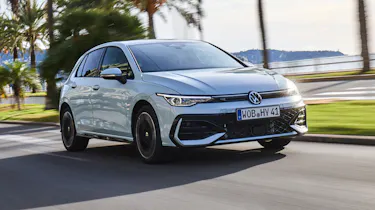
Volkswagen has plugged a hole in its part-electric Golf hatchback range with a new full-hybrid powertrain, designed to appeal to those who want greater city-based electric driving from their car, but who don’t want the hassle of having to plug in a PHEV for regular charging sessions. The resulting product is, as you’d expect, polished and capable, but it doesn’t feel a particularly necessary or memorable addition to a line-up that’s getting a little long in the tooth these days.
It might seem strange for Volkswagen to be introducing a wholly new drivetrain choice to the ageing Mk8 Golf line-up, but that’s precisely what the German firm is doing with the launch of this, the Golf Hybrid.
This is a powertrain which fits neatly into the hybrid gap left by the manufacturer between the 148bhp eTSI mild-hybrid (MHEV) and the 201bhp eHybrid plug-in (PHEV) models.
Yet the Golf Hybrid uses plenty of familiar hardware. For instance, it runs the 148bhp 1.5-litre TSI Evo engine, shared with its MHEV and PHEV relations, only it further has a pair of potent motors – providing up to 44kW of drivetrain boost – powered by a 1.6kWh gross NMC (nickel manganese cobalt) pack, with 0.64kWh of that capacity usable.
Used - available now


There’s no official stated electric driving range for the Golf Hybrid as a result of that relatively small battery, but unlike the eTSI, the full HEV can drive at up to 37mph on electric power alone – provided there’s some charge remaining in the battery.
That’s enough to boost its economy figures compared to the eTSI. Although there will be two choices of Hybrid output offered in the UK – 134bhp and 168bhp – even the latter, which we drove here, is thriftier on its resources than a 148bhp eTSI in the same R-Line trim.
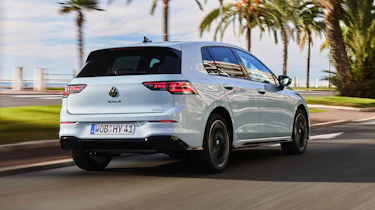
VW’s quoted stats for the MHEV Golf stand at 53.8mpg and 120g/km in R-Line spec. The Hybrid, which should also be offered in Style and Match specifications, pushes up to and beyond 60mpg, with CO2 rated at between 104g/km and 117g/km.
How the system works is fairly complex, but one senior engineer involved in the Golf Hybrid’s development told us that the powertrain is most similar to Honda’s i-MMD arrangement. In the Golf, this means there are two electric motors supporting the 1.5-litre petrol engine, although it’s almost best thinking of the Hybrid as a range-extender – it’s primarily always trying to offer an EV-like driving experience, certainly at under 40mph.
For electric driving, the TSI lies dormant in the Golf Hybrid and the larger propulsion motor sandwiched into the hybrid module is doing the donkey work.
If the battery gets too low in charge to support electric driving, or you ask for a bit more power from the VW, then it switches to series-hybrid driving, where the TSI then powers up but is disconnected from the front wheels. In this case, the ICE is merely sending its power to the secondary generator motor, which in turn tops up the battery to feed the main propulsion motor.
Finally, there’s parallel-hybrid drive. Above 37mph or when asking for a lot of acceleration, a clutch closes and finally the TSI is directly linked to the driven wheels, while the main electric-drive motor then supports the turbo four as a ‘booster’.
That transmission, by the way, is not a single-speed reduction gear as in an EV, nor is it a CVT. We were again told by the team behind the Golf Hybrid that it’s almost like a sixth gear taken from one of its regular ’boxes, with the car limited to a maximum 4,500rpm and, accordingly, a 112mph top speed.
All told, in its more potent configuration, the Golf Hybrid has 168bhp and 310Nm in total, with the hybrid unit constituting 48kg of weight. That means the R-Line’s total kerb figure is 1,484kg, so it can sprint from 0-62mph in a sprightly 7.5 seconds.
Aimed at commuters who regularly drive in urban conditions and need more electric-powered motoring than the eTSI can provide, but who perhaps live in properties where a wallbox charger to support the running of an eHybrid PHEV is not a possibility, it’s clear to see the Golf Hybrid will target fleet users.
VW has also mitigated the cost of developing this powertrain by slotting it into the much newer second-gen Volkswagen T-Roc crossover, alongside the Golf. And it’s not hard to imagine it appearing in other group products before too long, such as the Skoda Octavia.
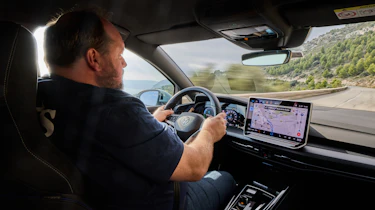
To drive, however, it’s very conventionally Golf-like. Around town, you do notice the TSI drops out of service often and you’re whirring around sedately on electric power alone, while under full acceleration the power delivery of the single-speed transmission is naturally different to the firm’s stepped DSG ’boxes.
But in the pleasing weight of its major controls, its impressive ride comfort on Dynamic Chassis Control (DCC) adaptive dampers and the assured way it minimises the impact of exterior noise contributors from affecting the people sitting within its well appointed passenger compartment, the Hybrid is about as Golf-like as you’d expect. Conventionally unconventional, if you will.
The HEV Golf is undoubtedly a good car, then. Yet it feels like a complexly engineered answer to a question nobody was particularly asking of the Mk8 range.
| Model: | Volkswagen Golf Hybrid R-Line |
| Price: | TBC (£33,560 est) |
| Powertrain: | 1.5-litre 4cyl petrol 1x e-motors and 0.64kWh (usable) battery |
| Power/torque: | 168bhp/310Nm |
| Transmission: | Single hybrid gear, front-wheel drive |
| 0-62mph: | 7.5 seconds |
| Top speed: | 112mph |
| Economy: | 61.4mpg |
| CO2: | 104g/km |
| Size (L/W/H): | 4,282/1,789/1,483mm |
| On sale: | Q4 2026 |
Deals on the Golf and alternatives