Vauxhall VXR8 vs Chryster 300C SRT-8 vs Jaguar S-Type R 2007 group test review
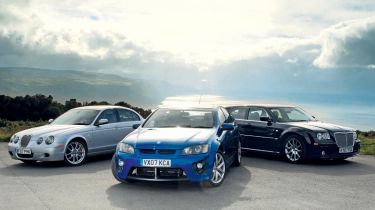
Can Vauxhall's Australian-Bred muscle car see off rumbling V8 rivals from Chrysler and Jaguar?
The muscle car is 50 years old. Chrysler, Plymouth and Dodge all claim to have pioneered the breed, but the first genuine example was 1957’s AMC Rambler Rebel – a 255bhp V8 promoted as “America’s fastest four-door”.
It started a craze that lasted nearly 20 years, and reached as far as Australia. The oil crisis in the Seventies brought an end to mid-size cars with huge V8s, but now, they’re back – with the US and Australia again at the forefront.
Not that you’re meant to know Vauxhall’s VXR8 hails from Down Under, where it’s badged the Holden HSV Clubsport R8. As with the Monaro coupé before it, this is a full UK-spec car, sold and maintained through Vauxhall’s dealer network. It’s powered by a Chevrolet Corvette engine and costs £35,105, so it’s no wonder the maker claims nothing else offers more bang for your bucks.
Chrysler might have something to say about that. The 300C is a striking saloon that’s been a hit in diesel guise. Here we’re interested in the flagship SRT-8, complete with a 6.1-litre HEMI V8. The four-door costs £39,850, but for extra entertainment, we’re testing the recently launched £41,110 estate.
Britain also has its own take on the muscle car, in the shape of the Jaguar S-Type R. It’s soon to be replaced, but has been kept fresh with tweaks, and shares its supercharged powerplant with the mighty XKR coupé. To add to its appeal, Jaguar has cut the price by £5,000, taking it to £45,090.
Used - available now

2024 Hyundai
i20
33,688 milesManualPetrol1.0L
Cash £11,800That means the S-Type costs £113 per bhp. Chrysler charges £97 and Vauxhall £85, so round one goes to the VXR8. Can the hot saloon retain this lead as we look for the best muscle car in Britain?
Verdict
On paper, these models have much in common. All are rear-wheel drive, based on standard executive class cars and powered by V8s developing at least 400bhp. In other words, they possess everything a muscle car should.
In reality, there’s lots of variation, and each reflects its national identity. The 300C seems to have rolled off a Californian drag strip. Brash and crude, it’s good on straights, but less so in corners. The S-Type is more reserved; it goes about its business confidently, yet sees no need to shout about it.
The Australian VXR8 is a blend of the two. It’s far more extrovert and fun-loving than the Jag, but is keen to impress with its sporting ability. Although it’s not as polished as the Brit, the roaring V8, meaty road manners and sheer charisma ensure the Vauxhall is enjoyable in any situation. Factor in a price saving of at least £6,000, and the case becomes even more clear cut.
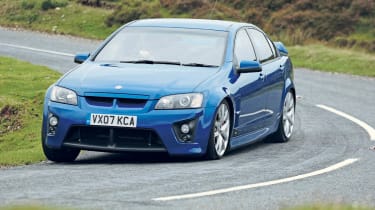
Vauxhall VXR8
It’s only just arriving in UK dealerships, but we would like to propose a name change for Vauxhall’s flagship performance car. The VXR8 tag is self-explanatory, yet XLR8 (think about it) gives a much better idea of what this machine is designed to do.
Not that the styling leaves much to the imagination. Yes, it has four-door underpinnings (it’s based on the Holden VE saloon), but as with all VXR models, the Vauxhall knows how to make an impression. Big spoilers, gaping air intakes and huge 19-inch wheels set the tone (20-inch rims are £2,500 more). What is surprising, though, is the neat detailing, particularly the LED rear lights.
In typically Australian fashion, what you see is what you get with the VXR8 – and that applies inside as well as out. It’s really practical, with a 496-litre load area and exceptional rear legroom – although the sculpted back bench means a centre occupant will struggle for comfort.
Slide behind the large steering wheel and the newcomer instantly feels more welcoming than the Monaro – not least because the driving position is so much better. No longer is your head crammed against the roof, and the switches and buttons operate more precisely. It comes across as a better-quality product, and while the materials aren’t up to Jaguar’s standards, it seems robustly constructed – certainly more so than the Chrysler.
Even the cabin layout is pleasingly simple, with neat heating controls and useful buttons on the steering wheel. Only the centrally mounted electric window switches and the awkward flush-fitting handbrake take some getting used to.
Peering outside, you’ll see that the door mirrors are small and the tail spoiler cuts off the bottom half of any cars following you. But then, given the might of the Vauxhall’s V8 engine, it’s forward visibility that matters more.
Borrowed from the latest Corvette, the 6.0-litre LS2 unit is not quite as potent as the SRT-8’s 6.1-litre HEMI, yet it still provides more torque than even a V10 BMW M5 can muster.
In fact, our test car probably delivers a bit more, courtesy of the freer-breathing £950 Walkinshaw exhaust fitted to it (and specified by 98 per cent of those who have ordered the VXR8). But the chief benefit of the pricey pipes is the sound.
We usually praise cars that are quiet in our noise tests, but the VXR8’s rumbling note is ever-present and an absolute delight. It’s meatier than the Chrysler’s, and especially good when burbling around town, where it echoes off buildings.
The Vauxhall certainly delivers on the promise of that growl, too. Thanks to good rear-wheel-drive traction, it was the fastest from 0-60mph at the test track, yet it can pull away from standstill in fourth gear. Pick any of the chunky six-speed box’s well spaced ratios and the VXR8 surges on. While the gearshift is long-winded and the brakes don’t provide the precision of the Jaguar’s, it has crisp throttle response and is very satisfying to drive.
And not only in a straight line. True, it’s a great long-distance car, soaking up miles and bumps without issue. But it’s the VXR8’s behaviour on twisting tarmac that impresses most. Although it’s nowhere near as fast and nimble as a Mitsubishi Evo, the car’s light, accurate steering and good balance ensures great manners at the limit. It’s more composed and fun than the Monaro was.
What’s more, the VXR8 is even better value. With a comprehensive equipment tally and a £35,105 price tag, it looks a bit of a steal.
Details
Price: £35,105
Model tested: Vauxhall VXR8
Chart position: 1
WHY: Taking over where the Monaro Coupe left off, the new saloon-only VXR8 promises to be faster and dynamically superior.
Economy
It’s extremely rare that we exceed the claimed combined figure when testing a car, but that’s the case with the VXR8. We bettered the official 18.5mpg result by five per cent, achieving 19.4mpg over the course of 500 miles.
Residuals
Analysts haven’t yet calculated depreciation for the VXR8, but given that the Monaro holds on to 41.1 per cent over three years, we’d expect better than that. Around 45 per cent would be a good guess, meaning a £15,800 retained value.
Servicing
We were unable to get cost estimates from any Vauxhall dealer, but going by the Monaro, they shouldn’t be outrageous – around £250 every 10,000 miles. Only 33 of Vauxhall’s 500 UK main dealers can maintain the VXR8, though.
Tax
Just because these cars wear attractive price tags doesn’t mean they’ll be equally affordable to run. The VXR8 is the cheapest at 113.4 pence per mile, but that’s still more costly than a BMW 550i M Sport – insurance of £900 a year is a big factor.
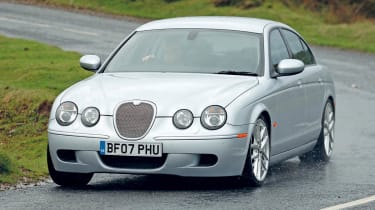
Jaguar S-Type R
Although it’s soon to be replaced by the eagerly awaited XF, the S-Type is still attracting Jaguar’s investment. When the flagship R model arrived in 2002, it cost £47,400. Yet after five years of development and inflation, it’s now cheaper. So, is it a steal, or has time caught up the big Brit?
One thing’s for sure: despite its unique front-end styling, the Jag hasn’t got the macho appeal of its rivals here. It doesn’t come across as either overtly sporting or particularly menacing – in fact, the round headlights and oval grille seem rather effeminate in this company.
Nevertheless, with 19-inch alloys and that distinctive crease down its side, the S-Type isn’t devoid of charisma. Also, it’s the only car to show any interest in aerodynamics – it has easily the most slippery shape, with a 0.32Cd drag factor.
It helps that the Jag is comparatively small, too – the shortest, lowest and narrowest model here. However, that does mean practicality suffers: the shallow boot can only hold 400 litres of luggage, there’s a substantial 10cm less knee clearance for rear seat passengers and it’s hard to get your feet under the low-mounted front chairs.
Not that the person at the wheel will be listening to grumbles. He or she will be enjoying the well bolstered seats and near-perfect driving position.
The layout, however, is dated. The slab of black plastic that forms the central panel is too plain, and although the switchgear is logically laid out and easy to use, it’s rather old-fashioned.
At least it’s well screwed together. While not quite a match for a BMW or Audi, the Jag’s cabin is way ahead of its rivals here in terms of materials and construction. Yet despite these advantages, it’s clear the S-Type R isn’t a genuine muscle car – its sober suit and luxury cabin lack the right attitude.
That’s not to say the Jaguar doesn’t qualify to be in this test. Its V8 is the smallest at 4.2 litres, but what the unit lacks in capacity it makes up for with supercharging. The S-Type R’s power and torque are very competitive, and in a straight line it is no slouch, blasting from 0-60mph in 5.3 seconds. On the road it’s every bit as fast as rivals; in fact, none feels quicker through the mid-range
The trouble is, the engine whines rather than roars – and that means it’s not as satisfying to use as the normally aspirated V8s. But it is smooth, lag-free and mated to a much better auto than in the Chrysler. Despite the box’s ageing J-gate layout, it shifts more sweetly, and doesn’t blunt the performance. The brakes are positive, too, inspiring confidence and stopping the car sooner; it came to a halt from 60mph in 34.4 metres.
But it’s the balance of ride and handling that really sets this car apart. Where both its rivals – especially the SRT-8 – tend to be a touch clumsy, the S-Type R is taut, agile and instantly regains its composure. The steering is possibly the best of any sports saloon – the latest-generation BMW M5 included – and the ride is equally impressive, soaking up B-road punishment and taking the sting out of long motorway stints.
The Jag has more subtle charms than its rivals – it doesn’t create the same level of excitement as the VXR8 – but immaculate road manners mean it still feels thoroughly modern to drive.
Despite the price cut and generous standard equipment, the S-Type R is still rather expensive in this company. But that’s not necessarily its biggest drawback. The question is whether the hugely capable Jag is too sensible to win here?
Details
Price: £45,090
Model tested: Jaguar S-Type R
Chart position: 2
WHY: It may not have the visual impact of its rivals here, but the fine-handling, supercharged Jag has a few tricks up its sleeve.
Economy
The S-Type fell furthest short of its official claim, of 22.7mpg; over 800 miles, we returned 18.8mpg. We topped 23mpg on motorways, yet that dropped to 17mpg when we worked the engine, and its thirsty supercharger, harder.
Residuals
Although the Jag is worth the most after three years, look how much it loses. A drop of £27,415 is the biggest here. The announcement of its replacement, the XF, did the damage. The high price means it has further to fall, too.
Servicing
According to the prices we were quoted by the UK dealer network, if you stump up for an S-Type R, it will cost you well over £300 each time you take it in. And the 10,000-mile service intervals aren’t that special, either.
Tax
As a more established and recognisable mainstream car, you might expect the S-Type to have the lowest long-term running costs. Sadly, this isn’t the case. Heavy depreciation and servicing bills contribute to its 115.1ppm figure.
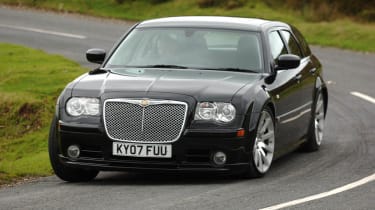
Chrysler 300C SRT-8
Street and Racing Technology. That’s what SRT stands for – and it’s a title that harks back to the glory days of the drag strip. The Chrysler 300C’s styling seems to have its roots in the late Fifties, too. Although it’s not an exclusively retro design, the huge chrome grille, long bonnet and slabby sides mean it’s far from modern. Yet it’s difficult to think of a car that has more road presence.
Despite its 20-inch forged aluminium wheels and modified bumpers, the flagship 300C doesn’t come across as aggressive. It’s certainly not sporty, either. Instead, it’s mean. With narrow windows, deep flanks and huge dimensions, it has more attitude than anything else on the road – it’s the car Batman would drive at the weekend.
There would certainly be room for all his gadgets. The 300C Touring has a large 630-litre boot and a maximum load length of nearly two metres. Rear legroom is plentiful and three fit abreast more comfortably than in the VXR8.
We’re not sure about the two-tone grey and beige door trims, but otherwise the Chrysler’s cabin is more tasteful than you might expect. It’s surprisingly understated and has reasonable stowage, although it’s also cheaply assembled from poor-quality plastics. The trim creaks, the seats are very soft, and the steering lacks reach adjustment. Apart from that, driver comfort is reasonable, but when you’re sitting there, the SRT-8 doesn’t feel particularly sporting.
That changes the instant you fire the 6.1-litre HEMI. It’s not as loud and proud as the VXR8’s engine, but it burbles menacingly, hinting at vast power reserves. Producing 85bhp more than a standard 5.7-litre HEMI, it gives its best when used hard: roaring, bellowing and providing startling acceleration given the car’s two-tonne kerbweight (200kg more than either rival).
Against the clock, the SRT-8 posted blistering times. A hesitant gearbox meant it was slow off the line, but it swept from 30-70mph in only 4.1 seconds and to 100mph in less than 12 seconds.
In day-to-day driving it rarely feels that fast, though. For starters, the 255-width rear tyres struggle with the 570Nm of torque, and the result is wheelspin when simply trying to exit a junction. Nor does the sloppy throttle help. It seems to be connected to the engine by elastic, with a delay between pressing the pedal and any result.
But our biggest gripe is the five-speed auto. While upshifts are quick, when left in self-shifting mode it responds sluggishly. Manual changes (you nudge the lever sideways) are just as late and lazy.
The brakes also fail to shine. The big 360mm front discs are gripped by Brembo calipers, but feel connected to the pedal by another piece of elastic. It’s this lack of precision in the pedals and gearbox that blunts the SRT-8’s edge, making it seem slower than it actually is. The steering is no better, giving you little more than a rough guess at what the front wheels are up to.
Of course, when driven in isolation the 300C doesn’t feel so bad, and it is actually relatively composed through smooth, fast corners. It rides 13mm lower than standard models, plus has thicker anti-roll bars and tauter suspension, but throw in some rough surfaces and tighter bends and the heavy SRT-8 starts to wallow.
The 300C is well equipped and attractively priced, and it is fun, thanks to its dramatic looks and mighty motor. But out on the road, it comes across as loose and old-fashioned to drive.
Details
Price: £41,110
Model tested: Chrysler 300C SRT-8
Chart position: 3
WHY: With lowered suspension and big brakes, the Chrysler looks likely to be an American car that’s not only fast, but drives well, too.
Economy
On paper, these three seem certain to give environmentalists sleepless nights, but their long gearing and low-rev torque means reasonable returns are possible. We averaged 18.6mpg in the heavy, unaerodynamic 300C.
Residuals
The diesel model nearly tops the magic 50 per cent mark for resale values, but all 300Cs fare comparatively well. Still, over 36 months, SRT-8 owners stand to lose £24,049 – which is nearly £10,000 more than the diesel.
Servicing
These days, service intervals of 7,500 miles are a disappointment, especially when many of the SRT-8’s rivals can travel nearly three times as far. However, we can’t fault the low costs – less than £200 per visit on average.
Tax
At 123.9 pence per mile, the 300C SRT-8 is likely to be the most expensive of our test car trio to maintain. Although servicing is cheap and depreciation tolerable, high fuel, insurance and tax costs do the damage.