Cupra Raval review
Cupra’s smallest model blends sporty cues with practicality, refinement and value


Our opinion on the Cupra Raval
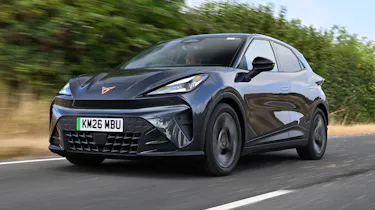
The Cupra Raval is the best small electric car around. It has a temptingly low starting price, competitive range and charging figures, and is simply really good fun to drive. The driving pleasure doesn’t come at too high a cost in terms of comfort, and thanks to a big boot and decent interior space, the Raval is easy to live with. The icing on the cake is that all of this is wrapped in a stylish body.
About the Cupra Raval
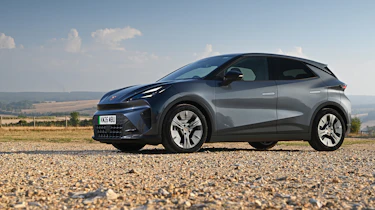
The Raval is currently Cupra’s smallest model, joining the range in 2026 and slotting under the larger Cupra Born. It’s built on Volkswagen Group’s new MEB Entry architecture, and already has one platform mate in the form of the Volkswagen ID.Polo.
Further relatives include the VW ID.Cross and the Skoda Epiq but the Raval is going to be the one to go for if you want a sense of style - it’s a great-looking car that successfully follows up the striking Urban Rebel concept that preceded it.
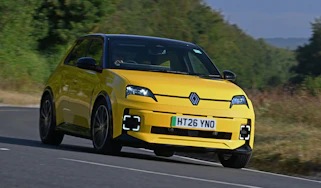
Our expert road testers have already driven various versions of the Raval both at the international launch and on a variety of UK roads. When we tested the Cupra Raval against the Renault 5 in a head-to-head comparison, the Cupra won thanks to its polished driving experience. The Raval also won our 2026 Supermini of the Year crown.
Performance & driving experience
Pros |
|
Cons |
|
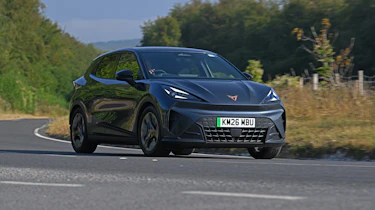
While the range-topping VZ is the hot hatch of the range, you’ll have fun behind the wheel of any Raval, and yet you’ll remain perfectly comfortable. Entry-level versions aren’t hugely quick, but sub-VZ models with the larger battery pack aren’t that far off their pricier siblings.
Performance, 0-60mph acceleration and top speed
All versions of the Raval are front-wheel drive, but the amount of power the electric motor provides increases as you move through the range. The base V1 with the smaller battery has 133bhp and 264Nm of torque, while upgrading to the larger pack also bumps power to a healthy 207bhp, although there’s a more modest increase in torque to 290Nm.
The top-spec VZ is being marketed as the sporty hot hatch, and with 222bhp it all but matches the most powerful version of the Alpine A290, but is behind the Peugeot E-208 GTi. The VZ has the same 290Nm torque figure as the 207bhp version.
One thing that we were impressed with when testing the mid-range powertrain was how easily the car put its power to the road. The front tyres simply dig in and you’re off, without a hint of wheelspin or torque steer, even when using full throttle out of corners.
This traction helps the 207bhp model manage 0-62mph in 7.1 seconds, and the VZ is 0.3 seconds faster than that. While the base model is lighter courtesy of its smaller battery, its power deficit to the other two models in the line-up means that 0-62mph takes 9.5 seconds, so it’ll still be a decent performer away from the traffic lights.
Cupra’s E-Launch system adds some drama to standing starts, with the cabin lighting, dashboard animations and audio piped through the speakers to emulate a race start.
Town driving, visibility and parking
As well as being responsive away from the lights, the Raval feels nimble when tackling tight urban rat runs. Compact dimensions and good visibility help with road positioning, while the steering is quick to respond to inputs and feels good to use. The 10.9-metre turning circle is nothing special (a Renault 5 turns tighter), but it’s good enough.
Cupra offers D and B drive modes on the steering column-mounted drive selector. The first has different levels of energy recuperation that are chosen via the touchscreen, but we prefer a system that uses paddleshifters, as found in the Kia EV2 and Renault 5.
Selecting B mode activates the Raval’s one-pedal driving setting. It’s easy to get along with, so much so that using the accelerator around town to adjust the car’s speed soon becomes second nature, although it does make for a jerky drive at higher speeds.
Country road driving and handling
Although the Raval is good around town, it’s equally at home on faster, more challenging roads. Strong mid-range acceleration means that getting up to speed is a doddle in the 52kWh cars, while the weight of the battery low in the chassis helps the Cupra to feel settled on bumpy lanes. The steering is direct and has decent weight, although there isn’t much feedback to be had.
Adaptive dampers are fitted as standard to the VZ model, and these broaden the Raval’s range of ability, while an electronic limited-slip diff boosts its cornering agility.
Range, Comfort, Performance and Cupra Individual drive modes are offered, with the latter delivering a distinct change in the way the Raval behaves, but not necessarily for the better. The throttle and brake pedals are far sharper so they deliver a sportier feel, but we found them hyper-sensitive – so much so that you have to be very delicate with your inputs.
Motorway driving and long-distance comfort
The Raval’s comfortable ride comes to the fore at the national limit, where it feels stable and refined. There’s a bit of tyre noise to be heard, but overall the Cupra is a quiet cruiser that belies its sporty focus.
| Model | Power | 0-62mph | Top speed |
| Raval 37kWh | 133bhp | 9.5sec | 99mph |
| Raval 52kWh | 207bhp | 7.1sec | 109mph |
| Raval VZ | 222bhp | 6.8sec | 109mph |
“The Raval is a real pocket rocket in its more powerful forms, and all versions are really good fun to drive” - Richard Ingram, deputy editor.
Range, charging & running costs
Pros |
|
Cons |
|
In its lower trim levels, the Raval is inexpensive to buy, but things do get expensive at the top end. Not that this is hugely relevant if you’re a company car user - as an EV, the baby Cupra has the usual rock-bottom Benefit in Kind (BiK) tax rate.
Real-world efficiency is competitive, so if you can keep the Raval charged at home and ideally on an electricity tariff that gives cut-price rates overnight, it’ll be very cheap to run.
Electric range, battery life and charge time
The smallest battery in the Raval is 37kWh in size, and has a claimed range of up to 203 miles. Upgrading to the larger 52kWh pack is a worthwhile investment, because not only do you get more power, but the range increases to a maximum of 276 miles on the WLTP test cycle too. The more powerful VZ offers 239 miles of range with the same 52kWh battery.
When we tested the V1 with the 52kWh battery, we saw an estimated range of 237 miles from the trip computer. Efficiency on a route that included a number of motorway miles was 4.5 miles per kWh, which is good for a range of 234 miles. It’s worth noting a heat pump is optional (£960), so driving range might be impacted in cold weather. The Renault 5 has a heat pump as standard.
The 37kWh models are capped at 88kW, making for a 10-80 per cent charge in 23 minutes. It's only a minute longer for the larger battery, because it can be recharged at up to 105kW.
| Model | Battery size | Range | Insurance group |
| Raval V1/V2 37kWh | 37kWh | 203 miles | 14 |
| Raval V1/V2 52kWh | 52kWh | 276 miles | 20 |
| Raval VZ | 52kWh | 234 miles | 22 |
Insurance groups
Ratings start in Group 14 for the Raval V1 with the small battery, while adding the 52kWh pack bumps it up to Group 20. V2 cars are in the same insurance groups, while VZ and VZ Extreme versions are slightly higher, in Group 22. In comparison, the Renault 5/Alpine A290 sits in groups 18-29.
Tax
Low P11D prices will help the Raval find favour with company car users, where its zero tailpipe emissions mean annual Benefit-in-Kind (BiK) costs are low. But the Renault 5 is cheaper still, if you want even bigger savings.
Depreciation
Residual values increase as you climb the model range, although they are largely similar across the board. The Raval V1 with the 37kWh battery is at the bottom end of the ranking, at just under 46 per cent, while the VZ is marginally stronger than the VZ Extreme, at 47.3 per cent. These figures are well ahead of the Cupra Born (in the 40 per cent range) and are slightly ahead of the Renault 5, too, which is in the 45-46 per cent bracket, but match the Alpine version.
Interior, design & technology
Pros |
|
Cons |
|
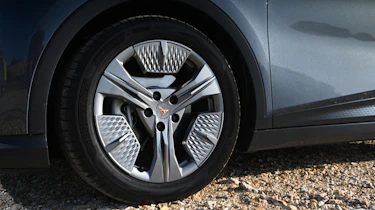
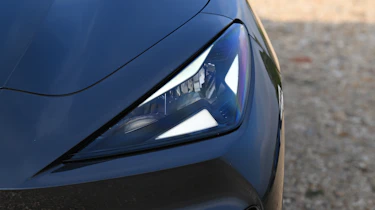
While some rivals go down the retro-inspired route, the Raval is thoroughly modern. It carries many of Cupra’s familiar styling cues, such as bronze badges and detailing, angular bodywork, intricate headlights and funky wheel designs in 18 and 19-inch diameters. In our eyes the Raval looks better proportioned than the larger Cupra Born, although the diffuser in the back bumper is overstyled.
Interior and dashboard design
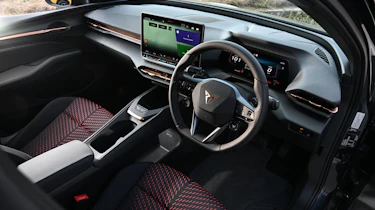
There are more familiar touches inside the Raval, with a sharp fold that runs the width of the dashboard and copper trim for the air vent controls and the tops of the door cards. V1 cars feature fabric upholstery, but it’s nicely made with a bright orange accent that gives it a lift, while the sporty VZ trim adds artificial leather.
Materials and build quality
There’s a carbon fibre-effect finish to the plastic trim that stretches across the width of the dashboard, but it feels a little cheap when compared with the softer material used across the top of the instrument binnacle. There are harder plastics for the centre console and door cards, but they do feel sturdy. There are no glossy materials used inside, so it should stand up to everyday knocks and scratches easily.
Infotainment, sat-nav and stereo
With a multifunction steering wheel and a headlight control panel to the right of that, plus hazard and central locking buttons, but that’s about it. The rest of the cabin functions are operated via the touchscreen, but this is well positioned front and centre of the dashboard.
All cars are fitted with a 12.9-inch display that runs the same operating system as larger Cupra models. The climate controls are a permanent fixture across the bottom of the screen and are easy enough to use, although the sliding temperature and volume controls need something of a delicate touch to operate.
“Like so many modern VW Group cars, the Raval is a little lacking when it comes to proper buttons. We like the stylish nature of the cabin, though, and the quality is mostly decent” - Dean Gibson, senior road test editor.
Boot space & practicality

Pros |
|
Cons |
|
Like any car with this sort of footprint, there are practicality compromises with the Raval, but it’s mostly very impressive, considering. The boot space in particular is a highlight, blowing the meagre offerings of many rivals out of the water.
Dimensions and size
The Raval is a little longer than the class average, but it’s still a very compact car. In terms of width and height, it’s bang average.
| Dimensions comparison | |||
| Model | Cupra Raval | Renault 5 | Mini Cooper E |
| Length | 4,046mm | 3,922mm | 3,858mm |
| Width | 1,784mm (2,000mm inc mirrors) | 1,774mm (2,020mm inc mirrors) | 1,756mm (1,967mm inc mirrors) |
| Height | 1,514mm | 1,498mm | 1,460mm |
| Wheelbase | 2,599mm | 2,540mm | 2,495mm |
| Boot space | 441 - 1,400 (est) litres | 277-959 litres | 210-800 litres |
Seats & passenger space
Large front doors improve access to the Raval’s cabin, and while the Cupra’s sill height is a bit taller than a Renault 5’s, it’s not enough to cause issues when climbing aboard. The driver’s seat benefits from height adjustment, while the reach and rake on the steering wheel can also be set to your liking. The front seats have pronounced side bolsters to give them a sportier feel, although these aren’t big enough to make the seat seem pinched into your sides.
The raised centre console creates a lower storage tray where two USB-C sockets are located, while above there are two cup-holders and a storage tray further forward that incorporates a wireless charging pad. The door bins are long and deep, and able to swallow a decent amount of stuff.
The Raval’s compact dimensions mean there has to be a compromise somewhere to fit everything in, and this is most obvious in the rear seats. The back doors aren’t quite as wide as you’ll find in some rivals, while rear legroom is a little cramped. It seems that Cupra was aware of the latter, because there are no seat-back pockets that could take up even more legroom.
The shortage of rear legroom is the only real issue with cabin space, though, because headroom is generous, there’s plenty of room for feet under the front seats, and the car’s width ensures there’s adequate shoulder room if you’re travelling three-up; it’s certainly more comfortable than an R5 in that regard.
Storage is fine, with door bins that are around half the size of those up front, while rear air vents and twin USB sockets are included, with a slot moulded into the plastic just ahead of them to store a smartphone.
Boot space
The space under the Raval’s bonnet is taken up by the powertrain, but the vast boot makes up for this. Its 441-litre capacity is more than you’ll find in the Cupra Born (that car is compromised by its rear-mounted power unit), and the space is wide and deep. There’s a false floor that offers a level load lip, but even in the lowest setting there’s still a deep storage area beneath it. One issue with this configuration is that the pockets behind the rear wheelarches have open sides, so smaller items are likely to fall into the lowest cargo area.
Towing
The Raval has a braked towing capacity of up to 1,200kg, which is good going in this class. A Renault 5, for comparison, can only haul up to 500kg, while the MINI Cooper Electric isn’t rated for towing at all. It’s possible to add a tow bar preparation to the Raval in the configurator for £165, while the hitch itself is £580.
“Like the related VW ID.Polo, it’s the Raval’s boot space that’s the most impressive part of its practicality offering. In fact, there’s more luggage capacity here than in the bigger, more expensive Cupra Born.” - Dean Gibson, senior road test editor.
Reliability & safety
Pros |
|
Cons |
|
Cupra has an advantage over other Volkswagen Group brands with a five-year warranty that has a 90,000-mile distance limit. There are two years of roadside assistance, too. That’s reassuring when Cupra doesn’t have the best reliability record. In our 2026 Driver Power survey, Cupra finished in a disappointing 28th place out of 30 for reliability. At least, as an electric car, the Raval has fewer moving parts than petrol and hybrid Cupra models, meaning there’s less to go wrong.
Unusually, the Raval has two Euro NCAP ratings, but the higher five-star score applies to all official UK imports, because they come with the predictive adaptive cruise control and forward crash-alert systems as standard; without these, the Raval is a four-star car for safety.
| Euro NCAP safety ratings | |
| Euro NCAP safety rating | Five stars (2026, with Safety Pack) |
| Safe driving | 72% |
| Crash avoidance | 77% |
| Crash protection | 91% |
| Post crash safety | 95% |
Buying, prices and deals
Best buy: Raval 52kWh V1
The range starts with the £26,995 V1, which is £29,995 when paired with the larger battery pack. Its standard equipment list includes 18-inch alloy wheels, electrically adjustable, folding and heated door mirrors, LED headlights, heated seats, a 12.9-inch infotainment system, 10.25-inch digital instrument cluster, wireless Apple CarPlay/Android Auto, dual-zone climate control, adaptive cruise control, front/rear parking sensors, a rear parking camera and keyless entry/start. That’s a pretty comprehensive list of kit, so we think it’s the one to go for, and ideally with the larger battery.
It’s £29,580 for the V2, or £32,580 if you've opted for the larger battery. This trim level adds 19-inch machined silver and black alloy wheels, a 12-speaker Sennheiser sound system, a wireless phone charger, and front bucket seats.
The VZ is only available with the larger battery, and along with its more powerful motor, it adds yet more equipment. Highlights include Matrix LED headlights, interior ambient lighting, electrically adjustable front bucket seats, vegan leather upholstery, pneumatic lumbar support, and adaptive suspension.
The range-topping VZ Extreme swaps the vegan leather for a ‘3D knit’ fabric while adding snazzy copper accents on the wheels, a top-view parking camera, a parking assistance system with remote control and an upgraded driver assistance setup.
You can save by building your new Cupra Raval with the Auto Express Buy A Car service. We also have a range of Raval leasing deals to choose from, and can even help you to sell your car.
Cupra Raval alternatives
The Raval’s closest rival is probably the Renault 5. It’s also very stylish, albeit in a more retro way, and great value. It’s not as practical, though.
The MINI Cooper Electric is another retro-styled rival, but it’s even less practical than the Renault. Should interior and boot space be a priority, look no further than the Volkswagen ID.Polo. It’s built from the same bits and pieces as the Raval, and therefore is similarly brilliant, but puts everything together in a more understated package. It’s a touch more comfortable, as well.
Cupra Raval pictures
Frequently Asked Questions
We’d go so far as to say the Cupra Raval is a great car. It’s good value, has a competitive range figure, is stylish and brilliant to drive. Cupra is onto a winner here.
Deals on the Raval and alternatives