Mercedes GLC Electric review
Mercedes’ mid-size EV is comfortable, hugely spacious and rammed full of tech, an impressive effort

Our opinion on the Mercedes GLC Electric
Mercedes has fulfilled the premium electric family-SUV brief very well with the GLC Electric. First impressions of the somewhat gaudy cabin with its giant screens might put some off but this is an extremely roomy, user-friendly and well-thought out family car. Performance is powerful but the GLC EV is focused on comfort; the ride is smooth in all versions, refinement is strong and it’s easy to drive – there are just better options if you prioritise sharp dynamics.
About the Mercedes GLC Electric
Given the undying popularity of SUVs and the urgent need to sell EVs, the latest Mercedes GLC is a car sitting at a crucial crossroads for its maker. The petrol, diesel and plug-in hybrid SUV has been a monster seller for Merc, so this electric version, running on the new MB.EA platform, absolutely has to hit the mark.
The potential problem is that a lot of other brands are also trying to carve out a piece of this market. The BMW iX3, Volvo EX60, Porsche Macan and others will have to be matched or bettered if buyer heads are to be turned in sufficient quantities. To do this, Mercedes has piled on the technology, turned on the style and kept at least half an eye on value for money.
Used - available now


We’ve tested the GLC Electric on the international launch in Germany with the adaptive Airmatic suspension fitted, and then again in the Surrey Hills where we put both the air suspension and the standard coil springs to work on some rough British B-roads.
Mercedes GLC Electric prices and latest deals
The GLC starts from £60,000 in Sport trim and then you can climb the range to AMG Line, AMG Line Premium, AMG Line Premium Plus and Premier Edition models. A single motor model is expected in the fullness of time. The Refinement Package adds the Airmatic air suspension and rear-wheel steering for £2,500 and is worth considering, as we’ll explore.
Performance & driving experience
Pros |
|
Cons |
|
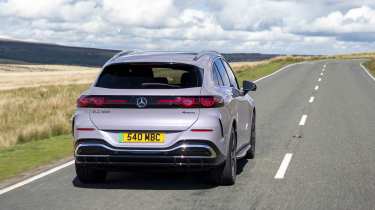
To begin with, all GLC Electric models get the same powertrain with two motors taking an axle each to deliver all-wheel drive. There’s an unusual two-speed gearbox where most EVs have one, plus what Mercedes refers to as its One-Box braking system.
The latter is effectively ‘brake-by-wire’ with no physical connection between the pedal and the brakes themselves. It’s all handled by a single computerised box of tricks that blends the regenerative and physical braking functions based on input from myriad sensors with the aim of giving consistent pedal feel regardless of the mode you’re in.
While not the last word in feel, they are powerful and consistent, giving you lots of confidence when slowing the 2.6-tonne car. The strength of the regenerative braking function is controlled by steering wheel paddles and its strongest mode is easily enough for one-pedal driving in town. If anything, on our test it seemed too grabby at low speeds, stopping the car too soon when you want to roll slowly up to a junction or roll forward into a parking space.
The best solution is the ‘D Auto’ intelligent mode that monitors various parameters to determine the optimum level of regenerative braking. Most owners will find themselves sticking in this setting as it feels very natural across the board. Generally the braking system works seamlessly and justifies Mercedes’ investment in the technology.
Performance, 0-60mph acceleration and top speed
| Model | Power | 0-62mph | Top speed |
| GLC 400 4MATIC Electric | 482bhp | 4.3s | 130mph |
The GLC Electric is quick in all forms. The 4.3-second 0-62mph time is rapid, even in our crazy age of electric family cars that can humble top tier petrol performance models of yesteryear. But Mercedes has calibrated it all very sensibly.
The experience isn’t one of the car straining at the leash. The accelerator pedal is easy to modulate for a gentle cruise, a progressive surge of power or even that stomach-turning lunge YouTube reprobates like to terrify their grannies with. There’s loads of grip and we had no issues deploying the power on the dry roads of our tests.
Town driving, visibility and parking
Models on air suspension obliterate bumps that bit more effectively in Comfort mode, with the system using Car-to-X technology that can receive information on upcoming speed bumps or expansion joints from Mercedes cars ahead or traffic infrastructure. Google Maps and sensor data is also used to automatically adjust the ride height.
The biggest boon for town driving, however, is the rear-wheel steering system that comes bundled with it in the Refinement Package and can turn the back wheels up to 4.5 degrees. It reduces the turning circle and can tuck the GLC around a mini-roundabout with an agility owners of most other 4.8m-long SUVs can only dream about.
Rear visibility is not great but you get a rear-view camera as standard with all-round parking sensors. There’s also a 360-degree camera system on AMG-Line Premium models that pops various external camera feeds up on the main screen when appropriate.
Country road driving and handling
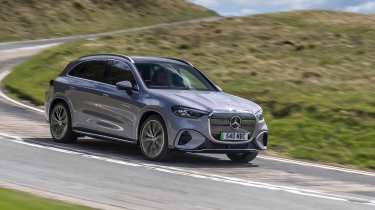
Out on the open road the Comfort setting starts to get a little floaty over undulations and you may want to tie things down a little with a switch to the Sport mode, which is still far from uncomfortable. On the versions with standard springs the all-round balance is probably better; the GLC feels slightly more tied down but also less unflustered by bad surfaces or odd cambers.
There is a significant amount of lean through corners and rapid changes of direction. Here, and under braking, you start to feel the weight of the car which is otherwise well hidden by the low centre of gravity generated by the battery in the floor.
The steering isn’t particularly direct, even in Sport mode. In fact, there isn’t a huge amount of difference in the pointiness of the steering, just a little extra weight as you cycle through the settings. It’s possible to get a nice fluent feel on B-roads but it’s ultimately not the most dynamic or engaging drive in the class.
Motorway driving and long-distance comfort
Once you get up over 50mph or so the near silence is broken by some road roar and wind noise that builds with speed but this is still a highly refined car with not a whisper from the motors. This would be a fine long distance companion where the easy-going nature can come to the fore.
“That rear-axle steering is a bit of a life-saver during low-speed manoeuvres. The system isn’t as aggressive as the 10-degree system on the EQS, but the 4.5-degree angle reduces the turning circle by almost a metre to 11.2 metres.” - Alastair Crooks, senior staff writer.
Range, charging & running costs
Pros |
|
Cons |
|
Mercedes’ latest EV technology ensures the GLC is competitive with the premium class best in terms of charging speeds and we’re likely to see longer ranges when a single-motor model emerges.
As it stands, the exclusively dual-motor, all-wheel-drive model range peppers the 400-mile mark in terms of official range from the 94kWh battery with variations depending on specification. That’s down on the 500 miles the BMW iX3 manages on the same WLTP tests with its 112kWh battery but on a par with the closely matched Volvo EX60, which gets 410 miles from a 95kWh battery.
On our tests, as is the norm, the indicated range didn’t live up to the official test results. We were seeing a range of around 250 miles on a full charge in temperatures close to 20 degrees celsius. Range seemed to decline broadly in line with battery charge and it’s likely that better returns would be achievable in cars that hadn't been driven by leaden-footed journalists. At least it charges quickly: the GLC will hit 330kW at the right charger, enough for a 10-80 per cent top-up in 22 minutes.
You get a heat-pump as standard to help the car maintain efficiency in cold weather and bi-directional charging that allows the car to act as a battery, feeding power back to your home or the grid.
| Model | Battery size | Range | Insurance group |
| GLC 400 4MATIC Electric Sport | 94kWh | 406 miles | 50 |
| GLC 400 4MATIC Electric AMG LIne Premium | 94kWh | 398 miles | 50 |
Insurance groups
Every Mercedes GLC Electric is in the highest group 50 for insurance, which is a drawback of the kind of performance on offer here. Rivals do a little better but not much, with an equivalent BMW iX3 in group 44 and the Volvo EX60 sitting in group 43 in a similar spec.
Tax
All models will incur the luxury car tax which comes in at the £50,000 mark for EVs, and will pay a £440 premium (£640 total) on the basic VED road tax in years two to six. Company-car drivers are pushed very strongly towards EVs by the tax bands these days and the GLC will be an attractive option for many business users.
Depreciation
It’s the base Sport models in the GLC Electric that hold their value best with predicted residuals of up to 54 per cent after three years and 36,000 miles. The Top spec Premium Edition cars retain 51 per cent of their value. These numbers are slightly better than you’ll see with more expensive versions of the petrol GLC and similar to the BMW iX3.
Interior, design & technology
Pros |
|
Cons |
|
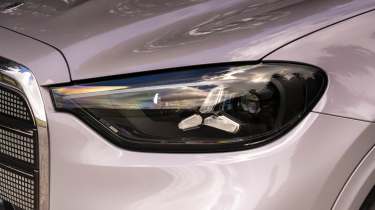
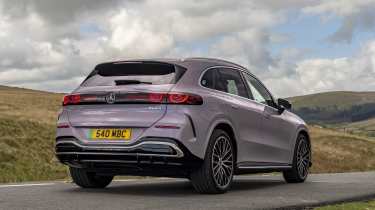
While BMW often gets hauled over the coals by internet critics for the bold adventures embarked upon by its design department, Mercedes tends to play it safer. The GLC Electric is the classical Mercedes mid-size SUV shape with a chunky chrome grille (backlit by hundreds of small LEDs) dominating the front end and a thick black bar incorporating the light units running across the rear. We’ll let you be the judge of how successful it is.
What Mercedes has definitely managed to do successfully is ensure that the entry level models don’t feel like poor relations to the higher spec cars. There’s a £13,000 price difference from top to bottom of a range with one powertrain option but the cheapest Sport models can hold their own inside and out – particularly because they get proper door handles rather than the pointless pop-out ones higher up the range.
Interior and dashboard design
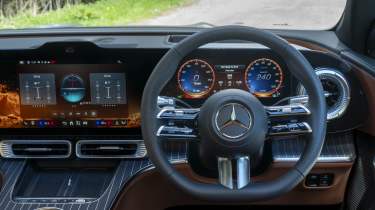
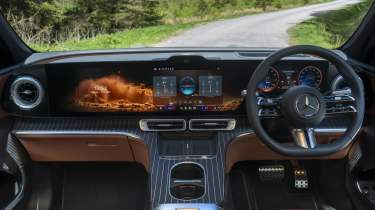
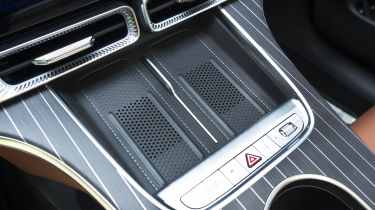
As is the way with modern Mercs, the cabin is dominated by a giant bank of screens running across the entirety of the dash. There are different levels of functionality as you ascend the range but this uniform look is applied to all models. There’s a high centre console with a wide charging pad for two phones under the central air vents. Two more giant vents like jet engines are positioned at either end of the screen.
It’s quite a busy look overall, even with so much space given over the screens there are various different finishes, textures and colourful ambient lighting on higher spec models. It’s in stark contrast to the minimalism favoured by Tesla and so many challenger brands from China.
Materials and build quality
Quality overall is solid, however; even Sport models get leather effect Artico seats and lots of metallic highlights. The door pulls are fashioned from a particularly impressive looking hunk of aluminium and even the plastics low down around the door pockets are of reasonable quality. You can actually order a certified completely vegan interior for the GLC Electric, which feels slightly at odds with the prevailing techno-modern ambience of the cabin.
Infotainment, sat-nav and stereo
We’ve seen Mercedes’ massive screens before in other models but they can still provoke a sharp intake of breath from anyone unprepared for their sheer size. In the base cars the unit looks like a single screen but is in fact a 10.3-inch driver’s display, a 14-inch central touchscreen and a 14-inch panel on the passenger's side. At the next level, the passenger screen becomes a touchscreen, while top-spec cars get the full-on Hyperscreen: a 39.1-inch single unit.
Thankfully, all this digital real estate is not just for show. The latest MBUX infotainment is fast and intuitive to use, the screen responding to presses with a satisfying click. The graphics are clear and there are bars along the base of the screen that keep commonly used controls in a fixed position.
Mercedes has also kept plenty of controls outside of the screen. Switches on the door move the seat, and a joystick on the steering column adjusts the wheel into position. There’s a button to select the drive modes and more on the steering wheel for the cruise control and stereo.
The steering wheel in the standard models actually has buttons annoyingly placed under your palm when you hold it in the traditional ‘quarter to three’ position. The double-spoke design on high-spec cars has much more space for you to hold it comfortably without accidentally pressing buttons.
“To ensure the driver isn’t distracted, there is a camera monitoring their eye movement, so if you stare at the passenger display screen for more than a few seconds it'll turn off. Yet what’s more amazing is that you can glance at the far wing mirror and the camera will be able to make the distinction.” - Alastair Crooks, senior staff writer.
Boot space & practicality
Pros |
|
Cons |
|
The front seats are split by a high, wide centre console that dominates the front of the cabin, creating distinct driver and passenger areas. This may make the driving position feel a little snug for some drivers as your left knee can rub against the console. But everything else about the GLC interior feels roomy and storage is surprisingly good for a premium car.
A very large space under that high centre console could take a handbag or other large items, plus there’s a deep bin under the central armrest. Together, they give loads of capacity for your clutter. But that’s not all, as there are decent-sized door bins in all four doors and front cupholders that adjust to fit different sized drinks – although larger bottles will have to go in the door pockets.
Dimensions and size
The Mercedes GLC is a big car, the same length as the previous-generation GLE from the class above, but also very close in size to the BMW iX3 and the Volvo EX60, it seems this is what the mid-size premium SUV class has grown to become. The Mercedes is the biggest of the three by a few millimeters in every direction and does a good job of translating its exterior size into interior space.
Dimensions comparison | |||
| Model | Mercedes GLC Electric | Volvo EX60 | BMW iX3 |
| Length | 4,845mm | 4,803mm | 4,782mm |
| Width | 1,913mm | 1,908mm | 1,895mm |
| Height | 1,644mm | 1,635mm | 1,635mm |
| Wheelbase | 2,972mm | 2,970mm | 2,897mm |
| Boot space | 570litres | 523litres | 520litres |
Seats & passenger space
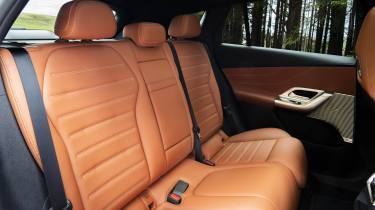
The front seats are firm and comfortable but the AMG Line sports seats on all bar the entry-level cars give much better side support. There’s a good amount of adjustment in the seat for those with longer legs or who want a less upright driving position but the steering column reach adjustment isn’t quite as generous and may limit how far back you can go.
Headroom is absolutely massive front and rear. Even with the full length ‘Skycontrol’ panoramic glass roof that’s fitted as standard, a six-foot tall driver could wear a five-inch hat without squishing it into the electrically opacifying glass.
In the back this prodigious headroom and the light from the glass roof add to the spacious feel. A six-foot passenger can sit behind their own driving position without their knees touching the seatback. There’s plenty of room for your feet under the front seats as well, but the middle seat on the rear bench is quite narrow so travelling three up for long distances may be a problem.
Boot space
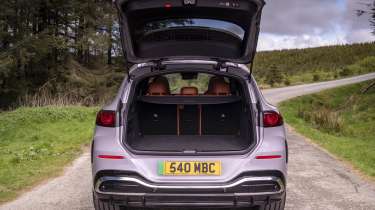
At 570 litres, the boot is around 50 litres bigger than the iX3 and EX60. There’s a wide space with no loading lip and flat sides other than the recesses for netted side pockets. Fold the seats down, which can be done from handy buttons in the boot area, and you have 1,740 litres to play with. There’s a huge 128-litre frunk accessed with a push of the Merc badge on the nose, as well.
Towing
There was a time when most EVs couldn’t pull the skin off a rice pudding but that is changing and the GLC’s novel two-speed gearbox helps it offer a 2.4-tonne braked trailer towing capacity. It’s still not a patch on the 3.5 tonnes you can pull with the best big diesel SUVs, but it’s enough for a mid-sized caravan or horse box.
There are special stability control modes that can be engaged via the touchscreen when towing that adapt to the type of trailer, plus Trailer Manoeuvring Assist that can control the steering as you reverse park with something hitched up.
Reliability & safety
Pros |
|
Cons |
|
As you’d imagine given the amount of technology features crammed into this car, there’s no shortage of safety kit and driver aids. Mercedes has made the majority of its core driver-assistance systems standard so all GLC Electric models get Blind Spot Assist and Active Lane Keeping Assist to watch over you on the motorway, plus Brake Assist and Traffic Sign Assist to monitor the speed limits.
In addition, all cars get automatic parking assistance and the Mercedes Pre-Safe system that primes safety tech if a potential accident is detected. The Mercedes GLC Electric hasn’t been tested by Euro NCAP yet but we would expect a high score in light of all this. The car is also too new to have appeared in our Driver Power survey but Mercedes came an excellent second out of 31 car brands in our 2025 manufacturers survey with a score of 89.26 per cent.
| Euro NCAP safety ratings | |
| Euro NCAP safety rating | n/a |
| Adult occupant protection | n/a |
| Child occupant protection | n/a |
| Vulnerable road user protection | n/a |
| Safety assist | n/a |
Buying and owning
- Best buy: Mercedes GLC 400 4MATIC Electric Sport
There’s just one powertrain for now so choosing the right GLC for you will come down to specs. The entry-level Sport model doesn’t look or feel hugely inferior to the higher-spec cars and comes with a very generous equipment list. It also has the best residual values of the range.
The AMG Line models have nicer seats and a more comfortable steering wheel that is well worth having. But at £3,000 extra it’s quite a jump. The other option to consider is the £2,500 Refinement Package (air suspension and rear-wheel steering); this feels like a better investment because it genuinely enhances the way the GLC Electric drives.
Mercedes GLC Electric alternatives
The obvious rivals to the Mercedes GLC Electric are the BMW iX3 and the Volvo EX60, not least because all emerged onto the market at around the same time. True to form, the BMW is the sharper drive and it also does a good job of competing with the GLC on the technology front while beating it on charging and range. It’s less comfortable though.
The Volvo is very comfort-focused and has a more minimalist Scandinavian cool interior but is the least dynamic of the three, despite matching them on straight-line performance. Keen drivers will also look to the Porsche Macan Electric or even the Alpine A390, though these are less practical than the others for families.
Mercedes GLC Electric review pictures
Deals on the Mercedes GLC Electric and alternatives