MINI Paceman vs Range Rover Evoque: 2013 twin test
The MINI Paceman goes head-to-head with the Range Rover Evoque

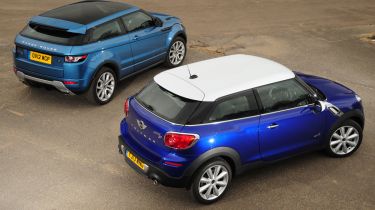
MINI sold more cars in the UK last year than ever before, but the company believes that the new Paceman has the right blend of ingredients for it to achieve even greater success.
The newcomer is based on the Countryman, but mixes crossover practicality with coupe style and MINI character in an attempt to emulate the design-led success of the Range Rover Evoque.
But can the seventh MINI in the range rival the pioneering coupe SUV – crowned Auto Express Car of the Year in 2011 – and offer a cheaper alternative?
The £24,290 Cooper SD ALL4 sits at the top of the model range, and comes with four-wheel drive and a 141bhp 2.0-litre diesel engine.
You’ll need an extra £5,905 to step up to the Range Rover, but even then you only get on the bottom rung of the ladder with the front-wheel-drive 147bhp eD4 model.
So which is the better choice? And is the Paceman the best variation on the MINI theme yet?
Verdict
Both the cars in this test display the traits that make their brands so popular. The Evoque mimics the relaxed persona of bigger Range Rovers, while the Paceman displays a touch of the youthful exuberance that’s become the trademark of the smaller MINI models.
Used - available now

2024 BMW
1 Series
39,224 milesAutomaticPetrol2.0L
Cash £21,790
2020 BMW
3 Series Touring
66,787 milesAutomaticDiesel2.0L
Cash £16,990
2024 Land Rover
Defender 130
8,656 milesAutomaticDiesel3.0L
Cash £71,750
2020 Mercedes
C-Class Saloon
44,393 milesAutomaticDiesel2.0L
Cash £13,400Yet although the models start from completely different positions, they converge to offer similar amounts of style, desirability and image. The Paceman is the most convincing crossover MINI yet, offering nearly as much practicality as the Countryman, with a far bigger helping of style.
Choose one over the two-wheel-drive Evoque and you can get the versatility and security of four-wheel drive and still save around £5,000 on the price. But the Range Rover is more practical, rides far more comfortably and feels more upmarket than the Paceman, particularly inside.
And while the MINI handles well, it seems a bit cumbersome at low speed. Plus, the gruff 2.0-litre four-cylinder diesel can’t match the Evoque for executive smoothness and refinement – although there’s little between the two cars when it comes to performance on the road.
However, it’s the Evoque that narrowly takes the win in this fashion-conscious encounter. Yes, it’s a lot more expensive, but if you specify a MINI to a similar standard, the price gap narrows significantly. And while it has been around for a while now, it still feels like one of the must-have cars of the moment.
First place: Range Rover Evoque
Our 2011 Car of the Year is still the height of fashion, and the entry-level Evoque eD4 is just as attractive as more expensive models. You have to sacrifice four-wheel drive to get close to the MINI in terms of price, but aside from a lack of winter grip, the driving experience is spot-on. A bigger boot means the Range Rover’s more practical than the Paceman, too.
In 1959, when the original Mini revolutionised affordable motoring with its innovative front-wheel drive packaging, the Series II Land Rover was the standard bearer for 4x4 off-roaders. So it’s a mark of how much the motoring landscape has changed that, in 2013, a front-driven Land Rover faces up to a four-wheel-drive MINI.
While these 21st century offerings are a world away from their trend-setting predecessors, the image created by those illustrious ancestors helps explain why the Land Rover and MINI badges still carry so much kudos today.
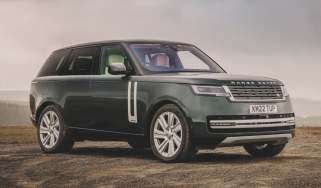
Yet the Range Rover Evoque’s current sales success is as much down to its head-turning looks as its desirable heritage. Fortunately, the entry-level two-wheel-drive eD4 is every bit as stylish as more expensive models.
Even the basic Pure trim gets 18-inch alloys, LED running lights and a roof spoiler. You can also choose a contrasting roof colour for £500 or, for £790, go for a panoramic glass roof, so it’s possible to make the eD4 look identical to the more expensive Dynamic Lux model shown in our pictures.
Inside, partial leather trim and brushed aluminium finishing ensure an upmarket feel. The stacked dashboard design is simple and pleasingly laid-out, while the modern switchgear finishes off the plush ambience. And although the optional touchscreen navigation features dated mapping and is a bit fiddly to use, we don’t have much else to grumble about, as the seats are comfortable and the driving position is excellent.
Once on the move, with light steering and simple controls, the Range Rover is agile and easy to drive. The six-speed manual (not the auto pictured) has a pleasant shift, and the ride is more comfortable than the MINI’s.
With the front wheels doing all the turning and accelerating, there’s a sense of the weight being over the nose, and a front bias to the handling. Still, there’s lots of grip – so much so that the Evoque almost lifts an unloaded rear wheel in extreme cornering. As a result, the 4x4 system will hand the MINI an advantage only in wintry conditions.
And by steering clear of all-wheel-drive running gear, the eD4 emits a gram less CO2, at 129g/km, despite being bigger and heavier than its rival. More importantly, the refined 2.2-litre engine and hushed cabin give it the edge over the MINI for refinement.
Performance is closely matched as well – the Evoque was six-tenths slower from 0-60mph, posting a time of 9.8 seconds, but in-gear response is all but identical, which means there’s little to separate the two on the road.
With a bigger boot and three-seat rear bench, the Range Rover is more practical, too. Add this to its style and desirability, and it could give the car the edge over the cheaper MINI – especially as superb 59.1 per cent residuals help offset the more the car’s higher price and more expensive running costs.
Second place: MINI Paceman
For many people, the Paceman will be a great bargain alternative to the Evoque. It looks great from most angles and the character-packed cabin strikes the right note. All-wheel-drive traction ensures it has the dynamic abilities to keep you going in the winter, while body control and handling are solid. Fixed-price servicing help running costs.
Purists scoffed at the idea of a crossover MINI, but the Countryman accounted for one in three models the brand sold in the UK last year – so clearly the marketing men got it right, which bodes well for the Paceman.
The car shares its underpinnings with the Countryman, and has an identical wheelbase, but stands out with its sweeping roofline, wraparound tail-lights and curved rear arches. Smart detailing and the usual range of MINI personalisation give it even more appeal.
Inside it’s all familiar MINI, with a dash that’s centred around the massive speedo and lots of retro design touches. Plenty of seat adjustment and a smart three-spoke multifunction wheel ensure driver comfort is good, plus raised SUV-like seating makes for excellent visibility through the curved screen.
As you’d expect for a MINI, build quality is top-notch, plus novel toggle switches and swanky mood lighting help the cabin rival the feelgood factor of the Evoque. Still, a few hard plastics mean it doesn’t feel quite as upmarket as the more expensive Range Rover.
On the plus side, the Paceman is one of the most practical cars to wear a MINI badge. In the back are two individual seats and, while clambering in is tricky, there’s enough legroom for adults.
Anyone stepping up from a MINI hatch will be happy at the space on offer – despite the sporty roofline, there’s just enough headroom, while bigger side windows and a wider rear screen mean it feels airier than the back of the Evoque Coupe.
There’s a sliding rail down the centre of the cabin, to which you can attach a sunglasses case or cup-holders, but the 330-litre boot capacity is relatively small for a car of this size.
However, it’s that famous smile-a-minute MINI driving experience that will attract a lot of people to the Paceman – and overall, the newcomer doesn’t disappoint.
For starters, it’s superbly engineered, and the controls are responsive. You get a snappy gearshift, positive throttle response and weighty steering – all of which are taken up a notch by the Sport button.
Turn-in is positive and body control good, while there’s plenty of grip and obviously no issues with traction. You can feel the higher centre of gravity and extra weight of the 4x4 drivetrain, but there’s still a taste of the MINI hatchback’s enthusiasm and agility.
Yet, weirdly, it doesn’t feel as light on its feet at low speed as the 205kg heavier Range Rover, plus the Paceman follows cambers in the road and feels a bit edgy compared to the more relaxed Evoque.
The MINI gets sports suspension as standard, but you can have a softer set-up as a no-cost option – we’d recommend this as it takes the edge off the ride stiffness without any obvious negative effect on handling. But even without it, the Paceman is firm and the Range Rover is more composed over bumpy tarmac.
With noticeable rattle at low revs and an intrusive drone on the motorway, the MINI’s engine refinement disappoints, too. At least performance is closely matched to that of the front-wheel-drive Evoque eD4, while CO2 emissions of 130g/km are just 1g/km dirtier. And the standard stop-start system helped the Paceman deliver respectable test economy of 42.6mpg.
Yet it’s the £24,290 price that gives the MINI an advantage in the value stakes, as it undercuts the Range Rover by £6,000. It’s worth noting our car had the Chili pack, an extra £2,445, while adding individual options can send the price to within a few hundred pounds of the better-equipped Evoque.
Still, fixed-price servicing and decent residuals make the MINI a strong ownership prospect. And don’t forget you get four-wheel drive, which will pay dividends each winter.
Facts and figures
| MINI Paceman | Range Rover Evoque | |
| On-the-road price/total as tested | £24,290/£30,975 | £30,195/£30,195 |
| Residual value (after 3yrs/30,000) | £13,262/54.6% | £17,845/59.1% |
| Depreciation | £11,028 | £12,350 |
| Annual tax liability std/higher rate | £1,018/£2,036 | £1,266/£2,532 |
| Annual fuel cost (12,000/20,000 miles) | £1,831/£3,052 | £2,179/£3,632 |
| Ins group/quote/road tax band/cost | 19/£397/D/£105 | 28/£546/D/£105 |
| Cost of 1st/2nd/3rd service | £249 (5yrs/50k) | £420/£500/£420 |
| Length/wheelbase | 4,115/2,596mm | 4,355/2,660mm |
| Height/width | 1,522/1,786mm | 1,605/1,965mm |
| Engine | 4cyl in-line/1,995cc | 4cyl in-line/2,179cc |
| Peak power | 141/4,000 bhp/rpm | 148/4,000 bhp/rpm |
| Peak torque | 305/1,750 Nm/rpm | 380/1,750 Nm/rpm |
| Transmission | 6-spd man/4wd | 6-spd man/fwd |
| Fuel tank capacity/spare wheel | 47 litres/sealant | 64 litres/sealant |
| Boot capacity (seats up/down) | 330/1,080 litres | 550/1,350litres |
| Kerbweight/payload/towing weight | 1,465/470/800kg | 1,595/755/1,500kg |
| Turning circle/drag coefficient | 11.6 metres/0.35Cd | 11.3 metres/0.35Cd |
| Basic warranty (miles)/recovery | 3yrs (unltd)/3yrs | 3yrs (unltd)/3yrs |
| Service intervals/UK dealers | Variable/148 | 15k (1yr)/130 |
| Driver Power manufacturer/dealer pos. | 28th/15th* | 25th/20th* |
| Euro NCAP: Adult/child/ped./stars | TBC | 86/75/41/5 |
| 0-60/30-70mph | 9.2/9.0 secs | 9.8/9.7 secs |
| 30-50mph in 3rd/4th | 4.2/7.1 secs | 4.2/7.0 secs |
| 50-70mph in 5th/6th | 8.4/11.2 secs | 8.4/12.3 secs |
| Top speed/rpm at 70mph | 122mph/2,000rpm | 112mph/1,800rpm |
| Braking 70-0/60-0/30-0mph | 52.6/33.0/9.7m | 50.2/35.4/9.3m |
| Noise levels outside/idle/30/70mph | 72/46/64/70dB | 67/48/61/68db |
| Auto Express econ (mpg/mpl)/range | 42.6/9.4/440 miles | 35.8/7.9/504 miles |
| Govt urban/extra-urban/combined | 53.3/60.1/57.6mpg | 47.9/62.8/57.6mpg |
| Govt urban/extra-urban/combined | 11.7/13.2/12.7mpl | 10.5/13.8/12.7mpl |
| Actual/claimed CO2/tax bracket | 178/130g/km/21% | 211/129g/km/21% |
| Airbags/Isofix/cruise control | Six/yes/£210 | Eight/yes/yes |
| Height adjust/leather/heated seats | Yes/£1,250/£250 | Yes/yes/yes |
| Metallic paint/air-con/panoramic roof | £450/yes/£795 | Yes/yes/£790 |
| Park sens/power-fold mirrors/rev cam | Yes/£210/no | Yes/£340/£300 |
| Sat-nav/DAB radio/USB connectivity | £1,345/yes/yes | £1,500/yes/yes |