New Tesla Model 3 RWD 2026 review: slightly less performance at a very competitive price
The entry-level Model 3 might just be the most appealing of them all


Verdict
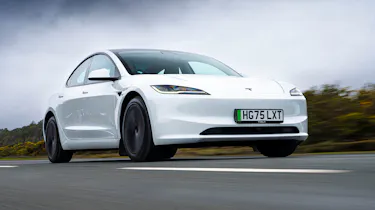
The Model 3 Rear-Wheel Drive is a compelling addition to the saloon car line-up. The only thing it really lacks when compared with other versions is punchy acceleration, and in everyday driving it’s more than fast enough for most needs. The efficient powertrain and pleasant driving experience are welcome, while competitive pricing is the icing on the cake.
While robots and rockets are seen as the bright new future for Tesla and its associated industries, it’s the Model 3 and Model Y that consistently bring home the bacon for the US company. The Model Y is a regular in the top 10 UK sales charts, while regular adjustments to trims and specifications have helped to keep them competitive in the increasingly busy EV sector.
With a wave of Chinese models now coming to market to steal sales from established players – and those sales figures mean that Tesla is now very much part of the establishment – the US firm has seen fit to introduce new value-minded versions of both the Model Y and Model 3. We tried the former at the end of 2025, when it proved to be a better option than the Smart #5 and Kia EV5. Now it’s the turn of the newly launched Model 3 Rear-Wheel Drive to see if it can offer a compelling case for itself.
Used - available now

2021 Tesla
Model 3
52,002 milesAutomaticElectric
Cash £15,290
2023 Tesla
Model 3
53,901 milesAutomaticElectric
Cash £18,081
2023 Tesla
Model 3
26,807 milesAutomaticElectric
Cash £20,823
2021 Tesla
Model 3
17,013 milesAutomaticElectric
Cash £20,040From the outside, there’s not much to give the game away that this is the entry-level Model 3, beyond a black Tesla T on the nose. In overseas markets, the Rear-Wheel Drive comes with 17-inch wheels, but in the UK it sticks with the 18-inch alloys with aerodynamic trims that feature on higher-spec Premium versions. That’s because bigger wheels are more appealing, which boosts the RWD car’s resale values and enables lower finance rates.
On the inside, the makeover hasn’t left the Model 3 feeling quite as spartan as the Model Y. Thanks to the distinct lack of buttons in the first place, it doesn’t feel like a car that’s been stripped of kit, and in reality there are still plenty of goodies to play with. You still get the same large touchscreen, while panoramic glass is still fitted. The big change is the inclusion of part-fabric upholstered seats, but the quality of the materials is good – especially when you consider the issues encountered when the Model 3 first launched, and the artificial leather it’s paired with is soft enough to be almost indistinguishable from the real thing.
The large central touchscreen still dominates the dashboard, but it’s a pretty user-friendly set-up, so much so that you can forgive the lack of smartphone integration. As before, you adjust functions such as the mirrors and steering wheel via the screen, but seat adjustment has also migrated here, too. It’s a logical step, really, because unless the Model 3 is a pool car, it’s unlikely that the seats will be moved much beyond their initial adjustment. Besides, owners are encouraged to pair their cars to their phones, which automatically sets the driving position according to which user has unlocked the car.
The other big change for the Model 3 RWD is a reduction in power when compared with the rest of the line-up. Tesla quotes a 0-62mph time of 6.2 seconds, which is 1.3 seconds slower than the next model in the line-up, and more than three seconds behind the Performance model. However, the RWD is still more than powerful enough for everyday driving. While faster Model 3s have that familiar kick in the back when you floor the throttle, the RWD builds pace more steadily, with a slower start off the line, but more than enough punch once you’re rolling.
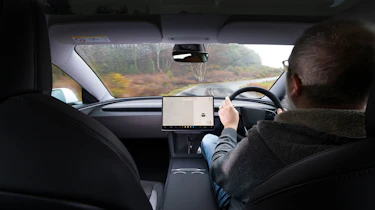
The rest of the driving experience remains unchanged, which is a good thing. There’s a decent balance between comfort and handling, with a slightly firm edge to the ride, but nothing that will cause discomfort because the damping does a good job of soaking up imperfections. The low front end and large glass area make positioning the Model 3 a doddle, although you’re still helped by Tesla’s Autopilot system, with a live feed supplying data of your surroundings on the central screen. And once it becomes approved for use in the UK, you’ll be able to upgrade the RWD model to full Level 5 autonomous driving, just like the rest of the range.
The steering is quick, too, which helps the RWD model feel agile, while the softer throttle response means that there are no concerns about the rear end stepping out of line unless you’re being very heavy on the throttle on loose surfaces. Even then the traction control steps in to take care of things.
Some of Tesla’s more unorthodox driving controls are actually pretty intuitive to use and work effectively. The drive selector, where you sweep a finger up the edge of the touchscreen to select forward and swipe back for reverse, soon becomes second nature to use, and it doesn’t hesitate when you use it. The wiper button on the steering wheel is another piece of tech that works well. Simply press the icon, and a graphic appears in the corner of the screen showing that moving up and down on the scroll wheel chooses your desired mode. The indicator stalk is better to use than the older push-button set-up, although the wand could do with being a bit more positive in its use – there’s a bit of vagueness about it that means you can never be sure if you’ve activated them or just used the brief five-click burst.
Tesla doesn’t quote battery sizes for its cars, but the RWD has the shortest WLTP-tested range of any Model 3, confirming that it has the smallest battery in the line-up. However, an official range figure of 332 miles is still generous when compared with similar rivals, plus you have the benefit of Tesla’s simplified payment system and high-speed Supercharger network. The RWD model has a maximum DC charging rate of 175kW, and Tesla claims that this is enough to add 162 miles of range in 15 minutes. On top of that, Tesla is dipping its toes into the home power market, so you could pay the firm a flat monthly rate not only to charge your car, but also power your entire home.
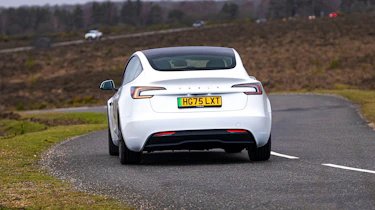
The Model 3 remains efficient, too, with Tesla quoting efficiency of 4.78 miles per kWh. During our brief drive in cold and damp conditions, with no regard for driving efficiently, we saw a return of 3.9mi/kWh – most rivals would only be managing to dip into the threes in similar conditions.
Prices for the Tesla Model 3 RWD start at £37,990, which is £7,000 less than the Premium Long Range, which is the next car in the line-up. But Tesla expects most buyers to purchase a Model 3 on finance, and here the RWD model is an even more tempting proposition. Put down a 12-month deposit, and if you cover 8,000 miles a year, then a personal contract hire plan over 36 months costs £299 for private buyers, while business users will pay even less. You can also save plenty when you build a new Tesla Model 3 through the Auto Express Buy a Car service.
That’s a pretty good deal considering what you get for your money, and should help Tesla keep pace with a fast-changing electric car market.
| Model: | Tesla Model 3 Rear-Wheel Drive |
| Price: | £37,990 |
| On sale: | Now |
| Powertrain: | 62.5kWh battery (est), 1x e-motor |
| Power: | 283bhp |
| Transmission: | Single-speed automatic, rear-wheel drive |
| 0-62mph/top speed: | 6.9 seconds/110mph |
| Range: | 332 miles |
| Max. charging: | 175kW |
| L/W/H: | 4,720/1,933/1,440mm |