New Vauxhall Astra PHEV 2026 facelift review: full EV is the better car
The updated Vauxhall Astra has arrived in the UK, and we try it out in plug-in hybrid form


Verdict
Sizeable discounts make the Vauxhall Astra a very compelling option in the compact family car sector. If you can commit to charging, then the EV is likely to be a better choice than the PHEV, but the latter is a decent stepping stone for those unsure about embracing electrification. A decent driving experience, smart cabin and good build quality boost the car’s appeal.
Family cars are largely SUV-shaped these days, but there’s still space in the market for models such as the Vauxhall Astra. While the Astra used to be a regular near the top of the new-car sales charts, its market share has shrunk due to SUVs’ unstoppable rise, but an update to the eighth-generation car is aimed at boosting its appeal.
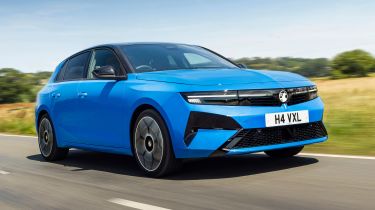
The revisions are subtle, but the most obvious change is on the nose, where a new LED daytime running light signature appears. It’s an upgrade over the set-up used by the Grandland SUV, because the Astra features a permanently illuminated Vauxhall badge and lighting strips day or night, not just when you turn on the lights. Two vertical compass lines above and below the Griffin badge add a crosshair-style look to the front end, too.
Used - available now

2020 Vauxhall
Astra
55,246 milesManualPetrol1.2L
Cash £7,960
2025 Vauxhall
Astra
76,056 milesAutomaticPetrol1.6L
Cash £11,250
2018 Vauxhall
Astra
54,950 milesManualPetrol1.4L
Cash £5,495
2019 Vauxhall
Astra
38,450 milesManualPetrol1.4L
Cash £8,000Other exterior tweaks include new 17 and 18-inch wheel designs, plus the addition of a contrast black roof as standard across the range. Vauxhall’s IntelliLux HD headlights are fitted as standard to top-spec Ultimate variants. These feature more LEDs than ever for a greater spread of light, and offer the ability to pick out objects more accurately when the main beam headlights are activated.
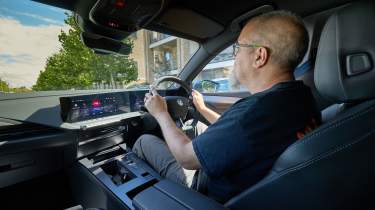
The cabin has been tweaked with the introduction of Intelli-Seats, which feature a recess in the base that’s designed to boost comfort and reduce strain on your back. Seat heating is now standard on all models, as is a heated steering wheel, while the top-spec Ultimate adds a massage function, too. The Astra’s dashboard layout remains largely unchanged, but Vauxhall has ditched the gloss-black centre console trim in favour of a new satin grey finish that should be less prone to scratches.
Tech on board is also updated, with new graphics for the 10-inch touchscreen and driver’s display, while over-the-air updates are included, too. Sat-nav is standard on all cars, as is wireless smartphone connectivity, keyless entry, front and rear parking sensors and adaptive cruise control. Overall, we like the clean dashboard layout, especially the two banks of shortcut keys beneath the main display, but while the touchscreen is angled towards the driver, it’s still a bit of a stretch to reach, especially if you’re tall and have the seat set back.
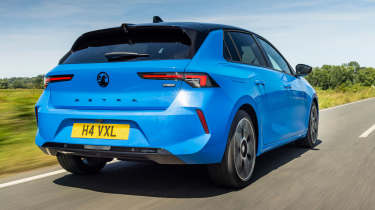
The powertrain line-up is carried over from the pre-facelift Astra, so there are petrol, hybrid, PHEV and all-electric options offered, although one major update is that the EV now has a 58kWh battery, an increase of 4kWh over the outgoing car and good for a range of up to 281 miles.
Five-door hatchback and Sports Tourer estate body styles are also the same as before, but Vauxhall has introduced price parity between them, so you have the option to upgrade to the more versatile load-lugger for no extra outlay.
Sticking with the hatchback, the Astra still looks smart, and is one of the few five-door models on sale that comes with a plug-in hybrid powertrain. It’s carried over from the outgoing car, so there’s a 1.6-litre engine and electric motor that produce a combined 192bhp, and a seven-speed gearbox that gets power to the road. A 17.2kWh battery offers an all-electric range of 52 miles, while charging from a 7.4kW wallbox takes just under three hours. A full charge from a domestic plug is complete in a little under six hours.
As long as there’s charge in the battery, the Astra will favour electric drive over the petrol part of the powertrain. There are three drive modes offered – Normal, Sport and Electric – while an e-Save function is available that allows you to hold six or 12 miles of range in the battery, or keep it fully charged until the energy is needed.
In Normal mode, the combination of petrol and electric power delivers quiet running at lower speeds, with the electric motor doing most of the work. The engine only cuts in when you need stronger acceleration, but it does so with a bit of a lurch that can be unsettling for passengers. However, the engine remains relatively quiet even when it’s at full revs, because sound insulation in the cabin is good – Ultimate models also feature laminated side glass for added refinement.
Sport mode pipes in some artificial engine sounds to give the car a racier character, while the engine stays on at all times to help boost the car’s responses. Use all of the Astra’s 192bhp and 360Nm of torque, and you can sprint from 0-62mph in 7.6 seconds without fuss.
The ride on larger 18-inch wheels is relatively smooth at lower speeds, although bigger bumps do unsettle it somewhat. This character trait improves the faster you go – since the Astra is developed by sister firm Opel in Germany, it will come as no surprise that some urban comfort is sacrificed at the altar of high-speed autobahn stability. Overall, the Astra behaves well, though, with decent steering and an agile chassis that doesn’t sacrifice much in the way of comfort – it’s certainly an antidote to the high-riding, wallowy character of some similarly priced family SUVs. The safety systems aren’t as intrusive as on some rivals, either, with the speed limit warning being subtle in its reminders, although a long press of a shortcut button below the main touchscreen will deactivate the system.
The Astra is a competent all-rounder that is perfectly acceptable family transport, but it doesn’t really stand out in any area, except for price. As already mentioned, you don’t have to pay a premium to upgrade from the hatch to the estate any more, while the range kicks off with the £27,495 1.2 Turbo auto Griffin (an even better value six-speed manual version will be launched later in the year).
Vauxhall has also locked in price parity between the hybrid, PHEV and all-electric powertrains, with all three starting from £29,995 in Griffin trim. This new pricing means the all-electric Astra hatch is now £5,000 less than the outgoing car, while the PHEV has an even bigger saving of £6,000. However, since the Astra Electric qualifies for the Government’s £1,500 Electric Car Grant, it works out even cheaper still, starting at a very competitive £28,495.
Choosing which powertrain works for you will largely depend on your access to charging. If you have a wallbox, then does the electric version make the PHEV unnecessary? And if you haven’t, will you see better overall fuel economy from the hybrid, seeing as you’ll be carrying the weight of the PHEV system without reaping its benefits? Since price parity has been achieved between all three versions, then it’s almost a risk-free decision to see which one works for you.
Did you know you can sell your car through Auto Express? We’ll help you get a great price and find a great deal on a new car, too.
| Model: | Vauxhall Astra 1.6 Plug-in Hybrid 195 Ultimate |
| Price: | £33,995 |
| Powertrain: | 1.6-litre petrol, 1x e-motor |
| Power/torque: | 192bhp/360Nm |
| Transmission: | Seven-speed automatic, front-wheel drive |
| 0-62mph: | 7.6 seconds |
| Top speed: | 140mph |
| Economy: | 122.8mpg |
| CO2: | 50g/km |
| Size (L/W/H): | 4,374/2,062 (incl mirrors)/1,441mm |
| On sale: | Now |