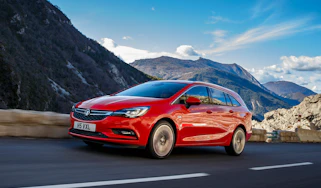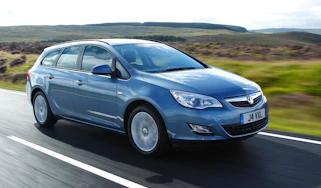
Vauxhall Astra Sports Tourer review
The Vauxhall Astra Sports Tourer is the pick of the Astra range, with a myriad of powertrains to choose from
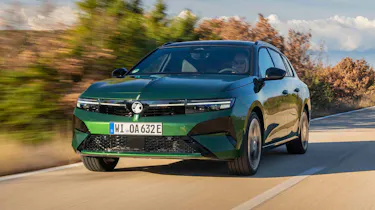

Our opinion on the Vauxhall Astra Sports Tourer
It’s now very difficult to pass on the Vauxhall Astra Sports Tourer in favour of the hatchback due to the price parity between the two. You get more space for the same money, so it’s a no-brainer, really.
The Astra Sports Tourer could still do with a little more rear legroom, and its interior isn’t quite as posh as some of its rivals. However, it’s a well-equipped and respectably versatile estate car with a wide selection of engine choices, ranging from traditional petrol through to an efficient mild-hybrid version for those unable to plug in. There are even company car-friendly plug-in hybrid and fully electric models – the latter of which helps the Astra Sports Tourer stand out against its rivals as being one of the few fully electric estates around.
About the Vauxhall Astra Sports Tourer
Now in its eighth generation, the Astra Sports Tourer (think estate, but with a marginally cooler name) received a facelift in 2026, which not only made it the same price as the hatch, but also aligned the pricing of the hybrid, plug-in hybrid and even the pure-electric. You can get a pure petrol for a little bit less, but pricing is on the Astra’s side no matter which variant you go for, as it all starts from under £30,000.
Used - available now

2019 Vauxhall
Astra
53,318 milesManualPetrol1.4L
Cash £9,197
2019 Vauxhall
Astra
79,094 milesManualPetrol1.4L
Cash £5,845
2025 Vauxhall
Astra
7,753 milesAutomaticPetrol1.2L
Cash £16,074
2025 Vauxhall
Astra
48,636 milesManualPetrol1.2L
Cash £13,199We’ve tried the Astra Sports Tourer in all its guises – whether that’s the 192bhp plug-in hybrid, regular 128bhp 1.2-litre petrol, 143bhp mild-hybrid e-DCT6 or the 154bhp all-electric version.
Performance & driving experience
| Pros |
|
| Cons |
|
Performance, 0-60mph acceleration and top speed
If you’re prioritising outright pace, it's the plug-in hybrid Astra Sports Tourer you'll want to go for thanks to its 7.7-second 0-62mph time. The smoothest-accelerating model in the line-up is the all-electric model, with its e-motor delivering a relaxing drive around town and at motorway speeds. It’s not as sprightly as other family electric hatchbacks, though; the EV3 and Elroq (both of which have at least 201bhp) will reach 62mph in well under eight seconds, whereas the Astra takes 9.5 seconds. The Hybrid 145 takes 9.3 seconds to get from 0-62mph, while the pure-petrol takes almost 10 seconds to reach 62mph - but in truth, neither feels awfully slow.
| Model | Power | 0-62mph | Top speed |
| Astra Sports Tourer 1.2 Turbo | 128bhp | 9.9 seconds | 130mph |
| Astra Sports Tourer Hybrid 145 | 145bhp | 9.3 seconds | 130mph |
| Astra Sports Tourer plug-in hybrid | 192bhp | 7.7 seconds | 140mph |
Town driving, visibility and parking
The Sports Tourer’s ride is fine in urban environments, and is no worse than the Peugeot 308 SW upon which it’s based, because there’s still plenty of suspension travel to soak up the worst bumps - the lower Griffin spec, with its 17-inch wheels, rides slightly better too.
In the Astra Sports Tourer Electric, compared with the Hybrid 145 and plug-in hybrid alternatives, we found the ride was more composed in the EV, possibly due to an extra 200kg of kerbweight.
With light, responsive steering, all Astras feel at home in town, with the PHEV and EV’s torque helping to nip between junctions confidently thanks to their punchy low-speed performance. In the PHEV the electric motor’s assistance helps cover any lethargy in the eight-speed automatic gearbox as it shuffles through its gears.
The power sources don’t always blend seamlessly, though, and it can be challenging to meter out the throttle when pulling away from a standstill. The brake pedal combines motor regeneration with the physical discs and pads, but as with the gearbox and electric motor combination, it results in an inconsistent pedal feel.
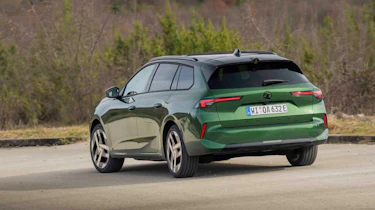
Country road driving and handling
Head out onto faster B-roads, and the high-ish kerbweight of all-electric and plug-in hybrid Sports Tourers results in a ride that has a tendency to fidget on rough roads – and this will only be made worse with larger wheels.
When it comes to its dynamics, all versions of the Sports Tourer feel pretty similar to their Astra hatchback equivalents. There’s safe, predictable handling that feels composed, but doesn’t ever seek to thrill.
Motorway driving and long-distance comfort
The electrified versions of the Astra Sports Tourer are the most refined - including the Hybrid 145 if you’re not booting the throttle and awakening the 1.2-litre unit. Wind and road noise are well dampened too, with the latter improved further if you opt for smaller wheels.
As for the ride, the Astra Sports Tourer tends to crash into potholes rather than filter them out, but a positive of the slightly firmer suspension is that it feels stable on a motorway cruise.
MPG & running costs
| Pros |
|
| Cons |
|
According to Vauxhall, the Astra Sports Tourer petrol models manage 46.3mpg on the WLTP combined cycle, while the most efficient mild-hybrid model manages 58.9mpg. That’s fine, but the hybrid Toyota Corolla Touring Sports offers over 60mpg in both 1.8 and 2.0-litre guises.
Granted, there is the option of a plug-in hybrid Astra Sports Tourer with an overall consumption number of 122.8mpg, but our experience with plug-in hybrid cars suggests you're unlikely to achieve that in the real world. You should get fuel efficiency similar to a traditional diesel car with regular charging, though.
| Model | MPG | CO2 | Insurance group |
| Astra Sports Tourer 1.2 Turbo auto | 47.9mpg | 133g/km | 19 |
| Astra Sports Tourer 1.2 MHEV | 57.6mpg | 109g/km | 20 |
| Astra Sports Tourer 1.6 PHEV 195 | 122.8mpg | 50g/km | 29 |
Electric range, battery life and charge time
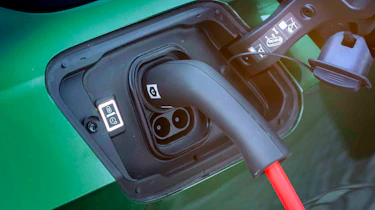
The plug-in hybrid Astra Sports Tourer uses a 17.2kWh battery to provide an electric-only driving range of up to 52 miles, although it does say in the small print that this assumes the vehicle has been pre-conditioned before you've started your journey. Still, it looks likely that you should be able to cover most or all of your daily driving on electric power alone, and when you do need to charge, it should take a typical 7.4kW home wallbox charger around three hours to recharge your car.
The all-electric version used to have a range of 255 miles, but this was bumped up to 276 miles for the 2026 facelift. During our testing, we managed 4.2 miles per kWh across a mix of roads, which would have given us a total range of around 245 miles (five miles more than what we saw in the old Astra Electric).
Unsurprisingly, the electric estate has exactly the same charging time as the hatchback. If you can find a rapid charger capable of supplying 100kWh of charging speed, you should be able to charge from 20 to 80 per cent in less than half an hour. That’s acceptable, but rivals such as the Elroq can charge up to 175kW. Plug in at home, and a 7.4kW charger should be able to refill your electric Astra estate in around eight hours.
| Model | Battery size | Range | Insurance group |
| Astra Sports Tourer 1.6 plug-in hybrid | 17.2kWh | 52 miles | 27 |
| Astra Sports Tourer Electric | 54kWh | 276 miles | 26 |
Insurance groups
Insurance premiums for the entry-level 128bhp Griffin model sits in group 18 out of 50 - one group higher than the hatchback. The base Toyota Corolla resides in group 17, while the SEAT Leon Estate will be far cheaper to insure as it’s in group 14. Moving through the Astra line-up, the Hybrid 145 starts in group 21, while the pure-EV starts in group 26, and the plug-in hybrid starts in group 27.
Tax
There aren’t any major tax breaks for EVs any more, but company-car drivers will at least benefit from low Benefit-in-Kind (BIK) rates tax rates if they opt for the Astra Electric hatchback, and you can read more about that in our dedicated review. The PHEV also brings a reduced rate compared with the regular petrol and hybrid versions, but the savings will be much smaller than those of the fully electric model.
Depreciation
According to our expert data, the eighth-generation Astra Sports Tourer should hold on to 44-48 per cent of its value after a typical three-year/36,000-mile ownership period, with the best version being the electric version in Griffin trim.
That’s on a par with the SEAT Leon Estate and Peugeot 308 SW, although the Toyota Corolla Touring Sports retains between 49 to 52 per cent of its value over the same period, with the 2.0-litre GR Sport model the top performer.
Interior, design & technology
| Pros |
|
| Cons |
|
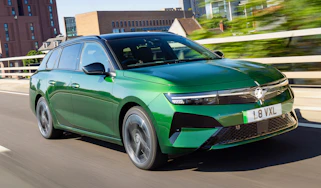
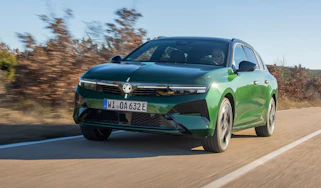
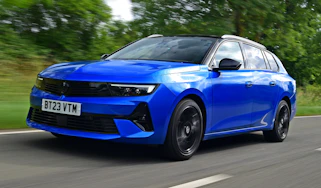
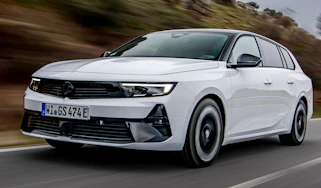
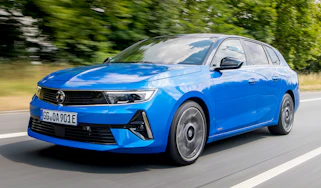
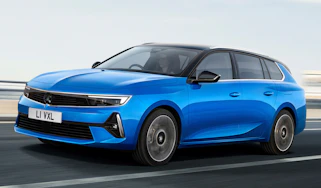
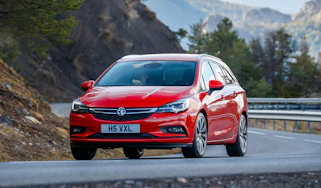
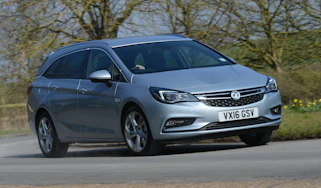
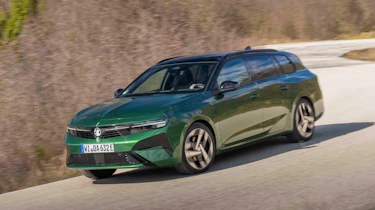
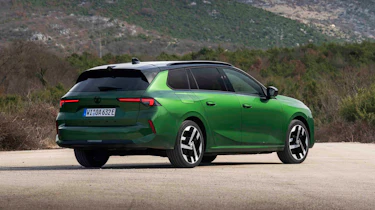
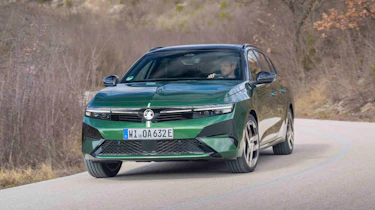
Vauxhall uses words like ‘Bold’ and ‘Pure’ to describe its design language. While we’ll leave you to make your own mind up on the new Vizor grille that now adorns all Vauxhalls, there's no denying it’s a strong departure from the look of the previous-generation car.
The mid-life facelift in 2026 tweaked the Vizor front end with an illuminated badge and extra lights as a stylistic nod to the ‘Opel compass’ seen on last year’s Corsa GSE Vision Gran Turismo concept.
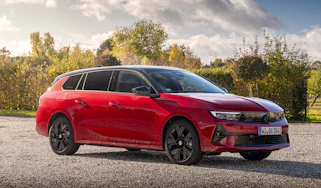
All trims come with a sportier-looking black exterior trim, but you can identify GS and Ultimate thanks to black accents on the bumper, 18-inch wheels and tinted rear windows.
The Griffin trim offers the best value and is our pick of the range. You get a rear-view camera, heated front seats, a heated steering wheel, adaptive cruise control, keyless entry, wireless smartphone charging, Vauxhall’s comfy AGR Ergonomic seats and loads more. Upgrading to GS trim adds some sportier styling touches inside and out, plus a 360-degree parking camera, dual-zone climate control, and ambient interior lighting.
The Ultimate trim we tested gets a head-up display, wireless smartphone charger, plus new heated and massaging front seats. There are also new ‘Intelli-Lux’ adaptive headlights, although we tried them out at night and didn’t find them as precise or responsive as the ‘Matrix’ lights seen on Volkswagen Group cars.
Materials and build quality
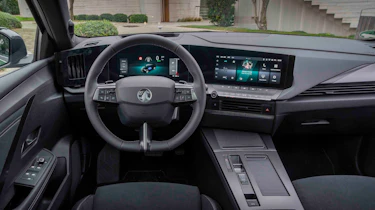
Cabin quality is the same as what you’d find in the Astra hatchback, so there are much plusher materials than the old Astra, with plenty of soft-touch plastics and even some Alcantara inserts on the door cards of Ultimate trim models. It’s let down by cheaper plastics on the centre console and lower door cards, which is disappointing, although the easily scratched gloss piano black trim on earlier models was replaced with satin silver for the facelift.
Infotainment, sat-nav and stereo
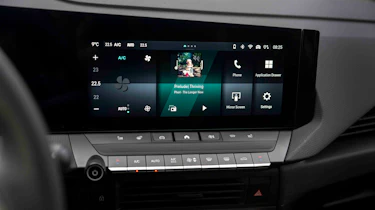
All Astras feature Vauxhall’s Pure Panel Pro infotainment set-up as standard, consisting of two 10-inch screens, one covering media functions and the other a digital instrument display providing information for the driver. Wireless Android Auto and Apple CarPlay are both included, along with a natural voice recognition system that we found to be both intuitive and accurate. However, loading times are a little slow, in our opinion. Plus, we found the auto-dimming of the screens, which occurs when going through short tunnels, can make the screen impossible to read for a few seconds.
The dual-screen set-up looks great when fully illuminated, and the Astra’s graphics look sharp. The reversing camera has superb definition, too. We also like that Vauxhall has stuck with physical shortcut buttons and climate controls that are easier to use when on the move than touch-sensitive sliders, which have been a real bugbear of the Volkswagen Golf. That said, the touchscreen menus aren’t the most intuitive, and some important settings are buried behind multiple screen prods.
The head-up display is excellent because it shows key information and isn’t distracting while driving. We also found adjusting its position to be child’s play because you use the electric door mirror controls to adjust it to your line of sight. Many rivals could learn from this (take note BMW), because you often need to dive into various sub-menus in order to find the screen adjustment menu.
Boot space & practicality
| Pros |
|
| Cons |
|
While the Sports Tourer used to cost more than the hatch, there’s now no reason not to go for the more practical model (unless you can’t fit the estate in your parking space or simply don’t want a car that big).
Interior storage is good with a big cubby located between the front seats, two trays with sliding covers and a fold-out section below the central air vent that can be used to store a phone or sunglasses. Griffin spec models and above feature a front centre armrest with cupholders, a heated steering wheel and heated front seats.
Our preferred Griffin model has front and rear parking sensors and a reversing camera to help out when manoeuvring. The 360-degree parking camera of GS models and above makes things even easier.
Dimensions and size
The Astra Sports Tourer measures 4,642mm in length, is 1,860mm wide (2,062mm including door mirrors), and 1,443mm in height. That makes it 268mm longer than the regular Astra hatchback, although only 57mm of this goes into a longer wheelbase for the estate version.
For context, a Skoda Octavia Estate is longer at 4,698mm, which goes some way into explaining why it offers more space inside.
| Dimensions comparison | |||
| Model | Vauxhall Astra Sports Tourer | Skoda Octavia Estate | Peugeot 308 SW |
| Length | 4,642mm | 4,698mm | 4,635mm |
| Width | 2,062mm | 2,003mm | 2,062mm |
| Height | 1,443mm | 1,468mm | 1,475mm |
| Wheelbase | 2,732mm | 2,686mm | 2,735mm |
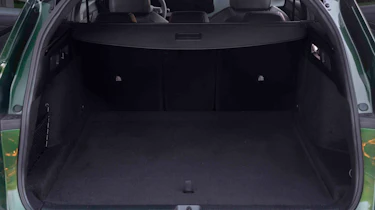
| Boot space | 516-1,634 litres | 640-1,700 litres | 548-1,634 litres |
Seats & passenger space
The Astra’s front seats have certification from the AGR (the Campaign for Healthier Backs in Germany) and include additional adjustments to improve comfort on long journeys.
In the back, the shallow windows let a surprising amount of light in, while headroom should be fine for most. However, if you’re sitting behind a tall person, you may find your knees are either poking their back or straddling the seat, so if you're likely to be putting tall teens or adults in the back regularly, you should look at an Octavia Estate instead. The Astra still provides plenty of room for passengers’ feet under the front seats, though, and the central hump in the floor is much lower than in, say, a Volkswagen Golf.
Two ISOFIX points are provided on the outer rear seating positions.
Boot space
Storage space in the Astra estate is, obviously, much more practical than the hatchback. As a plus point, the 40/20/40 split folding rear seats offer greater flexibility than rivals such as the SEAT Leon Estate, which only offers a 60/40 split. However, its 597-litre capacity isn’t the greatest and comes up short of the 640 litres provided by the Octavia Estate. Dropping the rear seats yields 1,634 litres of space, which is still 66 litres down on the Octavia.
The plug-in hybrid and electric versions have a slightly compromised boot compared with petrol models, with capacity dropping from 597 litres to 516 litres. That’s actually more than you’ll find in plug-in hybrid versions of the SEAT Leon Estate, so it compares well with its closest rivals. Folding all the seats down reveals 1,533 litres of space.
Towing
The 1.2-litre petrol Astra Sports Tourer with a manual transmission can tow a braked trailer that weighs up to 1,200kg. The same 1.2 equipped with an automatic gearbox has the same towing capacity as the plug-in hybrid and GSe models: 1,400kg. The electric version isn’t rated to tow, but you can with the 143bhp mild-hybrid, albeit only up to 1,100kg.
Those are all competitive numbers, but if you need even more capacity, you’ll be better off with either an Octavia Estate or Golf Estate in 2.0 TDI 150 DSG auto form, because both can lug around a 1,600kg trailer or caravan.
“The estate’s interior is familiar, with the obvious addition of a lot more practicality. The PHEV is slightly compromised compared with petrol models, but it’s still a good size and there’s plenty of rear passenger room, so it’ll take care of family duties well.” - Alastair Crooks, Senior News Reporter
Reliability & Safety
| Pros |
|
| Cons |
|
Vauxhall has equipped all Astra Sports Tourer models with lane departure warning and lane-keep assist, speed sign recognition, a driver drowsiness alert, adaptive cruise control, and autonomous emergency braking (AEB). Mid-range GS trim along with a more advanced collision alert system that works at higher speeds, while top-of-the-range Ultimate adds blind spot monitoring and a lane position assist feature.
Unfortunately, the Astra Sports Tourer (just like its Astra hatchback sibling) received a four-star Euro NCAP score. That’s one lower than its SEAT Leon Estate and Skoda Octavia Estate rivals. The safety experts criticised the lack of a central airbag to protect front seat occupants in a side-on collision, and the emergency braking system for its poor response in recognising pedestrians.
While the Astra performed exceptionally well in the 2025 Driver Power owner satisfaction survey, coming in third place out of 50 cars, has since dropped to 27th in our current 2026 results. That still puts it ahead of the VW Golf (41st), but it is disappointing that it has dropped so much.
The Vauxhall brand placed a far more impressive sixth out of the 30 best manufacturers list in the 2026 survey. While the brand posted average scores in the practicality and boot space categories of our questionnaire, owners were happy with the handling, brakes and steering of their cars, while running costs, fuel economy, and insurance costs were also praised.
| Euro NCAP safety ratings | |
| Euro NCAP safety rating | 4 stars (2022) |
| Adult occupant protection | 80% |
| Child occupant protection | 82% |
| Vulnerable road user protection | 67% |
| Safety assist | 66% |
Buying and owning
Best buy: Vauxhall Astra Sports Tourer GS Electric
With so many powertrain options to pick from, the Astra Sports Tourer line-up can look a bit overwhelming, but the 2026 facelift made things a lot easier. The pure-petrol starts off at £27,495, while the three other powertrains kick off at £29,995, rising to £31,495 for GS or the £33,995 Ultimate. There’s no price penalty for buying the Sports Tourer over the hatch, either.
GS trim is the best mix of useful kit and value for money, making it our pick. Due to the hybrid and electric being the same price, and the electric version being only £1,500 more than the petrol, we'd say go for the electric model. Especially if you can take advantage of a cheap electricity rate, because you'll easily make that difference back in lower fuel costs.
Right now, you can enjoy a discount of over £7,000 on the Vauxhall Astra Sports Tourer when you go to the Auto Express Buy a Car service. For even cheaper models, there’s a wide selection of used Vauxhall Astra deals, too.
Vauxhall Astra Sports Tourer alternatives
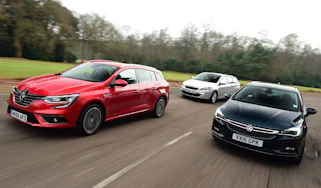
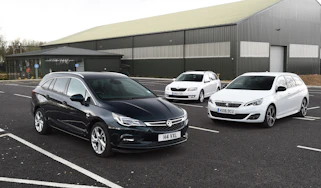
The Vauxhall Astra Sports Tourer is an estate car, similar in size and price to the Peugeot 308 SW, Skoda Octavia Estate, SEAT Leon Estate and Toyota Corolla Touring Sports. Considering practicality, comfort, the driving experience and value-for-money, the Skoda Octavia Estate is hard to beat, but it doesn’t offer the same range of powertrains as the Vauxhall. If you’re set on an electric estate car, the Astra is your best bet at this price point.
Look outside of the estate car market, however, and your options expand dramatically. There are many electric SUVs available today offering similar practicality to the Astra Sports Tourer, such as the Skoda Elroq and Kia EV3. In fact, Vauxhall’s own Frontera is available in petrol and electric guises and features a roomy cabin and a big boot – all for considerably less money than the Astra Sports Tourer.
Deals on the Astra Sports Tourer and alternatives
Vauxhall Astra Sports Tourer pictures
Frequently Asked Questions
All Vauxhall cars are covered by a three-year/60,000-mile warranty. Plug-in hybrid and Astra Sport Tourer Electric models have a separate eight-year or 100,000-mile policy for the battery pack. If the battery’s state of health drops below 70% during that time, Vauxhall will replace it for free.
More reviews
In-depth reviews
Road tests
Which Is Best
Most Economical
- Name1.6 Plug-in Hybrid 195 Griffin 5dr e-DCT7
- Gearbox typeSemi-auto
- RRP£29,880