Vauxhall Astra Sports Tourer Electric 2026 review: plug-in estate makes a lot of sense
Amongst the variety of Astra variants, the all-electric Sports Tourer is the most appealing


Verdict
Mid-life updates to the powertrain for greater range and new kit certainly help keep the Astra Electric competitive - impressive given the model as a whole has to rival bespoke EVs along with combustion-engined alternatives. The Sports Tourer estate also seems like it makes the most sense of the lot, given the Astra’s new price parity approach, but more characterful options are out there if you go beyond estates.
When we first drove the Vauxhall Astra Electric in its Sports Tourer estate guise in 2023, we commented that all-electric wagons are rather thin on the ground. Three years on and things haven’t really changed. Sure, there are many more EVs for sale and in more segments than ever, but as for affordable electric estates there really isn’t too much choice. In fact, the death of the MG5 means Vauxhall’s electric estate car really only has its Peugeot E-308 SW sibling for close company. So is the newly facelifted Astra Sports Tourer Electric good enough to keep this seemingly niche market afloat?
Well, pricing is certainly on the Astra’s side. In a bold move, Vauxhall’s price parity strategy for the facelifted Astra means the hybrid, plug-in hybrid and the electric models all cost the same. Not only that, the hatchback and the Sports Tourer’s costs are identical, too, so there’s a choice of the £29,995 Griffin, mid-spec £31,495 GS or our test car, which is the £33,995 Ultimate.
Used - available now

2025 Vauxhall
Astra
18,218 milesAutomaticPetrol1.2L
Cash £14,940
2019 Vauxhall
Astra
35,715 milesManualPetrol1.4L
Cash £8,108
2023 Vauxhall
Astra
22,324 milesAutomaticPetrol1.6L
Cash £14,396
2025 Vauxhall
Astra
7,533 milesManualPetrol1.2L
Cash £15,105The three powertrains (soon to be four when the pure-petrol joins the range later this year), all offer their own upsides and downsides in terms of running costs and driveability. But as for deciding between the hatchback or the Sports Tourer, unless you can’t fit the estate in your parking space or simply don’t want a car that big, there seems to be no logical reason to not go for the more practical model.
It is noticeably more practical, too. At 4,642mm long compared with the 4,374mm hatchback (all that extra length is provided behind the rear wheels), the Sports Tourer has a 516-litre boot, rising to 1,553 litres with the rear seats down, which can be done in a 40:20:40 split ratio. The Astra Hatchback Electric offers between 352 litres and 1,268 litres in comparison. Given the Astra Electric falls short of its combustion-engined alternatives (422 litres in the hatch and 597 litres for the estate) for boot space due to battery packaging, opting for the estate makes even more sense to offset the EV’s loss of space.
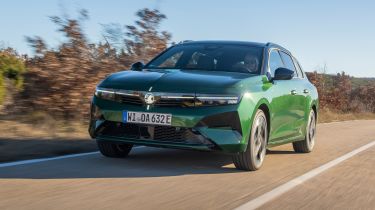
So aside from the keen pricing, what’s changed on this updated Astra? Well, you might need to look closely, but it’s got a new exterior look. The ‘Vizor’ front treatment that adorns all Vauxhalls has been altered with an illuminated badge and extra lights as a stylistic nod to the ‘Opel compass’ seen on last year’s Corsa GSE Vision Gran Turismo concept.
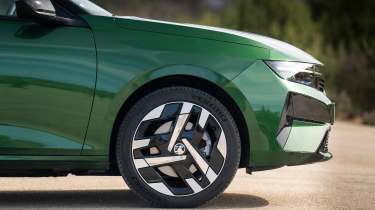
There’s also a new front bumper, with the GS and Ultimate gaining a slightly sportier look with black inserts and bespoke 18-inch wheels for the Electric model, too. Overall, though, the styling hasn’t moved on from the old Astra that much and while it’s neat and inoffensive, rivals (for the Astra Electric hatch at least) such as the Kia EV3 and Skoda Elroq certainly demand more attention.
While those cars and a few others, such as the Volkswagen ID.3 and Cupra Born, ride on a bespoke electric architecture, the Astra Electric makes do with EMP2 – a Stellantis platform that’s designed for both internal-combustion and pure-electric cars. This brings compromises in terms of packaging, but with the Astra, Vauxhall has done a pretty good job.
For starters, there’s a new 58kWh battery – the same unit found in the Peugeot E-408 and the Astra’s sibling model, the Peugeot e-308. The Vauxhall has even more range than its Stellantis sibling, at 282 miles (276 miles in the estate), which is 22 miles more than the previous Astra Electric. It’s also more than you get in the similarly priced small-battery, basic specifications versions of the Skoda Elroq (267 miles) and the Kia EV3 (270 miles).
We achieved 4.2 miles per kWh during a motorway run and around town, which would have given us a total range of around 245 miles (five miles more than what we saw in the old Astra Electric). We’re confident we could have upped the predicted range fairly easily with some more steady miles.
While rivals such as the Elroq can charge up to 175kW, the Astra’s 100kW maximum speed is unchanged from before. With the larger battery this means a 20 to 80 per cent top up takes a few minutes longer than before, at around half an hour. What is new for the Astra Electric is vehicle-to-load functionality, so you can charge appliances from the Vauxhall’s battery.
As for the way the Astra Electric drives, it’s 0.3 seconds slower from 0-62mph than before due to the extra weight of the larger battery, but otherwise it feels the same. The front-mounted electric motor with its 154bhp and 270Nm of torque is certainly responsive enough and delivers a decent amount of shove even up to motorway speeds. But compared with rivals such as the EV3 and Elroq (both of which have at least 201bhp), the Vauxhall isn’t particularly exhilarating in a straight line.
The Astra Electric, like its combustion-engined alternatives, handles in a safe, predictable manner. There’s light, albeit slightly vague steering, but it’s possible to lean on decent levels of front grip, although the Astra isn’t particularly rewarding to drive quickly.
Comparing the Astra Electric back to back with its Hybrid 145 and plug-in hybrid alternatives, we found the ride was more composed in the EV. We put this down to the extra weight (more than 200kg more than the Hybrid 145), counteracting what can be an occasionally choppy ride in the other Astra models.
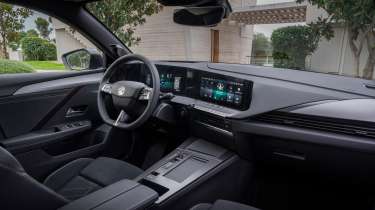
The standard kit is even better on the Astra than it was before. Our Ultimate trim gets a head-up display, wireless smartphone charger, plus new heated and massaging front seats. There’s also new ‘Intelli-Lux’ adaptive headlights, although we tried them out at night and didn’t find them as precise or responsive as the ‘Matrix’ lights from the Volkswagen Group.
| Model: | Vauxhall Astra Sports Tourer Electric Ultimate |
| Price: | £33,995 |
| Powertrain: | 1x e-motor, 58.3kWh battery |
| Power/torque: | 154bhp/270Nm |
| Transmission: | Single-speed automatic, front-wheel drive |
| 0-62mph: | 9.5 seconds |
| Top speed: | 106mph |
| Charging: | 100kW (20-80% in 32 minutes) |
| Range: | 276 miles |
| Size (L/W/H): | 4,642/1,860/1,443mm |
| On sale: | Now |
Latest deals on the Astra and rivals