Volkswagen T-Cross review
The Volkswagen T-Cross is a competent small SUV, but it lacks pizzazz

Our opinion on the Volkswagen T-Cross
The Volkswagen T-Cross has all the fundamentals to provide stiff competition in the compact SUV segment. Among its many attributes are a practical cabin with a sliding rear bench seat, and a strong engine line-up that provides decent performance and fuel efficiency. However, it’s not quite capable of toppling the best in the class when it comes to excitement behind the wheel, and the interior is a little humdrum.
About the Volkswagen T-Cross
The Volkswagen T-Cross started life as a rather left-field concept called the Breeze unveiled at the 2016 Geneva Motor Show. The Breeze looked pretty much identical to the production-spec T-Cross, aside from not having a roof. The Volkswagen T-Roc Convertible filled VW’s drop-top SUV niche a few years later, and the T-Cross took on the popular small SUV segment, first going on sale in March 2019. It’s been well received by buyers, and has only needed minor updates to keep it relevant today.
Over time, the T-Cross line-up has been slimmed down, now featuring four trim levels: Match, Style Edition, Black Edition, and R-Line. The majority of T-Cross models are powered by a 1.0-litre TSI petrol engine that produces either 94bhp or 113bhp, while Black Edition and R-Line models can also be had with a 148bhp 1.5-litre TSI EVO engine. The 1.0 motor comes with a five-speed manual in 94bhp form, or can be paired with a six-speed manual or seven-speed automatic transmission in 113bhp form; the 1.5 is auto-only.
Used - available now

2023 Volkswagen
T-Cross
32,307 milesManualPetrol1.0L
Cash £15,274
2023 Volkswagen
T-Cross
35,659 milesAutomaticPetrol1.0L
Cash £14,920
2021 Volkswagen
T-Cross
13,295 milesManualPetrol1.0L
Cash £14,929
2023 Volkswagen
T-Cross
25,508 milesManualPetrol1.0L
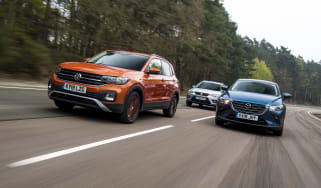
Cash £15,230We've tested the T-Cross plenty of times over the years, and included pitting a pre-facelift VW T-Cross in a triple test against the Citroen C3 Aircross and Skoda Kamiq, and running a 1.0 115PS VW T-Cross as part of our long term test fleet.
Performance & driving experience

Pros |
|
Cons |
|
As you’d expect with most of the brand’s offerings, the Volkswagen T-Cross is a car that you can just get into and instantly feel comfortable with. All of the control weights are nicely matched to one another; the clutch engages smoothly when you press the pedal, the throttle response is consistent through the rev range, and the steering is light and precise. Throw in its compact dimensions, and the T-Cross is a stress-free experience overall.
The VW’s ride is smoother than in a SEAT Arona, but the 18-inch wheels of Black Edition and R-Line models make the T-Cross fidget over low-speed bumps more than the smaller wheel sizes, although the VW does settle down the faster you go. The big wheels increase road noise, too, so refinement on a motorway cruise is better with the smaller 16- or 17-inch wheel sizes certain models get. The six-speed gearbox of the more powerful 113bhp 1.0-litre engine helps to keep the revs lower at motorway speeds than they would otherwise be with the entry-level engine, which only gets a five-speed gearbox. The brakes, meanwhile, feel strong and inspire plenty of confidence for emergency stops.
Performance, 0-60mph acceleration and top speed
The T-Cross’s engine line-up is straightforward: there’s a 1.0-litre turbocharged petrol engine offered with two power outputs (94bhp and 113bhp), and a 1.5-litre petrol unit with 148bhp.
The lesser 94bhp petrol model is okay, particularly if you only intend to drive around town. It accelerates from 0-62mph in 11.3 seconds, and pulls smoothly from around 2,000rpm, even in fifth gear. It will struggle below that point, so steep uphill sections on a country road may need a downshift. Officially, the top speed stands at 112mph.
For most people, we’d recommend the more powerful 113bhp unit. With 200Nm of torque, it's 25Nm higher than in the cheaper model and is available over the same rev range. It’s a similar story when it comes to power: both variants hit peak power at 5,000rpm, but the 113bhp unit can maintain its figure for a further 500rpm. As a result, the engine feels stronger at any speed, as shown by its 10.1-second 0-62mph time and 120mph maximum. The automatic version has a marginally slower acceleration time of 10.3 seconds.
The 1.5-litre petrol engine is only available with Black Edition and R-Line trims, and unsurprisingly, it has the best performance figures of the lot. It takes 8.4 seconds for the 0-62mph sprint, and the top speed is 124mph. The SEAT Arona and Skoda Kamiq both offer this engine, with the SEAT trailing the VW by 0.1 seconds to 62mph, and the Skoda posting an 8.3-second sprint time.
Both the five- and six-speed manual ‘boxes shift smoothly and are paired with a light clutch pedal, which makes driving in heavy traffic easy. The DSG dual-clutch auto, on the other hand, isn’t the best in the business: it can be jerky when parking, and is often slow to kick down when accelerating out of a corner.
| Model | Power | 0-62mph | Top speed |
| Life 1.0 TSI 95PS 5-speed Manual | 94bhp | 11.3s | 112mph |
| Match 1.0 TSI 115PS 6-speed Manual | 113bhp | 10.1s | 120mph |
| R-Line 1.5 TSI 150PS 7-speed DSG | 148bhp | 8.4s | 124mph |
Town driving, visibility and parking
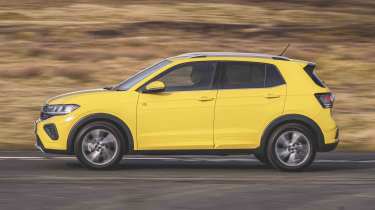
The T-Cross’s supermini DNA makes it a breeze to dart around town in. Light and forgiving controls help to take the sting out of stop-start traffic, while the high driving position provides good visibility all around. This VW’s small size means parking is a doddle by SUV standards, too.
Country road driving and handling
Head out onto the open road, and the T-Cross’s handling is safe rather than entertaining like the Ford Puma. There’s plenty of grip and the balance is neutral, but the steering offers little in the way of feedback. The higher centre of gravity is noticeable when compared to the Volkswagen Polo on which the T-Cross is based, but the driving position is much more like an SUV, so it gives you a good view out.
Motorway driving and long-distance comfort
Every T-Cross engine is capable of taking on motorway runs, but the occasional dim-witted nature of the DSG automatic gearbox can mean overtaking takes a little bit longer than we’d like. Opt for a manual model, though, and there’s a decent amount of shove in all of its six gears.
“When it comes to driving dynamics, there’s not a lot separating the Volkswagen T-Cross from the Skoda Kamiq; unsurprising when you consider they share a platform. Like the Kamiq, the T-Cross has a strong engine, is easy to drive around town and agile when cornering at higher speeds. We especially like the feel of VW’s manual gearbox; it’s light, slick and precise.” - Alex Ingram, chief reviewer.
MPG & running costs
| Pros |
|
| Cons |
|
The T-Cross engine range starts with a turbocharged 1.0-litre three-cylinder petrol engine under the bonnet. The entry-level 94bhp version is paired with a five-speed manual gearbox and manages a claimed maximum of 50.4mpg, with CO2 emissions from 126g/km.
The 113bhp model gets a six-speed manual gearbox, and has a fuel economy figure of 49.6mpg and emissions of 130g/km of CO2. If you opt for the DSG auto, claimed fuel economy drops to 48.4mpg, while CO2 emissions increase to 133g/km.
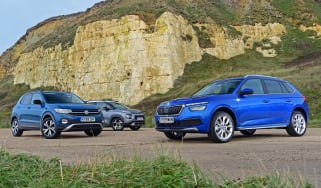
When we tested the T-Cross against the Skoda Kamiq and previous generation Citroen C3 Aircross in a group test, the VW (powered by the 113bhp 1.0-litre engine with six-speed manual) returned an average of 43.8mpg. This was slightly less than the Kamiq, which managed 45.3mpg despite sharing the same powertrain. The Citroen languished behind both VW Group cars, though at just 38.3mpg.
If you need more power, choose the 1.5-litre three-pot turbo petrol engine. VW says this engine will average 46.7mpg and emit 137g/km of CO2, which isn't far off the smaller 1.0-litre engine with the same gearbox. That’s because this engine has clever cylinder deactivation technology that saves fuel when cruising by shutting off two of the engine’s four cylinders when they’re not needed.
The T-Cross isn’t available with a hybrid powertrain, unlike the much more fuel-efficient Renault Captur, or as an EV, such as the Ford Puma Gen-E or Peugeot 2008, which avoid burning fossil fuels altogether.
| Model | MPG | CO2 | Insurance group |
| Life 1.0 TSI 95PS 5-speed Manual | 50.4mpg | 126g/km | 11E |
| Match 1.0 TSI 115PS 6-speed Manual | 49.6mpg | 130g/km | 14E |
| R-Line 1.5 TSI 150PS 7-speed DSG | 46.7mpg | 137g/km | 19E |
Insurance groups
The Volkswagen T-Cross will be relatively cheap to insure, like many of its rivals. Life trim with the lower-powered engine is in group 11, while those fitted with the 113bhp engine are in group 14. On the other end of the spectrum, an R-Line model with the most powerful engine and automatic gearbox tops out at group 19. Equivalent versions of the SEAT Arona are in similar insurance groups.
Check if your car needs an MoT and view its complete history with our MoT History Checker...
Tax
The T-Cross isn’t available with hybrid or electric power, which would give company car users Benefit-in-Kind (BiK) tax savings. All T-Roc models are charged at the standard rate of Vehicle Excise Duty (VED) because no version is subject to the luxury car tax surcharge for cars costing over £40,000 when new.
Depreciation
Our experts predict that the T-Cross will hold onto between 48 and 51 per cent of its value after 36,000 miles or three years, with the 1.0-litre 115 TSI in Style Edition trim expected to retain the most.
That puts the T-Cross on par with rivals like the Citroen C3 Aircross and Toyota Yaris Cross, but behind the Dacia Duster, which retains between 55 and 63 per cent of its original value over the same period.
To get an accurate valuation on a specific model check out our free car valuation tool...
Interior, design & technology
| Pros |
|
| Cons |
|
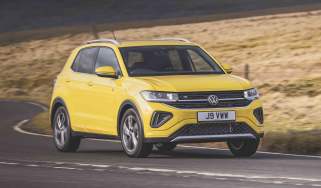
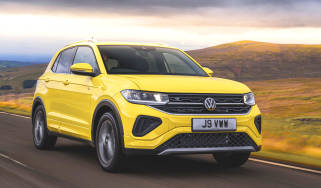
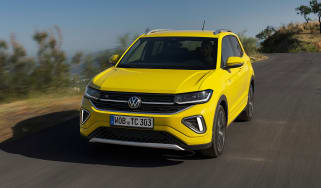
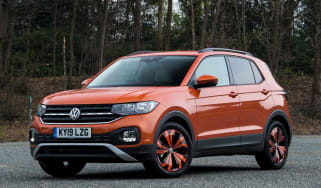
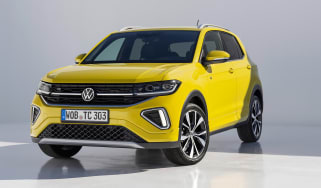
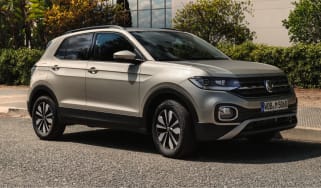
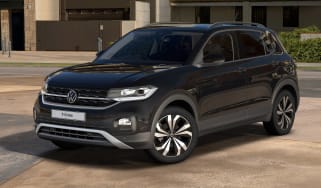
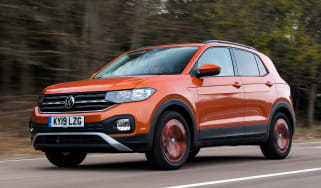
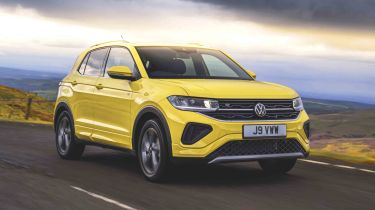
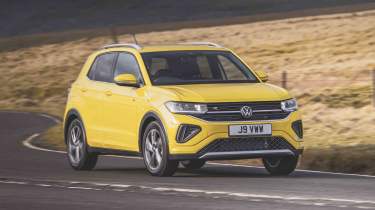
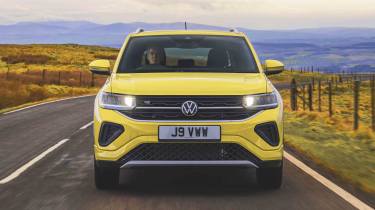
In a class that’s full of quirky, colourful and interesting designs, the T-Cross is not the most eye-catching small SUV around, but it looks smart in a way that is sure to appeal to Volkswagen’s fan base. If you do want to liven things up beyond the usual array of white, grey and black paint options, the T-Cross is available in a fetching Clear Blue metallic, a pricey Kings Red metallic for £940, or a bold Rubber Ducky Yellow. The general public voted for the latter name as part of a social media poll.
Our preferred version of T-Cross is Match, which includes:
- 17-inch alloy wheels
- Reversing camera
- Keyless entry and start
- Rear privacy glass
The luxury Style Edition trim features 18-inch alloys, adaptive LED headlights, a fully configurable 10.25-inch digital driver's display, sat-nav, and dual-zone climate control. R-Line and Black Edition are the only trim levels you can option the more powerful 1.5-litre engine with, and they have a sportier appearance both inside and out, but the latter is better specified with the adaptive LED headlights of the Style Edition.
Interior and dashboard design
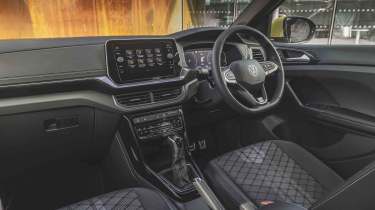
Inside, the dashboard layout is almost identical to that of the closely related Polo. That means there’s an eight-inch infotainment display sitting above a pair of central air vents, simple, logical control layouts and an attractive steering wheel design. Life and Match trims have a bit of silver trim across the dash that’s a bit more jazzy than the darker panels of R-Line cars, while Style can be had with a Cosmic Blue interior or a contrasting Mistral and Titanium Black interior.
The majority of the T-Cross line-up, including the base model, comes with an eight-inch digital driver’s display, while Style Edition and Black Edition models get a fully configurable 10.25-inch digital cockpit instead. The latter allows the driver to customise the information presented, choosing a regular-looking speedometer and rev counter, or prioritising trip or navigation readouts. The graphics are sharp, and while it isn’t completely essential, it does make the cabin feel more high-tech than those of many rivals.
Entry-level Match trim features physical dials for the air-con controls, which we’re fond of. Style, R-Line and Black Edition cars have dual-zone climate control, which utilises a touch-sensitive set-up that isn’t as easy to use on the move.
Materials and build quality
There isn't as much soft-touch material used within the T-Cross as we'd like: the top of the dashboard is hard and scratchy, unlike in the Polo, where it’s made of a softer, rubberised material. As a result, the cabin doesn’t feel as premium as those of the Renault Captur or the Peugeot 2008.
Infotainment, sat-nav and stereo
Every model in the T-Cross range comes with an eight-inch touchscreen as standard. In Match models, this includes Bluetooth and a DAB radio, but no built-in satellite navigation, which is optional unless you stretch to a Style Edition, R-Line or Black Edition model. However, wireless Apple CarPlay and Android Auto are both standard-fit, so we don’t expect many people will bother forking over the extra cash, as they can just use a navigation app from their phone instead.
The infotainment system itself is still one of the best in its class. The graphics look clear and sharp, while the touch-sensitive shortcut buttons surrounding the display are big enough not to be distracting on the move. The two physical dials – one for volume and one to adjust the navigation zoom – are quite small and fiddly, though. Spring for the larger 10.25in screen that comes as part of the Discover Pro package, and these dials are removed altogether in favour of a pure touchscreen setup.
Programming the navigation system is easy, thanks to a large on-screen keyboard. Loading times are quick enough, and you can pinch and swipe on the display to preview a route.
The audio experience is the one area of the VW infotainment system that lets the side down. The sound quality from the standard speakers is nothing more than average; they lack clarity and punch. A six-speaker, 300-watt sound system is among the optional extras available, though.
“The current T-Roc feels better than the pre-facelift car, with more soft-touch plastics in key areas, although some of the cabin layout is still disappointing. The climate system, for example, features controls that are awkwardly set low down on the dashboard.” - Dean Gibson, senior road test editor.
Boot space & practicality

| Pros |
|
| Cons |
|
When it comes to practicality, the Volkswagen T-Cross is competitive within its class. Available in just one five-door compact small SUV bodystyle, the car’s boxy dimensions and high roof translate into plenty of cabin space.
It scores big points for versatility, too, thanks in no small part to the sliding rear seat bench that’s standard across the range. Up front, it’s just as impressive, with a comfortable driving position that has enough adjustment to accommodate drivers of all shapes and sizes.
In addition to plenty of room, there are lots of spaces to keep items up front. A rubberised tray on top of the dash is ideal for small, lightweight items, while the huge cubby ahead of the gear lever has space for big smartphones and USB cables. The door bins are deep and wide enough to hold a large water bottle, and there is further storage space beneath the centre armrest. Passengers in the back can make use of similarly generous door bins and a pair of USB ports.
| Dimensions comparison | |||
| Model | Volkswagen T-Cross | Ford Puma | Renault Captur |
| Length | 4,127mm | 4,186mm | 4,239mm |
| Width | 1,760mm (1,993mm inc mirrors) | 1,805mm (1,930mm inc mirrors) | 1,797mm (2,004mm inc mirrors) |
| Height | 1,573mm | 1,550mm | 1,575mm |
| Wheelbase | 2,551mm | 2,588mm | 2,693mm |
| Boot space | 455-1,281 litres | 456-1,216 litres | 422-1,363 litres |
Dimensions and size
The Volkswagen T-Cross measures 4,127mm long, 1,760mm wide and 1,573 tall, so it’s a similar size to its VW Group siblings. The T-Cross is slightly longer than the Polo supermini which sits on the same platform, but it’s still comfortably shorter than a Golf, making this an ideal size for city driving.
Driving position, seats & space in the front
Up front, the T-Cross feels very spacious, largely thanks to its high roof and boxy stature. Headroom is generous, too, while the driver’s seat offers a wide range of adjustment (the height, in particular, can be varied by a huge amount).
The T-Cross also comes with Isofix mounting points both in the front passenger seat and the outer two rear seats.
Seats & space in the back
Headroom is equally good for back-seat passengers, while there’s more than enough foot space beneath the front seats. Legroom depends entirely on the positions of the sliding rear bench: in its rearmost position, the T-Cross is among the most spacious in its class. However, slide the bench forward its full 140mm of travel to maximise luggage capacity, and there won’t be any legroom whatsoever for people sitting behind a driver of average height.

Boot space
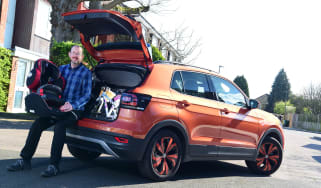
The T-Cross has between 385 and 455 litres of boot space, depending on the seat positioning. The sliding rear bench allows you to prioritise either boot capacity or rear legroom. Even with the seats in the most rearward position, the 385-litre volume is larger than that of a Volkswagen Golf, and sliding the seat all the way forward increases it to 455 litres. However, this leaves a significant gap between the raised boot floor and the back seats, which could cause smaller items to be lost.
The T-Cross comes with an adjustable boot floor as standard. In its raised position, there’s no load lip to lift items over, and should you need to, there's space to store the parcel shelf beneath it. The boot should accommodate a set of golf clubs, though they’ll fit more easily in a Ford Puma, which features an innovative ‘Megabox’ system. This is a handy 68-litre tub moulded into the boot floor that allows you to stand a golf bag upright. It also features a plug at the bottom, making it an ideal spot to store muddy boots that can be washed out later.
The rear seat bench splits 60:40, and leaves a completely flat load area. This expands the total storage area to 1,281 litres, which is six litres more than you get in a Renault Captur.
Towing
The 94bhp 1.0-litre engine has a braked towing capacity of 1,000kg, while the more powerful 113bhp version increases this to 1,100kg, much like the Ford Puma. Opting for the 1.5-litre engine only increases capacity to 1,200kg.
VW has increased the tow ball load from 55kg to 75kg, allowing you to carry up to three e-bikes on a dedicated bike carrier.
“With the rear seat set as far back as possible, there’s 385 litres of boot space, but if you slide the bench forward there’s an impressive 455 litres. However, with the seats forward there really isn’t much legroom at all with them in this position. Tall adults won’t be able to get comfortable unless the bench is set back, although headroom is good.” - Dean Gibson, senior road test editor.
Reliability & safety
| Pros |
|
| Cons |
|
Euro NCAP originally tested the T-Cross in 2019 and awarded it a full five stars for safety. However, it was reassessed in 2025 under a much more stringent testing program, and the score for the T-Cross has been reduced to three stars out of five.
The T-Cross does still get plenty of safety assistance technology, including autonomous emergency braking (AEB) with pedestrian and cyclist detection, a lane-keep assist system, blind spot monitoring, plus adaptive cruise control. The latter two are often options on many of its rivals.
Volkswagen came 26th out of 30 best manufacturer rankings in the 2026 Driver Power customer satisfaction survey. Owners commented on high running costs and concerns about the infotainment system, but appreciated the fit and finish of their cars, along with boot capacity.
| Euro NCAP safety ratings | |
| Euro NCAP safety rating | Three stars (2025) |
| Adult occupant protection | 74% |
| Child occupant protection | 81% |
| Vulnerable road user protection | 60% |
| Safety assist | 57% |
Buying and owning
Our best buy: Volkswagen T-Cross 1.0 115 TSI Match manual
With the cheaper Life trim being dropped, pricing for the T-Cross starts at a little under £26,500 for a Match trim model with the 94bhp 1.0-litre engine. That's more than the likes of the Citroen C3 Aircross and Renault Captur, but undercuts the Ford Puma and Toyota Yaris Cross. Style Edition is only available with the more powerful 113bhp 1.0-litre engine and starts from around £28,500, while the sportier-looking Black Edition and R-Line trims start from around £31,000 and £32,000, respectively.
The T-Cross comes with enough kit in Match trim to suit most buyers' wants and needs, while the more powerful 1.0-litre engine provides sufficient oomph for town and motorway journeys. We'd recommend going for the manual unless you specifically require an automatic, because this will save you even more money.
If you'd like a Volkswagen T-Cross of your own, our Buy a Car service is here to help. You can configure your ideal Volkswagen T-Cross and receive top deals from our dealer network, find the best T-Cross leasing deals or browse our selection of fantastic used T-Cross models. Selling your current car? Take a look at our Sell My Car page.
Volkswagen T-Cross alternatives
Rivals include the Citroen C3 Aircross, Ford Puma, Renault Captur, Nissan Juke, Toyota Yaris Cross and Peugeot 2008, as well as the other similarly sized models from within the Volkswagen Group: the Seat Arona and Skoda Kamiq. The T-Cross is the smallest SUV in VW’s range, sitting below the Volkswagen Taigo and Volkswagen T-Roc.
Latest deals on the T-Cross and rivals
Volkswagen T-Cross pictures
Key updates of the Volkswagen T-Cross review
12 August 2026: Update to include the results of the 2026 Driver Power customer satisfaction survey
Frequently Asked Questions
All Volkswagen T-Cross models have a manufacturer's warranty of three years or 60,000 miles, which is par for the course, but beaten by a number of rivals.
New & used Volkswagen T-Cross deals