New Mazda CX-6e 2026 review: trails rivals on range and charging
EV lacks the range of SUV rivals but makes up for it with space, tech and refinement. It just doesn’t feel much like a Mazda, though

Verdict
The Mazda CX-6e is something of a slow burn, a car that you need to spend time with to appreciate rather than dismiss straight away on account of some of its underwhelming stats. Its contemporary design, spacious interior and generous equipment count are immediate pluses, but it lacks a certain feel and authenticity to be considered one of Mazda’s best.
Mazda might be most famous for its iconic MX-5 roadster, but the bedrock of its success over the past few years has been an expanding line-up of SUVs.
To keep up with market demands, it’s now adding a fully electric one to the range, but it’s not quite as ‘Mazda’ as it might appear. That’s because the CX-6e is the result of a collaboration with Chinese partner Changan – the second after the electric Mazda 6e – although we’re told it has been specifically designed and tuned for European buyers’ tastes.
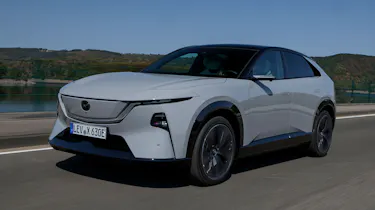
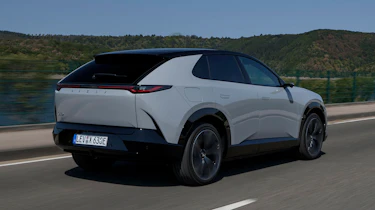
The CX-6e shares much of its underpinnings with the Deepal S07, but Mazda’s design team has reshaped the exterior with plenty of cues that help it to maintain a family resemblance with other models in the range. However, the CX-6e is an edgier and more modern shape than any we’ve seen from the Japanese brand in the last decade, and looks far more contemporary than the new petrol-powered CX-5 that’s just gone on sale.
Used - available now

2024 Hyundai
Kona
28,137 milesAutomaticPetrol1.6L
Cash £21,449
2024 Audi
A1 Sportback
6,650 milesAutomaticPetrol1.0L
Cash £18,499
2026 Vauxhall
Corsa
35,517 milesManualPetrol1.2L
Cash £11,149
2023 Ford
Kuga
35,473 milesManualPetrol1.5L
Cash £15,399The ‘Signature Wing’ at the front – a feature of Mazda cars since the 2013 CX-5 – is now illuminated and leads into what are among the sleekest LED daytime running lights around. Its main headlight units are placed lower down, next to notably large air intakes that channel airflow down the sides of the car.
More subtle is the spoiler on the bonnet’s leading edge, which acts in a similar way to help send air more smoothly up and over the windscreen. It’s a feature we’ve already seen on the Polestar 3, and it contributes to a reduction in wind noise at higher speeds too, while other details – such as the way the wipers are tucked down below the bonnet line – add to what is a clean and very premium look.
There’s some interesting technology, too, including side view cameras in place of traditional door mirrors. These feature on the top-spec versions, helping to reduce drag as well as lower wind noise generated by the air passing over them. The feed is relayed on to display screens fitted into the doors.
The flush-fitting door handles are neat, and also shared with the Mazda 6e, while the D-pillar design discreetly incorporates an air channel that exits on either side of the large rear window. There are 19-inch wheels as standard, but Takumi Plus models get 21-inch wheels.
All versions feature a contrasting black roof, and there’s a pleasing variety of colours, including Air Stream Blue, Soul Red Crystal and Nightfall Violet, a paint that appears black in lower light conditions and a deep, rich purple in the sun. For those who love nothing better than a dull grey, there are some options at that end of the palette, too.
Unlike many of its competitors, Mazda offers just one powertrain. It comprises a 78kWh lithium-iron-phosphate (LFP) battery that has enough energy capacity for an official range of up to 300 miles. That lags behind most of its nearest rivals; a Tesla Model Y can cover up to 390 miles, for example, while the Skoda Enyaq is good for 360 miles and a Citroen e-C5 Aircross can do up to 421 miles between charges of its larger battery.
Neither does the Mazda top the charts when it comes to charging. With a peak of 165kW, it’s lower than most key rivals and significantly less than the class best. Still, it being an LFP battery means charging to 100 per cent regularly should have no adverse effects on its longevity, and Mazda says a 10 to 80 per cent recharge can be completed in 24 minutes. A full charge using home charging can be completed in eight hours.
A single electric motor produces 255bhp and drives the rear wheels of the CX-6e. Performance is adequate, with 0-62mph dispatched in 7.9 seconds and a top speed of 155mph. It doesn’t feel especially fast, but across the drive modes (Normal, Sport and Individual) the power feeds in at a predictable and controllable rate, rather than threatening to pin your passengers’ heads back in their seats.
Thanks in part to the rear-wheel-drive layout, the steering is uncorrupted and gives the driver a good sense of what’s going on at road level. The driving position also warrants mention as the raised seating position and thin A-pillars provide good outward visibility, particularly useful when exiting junctions, for example.
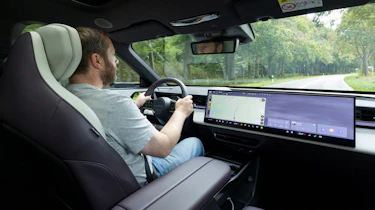
There’s an abundance of driver assistance aids, as expected, but they can be overly sensitive and accompanied by an often annoying mix of beeps and bongs. These can be adjusted or muted, but not always easily.
You will need to delve into the menu system to do this, and it isn’t the most intuitive to use. Nonetheless, the vast 26-inch widescreen display does look impressive and isn’t as distracting as might be expected, because there’s a head-up display for the driver to keep their eyes on. However, the touchscreen layout could be improved; the temperature settings are far too small and often take several stabs to adjust while driving. The integration of Apple CarPlay and Android Auto also looks more like a pop-up on the display, than something elegantly integrated into the interface.
Interior noise levels are impressively low, even by EV standards. On the larger wheels, cabin noise remained well suppressed across a variety of road surfaces, while high-speed driving on the German autobahn produced little noticeable wind noise. The side view cameras may help with that, but using them does take some getting used to; they simply aren’t as natural to use as regular mirrors.
Through bends, the CX-6e feels relatively light on its feet, but the suspension often seems busy, and it could do with some better damping to smooth things out. Body control is good, though, as is the brake pedal feel. There are several energy recuperation modes, the strongest of which provides one-pedal driving of sorts.
Passengers will be equally impressed by the amount of rear space on hand. Both legroom and headroom rank among the best in the segment, and with the front seats being on raised rails, it’s easy for back-seat passengers to stretch their feet out underneath. Having ISOFIX points in the outer rear seats as well as in the front passenger seat is a further plus.
At 486 litres, the boot isn’t the largest by volume, but it does have a generous aperture, and the rear seats have a 60:40 split that, when folded, boosts cargo volume to 1,434 litres. Plus, there’s also an 80-litre frunk. For those who tow, the Mazda can pull a braked trailer up to 1,500kg.
Fundamentally, the CX-6e doesn’t excel in any key metrics, with the possible exception of its dramatic styling. But the bigger issue is that it doesn’t feature much, if any, of the innate Mazda-ness that’s long been key to its models being more than just any other mainstream offering. For some customers this might not be a problem, but for others it undoubtedly will be.
Did you know you can sell your car through Auto Express? We’ll help you get a great price and find a great deal on a new car, too.
| Model: | Mazda CX-6e Takumi Plus |
| Price: | £42,990 (£46,150 as tested) |
| Powertrain: | 78kW battery, 1 x motor |
| Power/torque: | 255bhp/290Nm (190kW) |
| Transmission: | Single-speed automatic, rear-wheel drive |
| 0-62mph: | 7.9 seconds |
| Top speed: | 115mph |
| Range: | 300 miles |
| Charging: | 165kW |
| Economy:/CO2: | 18.9-19.4kWh/100km/0g/km |
| Size (L/W/H): | 4,850/1,935/1,620mm |
| On sale: | Now |