New Mercedes C-Class costs £5k more than a BMW 3 Series
Mercedes confirms compact exec line-up for British buyers, and the bad news is that we won’t be getting a diesel model
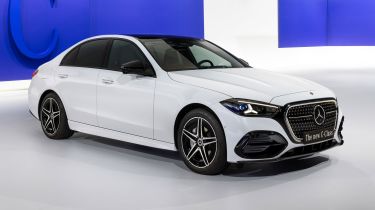
Pricing for the updated Mercedes C-Class has been announced, with a range of three powertrains in four trim levels kicking off at £46,995 for the C 250 petrol in entry-level Urban Edition trim, putting it more than £5,000 above the current entry-level BMW 3 Series. A more powerful C 300 petrol costs from £49,145, and there’s a C300e plug-in hybrid at £52,515.
Mercedes C-Class UK specs and prices
The Urban Edition is anything but a base spec, though, as all UK models use AMG Line styling as a basis, adding black styling elements around the window trims and 19-inch wheels. The interior features half-synthetic leather and micro-suede upholstery, with the option of full synthetic leather for an extra £500.

Traditional AMG Line then kicks off at a £5,000 premium, switching to a bright exterior trim package, an illuminated grille and clever ‘Digital’ LED headlights. Inside there’s standard synthetic leather in a wider range of colours, plus a more comprehensive ambient lighting package, 360-degree parking cameras and electric seats.
Premium Plus will cost an extra £2,500, and comes with a new 19-inch wheel design, Burmester stereo, head-up display and panoramic sunroof.
Finally, topping the tree is a Premier Edition for another £2,500. This adds another new wheel design, while the dark-finish exterior styling elements return, and inside there are real leather seats. This model also incorporates a few technical upgrades, including adaptive dampers and rear-wheel steering as standard.
Lesser models can also be fitted with the adaptive dampers and rear-steer via a £2,500 Refinement Package, and you can upgrade to real leather on all but the top-spec model for £1,750.
The C-Class Estate can be had with the same trims and engines as the saloon, and costs around £2,500 extra.
How much more expensive is the Electric C-Class by comparison?
These figures compare to a starting price of £57,995 for the C 400 4Matic Electric, which steps up across five trims to the £70,995 flagship. This sounds expensive compared to petrol-powered models, but the C 400 Electric is the highest-specification non-AMG C-Class Electric that will be made available. More BEV variants that are closer to price parity will come on stream in the next few months.
We won’t, however, see an electric C-Class Estate, despite BMW offering a new i3 Touring in the next few months. But the GLC SUV does largely the same job, reducing too much range complexity for buyers.
This comprehensive spread of models does reveal one quirk of the new C-Class, though. Mercedes UK has decided not to offer this facelifted model with any diesel powertrains, despite it being available with two new, mild-hybrid assisted options in continental European markets. These new diesels are future-proofed, too, as they’re already compliant with tough new Euro7 emissions regulations that will be enforced from November this year.
What else has changed in the new Mercedes C-Class?
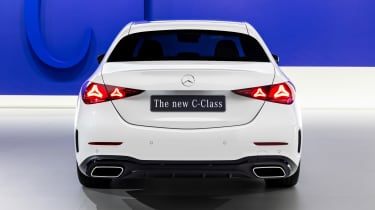
So what’s changed on the new C-Class aside from the loss of a diesel? Well, in terms of design the C-Class features the firm’s latest design language, as showcased on the E-Class and S-Class. This sees new headlights – complete with star-shaped daytime-running lights – connected to the grille, which comes with bright chrome accents, an illuminated surround and larger three-pointed star.
However, it’s worth noting that this model does not feature the striking illuminated grille of its electric counterpart, endowing it with a more conservative look overall. The rear end is largely the same as before, with the exception of new lights on the saloon; the estate makes do with those used on the existing model.
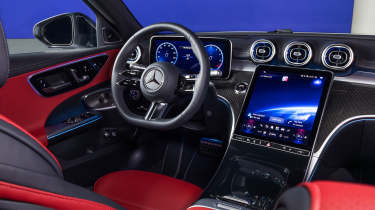
The cabin has not evolved from its current generation, so if you were hoping for an S-Class-style replacement of the dash with a full-width screen you’ll be disappointed. You get the same 12.3-inch driver’s display and 11.9-inch portrait-oriented touchscreen.
Instead, Mercedes has integrated its latest user interface into the existing layout. Within these changes are greater levels of AI support in the software, which can enable more substantial over-the-air updates.
Another major beneficiary of this change is Mercedes’ navigation, which now incorporates both Google AI and Maps data. The rest of the cabin updates revolve around a new simplified steering wheel already seen on its other models, plus refreshed materials and trim options.
What engines are available on the new Mercedes C-Class?
The two mild-hybrid petrol options consist of the C 250, which has a turbocharged four-cylinder engine mated to an electric motor, and puts out a total of 237bhp and 320Nm of torque for a 7.3-second 0-62mph time and 154mph top speed. The combined efficiency for the C 250 stands at 43.5mpg – identical to its main rival, the BMW 320i.
The C 300 has a more powerful version of the same four-cylinder engine and the same 48-volt mild-hybrid system. Total power stands at 278bhp and 400Nm of torque, lowering the 0-62mph time to 6.1 seconds while increasing the top speed to 155mph. The economy dips slightly as a result of the extra power: on a combined run the C 300 should return 42.9mpg.
There’s one plug-in hybrid option in the C300e, which has 347bhp thanks to a small power hike for the petrol and electric motors. Mercedes quotes a 62-mile BEV range. While on paper this is less than the previous 70-mile quoted range, the standardised test has been tweaked for the latest generation – so we expect the real-world results to be largely the same.
There have been no major updates to the battery pack or its 19.5kWh capacity, and it’s also still able to be recharged at up to 55kW on a DC fast charger. Mercedes will no longer offer the C300de diesel plug-in hybrid.
Did you know you can sell your car through Auto Express? We’ll help you get a great price and find a great deal on a new car, too.