Used Mercedes S-Class (Mk6, W222, 2013 - 2020) review
A full used buyer’s guide on the Mercedes S-Class covering the S-Class Mk6 (2013-2020)

Verdict
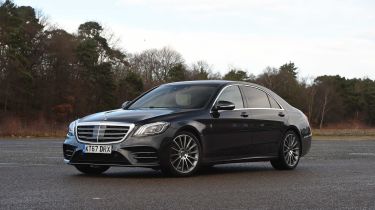
The Mercedes S-Class is the best luxury car you can buy, despite seriously tough competition. In a demonstration of its all-round brilliance, it usually scoops our Best Luxury Car prize in our annual New Car Awards. Deciding which version is right for you isn’t easy, though, because there’s a potentially bewildering array of powertrains. But hybrids and plug-in hybrids are rare, and expensive, particularly compared with the 3.0-litre diesel editions.The key thing to remember is that while the S-Class is something of a bargain thanks to its depreciation, running costs might not be so affordable – so keep some cash in reserve.
Mercedes is the world’s oldest car maker, and also one of the most innovative. The brand has arguably pioneered more new technologies than any other marque, whether they’re aimed at improving comfort, safety, reliability, usability or efficiency. And nowhere has this ground-breaking approach been more apparent than in Mercedes’ most prestigious luxury saloon, the S-Class, which has topped the company’s range since the sixties.
The current edition arrived six years ago and although it will soon be replaced, the S-Class is still a deeply impressive car that will seem modern for years to come. The best bit? Hefty depreciation ensures that you can buy a superb used example for the same money as an ordinary family car.
Models covered
- Mercedes S-Class (2013-date) - Luxury motoring for price of a family saloon – but do save some cash for running costs.
History
The seventh-generation (W222) S-Class went on sale in the UK in June 2013, priced from £62,650. Buyers could choose S350 Bluetec (3.0 V6 diesel), S400 hybrid (3.5 V6 petrol-electric) or S500 (4.7 V8 petrol) models, as well as SE Line or AMG Line trims. By November 2013 the 577bhp S63 AMG (5.5 twin-turbo V8) had joined the range, with the 523bhp S600 and 621bhp S65 AMG (both with a 6.0 twin-turbo V12) arriving a few months later, alongside the S300 Hybrid (2.2 four-cylinder diesel-electric).
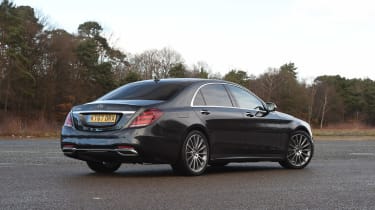
In September 2014 the S500e plug-in hybrid was launched, while a facelifted S-Class arrived in July 2017 with cosmetic external changes and two new engines: a 2.9-litre six-cylinder diesel in 282bhp S350d and 335bhp S400d forms, and a 463bhp 4.0-litre twin-turbo V8 in the S560. An S-Class coupé was launched in September 2014 and a cabriolet followed nearly a year later – but we’re focusing on the saloon in this guide. The seventh generation W223 S-Class launched in 2020 to replace this car.
Mercedes S-Class reviews
- Mercedes S-Class in-depth review
- Mercedes S 350 d review
- Mercedes S 500 L review
- Mercedes S 560 e L review
- Mercedes-AMG S 63 review
Which one should I buy?
It’s the diesel models that make the most sense, most of the time. Refined, frugal and with plenty of muscle, these six-cylinder engines (V6, then straight six from mid-2017) are superb and complied with Euro 6 regulations from the outset, so should be fine for use in all current Clean Air Zones.
Used - available now

2019 Mercedes
S Class
13,000 milesAutomaticPetrol3.0L
Cash £37,000
2017 Mercedes
S Class
93,200 milesAutomaticDiesel2.1L
Cash £14,994
2015 Mercedes
S Class
77,813 milesAutomaticDiesel3.0L
Cash £17,784
2019 Mercedes
S Class
60,000 milesAutomaticPetrol3.0L
Cash £26,250All S-Classes are luxurious, with air suspension, LED lights, alloy wheels, park assist with rear camera, leather trim, electrically adjustable front seats, top-quality infotainment and a seven-speed automatic transmission fitted as standard, even on the entry-level SE Line.
The AMG Line received sportier detailing inside and out, while the S63 and S65 got sports seats, upgraded infotainment and reclining rear seats. Options worth seeking out include the opening panoramic glass roof, 360-degree camera, and heated windscreen, plus one of the upgraded Burmester multimedia packages.
Alternatives to the Mercedes S-Class
The Audi A8 is the S-Class’s toughest rival in terms of ability, availability, costs, quality and image. With its aluminium body and standard quattro four-wheel drive, the A8 is a unique proposition. The Jaguar XJ also has an aluminium construction, but feels much less hi-tech, plus the model range is quite narrow.
Lexus’s LS range is even narrower, and not many are on sale, but its refinement and reliability are superb, as are its gadgets. The BMW 7 Series gives one of the sector’s more enjoyable drives, and boasts plenty of tech plus some excellent engines. Meanwhile, a Bentley Flying Spur is seriously opulent; it’s the perfect way to arrive in style.
What to look for
Layout
Standard cars came with either two or three seats in the rear; long-wheelbase cars offered five different seating packages.
Headlights
Those LED lamps fog up readily, but they’re vented and are actually designed to do so; they soon clear themselves if you leave them to it.
Gearbox
All S-Classes have automatic gearboxes and are big cars, so brakes tend to have a hard life; be sure to check they’re not worn out.
Tyres
Rear rubber wears quickly as a consequence of both the car’s relatively heavy weight and the torquey engines; do check the tread depths.
Interior
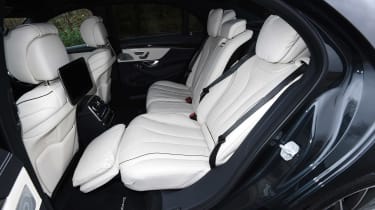
As the biggest saloon in the Mercedes range, the S-Class unsurprisingly has no lack of passenger space, both in the front and rear seats. Long-wheelbase editions are especially roomy in the back. New-car buyers could choose between numerous optional rear packages, with top-spec models getting two electrically reclining, heated, massaging seats, accompanied by window blinds and lavish entertainment packages.
It’s all very impressive – and so is the boot space, which can be as much as 530 litres but drops to as little as 395 litres for plug-in hybrid models. Overall, the interior is made using only the highest-quality materials – as you would expect. A highlight is the massive digital display.
Running costs
The service interval for all W222 S-Classes is set at 12 months or 15,500 miles. There are so many powertrains available that maintenance requirements and costs vary significantly across the model range, but as a rule of thumb the prices for servicing one of the 3.0-litre diesels will give you a good idea.
The first service is priced at £370 and the second at £833, then £645, £833, £645 and £955. Log on to http://lite.servicemercedes.co.uk/ess/pc and you can see what needs doing and when. While these costs might seem high, there are no cambelts to replace on any engine – plus there’s a raft of independent specialists that can help slash your maintenance expenditure.
Recalls
The S-Class is complex, but 21 recalls in seven years still disappoints. Those in December 2013 and November 2015 were because of faulty seatbelts; a further seven followed (the final one in May 2019) due to dodgy belts, buckles or pretensioners. Software glitches that prevented the engine from starting or the stop/start working prompted actions in November 2015 and January 2016; faulty wiring led to an October 2016 campaign.
More software faults (for safety and emissions set-ups) led to a recall in April 2017; then came recalls in July 2017 (oil leaks and airbag wiring); September 2018 (fuseboxes); April 2019 (hands-off-steering sensors and stop/start failure); September 2019 (emissions and radar); November 2019 (airbags); and, most recently, in February 2020 (poorly made engine components).
Driver Power owner satisfaction
The S-Class has never sold in large enough quantities to appear in our new or used Driver Power surveys, but most owners give it a big thumbs-up in the Carbuyer reviews. Virtually everyone highly rates the superb fuel economy, refinement, comfort and engineering, as well as superlative build quality. However, Mercedes’ 28th out of 30 rating in our 2020 Driver Power brand survey is rather less impressive
Mercedes S-Class (2013-2020) review: What we said
Extracts from our 2019 in-depth review of the Mk6 Mercedes S-Class
There are few experiences more relaxing than driving an S-Class; in fact, just about the only thing that can top it is if you're in the back seat, being chauffeured. Merc's biggest saloon was crowned our 2016 Luxury Car of the Year, and vibrations through the pedals and steering wheel are non-existent: even at motorway speeds you won’t hear any wind or tyre roar.
All the engines are fantastic, but it’s amazing that Mercedes can offer a six-cylinder diesel-engined model that returns more than 50mpg. For the ultimate in speed, there are high performance S 63 V8 or S 65 V12 Mercedes-AMG versions. Stepping down a peg, there’s the S 500 straight-six which is still no slouch, hitting 0-62mph in under five seconds and averaging more than 40mpg.
• Mercedes S-Class vs Audi A8 vs Lexus LS
In short, the Mercedes S-Class has set the standard for luxury and cutting-edge technology for over 40 years - and this sixth-generation car is the best yet. Other revisions for the 2017 model year include some minor styling updates and some major technical changes, including a new straight-six diesel engine and a new mild-hybrid powertrain.
Not only is the S-Class easily the best car in its class, it also shows up much more expensive models with its sublime ride, expansive tech package and luxurious interior.
The Mercedes Benz S-Class is the most luxurious model to wear the famed three-pointed star, and as you would expect it’s a technical and technological tour-de-force.
The ultimate Mercedes saloon takes on a small but very desirable band of rivals in the luxury sector, including relatively mainstream models such as the Audi A8, BMW 7 Series and Jaguar XJ, and more rarified competitors like the Aston Martin Rapide, Bentley Flying Spur, Maserati Quattroporte, Porsche Panamera and even the Rolls-Royce Ghost. That’s before you factor in a variety of high-end luxury SUVs, including the Range Rover, Audi Q7 and the Bentley Bentayga. There’s a standard S-Class saloon, but most of the models have an extended wheelbase that caters for those who don’t drive themselves. In complete contrast, the high-performance Mercedes-AMG S 63 and 65 models, as well as the coupe and cabriolet versions, add a dash of extra excitement for those who do.
While today's S-Class lacks some of the bespoke feel of previous generations – until the mid-1990s, the Mercedes flagship’s development was famously free of budget restrictions – it remains a remarkable machine. The model also maintains the tradition of introducing exciting new technologies to the Mercedes line-up, and often to the automotive world.
In the case of the current S-Class, it was Magic Body Control that garnered the headlines at launch. Standard on the S 65, it’s a system that uses cameras to scan the road in front for imperfections, then pre-adjusts the suspension to meet the oncoming challenge. Other highlights include an advanced high-definition TFT instrument pack, and the Driving Assistance tech that keeps the car in its lane and a safe distance from other traffic when the cruise control is switched on.
Aside from the technical advances, the S-Class has always been the car that shows the way forward for Mercedes' design, which means sleekly powerful lines and a superbly finished cabin.
Under the bonnet, the 'regular' S-Class is available with a choice of two 3.0-litre six-cylinder engines: a diesel unit in the S 350d or a considerably more powerful petrol engine in the S 500. Then, at the top of the range are the Mercedes-AMG S 63 and S 65 models, with monstrously powerful 4.0-litre V8 and 6.0-litre V12 engines, respectively.
For those looking for better fuel economy, Mercedes will also sell you a mild-hybrid S-Class, called the S 560 e. It combines a 3.0-litre petrol V6 with an electric motor, producing claimed economy figures of 113mpg and a combined power output of 469bhp.
Trim levels are even simpler, with both the S 350d and S 500 coming in AMG Line trim and the two AMG models having their own unique specifications. If you want to go beyond AMG Line trim, not only are there loads of options, you can also add either the Premium or Premium Plus packages. The former adds a 360-degree camera with remote parking assistant, heated/cooled front seats, a panoramic glass sunroof and nappa leather upholstery; and, on top of that, the latter adds an uprated stereo, massaging front seats and both the Energising Comfort and Air-Balance packages.
Even ‘standard’ AMG Line cars are well equipped, with air suspension, keyless-go, 19-inch alloy wheels, an AMG bodykit, metallic paint, electrically adjustable front seats, a 12.3-inch display and ambient lighting, with a choice of 64 different colours. And, if you want to make things even more luxurious for your rear-seat passengers, there's the Executive package, which includes adjustable backrests, heated/cooled electrically operated seats, blinds in the rear windows and rear climate control.
Engines, performance and drive
Despite its focus on luxury and refinement, the S-Class is still one of the most engaging executive limousines on the market. The standard air suspension gives a wonderfully cushioned ride, while S 65 buyers can get even sharper driving dynamics with the Magic Body Control system, which reads the road ahead and adjusts the car's set-up accordingly.
There’s barely any wind or road noise, while the standard air-suspension effortlessly smooths out bumps – although the 19-inch wheels can crash into potholes.
Yet, this comfort doesn’t come at the expense of agility. The steering is quick and well weighted, plus there’s lots of grip. Selecting Sport mode stiffens the standard adaptive dampers, and a fast, flowing road is good fun in the S 350 d, thanks to the accurate steering and a body that’s surprisingly resistant to roll. It’s no sports car, but there is still some driver appeal.
On the road, the new S-Class doesn’t feel as urgent as the Audi A8, but it still packs plenty of overtaking punch, whatever engine is under the bonnet. The brakes are strong, too, with a positive and progressive pedal feel.
The high-power Mercedes-AMG models give this limo supercar-rivalling performance. They come in long-wheelbase form only, and while they're not the last word in sharp handling, you'll be surprised by how well they corner considering the car's sheer size.
Engines
The S 350 diesel will make up the majority of S-Class sales, and it's our pick of the range, thanks to its super-smooth and quiet engine. Combined with seriously quick acceleration, it proves refinement doesn’t come at the expense of performance.
It’s extremely quiet and there’s only a faint rattle at idle. In fact, you’ll sometimes think the stop-start system has kicked in, even when the engine is still running. It’s not totally silent as the revs rise, but it’s still a great fit and feels suitably luxurious.
There’s plenty of power, too; with 282bhp and 600Nm of torque (the latter available from just 1,200rpm), the S 350d is a genuinely fast car. It was built for motorway cruising, and the torquey engine means overtakes are never stressful or drawn-out. The nine-speed automatic gearbox shifts smoothly, so even when it does need to kick down, there’s little hesitation.
If you can stretch to it, the S 500 does 0-62mph in 4.8 seconds; and, if you want a limousine with real supercar credentials, the V8-engined S 63 can manage 0-62mph in 4.3 seconds. The V12 S 65 is a further tenth of a second faster.
However, the S 560 e plug-in hybrid is almost as quick as both AMG versions, with 469bhp and 700Nm of torque on tap and a 0-62mph time of five seconds flat and a top speed of 155mph. As an added benefit, it has claimed economy figures of 113mpg, and will cover around 50km (or 30 miles) in electric-only mode.
And, on the basis of our short test in Germany, we reckon the numbers are actually pretty realistic. We drove the S 560 e for more than 40km, including stretches of motorway running at 60-70mph, and still had a few miles of electric-only range remaining when we got to the end of our journey.
MPG, CO2 and running costs
With prices starting comfortably in excess of £72,000, the S-Class isn’t exactly cheap to buy; and, if you get a bit friendly with the options list, the price can rise to well over £100,000. However, despite the price tag, the S-Class shouldn’t cost you the earth to run.
Under the official testing regime, the S 350 d returns more than 50mpg and emits 139g/km of CO2, while the S 500 L averages just over 40mpg, and even the S 63 returns 32.1mpg. The S 560 e mild-hybrid is claimed to be the most economical, returning 113mpg. Those are impressive figures, given how big the car is and how fast it can go.
Depending on how you use the car, of course, those figures could be very different. The economy will certainly plummet, if you delve into the available performance, for example.
Interior, design and technology
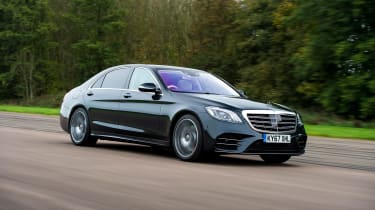
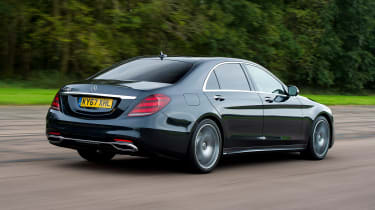
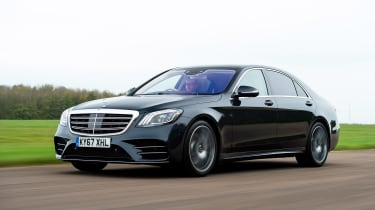
Externally, the S-Class benefits from imposing styling with neat design details, such as the new set of bumpers, lights and a fresh grille that were introduced as part of the 2017 revisions. Yet, despite its vast external dimensions, the Mercedes disguises its bulk well, thanks to its sweeping roofline and the carefully sculpted lines cut into the flanks.
A bold grille, topped by the brand’s trademark three-pointed star, swept-back all-LED headlamps and tastefully applied chrome trim add a dash of glamour, while AMG Line trim also includes racy-looking 19-inch alloy wheels and a subtle bodykit.
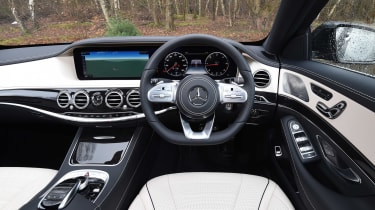
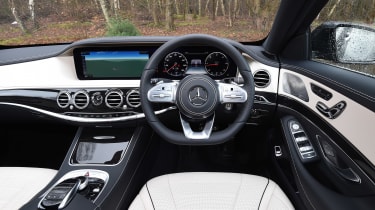
The Mercedes’ interior is even more impressive, as it’s beautifully built, supremely comfortable and plushly appointed. The wide dashboard features a pair of 12.3-inch TFT screens – one for the sat-nav, infotainment and energy use, the other for the speedo, rev counter, trip computer and optional night vision display.
Other highlights include the metal-finish eyeball vents for the air-conditioning, the precise action of the switchgear and the intuitive COMAND rotary controller.
As you’d expect, the fit and finish are flawless, while the materials are all top-notch. Lustrous Black Poplar wood trim covers the dashboard, centre console, door trims and steering wheel, plus there's a £1,740 soft Nappa leather trim option for AMG Line cars.
Sat-nav, stereo and infotainment
As you’d expect, quality is the watchword for the S-Class infotainment systems.
All models come with the 12.3-inch high-definition screen, sat-nav, digital radio and single CD/DVD drive as part of the COMAND Online system.
You also get Bluetooth and a WLAN hotspot facility, but if you want to use Facebook and various on-board apps via the Connect Me package you’ll need to tick an option box. Other options include a rear seat entertainment system with a pair of 10-inch screens, and of course a TV tuner.
If you really want to push the boat out on the audio front, try the Burmester high-end 3D Surround Sound System which has 24 speakers, a 24 channel amplifier and a total output of 1,540 watts.
Practicality, comfort and boot space
More rarefied brands like Rolls-Royce and Bentley can provide a more bespoke luxury feel, but it’s hard to imagine a car that’s more comfortable than a Mercedes S-Class.
The big Merc is near-peerless, with superb on-road refinement, a silken ride quality, a living-room-sized cabin with superlative seats that will even massage you if required, plus fabulous entertainment systems and internet connectivity, so driver and passengers want for nothing.
If you have to drive it yourself, then an array of sensors and cameras take care of close-quarter manoeuvres in town, while out on the road you can let the clever cruise control and other aids share the load.
Size
The S-Class in standard length is 5,155mm long, but there’s a long-wheelbase version with a 13cm extension in the rear passenger compartment. That said, unless you’re after the best-selling S 350d you can’t pick and choose: the diesel-engined model is available with both bodies, but all the other versions come in long-wheelbase L guise only.
In case you are compelled to have the biggest car in the car park, it’s worth noting that the S-Class in standard length is shorter than an Audi A8 and Rolls-Royce Ghost. It beats the standard BMW 7-Series, though.
Leg room, head room & passenger space
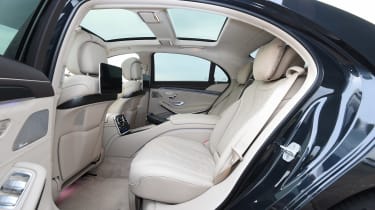
Given the S-Class’s luxury car status, it’s no surprise to find most of the space in the cabin is reserved for rear seat passengers. There’s a trio of three-point belts for the rear bench, but most buyers will treat this car as a four-seater, and Mercedes offers an optional two-seater rear seating set-up for even more luxury.
Rear head and legroom is generous, while the Executive Rear Package adds a reclining function, powered blinds for the side and rear windows and ventilation for the seats. There’s also plenty of storage space, including the fold-down rear armrest that includes a pair of cup-holders and neat lidded cubby, while fold-out tables make the car the perfect office space.
Boot
With a conventional powertrain, the Mercedes features a useful 510-litre boot – although the optional fridge compartment reduces capacity by 40 litres. Opt for the mild-hybrid system in the S 560 e, and this space is further reduced to 395 litres due to the added battery pack. Without either of these limiting factors, the Merc’s luggage space is a little bigger than the Rolls’ and BMW’s, and matches the Audi’s exactly.
Buy a car with Auto Express. Our nationwide dealer network has some fantastic cars on offer right now with new, used and leasing deals to choose from...