New Peugeot E-408 2026 review: stylish, comfy EV with iffy tech
The Peugeot E-408 has been given a revamp, but some irksome flaws remain


Verdict
The Peugeot E-408 still offers style and substance in fairly equal quantities. It looks striking, the interior has an air of quality and there's lots of space, plus it's only slightly more expensive than the petrol-electric hybrid. However, the laggy tech, compromised dashboard layout and so-so range and charging make newer models like the award-winning Nissan Leaf look particularly tempting.
The Peugeot 408 has never been afraid to strut its stuff down the high street, but now the already sharp-looking family car is even more of a head-turner following a mid-life refresh.
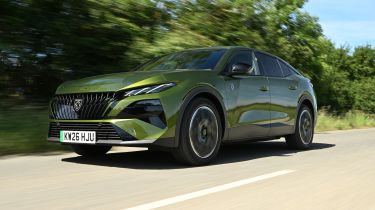
The most significant changes are up front, where Peugeot has given the fetching fastback a new look that’s more in line with the rest of its range. The 408’s distinctive fang-like daytime running lights are gone; replaced by a sleeker ‘three-claw’ design connected by LED strips incorporated into the more sculpted fresh grille, which on all but the base model features an illuminated Peugeot shield sitting in pride of place in the centre.
In order to not distract from those striking new daytime running lights, Peugeot has concealed the main headlights in the large gloss-black air vents lower down in the redesigned bumper. Similarly, the car’s proximity radar is hidden behind the Peugeot badge.
Used - available now


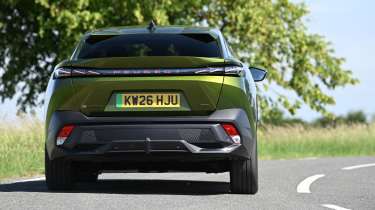
The smaller 308 recently received a similar treatment as part of their recent facelift, but only the 408 got light-up lettering at the rear. It’s integrated into a transparent strip across the tailgate, which connects the new three-claw tail-lights.
Also fresh is the exclusive Flare Green paint our of our test car. It’s supposed to change hue depending on the light conditions, shifting towards more of a yellow tone in sunlight and deep green in shadows. We didn’t notice a dramatic change in the colour during our time with the Peugeot, but we did get lots of compliments about it and for a standard paint option, it’s excellent.
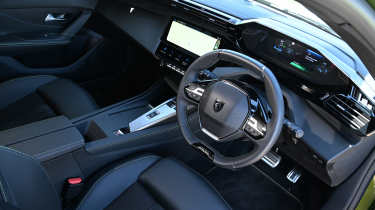
The 408's interior is largely the same as before, aside from some updated graphics for the 10-inch driver’s display, the addition of a driver-monitoring camera on the windscreen pillar to watch for fatigue or a distracted motorist, plus some new fabrics and other materials selected to boost perceived quality. Top-spec models feature aluminium, Alcantara and Nappa leather, adding to what was already a well finished, stylish if not particularly inviting, cabin.
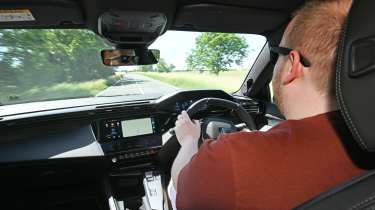
One element that definitely hasn’t changed is Peugeot’s unconventional i-Cockpit layout. This set-up requires drivers to look over the top of the small, chunky and rather odd octagonal steering wheel to read the instrument cluster. In theory, it helps keep the motorist’s eyes on the road, but can result in an awkward driving position, sometimes putting the steering wheel almost in your lap.
We got along with the 408's layout much more than we did in the equivalent 308, perhaps because the driving position is higher, giving a better view of the dials. Plus there’s plenty of adjustment in the driver’s seat and steering wheel, so most people should be able to get comfortable. Although, we still recommend potential buyers try it out for themselves before they buy.
The 10-inch central touchscreen is the same as before, too. It’s bright and sharp, but the infotainment system is slow and fiddly to use. So we’re grateful wireless Apple CarPlay and Android Auto come as standard, and GT and GT Premium models such as the one we tested come with another display for a row of large customisable ‘i-Toggles’ shortcut buttons. These help with switching between the various menus, or between CarPlay and the native software.
Below the i-Toggles panel are some physical switches, including one that many people don’t know can be used to deactivate some of the driver-assistance features by pressing it for a second or so. However, most of the other functions on the car, such as adjusting the cabin temperature, have to be done either via the main touchscreen, which can often be annoying and distracting due to how slow the infotainment system is at times, or with the help of the ChatGPT-aided virtual assistant.
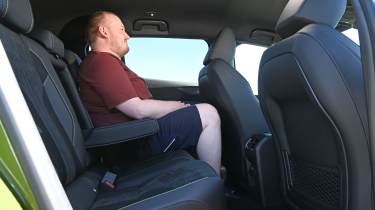
The rakish roofline means the 408 isn’t as spacious as a traditional family SUV and the dark interior is rather gloomy, but it doesn’t feel cramped. Even six-foot adults have a little headroom to spare and enough legroom to get comfortable, because the backs of the front seats are sculpted to make room for passengers’ knees. It will be a squeeze trying to get three adults in the back though, due to a tall hump in the floor that eats up quite a bit of foot space, but a trio of teenagers should be fine. For younger children, there are two sets of Isofix mounting points on the back bench.
The standard 408 Hybrid has an impressive 536-litre boot, but this is reduced to 471 litres in the plug-in hybrid and pure-electric 408s, or 454 litres when equipped with the upgraded Focal sound system. Even so, that is about the same as the new Nissan Leaf and Skoda Elroq offer, plus the boot is a square shape and easy to load.
While the sloped rear window line limits the height you can stack objects to, more annoying is there’s not enough underfloor storage or a ‘frunk’ in the nose to stow the charging cables, so they just take up space in the boot.
The facelifted E-408 features the same 58.2kWh battery and 210bhp front-mounted e-motor as before, but thanks to refinements to the car’s aerodynamics, Peugeot claims the set-up is now more efficient and good for up to 283 miles on a single charge – three miles more than before.
The entry-level versions of the Kia EV4, Skoda Elroq and Nissan Leaf offer similar ranges from comparable battery sizes. However, there are long-range versions of all three that can cover about 100 miles more than the E-408 and aren’t much more expensive.
We did more than 800 miles testing the new E-408, many of which were on a motorway, and averaged a respectable 3.8mi/kWh, which equates to a real-world range of 221 miles. The Peugeot’s 120kW peak charging speed isn’t lightning-fast, but is enough for a 20 to 80 per cent top-up in around half an hour – similar to its Kia and Skoda rivals.
New for 2026 is the ability to pre-condition the E-408’s battery so it’s at the optimal temperature for a rapid charge. On top-spec models, if you programme a charging station as the destination in the sat-nav, the car will automatically begin pre-conditioning the powerpack.
Another welcome new feature is the multiple strength levels for the regenerative braking, which drivers can toggle between using the paddles on the steering wheel. However, there are only three options and one of those is 'off'; there's no one-pedal mode like the Kia or Nissan offer.
Despite what the razor-sharp styling might suggest, the E-408 is not a sporty or exciting car to drive, but it is reasonably comfortable and a solid all-rounder, which is probably what most family buyers are looking for. The ride is firm and a bit jittery at low speeds, but it gets better and smoother the faster you go. Combined with the quiet cabin, this Peugeot feels most at home on a motorway.
It has sufficient power to quickly exceed the national limit, but not enough to pin occupants in their seats like a Tesla Model 3. Body control is good – until you try to change direction quickly, then you’ll suddenly notice the E-408 leaning over. The steering is quick and light, but almost entirely devoid of feel, yet it’s quick enough that you’re not spinning the tiny steering wheel around while driving along a twisty country road.
Surprisingly, rear visibility isn’t bad, even with that heavily sloped windscreen. The bigger issue is the lack of a rear wiper, so drivers will want to be more cautious than usual driving in heavy rain.
Standard kit includes the dual 10-inch displays, wireless smartphone connectivity, adaptive cruise control, a reversing camera, 19-inch alloy wheels and myriad driver-assistance features, such as lane-keep assist and driver-attention monitoring. GT and GT Premium trim adds ambient lighting, the illuminated grille and Peugeot badge, a powered tailgate and a wireless charging pad, among other equipment.
The UK Government’s £1,500 Electric Car Grant means the Peugeot E-408 is currently available from £32,695 – that’s only £700 more than the base hybrid version. But as impressive as nearly achieving price parity is, the newly crowned Auto Express Car of the Year for 2026, the Nissan Leaf, with the upgraded battery and a 386-mile range costs about the same.
| Model: | Peugeot E-408 GT Premium |
| Price: | £37,995 |
| On sale: | Now |
| Powertrain: | 58kWh battery, 1x e-motor |
| Transmission: | Single-speed automatic, front-wheel drive |
| 0-62mph: | 7.6 seconds |
| Top speed: | 99mph |
| Range: | 280 miles |
| Max. charging: | 120kW (20-80% in 31 minutes) |
| Size (L/W/H): | 4,687/2,0621,485mm |
Buy a car with Auto Express. Our nationwide dealer network has some fantastic cars on offer right now with new, used and leasing deals to choose from...