Polestar 3 review
Sleek looks define the brand’s largest model, but the technology of the Polestar 3 is unnecessarily fiddly

Our opinion on the Polestar 3
The Polestar 3 is the company’s largest car to date, and it has electric rivals from the big German manufacturers in its sights. When it comes to space, range, charging speed and performance, everything looks great on paper, but in the real world, the Polestar 3 doesn’t quite deliver on all of those fronts. However, the well honed chassis means it’s better to drive than its substantial size would lead you to believe.
About the Polestar 3
Based on the same platform as the Volvo EX90, the Polestar 3 features a far more dynamic and driver-oriented approach than its sibling and aims to take on the Audi Q6 e-tron, plus the BMW iX and Mercedes EQE SUV.
Given that it’s a premium electric SUV, prices for the Polestar 3 are on the high side. However, it does come very well equipped in standard form, and is available in Rear Motor, Dual Motor, and Performance forms. The Rear Motor models come with a 92kWh battery, while the four-wheel drive Dual Motor and Performance versions get a larger capacity 106kWh battery.
Small updates to the Polestar 3 in mid-2026 resulted in improvements across the board, with stronger performance and quicker charging speeds at the heart of it, and previously optional equipment now included as standard too.
Used - available now

2025 Polestar
3
16,570 milesAutomaticElectric
Cash £45,490We’ve tested a number of different versions of this electric SUV since it launched, and even pitched a Dual Motor version of the Polestar 3 against the Audi Q6 e-tron in a twin test. We’ve also run a Rear Motor version of the Polestar 3 to our long-term test fleet.
Performance & driving experience
Pros |
|
Cons |
|
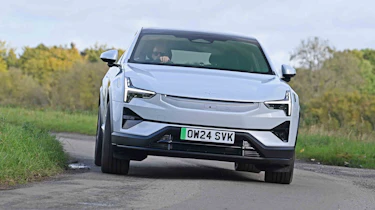
There’s a well-honed chassis underneath the Polestar 3, which makes it drive better than its substantial size would have you believe.
While some EVs use an electronic torque-vectoring system, which brakes the inside wheel to improve agility, the Polestar uses a pair of physical clutches to distribute torque from one side of the axle to the other. This set-up accelerates the outer wheel to give a sense of the rear wheels pushing through corners, which feels more akin to a traditional internal combustion car. It’s also able to disconnect the rear drive of dual-motor models when cruising, reducing energy usage.
Performance, 0-60mph acceleration and top speed
The Polestar 3 range kicks off with the Rear Motor, which sends 329bhp and 480Nm to the rear wheels. Those numbers are a noticeable improvement over earlier Polestar 3 models, and combat this car’s significant size and weight to drop the 0-62mph time by a second from 7.5 seconds to a much more sprightly 6.5 seconds. The top speed has also increased from 112mph to 130mph – not that you can go that fast in the UK.
A twin-motor arrangement lifts the output further by providing an electric motor on each axle to deliver four-wheel drive, with outputs of 536bhp/740Nm for the Dual Motor contributing to a rapid 4.5-second 0-62mph time, while the Performance turns the wick up to eleven with a massive 670bhp/870Nm. That’s enough to get the 3 to 62mph from rest in 3.8 seconds. Top speed for both four-wheel drive models is 140mph.
| Model | Power | 0-62mph | Top speed |
| Polestar 3 Rear Motor | 329bhp | 6.3sec | 130mph |
| Polestar 3 Dual Motor | 536bhp | 4.5sec | 140mph |
| Polestar 3 Performance | 670bhp | 3.8sec | 140mph |
Town driving, visibility and parking
Compared with some EV rivals, the Polestar has limited scope for adjusting its brake regeneration. The choices come down to one-pedal driving, gentle recuperation and full coasting. You can’t make any adjustments on the fly, however, because the settings are adjusted via the touchscreen – we’d much prefer steering wheel paddles to tweak the levels easily. We also found that in one-pedal mode, the deceleration could become sudden and tricky to modulate. The switch between mechanical and regenerative braking isn’t as smooth as in an Audi Q6 e-tron, for example.
The Polestar 3’s air-suspension system (standard on Dual Motor and Performance models) can be raised at low speeds, and while it doesn’t transform the car into an off-roader, it comes in handy when dealing with rougher roads. At 11.8 metres, the Polestar’s turning circle is reasonable for a long car, but the likes of the Mercedes EQE SUV and BMW iX are better, courtesy of their four-wheel steering systems.
Country road driving and handling
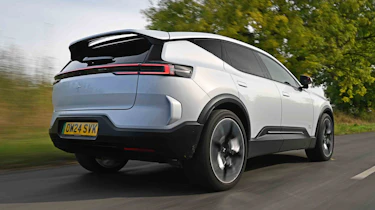
For a car of this size, the Polestar 3’s body control is impressive. While it can’t quite contain side-to-side movements at speed on bumpy roads, the ride is composed for the most part and body roll is well contained. The three suspension settings adjust the levels of stiffness; the Firm setting lives up to its name by producing a bit of jiggle, so we preferred to leave the car in Standard or Nimble, which weren’t vastly different from each other in terms of comfort or handling. The steering is light, quick, but not loaded with feel. However, it's accurate enough and feels well matched to the chassis.
Motorway driving and long-distance comfort
High-speed refinement is impressive, with a touch less road noise from the tyres than you’ll find in an Audi Q6 e-tron, but slightly more than you’ll get from the refined BMW iX. Ride comfort and stability are impressive at speed.
“With a heavy right foot, there’s enough power on tap to break traction on the front axle – albeit briefly – in Performance mode. Range mode softens things up, but by too much; the throttle becomes so unresponsive that there’s a long pause between squeezing the pedal and getting any action at all.” – Alex Ingram, special contributor.
Range, charging & running costs
Pros |
|
Cons |
|
Since its launch, the Polestar 3 battery line-up has been revised, with the Rear Motor model getting a smaller 92kWh battery, and the four-wheel drive Dual Motor and Performance models coming with a 106kWh battery. Both are reduced in capacity compared with the 111kWh battery of earlier models.
Electric range, battery life and charge time
Revisions to improve efficiency in 2026 mean that range figures are looking a little healthier than they were when the car was launched. The Rear Motor’s smaller battery means its 374 miles is still less than the entry-model car at launch, but the Performance has risen to 373 miles, while the longest range Polestar 3, the Dual Motor, now breaks the 400-mile barrier by a couple of miles.
In earlier models, we achieved an efficiency figure of 2.5 miles per kWh in a Long Range Dual Motor, which equates to a range of around 260 miles, which wasn’t fantastic given the size of the battery pack. Our long-term testing of a pre-revision Long Range Single Motor model saw efficiency of 2.8 miles per kWh, or just shy of 300 miles to a charge. A recent test of the Rear Motor car returned 3.2 miles per kWh, the best yet, suggesting real-world efficiency is slowly improving, though that 3.2 miles/kWh number still means a realistic maximum of only 294 miles from 100 per cent to completely empty – so more like 250 miles if you’re not pushing your luck and using every kilowatt hour the battery has to offer.
Like the revised EX90, the Polestar 3 now comes with an 800v architecture versus the 400v architecture of earlier models. While that sounds meaningless to some, the upshot is the revised model can charge faster, going from a maximum peak of 250kW to 310kW for Rear Motor models, and 350kW for Dual Motor and Performance versions. Provided you can hook up to a charger capable of delivering those speeds, this has improved the 10-80 per cent rapid charge time to 22 minutes compared with 30 minutes of earlier models.
Most owners will want to home charge the Polestar 3, and a typical 7kW wallbox charger at home, it will take just over 16 hours to fully recharge a Dual Motor or Performance Polestar 3 from 0 to 100 per cent, while the slightly lower capacity battery in a Rear Motor model will take 14 hours to be recharged.
| Model | Battery size | Range | Insurance group |
| Polestar 3 Rear Motor | 92kWh | 374 miles | 50 |
| Polestar 3 Dual Motor | 106kWh | 402 miles | 50 |
| Polestar 3 Performance | 106kWh | 373 miles | 50 |
Insurance groups
You’ll also need to set aside some budget for the cost of insurance, because the entire Polestar 3 line-up sits in the highest band, group 50.
Tax
EVs are sadly no longer exempt from paying the standard vehicle excise duty (VED) rate, and due to costing over £50,000 when new, the Polestar 3 will be subjected to the additional luxury car tax, which applies from the second time the vehicle is taxed up until it is six years old. Company car users will be happy with the four per cent (for the 2026/27 tax year) Benefit-in-Kind (BiK) band.
Depreciation
Residual values for the Polestar 3 lag behind those of its closest rivals, with our experts predicting it’ll only retain 39 per cent of its original value over three years or 36,000 miles. Meanwhile, the Mercedes EQE SUV will retain between 40 and 48 per cent over the same period, and the Audi Q6 e-tron is likely to maintain between 45 and 50 per cent. Neither can match the Porsche Macan Electric, which retains between 56 and 59 per cent of its original value.
To get an accurate valuation for a specific model, check out our free car valuation tool...
Interior, design & technology
Pros |
|
Cons |
|
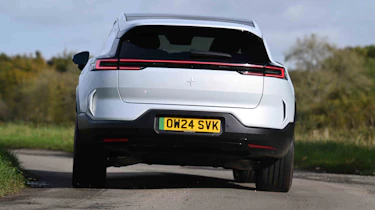
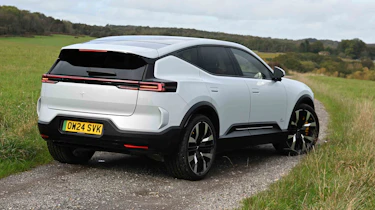
Unlike many of those rivals, Polestar has kept the roof of its car relatively low; it’s roughly 80mm below the BMW’s, for example. Not only does that give the Polestar 3 a sleek and dramatic presence on the road, but it also makes use of slick aerodynamic aids, such as the front spoiler at the leading edge of the bonnet. As a result, it enables this near five-metre-long, two-metre-wide SUV to return a slippery drag coefficient of 0.29Cd.
Prices are high, but the Polestar 3 is very well equipped even in entry-level form. There are 20-inch alloy wheels, Brembo brakes, LED headlights with active main beam, auto lights and wipers, electrically heated frameless door mirrors, a powered tailgate, three-zone climate control, heated front seats, a 14.5-inch central display with a Google operating system, built-in apps and 5G connectivity, plus a vast suite of safety systems.
Interior and dashboard design
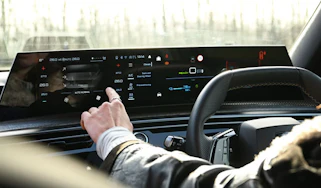
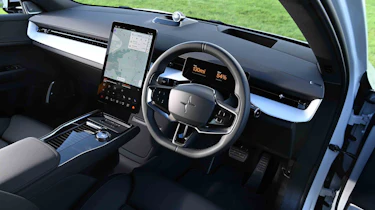
The minimalist dashboard design is interrupted only by a vast central touchscreen that controls nearly all of the car’s main functions. While we don’t mind things such as the door mirrors being accessed via the screen, consigning the headlights to it is less excusable when they’re something that’s used nearly every time you drive. Not only that, but during our time with a Polestar 3, we found the headlight flasher didn’t respond well – and sometimes not at all – to the column stalk.
Materials and build quality
The Polestar 3 is up against some finely built competition, such as the BMW iX and the Audi Q6 e-tron, but it can match them for fit and finish. It feels expensive, and things are helped by wonderfully comfortable front seats.
Infotainment, sat-nav and stereo
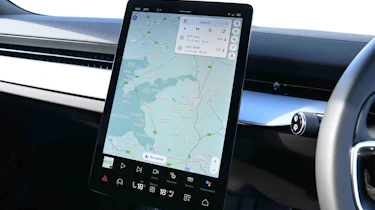
There is little room on the dashboard for physical buttons when a 14.5-inch portrait touchscreen occupies most of the space. We’d prefer the climate controls to be separate from the main display, which would allow more room for the best bits of the Android Automotive operating system, such as the fantastic Google-based navigation system.
We did find it curious that it was possible to use the on-screen keyboard to enter an address on the move, though – we can’t see how this is any safer than using your own smartphone. Considering Polestar’s close ties with Volvo and its strong safety record, we expected to find the keypad locked out when driving.
Along with 2026’s range and performance improvements, the infotainment’s processing power was given a boost, and among other things it allows for faster and more significant over-the-air updates. It hasn’t changed the actual operation of the touchscreen though, nor fixed our gripes with all the controls being buried in there.
“The Polestar 3 is available with a Bowers & Wilkins audio system, and aside from Bentley’s incredible Naim set-up, is frequently rated among the best in-car music experiences money can buy thanks to the clarity, power and precision of the 25-speaker, 1,610-watt arrangement. It’s a staggeringly good system that’s helped by the superb refinement of the Polestar 3.” – Alex Ingram, special contributor.
Boot space & practicality
Pros |
|
Cons |
|
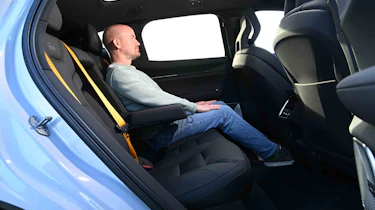
Thanks to its large SUV bodystyle, there’s plenty of space in the Polestar 3 whether you’re sitting in the front or the back. However, we would have expected to see a bigger boot given this is supposed to be a practical five-seat car used by families; as the comparison table shows, it’s smaller than some direct rivals, and there are cars a class or two below that can also boast larger load bays.
Dimensions and size
| Dimensions comparison | |||
| Model | Polestar 3 | Audi Q6 e-tron | Mercedes EQE SUV |
| Length | 4,900mm | 4,771mm | 4,863mm |
| Width | 2,070mm (2,120mm inc mirrors) | 2,193mm inc mirrors | 1,940mm (2,141mm inc mirrors) |
| Height | 1,614mm | 1,702mm | 1,707mm |
| Wheelbase | 2,985mm | 2,899mm | 3,030mm |
| Boot space | 484-1,411 litres | 526-1,529 litres | 520-1,675 litres |
Seats & passenger space
With such a slim driver’s display behind the steering wheel, the view ahead is uninterrupted, which means that visibility is good for a car so large. The pillars are thick all around, though, and this is especially noticeable at the back, where a small window makes over-the-shoulder visibility limited. At least the Polestar 3 is littered with surround-view cameras and has large door mirrors.
When it comes to kneeroom, few cars in any class allow you to stretch your legs quite so much as the Polestar 3. Rear-seat space is vast, and it feels all the more generous thanks to a completely flat floor. Headroom, though excellent, could be even better were it not for the lump in the ceiling caused by the trailing edge of the panoramic sunroof. The cabin is wide, too, to the point where the central passenger gets a seat that is as sculpted and comfortable – if a little narrower – than the occupants to either side.
Boot space
The area that the Polestar 3’s boot takes up is vast, with well over a square metre available, so it’s handy to have a folding partition to divide that area into smaller spaces. Tether hooks are also useful for securing items, and power can be drawn from a 12-volt socket.
While the area is large, the distance between the boot floor and the window line is a little more shallow than in rivals such as the Audi Q6 e-tron, and as a result, the overall volume, at 484 litres, isn’t as generous. Fold down the back seats, and that figure grows to 1,411 litres. There’s plenty of underfloor storage, however, plus an extra 32 litres under that aero-optimised nose for taking a charge cable or two.
“Entry-level Rear Motor Polestar 3 models can manage a towing capacity of 1,500kg, but you’ll need a four-wheel drive model for towing bigger trailers or caravans to get the higher 2,200kg capacity. Neither is a bad figure, but the Audi Q6 e-tron can handle more, from 2,000kg for two-wheel drive models to 2,400kg if you plump for quattro four-wheel drive.” – Max Adams, online reviews editor.
Reliability & safety
Pros |
|
Cons |
|
The Polestar 3 has been awarded the maximum five stars out of five rating by Euro NCAP, which is just as well, given the manufacturer’s ties to Volvo. That score was no doubt helped by its extensive list of standard safety and driver-assist tech; every Polestar 3 comes with nine airbags, adaptive cruise control, a collision-avoidance system (which can detect not only vehicles, but cyclists and pedestrians, too), lane-keeping assist, a driver-awareness alert and blind-spot detection.
The Pilot Pack adds acceleration, braking and steering support at speeds of up to 93mph, parking assist and lane-change assist. We tried out the lane-keep assist and found it to be one of the best systems out there, offering gentle movements of the steering wheel to keep the car in its lane. However, the Lidar technology that was also supposed to feature on the Volvo EX90 isn’t available on the Polestar 3 at the moment.
Polestar’s most recent entry into our Driver Power satisfaction survey was in 2023, where it finished a superb second overall.
| Euro NCAP safety ratings | |
| Euro NCAP safety rating | 5-stars (Euro NCAP, 2025) |
| Adult occupant protection | 90% |
| Child occupant protection | 93% |
| Vulnerable road user protection | 79% |
| Safety assist | 83% |
Buying and owning
Best buy: Polestar 3 Dual Motor
How much does the Polestar 3 cost? Well, official ‘on the road’ prices range from £76,540 to £92,040, but you can currently save an average of £10,000 through the Auto Express Find A Car service, where prices start at £66,540. You can lease a Polestar 3 from £524 per month or buy a used model at prices starting from under £40,000
Every version of the Polestar 3 comes with plenty of equipment and a number of different packs that provide lots of extra equipment and driver assistance features. We suspect adding the £1,600 electrochromic glass roof would be worthwhile given it floods the interior with light and is likely to be a sought-after feature come resale time.
The Dual Motor model adds adaptive air suspension that’ll lower the car at motorway speeds to make it more aerodynamic and improve the range. It also has the best towing capacity, if you’re planning on hauling around a trailer or caravan.
Check out our latest new car deals, leasing deals and used car deals for the top offers available now on Auto Express. And don't forget we can help you sell your car, too.
Polestar 3 alternatives
The large SUV sector is awash with electric options, so the Polestar 3 will have to fight for sales. It goes up against the likes of the BMW iX, Mercedes EQE SUV and even the Volvo EX90, a car that is based on the same basic platform. It’s arguable that the Polestar’s relatively distinctive shape will help it to draw buyers in.
Key updates of the Polestar 3 review
29 July 2026: General update to reflect the revised battery and range figures with the 800v architecture
Frequently Asked Questions
There’s a three-year/60,000-mile warranty for the whole car, while the drive battery comes with eight years or 100,000 miles of cover.
Deals on the Polestar 3 and alternatives