Toyota GT 86 vs Audi TT 1.8T vs Nissan 370Z: 2012 group test
Toyota is returning to its sports car roots – but is the all-new GT 86 a match for key rivals from Audi and Nissan?

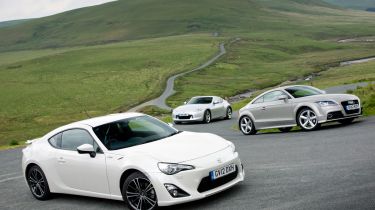
Some cars are so enjoyable from behind the wheel that you drive them purely for fun. It’s something that’s been lacking from Toyotas of late, but the new GT 86 is set to change that. Designed to offer a classic sports car experience, the GT 86 takes inspiration from some of the great Toyota sports cars of the past, including the 2000GT and Celica.
It was developed in partnership with Subaru, and the rear-wheel-drive, boxer-engined coupe promises thrill-a-minute motoring. But it faces stiff competition. The Audi TT is hard to ignore, especially as the entry-level 1.8 TFSI makes it more affordable than ever. Plus it’s great to drive and cheap to run. For old-school excitement, there’s little to beat the Nissan 370Z. It costs more than the GT 86, but it offers big V6 performance and traditional rear-drive handling. We headed for some of the best roads in the UK to see which one of our contenders takes the top spot.
Verdict
The Toyota GT 86 is a back-to-basics sports car that follows a classic recipe to deliver a smile-a-minute driving experience. It’s the sort of car that makes you seek out a twisty road rather than take the direct route – and it wins this test. But only by the smallest of margins – because we think the 1.8 TFSI is the best TT in the range. The engine is punchy, refined and efficient. The Audi handles like a hot hatch, plus it’s comfortable, has a great cabin and is cheaper to own than its rivals. However, the fact that the agile Toyota is surprisingly refined and easy to live with narrowly keeps it ahead of the stylish TT. Unfortunately, aside from its power advantage, the more expensive Nissan 370Z is comprehensively outclassed and comes third. Toyota has proved that it has rediscovered some of its sparkle and the GT 86 is our pick.
Used - available now

2020 Hyundai
Kona
57,198 milesManualPetrol1.0L
Cash £8,299
2022 Renault
Arkana
23,187 milesAutomaticPetrol1.6L
Cash £15,995
2022 Volvo
XC40
17,888 milesAutomaticPetrol2.0L
Cash £22,995
2023 Peugeot
208
17,050 milesAutomaticPetrol1.2L
Cash £13,995Winner: Toyota GT 86 ★★★★★ The beautifully engineered GT 86 offers the sort of engagement normally reserved for cars like the Lotus Elise. The boxer engine loves working hard and the handling is near perfect. Yet despite its focus it rides well, and the cabin is comfortable, if a little dated.
2nd: Audi TT ★★★★★ It doesn’t have the traditional rear-wheel-drive balance and engagement of the Toyota, but the front-driven TT is composed, fast and fun. Part coupe, part stylised hot hatch, its lower emissions make it the best company car choice, and with a decent boot, it’s the most practical.
3rd: Nissan 370Z ★★★ On paper, the rear-wheel-drive, V6-engined Nissan has all the right ingredients to succeed in this test. Unfortunately its gruff engine, hefty weight and poorly controlled chassis let it down. Although it’s the fastest car here, it’s also the most expensive to buy and own.
Toyota GT 86
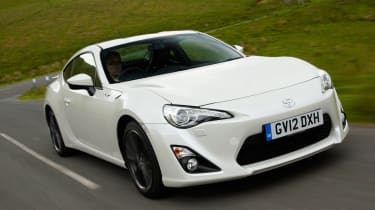
Toyota has a sports car heritage that stretches back nearly half a century. But in recent years, the Japanese maker has been more focused on practical cars. However, that’s set to change with the all-new GT 86.
Designed to reignite some of the passion found in the firm’s old MR2, Celica and rear-wheel-drive AE86 Corolla – from which the newcomer takes its name – the latest Toyota aims to inject some sparkle into the straight-laced line-up. And it’s not just the driving dynamics that hark back to its most famous models, the styling takes its cues from the past, too.
Designers placed a very rare 1967 2000GT coupé in the studio when they worked on the GT 86 – and it’s clear the diminutive sixties sports car has influenced the compact proportions of Toyota’s 21st century model.
Yet, there’s also a hint of Lexus LFA supercar about the front end, while the wide-spaced exhaust pipes and muscular styling add to the car’s considerable kerb appeal.
The cabin feels small, but a big glass area means you don’t feel hemmed in, and visibility is good. A low-mounted seat places you in a traditional sports car driving position, while the large rev counter takes pride of place directly ahead of you.
The rear seats are tiny, but no less practical than the TT’s. In an effort to highlight the kind of driver expected to buy the GT 86, Toyota claims that with the bench folded you can carry a set of tyres and rims in the boot for a track day.
Less focused buyers may be disappointed by the cabin’s old-fashioned design and the cheap feel of some plastics. Still, the dash is well thought out and feels solidly constructed.
When it came to delivering a stunning driving experience, Toyota had three key design parameters – rear-wheel drive, no turbocharging and ordinary tyres. Not relying on performance rubber to achieve grip means the GT 86 has 17-inch wheels and the same eco-friendly, low rolling resistance tyres as a Prius. As a result, on all but the roughest of city roads, the ride is surprisingly comfortable.
Yet, this hasn’t detracted from the car’s abilities on a twisty road. Body control is superb and the electric power-steering fast. Extensive weight saving means the GT 86 tips the scales at just 1,240kg, while a low centre of gravity and well balanced weight distribution add to its dynamic poise. But it’s the rear-wheel-drive layout that creates the real magic.
You can certainly feel the extra agility and the purity of the responses. Lots of modern performance cars are capable, but offer little engagement at safe road speeds. However, in the GT 86 you can feel the limit of grip arriving, and with the stability system disengaged you can use the power to gently let the rear tyres surrender before balancing the car with the steering and throttle. The engine itself is packed with character. Its boxer configuration will be familiar to Subaru fans, but Toyota has added its direct injection technology.
With 197bhp, it’s more powerful than the TT, but a modest 205Nm means it trails the turbo Audi for torque. Still, rear-drive traction and its low weight mean the GT 86 is a fraction faster in the 0-60mph sprint, with a time of 7.5 seconds. At very low revs it’s a little flat, but hit 4,000rpm and the boxer takes on a manic persona, eagerly spinning to the red line.
Throttle response is good as well, and while the engine thrums away each time you press the accelerator, on the motorway the Toyota is unobtrusive and surprisingly refined for a focused sports car.
Costing £24,995 with a decent standard equipment tally, the GT 86 has plenty of real world appeal. So by blending value and everyday usability with an engaging chassis, has Toyota got a winning sports car again?
Audi TT 1.8T
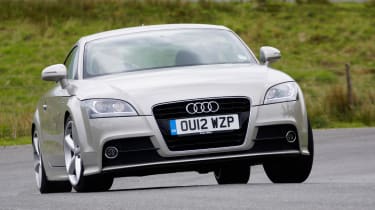
If Toyota’s new sports car wants to steal sales from established coupe contenders, then it has to face up to the Audi TT. A classy image, faultless build quality and well sorted handling mean that six years on from its original launch, the current TT has lost none of its desirability. Traditionally all this has come at a price, yet thanks to the introduction of the 1.8-litre TFSI engine, the TT is more affordable than ever. In fact, the £24,975 Sport is the same price as the GT 86, something that should worry Toyota. We’ve tested the TT in the sportier S line trim, but even then it costs just £1,070 more than the Toyota, while lower emissions and better residuals help reduce running costs and dispel the myth that opting for a premium badge means spending a lot more.
Better still, sportier bumpers and subtle S line badging add to the attractive shape of the TT. And while its familiarity ensures it draws less attention on the road than the GT 86, few people would deny that the Audi has an extra pinch of style. The TT really extends its advantage when you slide into the driver’s seat. With top- quality materials throughout, the beautifully crafted cabin looks and feels more upmarket than either the Toyota or the Nissan.
Smart details include a chunky gearlever, metal-ringed air vents, knurled air-con controls and a tactile flat-bottomed wheel. With chunky pillars and a narrow windscreen the glass area is small, but the driving position is perfect. As in the Toyota, the rear seats are of limited use, but split/folding means the TT is the most practical car here. Under the bonnet, the 158bhp 1.8-litre turbo engine (which was first introduced in the TT Roadster) is fantastic. There’s a lovely broad spread of power and you get the low- down urge missing from the Toyota.
At the test track, the TT was just two-tenths of a second behind the GT 86 in the 0-60mph sprint with a time of 7.7 seconds, and was quicker to respond in gear, particularly in sixth. The engine is also impressively refined, while the raspy exhaust note and the slick action of the manual gearbox are the icing on the cake. In corners, the Audi is composed, turns in well and has strong grip. The smooth power delivery helps traction and the steering is nicely weighted.
It doesn’t feel as alive as the rear-wheel-drive Toyota, but it’s far more agile than the heavy Nissan. It’s about as good as a front-wheel-drive car gets. In fact, if you think of this entry-level TT as an exceptionally good to drive, but far more stylish hot hatch, then you wouldn’t be far off the mark. That’s no bad thing, but in a test that’s focused heavily on the driving experience, is that enough for the TT to defeat the more powerful 370Z, let alone Toyota’s hugely talented new coupe?
Nissan 370Z
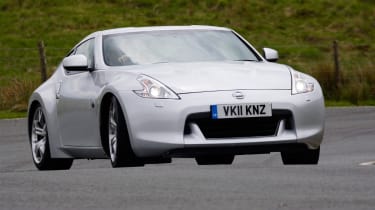
Like Toyota, Nissan has a sports car pedigree it can be proud of. The 370Z follows the same template as the 350Z it replaced, and both take inspiration from the famous 1969 240Z. With its long bonnet, shallow side windows, power bulges and stubby rear end, the classic Z-car look is clear to see in the latest model, and it helps the 370Z stand out from the crowd. But while the GT 86’s classic inspiration extends to being small and light, the 370Z’s doesn’t. It’s only 10mm longer than the Toyota, but with a 20mm shorter wheelbase, bigger overhangs and 30mm higher roof line, it looks cumbersome in comparison.
Inside, a high transmission tunnel and instruments stacked in a pod mounted to the steering column help create a driver-focused feel. Headroom is better than in the Toyota, but the wheel is only height adjustable, while rear visibility isn’t great and space is a little tight. Even more disappointingly, given that the Nissan is the most expensive car in the test, the cabin plastics look and feel cheap compared to the Audi. However, the 370Z’s price premium doesn’t seem so outrageous when you take a look under the bonnet. Up against its four-cylinder rivals, the 326bhp 3.7-litre V6 engine delivers 129bhp more than the GT 86 and more than double the power output of the Audi. Not only that, the 363Nm torque output is the biggest here by some margin. Even taking into account its considerable kerbweight, it’s no surprise that the Nissan was the fastest car of our trio at the test track.
Unfortunately, while there’s a small sweet spot around 3,000rpm, where the exhaust note is fairly tuneful, elsewhere the character of the engine takes the edge off performance. The V6 is strained at high revs, disappointingly unrefined and noisy. The automatic gearshift on the car in our pictures suffers from a slow shift, while the manual version is clunky, too. Worse still, with the poorest fuel consumption of the trio and emissions of 248g/km, you’ll also pay the price at the pumps and in your tax bill. But it’s the fact that the 370Z falls short in corners that will trouble driving enthusiasts.
The weighty steering is positive and the 370Z turns in well, but once into the bend the Nissan’s composure falls apart. The chassis struggles to keep the Z’s 1,496kg weight under control and there’s lots of body movement. The suspension can’t cope with bumpy surfaces, which has a dire impact on traction and grip. Even in less extreme driving situations, the Nissan troubles its traction control far more than its rivals, while an unsettled ride and excessive road noise ruin cruising comfort. Neither as relaxed nor as enjoyable as either of its rivals, aside from its extra power, it’s very hard to see how Nissan can justify its near-£30,000 price tag in this company. Especially as it’s the least practical car, has the worst residual values and the highest running costs.
| Toyota GT 86 | Audi TT 1.8 TFSI S line | Nissan 370Z Coupe | |
| On the road price/total as tested | £24,995/£27,795 | £26,065/£29,765 | £29,975/£34,725 |
| Residual value (after 3yrs/36,000) | £11,473/45.9% | £14,909/57.2% | £12,769/42.6% |
| Depreciation | £13,522 | £11,156 | £17,206 |
| Annual tax liability std/higher rate | £1,280/£2,560 | £1,035/£2,070 | £2037/£4,075 |
| Annual fuel cost (12k/20k miles) | £2,600/£4,333 | £2,408/£4,014 | £2,677/£4,462 |
| Insurance group/quote | TBA/£437 | 32/£490 | 46/£966 |
| Road tax band/cost | I/£ 215 | F/£135 | L/£460 |
| Cost of 1st/2nd/3rd service | TBC | £34 per month (3yrs) | £219/£309/£219 |
| Length/wheelbase | 4,240/2,570mm | 4,187/2,468mm | 4,250/2,550mm |
| Height/width | 1,285/1,775mm | 1,353/1,842mm | 1,315/1,845mm |
| Engine | 4cyl boxer/1,998cc | 4cyl in-line/1,798cc | V6/3,696cc |
| Peak power/revs | 197/7,000 bhp/rpm | 158/4,450 bhp/rpm | 326/7,000 bhp/rpm |
| Peak torque/revs | 205/6,400 Nm/rpm | 250/1,500 Nm/rpm | 363/5,200 Nm/rpm |
| Transmission | 6spd man/rwd | 6spd man/fwd | 6spd man/rwd |
| Fuel tank capacity/spare wheel | 50 litres/sealant | 55 litres/sealant | 72 litres/sealant |
| Boot capacity (seats up/down) | 243 litres/N/A | 292/700 litres | 235 litres/N/A |
| Kerbweight/payload | 1,240/395kg | 1,260/400kg | 1,496/304kg |
| Turning circle/drag coefficient | 10.8 metres/0.27Cd | 10.9 metres/0.30Cd | 10.6 metres/0.29Cd |
| Basic warranty (miles)/recovery | 5yrs (100,000)/1yr | 3yrs (60,000 miles)/3yrs | 3yrs (60,000)/3yrs |
| Service intervals/UK dealers | 10,000 miles (1yr)/184 | Variable miles/135 | 9,000 miles/209 |
| Driver Power manufacturer/dealer pos. | 5th/4th* | 15th/26th* | 4th/6th* |
| 0-60/30-70mph | 7.5/7.0 secs | 7.7/7.1 secs | 5.7/5.3 secs |
| 30-50mph in 3rd/4th | 4.3/5.5 secs | 3.7/4.9 secs | 3.4/4.7 secs |
| 50-70mph in 5th/6th | 7.3/11.2 secs | 7.1/9.1 secs | 5.1/7.4 secs |
| Top speed/rpm at 70mph | 140mph/3,000rpm | 140mph/2,300rpm | 155mph/2,600rpm |
| Braking 70-0/60-0/30-0mph | 48.8/36.1/9.1 metres+ | 50.4/37.1/9.3 metres+ | 44.8/34.7/8.2m++ |
| Auto Express econ (mpg/mpl)/range | 27.7/6.2/305 miles | 29.9/6.6/362 miles | 26.9/6.0/426 miles |
| Noise outside/idle/30/70mph | 59/44/62/69dB | 58/42/60/69dB | N/A |
| Govt urban/extra-urban/combined | 27.2/44.1/36.2mpg | 33.2/54.3/44.1mpg | 18.3/36.2/26.6mpg |
| Actual/claimed CO2/tax bracket | 236/181g/km/26% | 218/149g/km/20% | 243/248g/km/35% |
| Airbags/Isofix/rear parking sensors | Seven/yes/DFO | Four/yes/£305 | Six/yes/£365 |
| Automatic gearbox/stability | £1,500/yes | £700/yes | £1,450^^^/yes |
| Climate control/cruise control | Yes/ yes | Yes/£220 | Yes/no |
| Leather/heated seats | £1,600^/£1,600^ | Yes**/£255 | No/no |
| Met paint/xenon lights/keyless go | £450/yes/yes | £510/yes/no | £550/yes/yes |
| Sat-nav/USB connection/Bluetooth | £750^^/yes/yes | £1,525^/£185/£250 | No/no/yes |