Used Toyota GT86 (Mk1, 2012-2020) review and buyer's guide
A full used buyer’s guide on the Toyota GT86 covering the GT86 Mk1 (2012-2020)

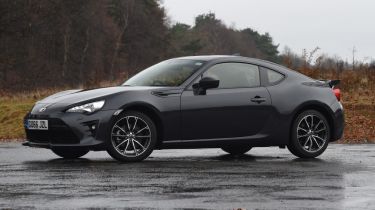
When the GT86 arrived, Toyota once again had a halo sports car to lust after. Immediately, it was critically acclaimed for its brilliant handling, and showed that just 197bhp was plenty to create a fun coupe. In the few years leading up to the arrival of the GT86, Toyota’s focus had been on its frugal hybrid technology and its SUVs, the brand’s famous sporty model lines like the Supra, MR2 and Celica had been left by the wayside. Pre-GT86, Toyota’s fastest-accelerating car was the V8-powered Land Cruiser behemoth.
Not that the GT86 chased fast sprint figures; instead, engineers focused on making it as light as possible and prioritised cornering dynamics over straight-line speed. Skinny tyres and rear-wheel drive made it great fun to drive, and the GT86’s centre of gravity was lower to the ground than that of the Porsche Cayman.
While many driver’s cars are compromised in terms of reliability or affordability, that isn’t the case with the Toyota. This really is a model that will suit a huge number of people unless ultimate practicality is key. The potential fly in the ointment is finding the right GT86 for you, because this isn’t a big-selling car in the UK. Owners also tend to hang on to them, so there aren’t huge numbers for sale at any one time. But as long as you’re prepared to travel or wait for the right example if necessary, you should be able to source the GT86 of your dreams.
Used - available now

2024 Vauxhall
Mokka
13,427 milesAutomaticPetrol1.2L
Cash £15,020
2022 Nissan
Qashqai
40,749 milesManualPetrol1.3L
Cash £14,497
2024 Vauxhall
Mokka
30,000 milesAutomaticPetrol1.2L
Cash £14,397
2021 MINI
5-Door Hatch
19,920 milesAutomaticPetrol1.5L
Cash £14,097The rear-wheel-drive GT86 is the spiritual successor to the earlier rear-driven Celicas, along with the Corolla GT that was loved by hot-hatch enthusiasts in the eighties. So when Toyota teamed up with Subaru to create a driver’s car par excellence, the goal was achieved; the GT86 proved you don’t need a lot of power to really enjoy every drive.
Models covered
- Toyota GT86 (2012-2020) - sporty Japanese coupé perfectly blends performance with practicality.
Toyota GT86
History
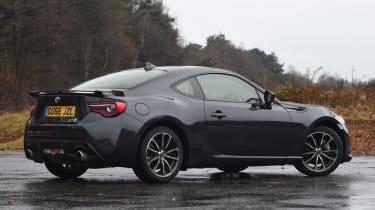
The first GT86s reached British roads in July 2012. There was only one trim level, and all cars had a 197bhp 2.0-litre flat-four petrol engine with either manual or automatic gearboxes, both with six ratios. A refresh in October 2014 brought a new entry-level Primo edition, a limited-run Giallo with metallic yellow paint, and the GT86 Aero, which added a bodykit. Tyre pressure monitoring became standard, too.
A Euro 6-compliant engine arrived in July 2015, while the GT86 Aero gained 18-inch alloys. A new Blanco special edition with pearlescent white paint and heated leather-trimmed seats joined the range, too. The car was more heavily revised in October 2017 with a stiffer bodyshell, retuned suspension, updated instrumentation, tweaked styling and improved aerodynamics. There was also a GT86 Pro range-topper with leather and Alcantara trim.
Which one should I buy?
Part of the pleasure of driving a GT86 comes from the deliciously precise gearchange, so while the auto box works well enough, and cars fitted with these have quite a following, most people will be better off buying the manual. Other than that, it’s a question of finding the best GT86 that you can afford.
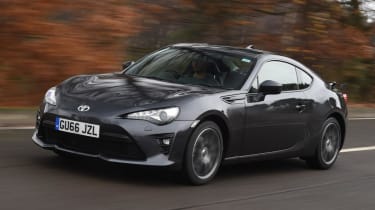
The standard car came with dual-zone climate control, sports seats, bi-xenon headlights, powered folding door mirrors with electric adjustment, and 17-inch alloys. Sat-nav was an option, along with leather and Alcantara-trimmed heated front seats, although some special editions got these as standard. Another option worth seeking out is the nine-speaker JBL sound system.
Alternatives to the Toyota GT86
The obvious alternative to the GT86 is a Subaru BRZ, because it’s essentially the same car with a different set of badges. The Subaru is rare, though; the agreement between the two companies meant the lion’s share of cars wore Toyota badges.
Audi’s TT is a hugely desirable sports car, with four-wheel drive on some models. It’s good to drive, although not as engaging as the Toyota, but you can buy one in coupé or roadster forms, with either petrol or diesel engines, and manual or auto transmissions.
The Volkswagen Scirocco also offers hatchback usability and a decent choice of engines or gearboxes, but this isn’t as much fun as the Toyota, either. The Nissan 370Z is another contender, with its muscular V6 engine and rear-wheel drive, but it’s thirsty.
What to look for
Gearbox
The manual box’s change into second gear can be particularly obstructive, especially until the oil has warmed up.
Electrics
Several owners have had problems with batteries going flat because of incorrectly wired heated seats, so ask vendors about this.
Brakes
Squeaky stoppers seem to be a fact of life for many GT86 owners, with effective fixes proving elusive; listen out for noisy brakes during a test drive.
Seats
The seat bolsters aren’t as durable as you might hope; they can wear through in fewer than 20,000 miles, so check for damage here.
Interior
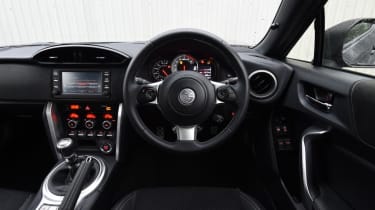
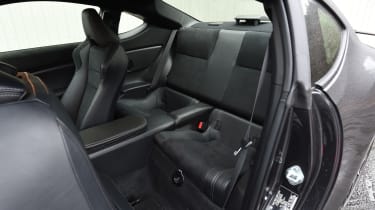
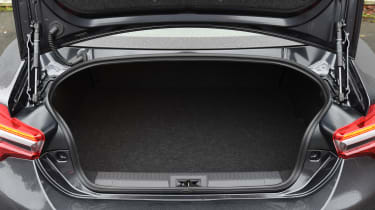
For a brilliant driver’s car the GT86 is fairly practical, because while the rear seats are only really suitable for children, they fold down to boost the 237-litre boot. The cabin design seems dated in places and some materials don’t look or feel of premium quality, but the seats are grippy and supportive, the available equipment ticks the right boxes and all the controls are user-friendly enough.
Prices
Check out used Toyota GT86 deals on our Find a Car service.
Running costs
All GT86s have to be serviced every 12 months or 10,000 miles. The schedule simply alternates between minor and major, priced at £250 and £395 respectively. The major service includes a brake-fluid change, because that’s due every two years or 20,000 miles, while the coolant should be replaced after the first 100,000 miles or 10 years, then every 60,000 miles or six years.
The cost of this is included in the major service, and because the engine is chain-driven, there’s no cambelt to replace, which helps to shave running costs. Once a GT86 hits its fifth birthday, it’s eligible for membership of the Toyota 5+ Club, which knocks 20 per cent off any maintenance or MoT performed by an official dealer.
The Toyota has the edge over the Subaru when it comes to warranty. Subaru BRZs get three years and 60,000 miles of cover, whereas the Toyotas left the factory with a five-year warranty. In 2021, Toyota announced its Relax warranty cover, which provides peace of mind for 10 years or 100,000 miles, whichever comes first. Impressively, the cover also applies to used cars; even if your car’s more than five years old, it can have a year’s warranty cover if you have it serviced at a Toyota garage.
Recalls
Toyota has issued two GT86 recalls. In October 2016, 4,556 cars built from April 2012 to March 2015 were called back because the steering power assistance could be lost. The fix is a new wiring harness. A recall in April 2019 affected 3,505 GT86s made from April 2012 to May 2013, with potentially faulty valve springs leading to possible engine damage. Stronger springs are the fix.
Driver Power owner satisfaction
The GT86 hasn’t appeared in our Driver Power surveys, but Toyota regularly finishes in the top 10 of our brands poll. Even more impressive are owner ratings across the reviews on our sister website carbuyer.co.uk; virtually all the write-ups give the Toyota a full five-star rating. Owners love the handling, rarity, reliability, practicality and value – and dislike virtually nothing.
Toyota GT86 (2012-2020) review: What we said
Extracts from our 2020 in-depth review of the Toyota GT86...
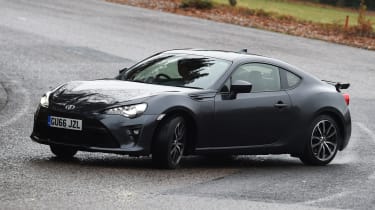
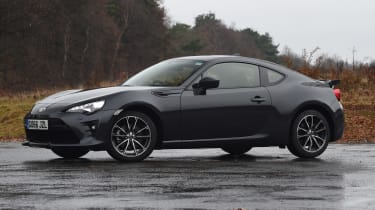
When the Toyota GT86 arrived in 2012, we praised it for its lightweight body, back-to-basics rear-wheel-drive handling, and characterful Boxer engine. The game has moved on, but in 2017 Toyota applied a light mid-life facelift to keep things fresh. The changes were limited, but a keen eye will spot the wider grille and new bumper design, revised fog lights and new LED headlamps. At the back there's a new set of LED tail lights.
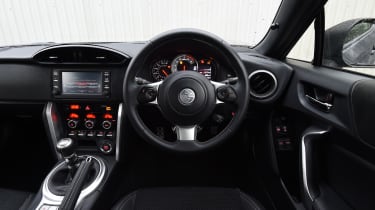
Inside, buyers get more leather and Alcantara trim, as well as handy audio controls on the steering wheel. There's a new 4.2-inch screen embedded in the dials, adding trip functionality and a digital fuel gauge.
While the GT86 isn't the most powerful car on sale, the engine begs to be revved and offers plenty of performance for keen drivers. The lightweight body and rear-wheel-drive layout make it one of the best handling sports cars for sale, especially at the affordable end of the segment where the GT86 competes.
Fuel efficiency isn't a GT86 highlight, and neither is the feel of the interior, but if you want one of the most engaging drives in this price bracket, Toyota's coupe delivers.
The Toyota GT86 is one of the most unique cars for sale in the UK today. Aside from the platform-sharing Subaru BRZ, there really isn't anything else like this light, compact four-seater coupe, and the new car market is all the better for its presence.
It shares running gear with the Subaru BRZ, so it specs a 197bhp 2.0-litre flat-four engine which sends drive to the rear wheels via a six-speed manual gearbox (or an optional auto). The GT86's relatively light weight (less than 1.3 tonnes) means that power output is put to good use, while fitting narrow tyres means the car is agile and involving to drive even at lower speeds.
This combination, and a price starting from around £28,000, means the GT86 is one of the cheapest rear-wheel drive sports cars for sale. As well as the BRZ, you could consider the Mazda MX-5 as an open-topped choice, while the Fiat 124 and Abarth 124 Spiders share tech with the Mazda and the same open-top experience. Elsewhere, cheaper versions of the BMW 2 Series Coupe could be considered, while the 2.3-litre Ford Mustang is pricier and heavier.
You could also consider the GT86 as an alternative to the swathe of front-wheel drive hot hatchbacks for sale. That price tag puts in the same ballpark as the Hyundai i30N, MINI Cooper JCW, Peugeot 308 GTi, Renaultsport Megane and VW Golf GTI.
Of course, the GT86's power deficit means it's not as fast as any of these cars in a straight line, but the Toyota's rear-drive layout and 50:50 weight distribution means it's designed to deliver greater enjoyment in the corners. The agile chassis and relatively low grip of the tyres mean you can push the car to the limit of adhesion without travelling too fast, and it's a great car to drive if you want to learn about car control.
There are two versions of the GT86, the standard version and the GT86 Pro. Both are pretty well equipped, with all cars getting 2-zone climate control, cruise control, keyless entry and starting, auto LED headlights and a touchscreen infotainment system. Pro adds leather and Alcantara seats with heating, plus a rear spoiler. Toyota also offers special versions of the GT86, including the Club Series models. These come in exclusive colours including blue and yellow, while a bodykitted TRD version has been offered in the past.
The GT86 follows is a spiritual ancestor to the Corolla AE86 of the 1980s, and that's where the '86' in its name comes from. The 'GT' part is a nod to Toyota's first sports car, the 2000GT. Toyota produced a number of FT86 concepts before the final production car arrived in 2012. It went on to win our Performance Car Of The Year test in that year, and as well as the Subaru version, the US market saw the car sold as the Scion FR-S, before that Toyota sub-brand was wound up in 2016.
Engines, performance and drive
With its low price and impressive handling, the Toyota GT86 has few rivals that come close to beating it for driving enjoyment at such a low cost. However, with the newer Mazda MX-5 now on sale, the Japanese coupe doesn't have it as easy as it once did.
The rear-wheel-drive chassis on the Toyota GT86 is perfectly balanced, however. There's loads of feedback from the steering and the brakes are strong without biting harshly, meaning the driver gets loads of confidence when driving quickly.
An even weight distribution means the car still feels well balanced, while responsive steering allows you to catch tail slides with relative ease. On track, you can easily turn a slide into a drift by keeping the power on, although circuit use also demonstrates that the GT86 could easily cope with an extra 50bhp, which would make it all the more entertaining.
In fact, owners often complain that the GT86 isn't really fast enough, yet in slippery conditions, 197bhp feels like plenty. Despite a mild facelift in 2017, however, there's still no option for a more powerful turbocharged version. The aforementioned facelift did make some changes to the shocks and steering, but you'd be hard-pushed to notice the changes without driving the two cars back-to-back.
The interior can get a bit noisy at speed and the firm suspension is a bit bouncy on the motorway – but the GT86 will put a smile back on your face as soon as you turn onto a twisty A-road.
Engines
The 2.0-litre flat-four boxer engine generates 197bhp and 205Nn of torque. Those are relatively modest numbers for a car of this nature, and to keep the power flowing, the Toyota's gearbox needs to be worked quite hard. Keen drivers won't mind too much, and the car will manage 0-62mph in 7.6 seconds with some nimble shifting.
Opt for the auto and you get a traditional torque converter unit rather than a dual-clutch set-up, although Toyota reckons its gearbox has software that mimics the feel of a dual-clutch box. It saps power though, to the extent that 0-62mph takes a rather pedestrian 8.2 seconds.
The ageing Nissan 370Z offers much more torque than the GT86, and some may prefer its muscular 324bhp V6 engine to the free-revving unit in the Toyota. All versions of Audi’s TT are quicker than the Toyota, too.
However, if you’re prepared to push for performance and are more interested in the actual drive than comparing vital statistics, then the GT86 can prove extremely rewarding.
MPG, CO2 and running costs
Despite its small 2.0-litre engine, the Toyota GT86 is surprisingly expensive to run. The six-speed manual version returns up to 33.2mpg on the WLTP test cycle and emits 196g/km of CO2. The truth is, of course, that driving the GT86 in the manner intended is likely to see consumption quickly drop to the wrong side of 30mpg.
To put the figures into perspective, a similarly specced Audi TT with 2.0 TFSI power returns around 46mpg. The Audi is also far cleaner thanks to CO2 emissions of 138g/km.
The Toyota GT86 with the automatic gearbox has slightly better figures. It manages a slightly improved 32.8mpg, but emissions of 183g/km are a lot better. However that model is best avoided as the manual is faster and far more fun. If you're looking at buying a GT86, you'll probably be happy to sacrifice some economy and emissions for the added fun of the manual box.
Unlike rivals from BMW and Audi, Toyota offers no fuel-efficient alternative to the petrol engine - a diesel would add weight, as would Toyota's hybrid system.
Interior, design and technology
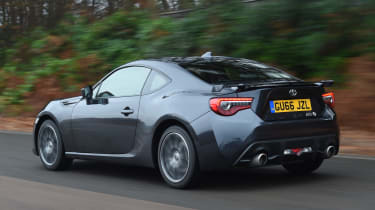
The Toyota GT86 is a traditional-looking sports car with aggressive styling, which includes a long bonnet and a short tail, plus a large front grille and rear splitter with twin exhausts. The Subaru BRZ is virtually indistinguishable, aside from the badges.
The Audi TT has a more premium feel and appearance, especially on the inside, but the way the Toyota GT86 looks reflects its personality - it's fun.
The interior of the Toyota GT86 is full of cheap-looking plastics, but the layout (flick switches, for example) and the mock-carbon fibre trim on Pro models make it feel like a road-going racer. A 2017 facelift added more leather and Alcantara trim for the Pro model, too, as well as a digital trip computer screen amongst the dials, but hot hatch rivals such as the Peugeot 308 GTi are cheaper to buy and nicer inside.
The Toyota GT86 TRD came with an even more aggressive body kit, which has a different front spoiler, side skirts and special 18-inch alloy wheels. This TRD bodykit isn't available via the UK dealer network, so if you want it, you'll need to search for it on the Japanese market.
Another special edition was the GT86 Aero, which had a bit of extra visual impact. There's a new bodykit, deeper front bumper and side skirts and a carbonfibre-effect rear diffuser. The most noticeable addition is a huge rear wing which looks a little bit like an awkward aftermarket add-on. Lighter forged alloy wheels were also part of the upgrade, which were designed to help reduce unsprung weight.
Sat-nav, stereo and infotainment
All GT86 models come with a six-speaker audio system, which is part of the Toyota Touch multimedia package. Featuring a 6.1-inch touch screen, the Bluetooth compatible system acts as the single interface for everything from sat-nav to smartphones.
There are a limited number of apps, including a ‘send to car’ function for google location searches. Upgrading to Touch & Go Plus adds voice recognition and email integration.
Practicality, comfort and boot space
The GT86 is a 2 plus 2, which means it comes with a back seat divided into a pair of buckets with safety belts for two passengers. It may as well not have any though, as it’s so cramped back there as to be virtually unusable by anyone out of junior school.
But that’s not really the point of the GT86, and for those up front there’s plenty of space to enjoy. For the driver there’s plenty of seat and wheel adjustment, although the low-slung driving position could hamper the view out if you’re short in stature – which would be particularly noticeable if you came to the Toyota from a sporty hatchback.
The big rear wing on the Aero model means rear visibility was compromised on that version, especially over the shoulder. Rear parking sensors are only available as an option for around £250.
There’s a surprising amount of cabin storage if you're travelling two-up, though, with big door bins and a decent glovebox, as well as space for your phone and drinks in the centre console.
Dimensions and size
As you’d expect from a proper sports car, the GT86 sits quite close to the ground. At just 1,285mm tall it’s nearly 7cms lower than an Audi TT. The Toyota is 4,240mm long, so 6cms longer than the Audi.
Leg room, head room & passenger space
Legroom in the back seats is limited for even the smallest occupants, so the rear is only really useful as extra storage space. Even trying to accommodate a single person sitting sideways across the rear seat is made trickier by the central console that extends right through the car to the rear seat back.
You do get Isofix mounts for child seats, though, although getting the kids strapped into them might feel like a bit of a chore if you have to do it more than occasionally.
Boot space
You don’t buy a GT86 for practical reasons, but it does come with a 237-litre boot, which is easily big enough to take the weekly shop or use on a weekend away. The back seats fold in a 50:50 split, and the car’s designers claim the space is big enough for you to carry a full set of wheels and tyres – the idea being you can take a set of sticky rubber with you if you head out for a track day.