Used Toyota RAV4 (Mk4, 2013-2018) review and buyer's guide
A full used buyer’s guide on the Toyota RAV4 featuring the RAV4 Mk4 (2013-2018)

Verdict
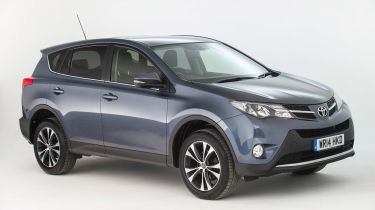
Over the years, the Toyota RAV4 shifted further upmarket as the focus moved more towards luxury and away from off-road ability for those on a budget. Although that has helped Toyota’s profits, it’s also pitched the car squarely against a raft of very talented compact SUVs, each of which is also much more capable on the road. However, if you do need to tackle rough terrain, the Toyota is surprisingly adept off the beaten track. Plus, every RAV4 of this generation with less than 100,000 miles can be covered under warranty, so there’s peace of mind on the off chance that something goes wrong.
When Toyota introduced the RAV4 (Recreational Active Vehicle four-wheel drive) in 1994, it effectively invented the compact SUV. And the brand probably didn’t realise just what a phenomenon it would become.
More than two decades later, most car makers have a small SUV in their model range; some have several. Meanwhile, Toyota is now on the fifth iteration of its RAV4, and the car is more luxurious and spacious than ever. So far it’s also proving to be very reliable, as you’d expect from a manufacturer famed for its dependability.
The RAV4 isn’t a class leader when new, but it’s still a strong choice in many ways with a hugely generous 10-year/100,000-mile warranty. Toyota introduced this new warranty in 2021, but it’s applicable for any UK-registered Toyota with full dealer service history that meets the age and mileage requirements. Even cars with servicing history at independent garages can get a year’s warranty by having a main dealer service.
History
The fourth-generation RAV4 reached UK showrooms in March 2013. At launch, there was a choice of a 2.0 petrol along with 2.0 or 2.2-litre D-4D diesels. Buyers could pick between Active, Icon and Invincible trims, but from January 2015, there was a Business Edition, too, based on the Active.
Used - available now

2014 Audi
A3 Saloon
73,500 milesAutomaticPetrol1.4L
Cash £8,350
2026 BYD
Seal
1,485 milesAutomaticElectric
Cash £29,450
2018 Mercedes
C-Class Estate
82,800 milesAutomaticPetrol2.0L
Cash £10,500
2015 Peugeot
2008
104,700 milesManualPetrol1.2L
Cash £2,195Initially, the 2.0 D-4D came in front-wheel drive only; from January 2014 there was a four-wheel-drive option. At the same time, the Icon and Invincible got extra kit and more optional driver assistance systems.
A facelift in December 2015 brought a new 2.0-litre diesel engine, an exterior redesign and an overhauled cabin, while Excel trim replaced Invincible. A month later, the RAV4 Hybrid arrived, combining a 2.5-litre petrol engine with an electric motor. As of September 2017, that model made up 65% of sales, so the engine was made available across the entire range.
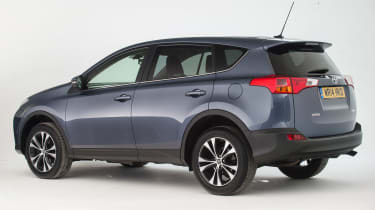
Which one should I buy?
All petrol-engined models are four-wheel-drive automatics, while the 2.2-litre diesel RAV4s have four-wheel drive, but there’s a choice of manual or auto gearboxes. All Hybrids are autos and the 2.0 diesel gets a manual gearbox, but both of these come with a choice of front or four-wheel drive.
Toyota doesn’t skimp on standard equipment; even the entry-level Active features 17-inch alloy wheels, Bluetooth, air-con, privacy glass and heated mirrors.
The Icon also has a powered tailgate, 18-inch wheels, touchscreen multimedia, folding door mirrors, cruise control, sports seats and automatic wipers. Invincible spec adds leather trim, heated front seats, rear parking sensors and keyless go.
Alternatives to the Toyota RAV4 Mk4
While the Audi Q3 and Volkswagen Tiguan are at the more expensive end of the spectrum and very capable, well built and come with excellent engines, they’re also rather clinical. In terms of driving enjoyment, build quality, standard equipment and smart styling, you’ll have to go a long way to beat the Mazda CX-5. This car has an excellent reliability record, too.
The Ford Kuga is also dynamically accomplished and decent value, plus there are lots to choose from, many of which are top-spec examples. Nissan’s Qashqai is another cracker that’s good to drive, plentiful and well equipped.
What to look for
Tyre pressure
Problems with the tyre pressure monitoring display are usually because the system hasn’t been set up properly after new tyres have been fitted.
Lights
Some light condensation can form inside the headlamp glass, but it should disappear very soon after the headlights have been switched on.
Rattles
Some owners have reported rattles and vibrations that appear to be a failed dual-mass flywheel – it’s usually just the exhaust or the manifold cover.
Spare wheel
A tyre-repair kit was only offered at launch, but Toyota changed this to a space saver following customer feedback, so make sure you check any purchase.
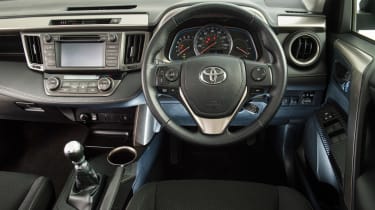
Interior
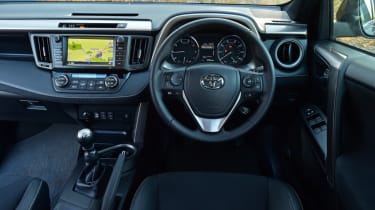
The cabin is a winner in terms of practicality, as the seats are comfortable and there’s plenty of space front and rear. But the dash design wasn’t in keeping with the Toyota’s asking price; it looks a bit outdated, while some of the plastics feel disappointingly flimsy - although that may be less of an issue when buying used. Boot space is good, though, at 547 litres – or 501 litres for hybrid models.
Running costs
All RAV4s have to be serviced every 12 months or 10,000 miles for private owners; fleet users can stretch the latter to 12,500 miles. After the first check-up, the services alternate between minor and major respectively.
When these cars reach five years old, they’re entitled to cut-price maintenance. The brake fluid needs to be replaced every two years, while coolant has to be changed after 100,000 miles then every 50,000 miles; these are both included in the relevant major service. Luckily there are no cambelts to worry about.
Recalls
Toyota has an unrivalled reputation for making reliable cars, and the Mk4 RAV4 has proven this, as it’s yet to be recalled. Since this version of the compact SUV arrived in spring 2013, several Toyotas have been called back, but most are cars built up to a decade earlier. Across all four generations of RAV4, nine recalls have been issued in all. In 2017 Toyota (and some other manufacturers) had to recall many models due to their Takata airbags.
Potential glitches included tyre damage and airbag faults, plus the accelerator pedal issue that hit Toyota’s range in 2010. But the car’s record is unblemished.
Driver Power owner satisfaction
The latest RAV4 enjoyed a strong debut in our Driver Power satisfaction survey, ranking 29th in 2015. Several years later, it fell to 39th. Apart from a rating of 114th for running costs, the Toyota finished in the top half across the board, including 20th for reliability, 25th for practicality and 30th for build quality. Toyota as a brand, meanwhile, scored an impressive sixth-place result in our 2020 list.
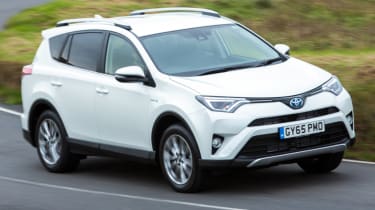
Toyota RAV4 (2013-2018) review: What we said
Extracts from our 2018 review of the Mk4 Toyota RAV4...
The Toyota RAV4 doesn't have the showroom appeal or good looks as newer models such as the SEAT Ateca and Renault Kadjar, but it does have space and practicality on its side. It's also well-made and should prove reliable, so it's perfect for family buyers who aren't interested in glamorous styling or fancy tech.
However, that's no excuse for it being so dull and characterless to drive and sit in. Both the ride and handling are behind rivals rivals such as the Mazda CX-5 and Renault Kadjar, and those models don't compromise too much on practicality or economy, either., plus have more modern interiors.
The RAV4 does have a hybrid version which makes it stand out, which will appeal to town dwellers or company car buyers - but it's even worse to drive than the standard car.
The Toyota RAV4 is a trendsetting SUV model that comfortably predates the Nissan Qashqai, yet somehow doesn’t seem to attract as much of the credit for helping to create the now massively popular crossover ‘niche’.
Nowadays only historians and used bargain hunters remember the old RAV4 for sale back in 1994, but a whole raft of modern day rivals including the Ford Kuga, Honda CR-V, Renault Kadjar, Mazda CX-5 and Volkswagen Tiguan all owe a lot to the RAV4’s success.
The modern Toyota RAV4 Hybrid illustrates just how far the model has moved on from its predecessors of course, but the basic concept remains the same – offroad style, some basic green-lane ability, combined with economy and running costs that aren’t too far removed from an ‘ordinary’ family hatch.
Toyota has revamped the RAV4 range for 2018, with more hybrid models reflecting the fact that the petrol-electric versions account for two-thirds of overall sales in the UK.
This coincides with a new trim level structure, which brings the RAV4 into line with the rest of the Toyota range. The excellent Safety Sense active safety and driver-assistance pack is now fitted as standard on all grades.
The new entry-level Icon features a 7-inch touchscreen system, six speakers, Bluetooth, DAB radio, reversing camera, smart entry, push-button start, dual-zone automatic air conditioning, automatic lights powered tailgate and rain-sensing wipers.
Next up is the Icon Tech, which adds improved navigation and connectivity functions, while Design models ride in 18-inch alloy wheels and feature LED headlights, black leather and Alcantara upholstery and power-sliding seats.
The flagship Excel adds gloss black 18-inch alloy wheels, a choice of leather trim, memory function for the driver's seat, an upgraded multimedia system, blind spot monitor and rear cross traffic alert.
There's a choice of two- or all-wheel drive, while the engine line-up comprises a 2.0-litre petrol, 2.0-litre diesel and 2.5-litre petrol-electric hybrid. There are two transmissions: a six-speed manual gearbox and a CVT, the latter of which is available exclusively with the 2.0-litre petrol and all-wheel drive.
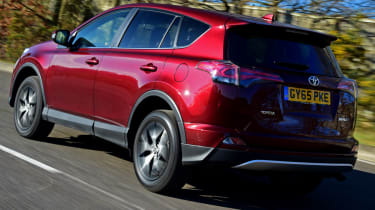
Engines, performance and drive
The original Toyota RAV4 was quirky and fun to drive, but you don't sense much of the spirit of the first generation car in this fourth-generation model. It's perfectly adequate for most tastes, but when you've got agile and engaging rivals like the Mazda CX-5 and SEAT Ateca, 'adequate' isn't really good enough.
The RAV4 offers decent ride comfort most of the time and reasonable refinement, which is a bonus. It's grippy, too. But there's quite a lot of body roll, the steering doesn't inspire driver enjoyment, and it feels heavy and lumpen where the best rivals feel agile and nimble. For family use, however, it'll do the job.
The hybrid is even less accomplished. The extra weight of the electric motors and battery pack blunts its responses, making it far less enjoyable to drive. There's less front end grip and the suspension doesn't control body movements as well. On top of that, the hybrid doesn't ride that well and it thuds into potholes while sharp ridges send a shudder through the cabin.
The RAV4 is composed on the motorway, and thanks to the large cabin passengers will stay happy for the whole journey, too. Although it's been set up for comfort, bumps in the road are still rather noticeable, and over potholes the ride starts to feel stiff.
The brakes are strong and on hybrid models are used to partially recharge the batteries - you can even hear the generator when you stop from high speed. Yet Toyota still hasn't managed to engineer a seamless transition between regenerative braking and the traditional discs and pads, plus the pedal has a sharp action.
There are two gearboxes, each paired with a different engine: a manual and a CVT automatic. The manual in the diesel model has a fairly long throw and feels notchy, and the CVT is noisy while accelerating, but on the motorway and in town it's pleasant and smooth.
Sport mode features on four-wheel drive models and adds weight to the steering and automatically sends 10 per cent of the to the rear axle in an effort to combat understeer. However, even in this set-up the RAV4 lacks the grip, composure and precision of rivals such as the Mazda CX-5 and Ford Kuga. The hybrid's four-wheel drive system uses electric motors at the back, rather than a driveshaft.
Engines
The Toyota RAV4 Hybrid uses a 2.5-litre petrol engine and either one or two electric motors depending on whether you go for four-wheel drive or not. On the AWD model the second motor powers the back wheels - but there's no more power available. There's plenty of it, however, with 195bhp in total - so it's good at overtaking on the motorway. It's well insulated too, as long as you keep your right foot off the floor.
The hybrid version of the Toyota RAV4 is a great choice for driving in town, as there's absolutely no noise while crawling through traffic - the electric motors only provide the power for around a mile though with the engine cutting in when you need to accelerate or the batteries (quickly) get to their minimum charge. Even when the motor does start up it's well insulated, although the CVT gearbox means that when you put your foot down there's a loud droning noise.
MPG, CO2 and running rosts
The most economical Toyota RAV4 is the 2.0-litre D-4D diesel mode, which returns 60.1mpg and emits 123g/km of CO2. That's true whichever model you go for, with larger wheels making no difference to the economy (though they do raise CO2 emissions by 1g/km).
Go for the hybrid and you'll find lower CO2 emissions and therefore lower VED and company car tax costs - but not by much, as the FWD model emits 115g/km and the AWD model emits 118g/km. Economy figures are just behind the diesel too, with the front-wheel drive model returning 57.6mpg and the all-wheel drive car returning 55.4mpg.
The most expensive model to run will be the 2.0-litre petrol, which emits 152g/km and returns 43.5mpg. We'd steer clear of this model in most cases - it's not even cheaper to buy than the more efficient diesel.
The Mazda CX-5's 2.2-litre diesel returns 61mpg, which just about beats the RAV4, but the lower-powered Renault Kadjar diesel returns 74.3mpg. Even the higher-powered Renault returns 65.7mpg - so there are better choices in the crossover class if fuel economy is important to you.
Interior, design and technology
A recent update to the Toyota RAV4 meant the front of the car is better looking than before, but overall the design is sadly rather plain - the Mazda CX-5 and Renault Kadjar prove that cars in this class can look good, and the RAV4 falls far behind them.
The facelift got rid of the previous car's 'nostrils' and moved the grille upwards, integrating new headlights and a larger badge. It's smart, and gives the car a more modern look at the front. The rear wasn't changed much at all, and now looks outdated next to the refreshed nose.
The RAV4's mix of creases and curves lacks the cohesion of rivals like the Ford Kuga, particularly at the bluff rear end. One bonus is the top-hinged tailgate, with Toyota scrapping the old side-hinged setup that made the RAV4 hard to use in tight car parks. As a result, the latest-gen car is much better in this respect.
The interior quality has been improved recently as well, and while the RAV's cabin lacks charm it does feel well built. Standard kit includes a touchscreen display, DAB radio, a reversing camera, cruise control, 17-inch alloy wheels, air-conditioning and tinted windows. Higher trim levels get sat-nav, auto lights and wipers, a powered tailgate, leather seats and a full set of parking sensors.
Sat-nav, stereo and infotainment
The sat-nav – which is standard on all but the entry-level Icon model – looks a bit dated, with chunky graphics and a low-resolution screen meaning rival systems are easier to use. There are few buttons, which clears up the dashboard, but the awkward touchscreen controls can get frustrating. The nav does give clear, concise directions, however.
Smartphone connectivity will be a boon for some drivers, and the display screen comes as standard. There's even a Google Street View function on certain models.
Practicality, comfort and boot space
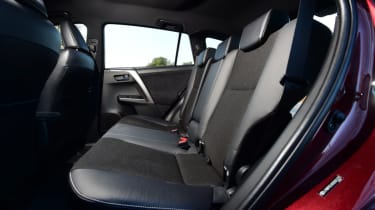
The RAV4 has grown in size with each new generation. This time, the Toyota is 30mm wider and 205mm longer than its predecessor. It also has a 100mm longer wheelbase, at 2,760mm, giving impressive interior space, particularly in the rear which features a totally flat floor and excellent head and legroom for all three passengers.
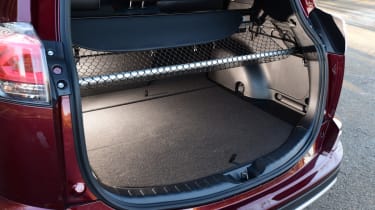
The boot is now accessed by a top-hinged tailgate, rather than one that opens like a door. Boot space has increased by 51 litres, to 547 litres, thanks to the fact that there’s a 100-litre storage area under the boot floor. However, this means there's no spare tyre.
There are plenty of deep cupholders throughout the interior, too, while the sports seats fitted on Icon models and above are comfortable.
Size
The RAV4 is around 4.6 metres long and 1.8 metres wide, which is on the large side for a crossover. It's bigger than the Nissan Qashqai, Skoda Yeti and even the Mazda CX-5, and the boxy shape means it makes good use of that size, with plenty of room inside.
Leg room, head room & passenger space
Thanks to a flat floor there's enough room for three passengers in the back, and none will be wanting for legroom, even with a tall driver or front-seat passenger. There's lots of headroom for the out seats, but the middle seat does start to feel cramped as it's much higher up. Getting in and out is easy as the RAV4 doesn't ride that high, even on the larger 18-inch alloy wheels.
Boot
With a boot capacity of 547 litres with the seats up, there's lots of luggage space in the Toyota. That's reduced to 501 litres in the hybrid version, but that's still comparable to the Mazda CX-5, which has 503 litres. The Honda CR-V's 589-litre space beats both significantly though.
Fold the rear seats down and you'll open up 1,735 litres of space, but the floor isn't completely flat. There's a useful storage net that goes across the boot, though, which means you can slot in longer items underneath and store things like backpacks and coats in the net for easy access. There's an under-floor storage area too.
Towing
The RAV4 can tow up to 1,650kg in AWD hybrid form, but the towing capacity varies greatly depending on which engine you go for - the petrol manages 1,500kg, but the FWD hybrid only pulls 800kg.