New Volkswagen ID. up! set to light up electric city car sector
The ID. Every1 concept is set to make way for a memorable name in 2027

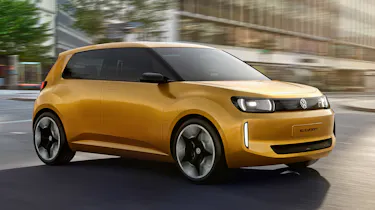
Small electric cars have been a tough market for car makers to make profitable, but in recent years we’ve seen the sector gather momentum and the latest brand looking to get in on the fun is Volkswagen. The new VW ID. up! is preparing for launch.
It was shown off a few years ago as the ID.Every1 concept, but Auto Express now expects the production car to be named ‘ID. up!’. That runs contrary to the rumours regarding a return of the Lupo nameplate or the use of ID.1.
The old VW up! city car had a long lifespan of 12 years in a single generation. It didn’t take long for it to gain electric power either with the e-up! joining the range from 2014 until the model’s death in 2023. Judging by the ID. Every1 concept, the new ID. up! looks set to continue the compact and cleanly styled approach that made the original up! So popular.
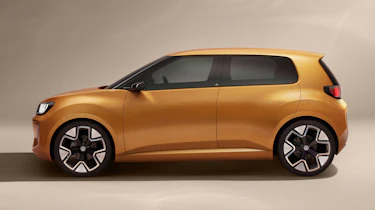
At 3,880mm long, the concept is around 280mm longer than the previous Volkswagen up!, largely because of its EV-specific architecture.
Unsurprisingly, given its A-segment dimensions, the ID. up! will be the entry-point to Volkswagen’s all-electric ID range, which is steadily switching from numerical nameplates to well-known names used on combustion-engined VWs, like the new ID. Polo and what we expect to be the ID. Tiguan.
VW ID. up! reveal plans
If the ID. Polo is anything to go by (having very closely followed the ID.2all Concept’s design), the ID. Every1 should give us a very good idea as to how the upcoming ID. up! will look.
The concept’s interior looks nearly production ready, but we know the final ID. up! cabin will be shown off at CES in Las Vegas in January 2027. This reveal will also give us fresh details over Rivian’s £4.5bn joint venture with VW to provide a next-generation electric car software. Rivian and VW's team-up will also create a new electric architecture with fewer control units and less wiring - similar to BMW’s sophisticated ‘superbrain’ computer in its Neue Klasse cars.
Later on in 2027 we should also see the world premiere of the ID. up! taking place at the Munich Motor Show in September.
Volkswagen ID. up! pricing and rivals
Despite the car harnessing elements of the latest software and technology from Rivian’s joint venture programme, keeping production costs low for the new ID. up! will be key to ensuring it sits comfortably below the new ID. Polo, which starts from £23,945.
VW’s board member for sales, Martin Sander, previously told us, "[ID.Every1] uses all the components from other products on the platform. It speaks to the flexibility and scalability of the platform to larger and also smaller products. We could never do the vehicle like the [ID.Every1] on its own. It would not work, but we need all the components, everything we have available.”
With help from economies of scale, Volkswagen is expecting to sell the ID. up! at around the 20,000-euro mark (just over £17,000).
VW’s technical development chief Kai Grunitz added: "Martin [Sander] came to me and said, hey, I need an entry vehicle. I want to sell it for €20,000 and I want to earn money with that.”
To keep costs down, the ID.Every1 concept utilises parts from other VW EVs. Grunitz said: "It took 1.5 years to develop the concept for that vehicle [ID.Every1]. Because we started with the ID.2 all concept, and the ID.Every1 is from the front to the A-pillar pretty much the same but with a different engine [motor].”
The VW ID. up!’s battery will also get a ‘dedicated chemistry’, though Volkswagen is implementing a rear axle borrowed from the Polo. Crucially, Grunitz says the baby EV will “still feel like a Volkswagen”.
Even with that price point of roughly 20,000 euros, the VW ID. up! won’t have the small electric car market to itself when it arrives in 2027. The Renault Twingo, which does 163 miles on a charge, is set to cost less than £20,000, and this should decrease further if it’s eligible for the UK’s Electric Car Grant. Sharing technology with the Twingo will be the even cheaper new Dacia Spring, which could start around £15,000. Then there’s the Leapmotor T03 and our 2024 Car of the Year, the Citroen e-C3 all competing for the attention of EV buyers on a budget.
Volkswagen ID. up!: technical details
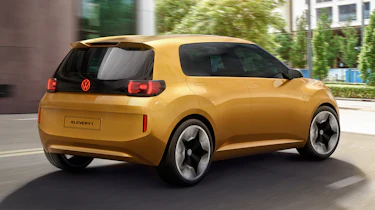
While the ID.Every1 is technically a concept car, VW says that it’s around 80 per cent relevant to the road-going ID. up!. Expect smaller wheels, bigger door handles and slightly different head and tail-lights, though no major changes to the bodywork or styling will arrive on the production car.
It will rely heavily on the revised MEB architecture that will be introduced with the ID. Polo, but for the concept Volkswagen reduced the wheelbase by around 60mm, plus fitted a new e-motor, battery pack and, as we’ve said, a rear axle from the current Polo supermini. Some particularly expensive elements, such as the firewall, are shared for the sake of scale.
Compared with the Renault Twingo, the VW concept is 91mm longer, while also being a little taller and wider. Volkswagen says this will yield very good space inside for up to four occupants, plus a 305-litre boot, which is around 50 litres bigger than the old VW up!’s.
The ID.Every1 concept rides on 19-inch wheels – these will be replaced by 18-inch rims for the production ID. up! with smaller rims for lower spec cars – but the overall design seen on the concept will be put into production as is.
Its downsized electric motor generates 94bhp, and is good for an 80mph top speed, while its 155-mile range is slightly short of the expected Renault Twingo’s but way up on the Honda Super N’s 128-mile maximum. However, with a specific focus on urban drivers, VW thinks its range will be sufficient.
No information has been released about the ID.Every1’s battery size, but it’s likely to be around the 35-40kWh mark, and will use an LFP battery chemistry. The ID. Polo’s smaller battery option, a 37kWh unit is expected to fit within the ID. up!’s wheelbase too, which could unlock over 200 miles of range. As with all MEB cars, it will sit in a flat panel under the cabin and between the axles.
Volkswagen ID. up!: design and interior
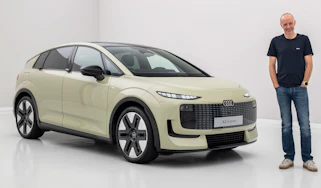
Key to the ID. up!’s success will be the styling, and in this case VW’s design boss, Andy Mindt and his team have employed the same ethos used with the ID.2all Concept in 2023. Using past VW icons for reference, such as the Lupo and of course the up!, the ID.Every1 draws inspiration from what made those cars great, without relying on literal design elements.
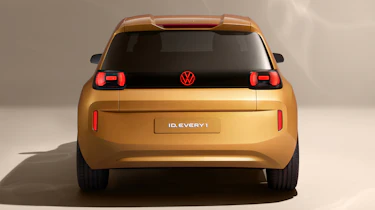
Its chunky body is designed to look timeless, without being bland. The nose has a simple form with a single headlight and grille graphic that will make its way to the production car. VW’s talent of giving design human characteristics through elements such as the headlight’s ‘pupils’ or subtle, cheeky ‘smile’ at the front end help make the car both approachable and personable.
Other fine detailing such as the contoured roof panel and its clever hidden third brake light, plus simple oblong elements such as the rear lights and lower air intake finalise a design package designed to broaden the ID. up!’s appeal. Overall, the car seen here will change slightly for production as all concepts generally do, however, the bits that matter such as the flared wheelarches and slim glasshouse will be carried over largely unchanged.
Volkswagen will also use the production car to introduce its all-new software-driven electronic architecture that’s been designed as part of VW’s joint venture with American EV manufacturer Rivian. It will emphasise the use of over-the-air updates to keep the car fresh long after it leaves the showroom, but will also yield lots of benefits that will improve performance, plus reduce development time and costs.
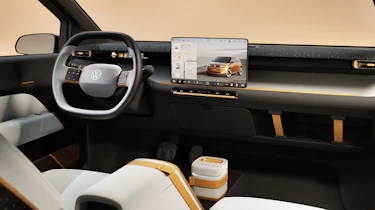
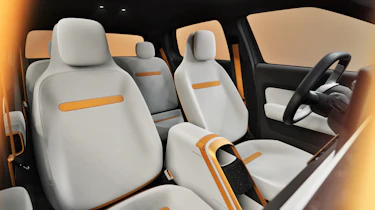
The cabin concept is very simple, but features clever use of non-coated and textured materials to keep it from feeling stark. The main dash integrates a small driver’s display and two outer air vents that reference the design of the headlights, with the touchscreen mounted above a physical set of controls for ventilation, volume and heated seats.
There’s a central cubby in the dash that will act as the car’s main glovebox, with an open section beside it with straps for larger items. These elements will be tweaked for the production ID. up!, but as the car will be aimed at both private and fleet customers, you will be able to specify the new car at a very basic level, with or without elements such as the centre console. The cabin will only seat four people, as is the norm with VW’s city-sized models.
Volkswagen knows it’s had a rough ride in the last few years, with company executives very clear at the ID.Every1’s international reveal about the firm’s misdirection in the past decade. But the team is confident that with this ID. up! at the base, the next generation of VWs will return to a leadership role within the entire European car industry.
How VW will keep it cheap
The low-cost EV is already a space that some brands are occupying, with Citroen and Fiat at the forefront with their e-C3 and Grande Panda, but VW’s ID. up! will be both less expensive yet more sophisticated. So, how does VW intend to make the numbers work in a space that’s been nearly impossible to make money from EVs that cost three or even four times the price?
This is a question we posed to VW’s member for research and development, Kai Grunitz, who explained how the brand will build a car at such a low price point, and at a relatively limited scale. The lower cost of batteries is an obvious starting point, but VW is adamant that it’s not the silver bullet that will allow EVs to suddenly become profitable.
“The battery is only one element, so if you want to reach that 20,000 euro mark, you need savings across the board,” Grunitz said.
“We see that the price did go down in the last few years, that’s also partly due to overcapacity – especially in China – but when the battery itself gets smaller, then the price point of the battery itself isn’t quite so important. For example, the battery size of an ID.7 is double the size, so it’s obviously going to cost more, but you can’t just rely on the battery to reach that 20,000 euro mark.”
So what else makes it possible? Key shared elements that are being developed for this new MEB-Entry platform are a factor, such as the scuttle – or the section of car between the pedals and front wheels – which is shared with the ID.2all concept.
According to VW, about 80 per cent of the cost of development is centred around just this point, saving huge amounts of cash. The front wing also features the charging point, making it closer to many of the electric powertrain elements, saving more money.
But the biggest saving might come from its new-generation software architecture that VW says will reduce development time, and therefore costs, to just three years for an all-new model, or even as low as 24-26 months for a re-fresh, as you might expect for a facelift or new derivative.
For now, the ID. up! will be just for VW, and has been costed with that scale taken into account. Grunitz added: ‘The most important element is speed. This car will take us roughly three years to develop, including all the new elements. A new topper with only minor technological updates could take as little as 24-26 months. This is competitive with companies in China. The most important point that allows this is the software architecture, because we are not starting with a white sheet of paper, we’re starting with what’s already on the road.”
It looks like the warning shots fired across VW’s bows have not been missed, and throughout our time with the manufacturer’s top brass, it’s clear that there’s an added sense of enthusiasm. There is also acknowledgement that mistakes have been made, and it’s up to the bosses to make amends. While the European EV market remains volatile, it is heading into one very clear direction, one that by 2030 VW is confident that it will once again lead.
Don't miss the best of Auto Express on Google! Make us a preferred source. Click here...