New Honda Super-N 2026 review: little EV is fun and full of character
Honda's quirky Super-N is compromised on paper, but in reality it's a fun and efficient small EV


Verdict
The Honda Super-N is a fun, characterful, good-value electric car that unquestionably amounts to more than the sum of its parts. On paper it looks slow, small and compromised, yet in reality it’s grown up, great to drive and remarkably efficient. Honda’s taking yet another unproven punt, but the Super-N really does deserve to succeed.
Japan’s obsession with the Kei car has never really translated here in the UK. British buyers have gravitated towards larger models in recent years – shunning small cars in favour of chunkier SUVs.
Those unfamiliar with the Kei-car concept may not truly appreciate its significance; 30 per cent of all cars sold in Japan fall within this tightly regulated segment. These vehicles are governed by strict parameters in that no model can be more than 3.4 metres long, 1.48m wide or 2m tall. The engines are limited to just 660cc, and can produce a maximum 63bhp.
While the new Honda Super-N doesn’t fit within this framework, the car it’s based on – the Japanese-market N-One – very much does. To make it suitable for European consumption, the maker has lengthened it by just over 200mm and widened it by 91mm. It’s also ditched the three-cylinder petrol engine in favour of a small battery and an electric motor, adding a ‘Boost’ function to push power to a heady 94bhp.
Used - available now

2025 Skoda
Karoq
19,189 milesManualPetrol1.5L
Cash £21,099
2023 Skoda
Enyaq
14,738 milesAutomaticElectric
Cash £20,099
2024 SEAT
Arona
16,466 milesAutomaticPetrol1.0L
Cash £14,849
2025 Vauxhall
Corsa
26,486 milesManualPetrol1.2L
Cash £11,699Even so, the Super-N is still dwarfed by almost everything on the road. It’s shorter than a Dacia Spring, for example, and just 4mm longer than the petrol-powered Kia Picanto. A Volkswagen Polo – a stalwart of the supermini sector – has almost half a metre of extra metal between its front and rear bumpers.
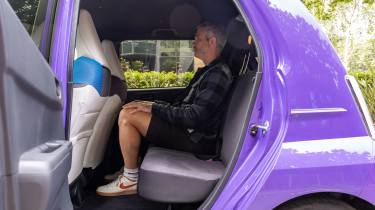
Don’t think for a second that this Honda is some kind of compromised two-seat city car, though. While it’s not as comfortable in the back as it is in the front, there’s enough space for two adults to sit side by side for short stints. Kneeroom is better than headroom, and the high-set floor means there isn’t much under-thigh support. But for something so small, the Super-N is surprisingly spacious.
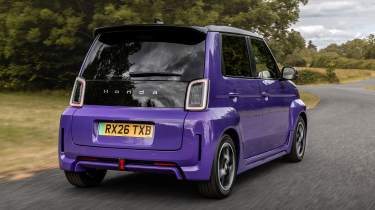
The same is true of the boot, which thanks to a pleasingly low load lip, can swallow more than you might expect. There’s no underfloor storage – that’s taken up by the Bose stereo’s sound-enhancing subwoofer – but the seats go completely flat, revealing almost 1,000 litres of cargo space when filled to the roof. Honda’s famous ‘Magic seats’ also feature, freeing up space in the cabin for tall items such as pot plants or kids’ bikes.
The layout up front will feel familiar if you’ve sat in any modern Honda. The small rectangular instrument cluster is clear and easy to configure, and while the central screen isn’t particularly big, it runs wireless Apple CarPlay and Android Auto, giving users easy access to maps and media on demand.
The Super-N is clearly built to a price – there are plenty of scratchy plastics on the doors and lower reaches of the cabin, and closing the doors with any force will send shockwaves reverberating through the frame – but the things you touch, such as the steering wheel and switchgear, feel more premium. The front seats are sculpted and well bolstered, making them comfortable even after a couple of hours on the road. Better still, they’re made from recycled plastics scavenged from old Honda uniforms.
This isn’t the kind of car you want to be driving if you’re not on first-name terms with your front-seat passenger, though. It’s snug up front, and you sit closer together than you would in a Fiat Grande Panda or Renault 5. There’s also little in the way of storage inside; the door bins will hold a water bottle but nothing else, while the shallow centre console isn’t even wide enough for a modestly sized smartphone. There’s another small shelf on the dash, next to a couple of USB-C ports, which is where we ended up ditching our device.
Being such a tall and upright car means visibility is good, and there’s a standard-fit reversing camera to help when parking. We were particularly impressed with the Super-N’s spec sheet actually; there’s only one trim available, meaning every version comes with 15-inch wheels and LED lights, twin screens, climate control and that eight-speaker Bose stereo. There’s also a full suite of advanced driver-assistance systems (ADAS) including forward-collision warning and traffic-sign recognition.
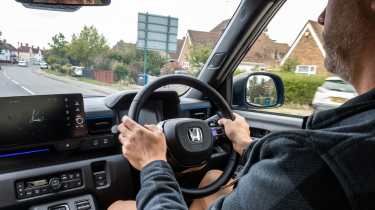
Amazingly in this day and age, these systems work faultlessly – better almost than any car at any price. The beeps and bongs aren’t overly intrusive, and not once did we have to delve into the sub-menus to switch off the lane-keeping aid. The plethora of small Chinese EVs could learn a thing or two from the Super-N in this regard.
It all helps create an engaging and stress-free driving experience. Honda’s engineers claim to have developed “the fun A-segment model [they] wanted to create” rather than one dictated by regulations or market trends. And while you might expect the result to be littered with compromises, the reality couldn’t be further from the truth.
It’s evident from the moment you set off that Honda has put an inordinate amount of time and effort into making the Super-N feel particularly grown-up for something so small and affordable – and without sacrificing the fun factor. There’s a maturity to the way this car rides; the chassis is inherently quite stiff, but the damping rounds off lumps and bumps and prevents shocks from being sent through the cabin. Honda claims the car has been developed in the UK, and it shows.
The steering is well weighted, and there are several strengths for the regenerative braking – including a one-pedal mode – adjustable via paddles behind the steering wheel. But that’s not all the paddles are good for; Honda has developed its own take on Hyundai’s virtual gearbox, and fitted it to a car costing less than one-third of the price of the Ioniq 5 N.
In Boost mode – accessed via an appropriately coloured purple button on the steering wheel – you get the full 94bhp, helping the car accelerate from 0-62mph in 10 seconds flat. Here, the electronics mimic a seven-speed automatic transmission, which you can even force to operate in manual mode. As a result, if you fail to shift up in time, the car will hit the ‘rev limiter’ and lurch forward as the power is restricted.
The whole process is accompanied by a synthesised engine sound, which Honda claims has been modelled on a blend of the eighties City Turbo II and the legendary DC2-generation Integra Type R. While it doesn’t sound quite as pure as its maker suggests, having this backing track pumped through the specially developed Bose speakers definitely adds to the experience.
And while on paper the Super-N might appear a bit ‘all show, no go’, the car’s relatively light weight (1,097kg) and torquey motor mean it never feels slow. Even in Normal mode, where the EV’s power is restricted to that Kei-limited 63bhp, it’s peppy enough to keep pace with city traffic. It’s great fun, too, with decent agility, very little body roll and good grip. It’s a little bit more breathless out of town, but no more so than any of its key petrol or electric rivals.
More of an issue is this car’s high-speed refinement. While few Super-N buyers will be commuting up and down the motorway each day, the tyre roar its little 15-inch wheels generate at 60mph is enough to require raised voices; a Picanto or Hyundai i10 feels better suited to sustained stretches at the national limit.
Keep a lid on your speed though, and you’ll find the tiny Honda is one of the most efficient EVs on the market. Over more than 50 miles of mixed urban and rural driving, plus a series of brisk dual-carriageways, we averaged 5.0mi/kWh. At that rate, you’d comfortably surpass Honda’s 128-mile WLTP figure, and we reckon without much effort you could come pretty close to the claimed city range of 199 miles.
Charging is restricted to 50kW (DC) – the same as the forthcoming Renault Twingo and on par with this car’s urban-focused rivals. Yet the Honda’s small battery means a 10 to 80 per cent top-up is possible in around 30 minutes; a standard 7kW home wallbox should be able to fully charge the car in less than five hours.
Honda says it sees the Super-N as an opportunity to score conquest sales; the city EV segment has apparently grown 300 per cent year-on-year and the maker predicts 70 per cent of customers will be new to the brand. First cars will start trickling into retailers at the end of July, with deliveries soon after – giving Honda’s newcomer almost six months of clean air until the new Twingo lands in the UK.
Did you know you can sell your car through Auto Express? We’ll help you get a great price and find a great deal on a new car, too.
| Model: | Honda Super-N |
| Price: | £18,995 |
| Powertrain: | 29.6kWh battery, 1x e-motor |
| Power/torque: | 94bhp/162Nm |
| Transmission: | Single-speed automatic, front-wheel drive |
| 0-62mph: | 10.0 seconds |
| Top speed: | 83mph |
| Range: | 128 miles |
| Max charging: | 50kW (10-80% in 30 mins) |
| Size (L/W/H): | 3,599/1,626/1,608mm |
| On sale: | 22 June |