Tesla Model Y vs Kia EV5 vs Smart #5: is the new cut-price Tesla electric SUV king?
The electric SUV class is hotting up with new Kia EV5 and Smart #5, plus an entry-level version of Tesla’s Model Y

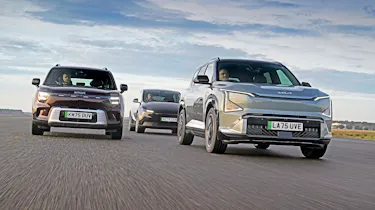
It’s been a busy few months for Kia in terms of model updates and new vehicle launches. The Sportage, Stonic and Picanto have all benefitted from a new look, the PV5 is taking the Korean brand into the world of vans, and fresh cars such as the K4 and EV4 are expanding the line-up.
But Kia isn’t finished yet, with the new EV5 tested here offering an all-electric alternative to the Sportage compact SUV. Based on its price, size and market position, the EV5 isn’t going to have an easy task to make headway into the sector, however. For a similar price, the all-new Smart #5 is the biggest car yet from the company that’s best known for its tiny ForTwo city car. Smart’s newcomer offers unique style, plenty of space inside and a range of electric powertrains at a similar price point to the EV5.
But if there’s one car that defines the electric-SUV niche, it’s the Tesla Model Y. The American model is a regular in the list of the top 10 best-selling new cars in Britain each month, and the company has just launched a new entry-level rear-wheel-drive variant that offers better value for money than any Model Y before.
Used - available now

2020 MINI
3-Door Hatch
36,589 milesManualPetrol2.0L
Cash £12,200
2017 Volkswagen
Golf GTE
79,000 milesAutomaticPetrol1.4L
Cash £9,735
2014 Toyota
Auris
26,317 milesManualPetrol1.3L
Cash £8,371
2026 Audi
A1 Sportback
22,736 milesAutomaticPetrol1.0L
Cash £16,402With such strong competition for sales in a market that’s bursting with talented machinery, can the new Kia EV5 really stand out? Or do the Smart #5 and Tesla Model Y offer that much more than their latest competitor? Those are the questions that we’ll be answering, before naming our winner.
Did you know you can sell your car through Auto Express? We’ll help you get a great price and find a great deal on a new car, too.
Kia EV5
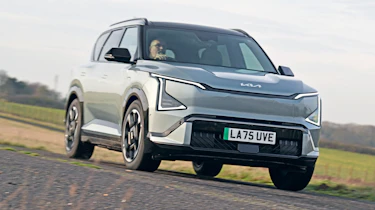
| Model: | Kia EV5 |
| Price: | £39,345 |
| Powertrain: | 81.4kWh battery, 1x e-motor, 214bhp |
| 0-62mph: | 8.4 seconds |
| Test efficiency: | 3.1 miles/kWh |
| Official range: | 313 miles |
| Annual VED: | £195 |
The EV5 slots between the EV3 and EV9 in Kia’s electric SUV line-up in the UK, and it measures slightly longer and wider than the Sportage. At launch the EV5 comes exclusively with front-wheel drive.
Prices start at £39,345 for the entry-level Air trim, which is comparable to a mid-range Sportage, and rise to just over £47,000 for the top-spec GT-Line S car. All are powered by a 214bhp electric motor and an 81.4kWh battery, with a range of 313-329 miles quoted for every model.
Tester’s notes
Kia has played safe with the EV5 in many ways. It’s pretty ordinary to drive, while the exterior styling seems like an AI-prompted merger of the EV9’s details with a Sportage body; it’s fairly neat, although there are hints of the Dacia Bigster about it.
Inside, there’s been a straight import of the dashboard seen in the EV9 and EV3, including the partially obscured climate controls, although these are replicated within the main screen. Placing everything high on the dash make space below for storage, and there’s lots in the Kia EV5.
As with the rest of the Kia line-up, the EV5 doesn’t come with much in the way of options. Metallic paint is the only extra that can be added to the whole line-up (we quite like the Iceberg Green our test car came in).
With options lacking, that means you need to move up a trim level to add extras. While the base Air model has a decent amount of kit, we’d step up to the GT-Line, because it adds artificial leather, electric adjustment for the driver’s seat, a powered tailgate and heated outer seats in the second row.
Smart #5
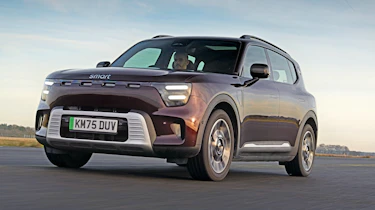
| Model: | Smart #5 |
| Price: | £39,800 |
| Powertrain: | 76kWh battery, 1x e-motor, 335bhp |
| 0-62mph: | 6.9 seconds |
| Test efficiency: | 2.4 miles/kWh |
| Official range: | 288 miles |
| Annual VED: | £195 |
It’s the third car in the revitalised Smart line-up, but the #5 is the largest model it’s ever made. It’s also the most expensive, but starting at just under £40,000 puts it right in the middle of the electric-SUV pack.
There are two battery sizes on offer, with the 76kWh unit in the Pro car tested here joined by a 100kWh pack in the Pro+, Pulse, Summit and Brabus models, while the latter two swap rear drive for four-wheel drive. The £51,800 Brabus tops the range, and has acceleration to match the fastest Model Y.
Tester’s notes
There are some quirks to the #5 that take getting used to. When parking, 360-degree cameras offer multiple viewing angles, while front, rear and side-mounted parking sensors help you avoid low-speed scrapes.
But there’s one aspect of the sensors that could be changed to make the risk of collision even lower. While the frequency of the Smart’s beeps increases as you get closer to an object, there’s no final ‘flatline’ as you’ll find in many other cars. At least the system projects an object’s distance from the car on the screen, though.
There are lots of upmarket touches in the cabin. The cross-shaped air vent controls look neat, although they leave us wondering whether this and the four-bar LED lights front and rear mean the car should be called the Smart #4, rather than #5.
We like the aircraft-style reading lights and reclining electric seat in the rear, but less successful are the push-button door releases. They can confuse the unfamiliar, and as with similar set-ups, a manual release is necessary anyway, so it just seems like excess tech for the sake of it.
Tesla Model Y
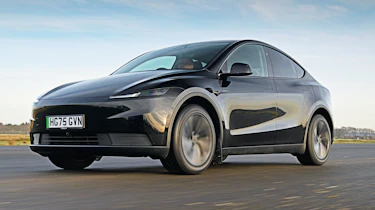
| Model: | Tesla Model Y |
| Price: | £41,990 |
| Powertrain: | 63kWh battery, 1x e-motor, 292bhp |
| 0-62mph: | 6.9 seconds |
| Test efficiency: | 3.6 miles/kWh |
| Official range: | 313 miles |
| Annual VED: | £195 |
In the past we have classed the Model Y as a premium electric SUV, but with the arrival of the new entry-level rear-wheel-drive model, the Tesla’s starting price drops to less than £42,000, making it a tempting alternative to Kia’s newcomer.
From the outside, basic lighting gives away that this is the base model, but you’re not really left wanting for standard kit when compared with the rest of the Model Y line-up. A claimed range of 313 miles is identical to the Kia’s.
Tester’s notes
Tesla has always produced fast EVs, but the reality is that even the Model Y Standard has more than enough performance for most needs. It offers instant responses, while the rear-wheel-drive configuration has good traction where front-wheel drive rivals struggle to get the power to the road.
We’d just like a bit more steering feel and weight to make the most of the car’s chassis. The wheel is overly light and almost nervous in its response to inputs; it feels more like you’re playing an arcade racer than actually driving.
If you only ever encounter the entry-level Model Y, then you’ll probably be happy with it. But compared with the rest of the range, there are some very obvious compromises that have been made to keep costs down.
The cabin is remarkably austere, almost taxi-like in its specification with no frills, grey cloth upholstery and acres of black plastic. The basic exterior lighting takes away the only interesting element of the design, while the tinny clang of the paper-thin bonnet as it’s closed is jarring and the untrimmed ‘frunk’ is disappointing.
Head-to-head
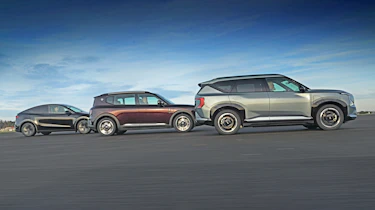
On the road
While the Kia is front-wheel drive and the other two send power to the rear, all three models deliver predictable, vice-free handling. The Smart has the softest ride of these three, and there’s more body roll here than in the Tesla. The Kia offers a good balance. All three cars feel quick enough off the line, while the Smart edges ahead for refinement, with a quieter cabin than either competitor at all speeds.
Tech highlights
If the Tesla didn’t have a touchscreen, the cabin would be bare, but thankfully the firm’s tech is easy to use, while the reintroduction of the indicator stalk is welcome. The EV5’s infotainment is carried over from the rest of the Kia line-up, but the climate panel is obscured by the steering wheel. Smart’s large touchscreen is quick to react, but there are a few too many screens to navigate through.
Price and running
While the entry-level Tesla is the priciest model here, it has the least equipment. The Smart feels upmarket and is generously specced, with the Kia offering a decent mix of equipment for the price. The Model Y was more efficient than the EV5 on test, and both were well ahead of the Smart #5. Only the Tesla comes with a heat pump as standard – higher-spec versions of its rivals include one.
Practicality
Tesla only quotes boot space to the roof, but its car also has the lowest load lip. The Smart has a decent boot and back seats, with electric adjustment for the seat backs, but the EV5 is roomier in two-seat mode. Under-floor storage is good in the Tesla and Smart, and they have more space than the Kia in the nose, too. It’s worth noting that the Model Y’s area looks unfinished in this base-spec version.
Safety
Both the Tesla and Smart offer sensor systems that relay the position of vehicles, objects and pedestrians on their respective screens, although the Model Y’s set-up is more detailed and faster to relay information. All three cars have high levels of safety assistance, but the Kia offers the simplest way to deactivate the speed- limit warning – simply give the volume mute button a long press and it cancels.
Ownership
Kia’s seven-year warranty is an attractive proposition for longer-term buyers, while Tesla offers hassle-free charging with its Supercharger network. Free servicing is also included when buying on finance. Smart’s three-year warranty looks stingy compared with both rivals’ cover – the Tesla has four years of cover – but at least there is no mileage limit and breakdown assistance lasts for the same period.
Verdict
Winner: Tesla Model Y
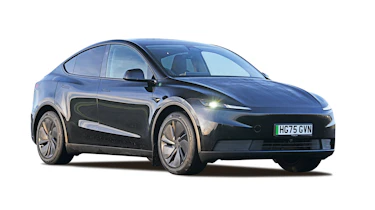
The basic Model Y lacks some of the neat touches of higher-spec versions, and it’s clear where some of the savings have been made inside and out, but overall it’s still one of the best electric family SUVs on sale.
While it’s not the most interesting car to drive, in terms of comfort it’s right on the money, while its passenger space, efficiency and Tesla’s user-friendly Supercharger network put it ahead of its rivals here.
Runner-up: Smart #5
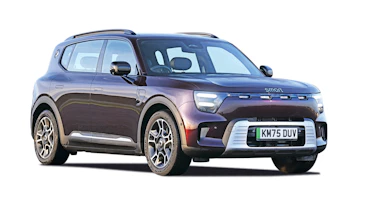
The new #5 has a lot going for it. It’s spacious, very well equipped for the money and has a premium edge that makes it feel more expensive than its prices suggests. It’s comfortable and refined at all speeds, too, while the powertrains deliver plenty of performance, even in entry-level specs.
The looks will split opinion, but if you’re a fan, the Smart is well worth considering. We’d recommend upgrading to the 100kWh model for a longer range and its faster charging technology.
Third: Kia EV5
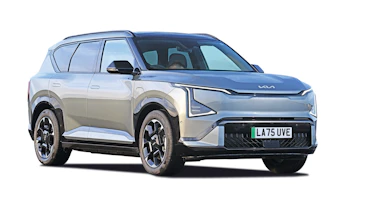
Placing third in this test is no slight on the EV5. It applies a formula that’s already been proven with the EV3, but it repackages everything into a larger body with a bigger battery. That means it’s a versatile and user-friendly EV that offers a good range that will suit most needs, while the understated looks will appeal to many. But there’s no real area where the Korean model stands out when compared with its rivals here, and the driving experience isn’t a highlight either.
Prices and specs
| Model tested | Kia EV5 | Smart #5 | Tesla Model Y |
| Price from/price of model tested | £39,345/£47,145 | £39,800/£39,800 | £41,990/£41,990 |
| Powertrain and performance | |||
| Powertrain | 1x electric motor | 1x electric motor | 1x electric motor |
| Power | 214bhp | 335bhp | 292bhp |
| Torque | 295Nm | 373Nm | 350Nm |
| Transmission | Single-speed/FWD | Single-speed/RWD | Single-speed/RWD |
| 0-62mph/top speed | 8.4 seconds/102mph | 6.9 seconds/124mph | 6.9 seconds/110mph |
| Battery capacity/usable | 81.4/78kWh (est) | 76/74.4kWh | 63/63kWh |
| Official range | 313 miles | 288 miles | 313 miles |
| Test efficiency/range | 3.1 mi/kWh/252 miles | 2.4 mi/kWh/179 miles | 3.6 mi/kWh/227 miles |
| Charging | 150kW (10-80% in 30 mins) | 150kW (10-80% in 30 mins) | 175kW (0-80% in 30 mins) |
| Dimensions | |||
| Length/wheelbase | 4,610/2,750mm | 4,695/2,900mm | 4,797/2,890mm |
| Width/height | 1,875/1,680mm | 1,920/1,705mm | 1,982/1,624mm |
| Rear knee room | 670-895mm | 710-960mm | 680-989mm |
| Rear headroom/elbow room | 950/1,495mm | 975/1,495mm | 848/1,455mm |
| Boot space (front/seats up/down) | 44/566/1,650 litres | 72/630/1,530 litres | 88/845*/2,118 litres (*to roof) |
| Boot length/width | 8895/1,015mm | 915/1,040mm | 1,091/945mm |
| Boot lip height | 765mm | 775mm | 600mm |
| Kerbweight/payload/towing weight | 2,092/488/1,200kg | 2,200/500/1,600kg | 1,906/N/A/1,600kg |
| Turning circle | 11.7 metres | 11.2 metres | 12.1 metres |
| Costs/ownership | |||
| Residuals (after 3yrs/36k miles) | £23,290/49.40% | N/A | £22,297/53.10% |
| Depreciation | £16,055 | N/A | £19,693 |
| Insurance group/AA.com quote/VED | N/A/£750/£195 | 41/TBC/£195 | 34/£1,457/£195 |
| Service cost | £400 (est) | £0 | £0 |
| Annual tax liability standard/higher rate | £282/£564 | £238/£477 | £252/£503 |
| Annual fuel cost (10k miles) | £893 | £1,154 | £769 |
| Basic warranty (miles)/recovery | 7yrs (100,000)/1yr | 3yrs (unlimited)/3yrs | 4yrs (unlimited)/4yrs |
| Driver Power manufacturer position | 18th | N/A | 11th |
| NCAP Adult/child/ped./assist/stars | N/A | 88/93/84/92/5_ (2025) | 97/87/82/98/5_ (2022) |
| Equipment | |||
| Metallic paint/wheel size | £675/19 inches | No-cost option/19 inches | £1,300/19 inches |
| Parking sensors/camera | Front, rear & side/rear | Front, rear & side/360-degree | Front & rear/360-degree |
| Spare wheel/Isofix points | Repair kit/two | Repair kit/three | Repair kit/two |
| Keyless entry & go/powered tailgate | Yes/yes | Yes/yes | Yes/yes |
| Leather/heated seats/wheel | Artificial/front & rear/yes | Artificial/front/yes | Artificial/front/yes |
| Screen size/digital dashboard | 12.3/12.3 inches | 13/10.25 inches | 15.4 inches/no |
| Climate control/panoramic sunroof | Yes/yes | Two zone/yes | Two zone/yes |
| USBs/wireless charging | Four/yes | Four/yes | Five/two |
| Wireless Apple CarPlay/Android Auto | Yes/yes | Yes/yes | No/no |
| Blind-spot warning/head-up display | Yes/yes | Yes/no | Yes/no |
| Adaptive cruise control/heat pump | Yes/£900 | Yes/no | Yes/yes |
What we would choose

Kia EV5
Beyond paint, the only other option that you can add to the EV5 is a £900 heat pump for the GT-Line S model. A no-cost option is black artificial leather with white bolsters, which adds white trim to the steering wheel as well.
Smart #5
As with the Kia, it’s only colours that can be chosen, with one option adding yellow accents to silver paint. Our test car’s Pulsar Ruby hue looks different enough to justify it over some of the more regular shades Smart offers.
Tesla Model Y
Enhanced Autopilot (£3,400) and Full Self-Driving (£6,800) packs are offered. The former adds lane changing and car park summon, while the latter includes traffic light and stop sign control, with future updates.
Looking for your next car? You can now search our nationwide dealer network for a choice of great cars on offer right now with new, used and leasing deals to choose from...