Kia PV5 Cargo van review
Kia’s first foray into the world of vans is a strong one, but the brand still has a few lessons to learn

Our opinion on the Kia PV5 Cargo
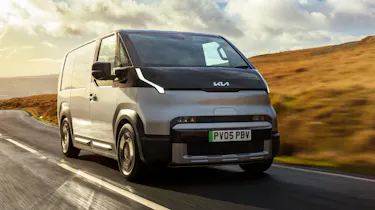
It’s taken a very long time for Kia to enter the UK’s van market, but the Korean brand has clearly made the most of its electric car-building know-how to create a compelling first effort. The PV5 Cargo is distinctively designed and pleasingly car-like to drive for the most part, and a number of the crucial commercial fundamentals are present. While some shortcomings prevent it from sitting at the top of the class, this EV is still capable of carrying a good amount of cargo without demolishing the battery’s range. It’s also adorned with a generous amount of kit and is very easy to load.
It also appears that Kia’s top brass are fully aware of the challenge they face in prying buyers away from the usual van brands, such as Ford and VW. The PV5 Cargo claims up to 258 miles of range on the WLTP combined cycle, which is already competitive, but Kia’s highly appealing seven-year/100,000-mile warranty also applies. What’s more, the PV5 Cargo starts from under £30,000, which is thousands less than several rivals, including some diesel vans. The £5,000 Plug-in van grant does help here, though.
About the Kia PV5 Cargo
The medium-sized electric van market is filled with well established names such as the Ford e-Transit Custom, Volkswagen ID. Buzz Cargo and Vauxhall Vivaro Electric, as well as newcomers like the Farizon SV and Maxus eDeliver 7. This pattern means the Kia PV5 Cargo is a bit of an oddity; it’s a newcomer, but it comes from a brand that’s very well established in the car world.
Used - available now

2023 Ford
Puma
28,781 milesManualPetrol1.0L
Cash £13,700
2020 Ford
Focus
64,595 milesManualPetrol1.0L
Cash £8,900
2022 Nissan
Qashqai
29,606 milesAutomaticPetrol1.5L
Cash £18,499
2024 BMW
2 Series Gran Coupe
20,500 milesAutomaticPetrol2.0L
Cash £24,036For now, the PV5 is available exclusively as a panel van, but Kia plans to bring in a number of variants including a crew and chassis cab model. There’s also the Kia PV5 Passenger (for which we have a dedicated in-depth review elsewhere), which is an MPV — just like the Ford Tourneo is based on the Transit.
In order to truly put the Kia PV5 Cargo to the test, we drove it through a number of villages and towns as well as A and B-roads throughout East Sussex. We also compared this electric van’s carrying capacity to its rivals’, and rated its real-world efficiency against the official claimed figures.
Range, charging & running costs
Pros |
|
Cons |
|
Much like its passenger-carrying counterpart, the Kia PV5 is exclusively available as an electric van, so the usual emissions-based charging and VED road tax savings can be enjoyed with every variant. Insurance will take its share of your finances, though, because the PV5 line-up sits in groups 32 to 33.
Adjustable regenerative braking is fitted as standard to all PV5s, and this will help to maintain battery charge as well as providing the convenience of one-pedal driving in its maximum setting.
The level of regen can be changed via steering wheel-mounted paddles, but we encountered an issue in our test van which only allowed us to move above level one once the battery had depleted below 85 per cent. Kia has assured us that this is just a technical glitch that will be resolved with an over-the-air update. To be fair to the PV5, teething troubles certainly aren’t unheard of in vehicles at the beginning of their life cycle, but it does mean the regen braking’s impact on charge is yet to be seen by our road testing team.
Electric range, battery life and charge time
There are two batteries to choose from in the PV5, and Kia believes the biggest-seller will be the largest ‘long-range’ 71.2kWh pack. This claims up to 258 miles on the WLTP combined cycle, which outshines the Ford E-Custom’s 204-mile range, but falls a bit short of the Volkswagen ID. Buzz Cargo’s 276 miles.
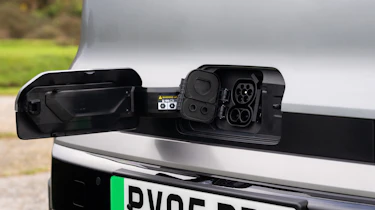
It should take around six and a half hours to recharge this battery from an 11kW AC charger. If you’re using a capable rapid-charger, a 150kW peak charging DC rate means a 10 to 80 per cent top-up should take less than half an hour.
The cheaper battery option is a ‘standard-range’ 51.5kWh unit, which still offers a reasonable 184 miles on the WLTP combined cycle. In our test van fitted with this battery, we saw an average efficiency rate of 3.1 miles/kWh, which equates to around 159 miles of real-world range. We achieved this after a mixture of driving both in town and on rural A and B-roads with an average ambient temperature of 11 degrees celsius.
To put this figure into perspective, it’s the same rate that we achieved with the Renault Kangoo E-Tech that spent six months on our long-term test fleet, even though it’s smaller and lighter than the PV5. The mid-sized Volkswagen ID. Buzz, meanwhile, only managed around 2.5mi/kWh.
Load space and practicality
Pros |
|
Cons |
|
Measuring 4,695mm long, 1,923mm tall and 1,895mm wide, the Kia PV5 Cargo is smaller than the Volkswagen ID. Buzz Cargo, Ford E-Transit Custom and Vauxhall Vivaro Electric. While this smaller stature has its advantages when weaving through traffic, it hasn’t come at the expense of the PV5’s carrying capability.
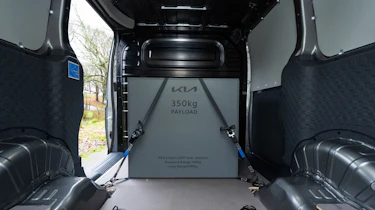
The L2/H1 variant (the only one currently on sale) has a cargo volume of 4.4 cubic metres. This is 0.5m³ more than in the ID. Buzz Cargo and enough space for two Euro pallets.
Maximum payload capacity varies depending on spec, with the PV5 Cargo able to carry up to 690kg in long-range form – or 790kg in the standard-range edition. For an extra £355 (excluding VAT), the PV5 can be fitted with dual sliding doors. These models cope with a maximum of 665kg when fitted with the larger battery, increasing to 745kg with the smaller pack.
The Kia runs pretty close to the ID. Buzz here, given that the latter can take between 595kg and 712kg. There’s no beating the Ford E-Transit Custom, though, which can take up to 1,135kg. The Farizon SV is an even better weightlifter at up to 1,350kg.
If you can make do with a more modest payload and would rather invest in not putting your back out, the Kia PV5 Cargo’s 419mm rear load lip will undoubtedly appeal. This results in a tiny step to get up and into the van via the 50:50-split rear doors, which can open up to 180 degrees. In fact, level boarding wouldn’t be out of the question if you can find a high enough kerb.
One thing we did find with the rear doors during testing, though, was that they had to be given a very firm slam in order to convince the on-board sensors that they were indeed closed. The van frequently registered that its doors were still open, and subsequently prevented us from driving off even though they were fully secure to the touch. This quickly became a bit frustrating, and would be even more so if we were making deliveries on a tight schedule.
If you’d rather enter from the side, the opening here is too narrow to accommodate a Euro pallet, but you won’t have to strain to store smaller cargo because the lip height is only 399mm.
Reliability, safety and security
Pros |
|
Cons |
|
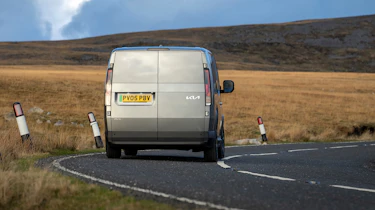
We’re yet to hear of any major horror stories regarding Kia’s electric cars, and we see no obvious reason why this shouldn’t continue with its vans. In the event that something does go wrong, though, the brand’s renowned seven-year/100,000-mile warranty provides official peace of mind.
The only van brand that can outdo this coverage is Toyota with its 10-year/100,000-mile plan, but this only applies when routine servicing is carried out on time by an authorised workshop. The Kia’s service intervals stand at every 20,000 miles or 24 months, whichever comes first.
The PV5 Cargo is one of the safer vans on the road, given that it managed to bag a full five-star rating from Euro NCAP when it was tested in 2025. Dual airbags are standard-fit (not always a given in the van world), along with highway driving assist, front-collision avoidance assist, lane-keeping assist and smart cruise control.
For the majority of the time, our test van’s systems worked quietly in the background without a hitch. However, the driver-attention warning was perhaps just a little bit too keen to scold us like a mischievous school child whenever we attempted to adjust the heating via the central touchscreen (we had to look away from the road for a split second because there are no buttons for this task).
The lane-keeping assistance system also became a bit flummoxed at times whenever we encountered poorly maintained road markings. This problem certainly isn’t unique to the Kia, but it did result in a bit of sudden wheel wrestling.
Driving and performance
Pros |
|
Cons |
|
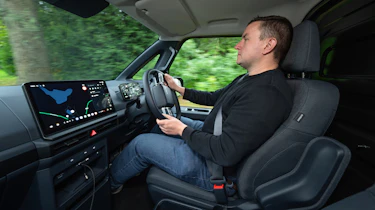
There’s very little difference between the PV5 Cargo and PV5 Passenger in the way they drive. Both feel like a big car for the most part, and that’s a good thing, because there’s plenty of acceleration on offer, as well as surprisingly adept handling and reasonably refined suspension. If there’s one area where the Cargo suffers compared with its people-carrying counterpart, though, it’s visibility.
Town driving, visibility and parking
We’ve already mentioned the PV5’s relatively slim width compared to its rivals, and this pays dividends when navigating city streets. We found it pretty easy to place this van on the road, and didn’t find ourselves taking to the nearest ditch whenever an SUV came charging towards us on a narrow street. The turning circle has been kept well under control, too, so most manoeuvres can be dealt with quickly.
It’s all rather drama-free except for one major pitfall: that aforementioned visibility. While our view of everything ahead of us was pretty much obstruction free thanks to a sizeable windscreen and short front end, it was a very different story when trying to see what was beside and behind us.
The PV5’s tall door windows and cut-outs in the A-pillars mean you won’t miss much within your immediate field of vision. However, as soon as we arrived at an offset T-junction, there was no option but to uncomfortably crane forward in order to get a view of the oncoming traffic, and even then there was an unsatisfactory level of guesswork involved as to whether or not there was a car approaching from more than a few metres away.
It’s a similar story with rearward visibility, too, because the bulkhead gets in the way. The modern solution to this problem would be a digital rear-view camera mounted where a traditional mirror would be. But although this is an option in the Ford E-Transit Custom, there’s no sign of it in the Kia PV5. While the door mirrors are a good size and provide a decent view of the traffic to either side, there’s a huge blind spot around the van’s rear end. This soon creates an underlying concern about whether an overenthusiastic cyclist or fellow driver is lurking too closely behind you, in prime position to fall foul of an emergency stop.
Motorway driving and long-distance comfort
The Kia’s official 0-62mph acceleration times are 16.2 seconds for vans fitted with the 51.5kWh battery, and 12.4 seconds for the 71.2kWh. This is due to the latter extracting an extra 40bhp from the same front-mounted single motor to produce a total of 160bhp. Both variants churn out 250Nm of torque, and as with the vast majority of EVs, this is applied as soon as you press your right foot down.
Our 51.5kWh test van felt far quicker than its official time suggests, even with 350kg of sand in the back. Any PV5 will be perfectly fine at getting up to and then cruising at motorway speeds. However, while the powertrain is up to the task, the cabin does suffer from wind noise and tyre roar as the speedometer climbs. We also experienced some occasional reverberation when driving over rougher tarmac. None of this is intolerable, but you’ll certainly notice it.
Things do improve in terms of ride quality, though. There’s some inevitable bounciness over the most uneven surfaces (which is at its worst when the van is unladen), but the PV5 remains comfortable without any overly harsh bangs or jolts.
Cab interior and technology
Pros |
|
Cons |
|
Just like the PV5 Passenger, the Kia PV5 Cargo offers a choice of two trim levels: Essential and Plus. The difference between the two is pretty small, though, because even the entry-level model is well equipped. The most notable advantages of the range-topper are its Vehicle-to-Load (V2L) capability and optional dual side doors. The fact that the heat pump is a £650 option (exc. VAT) that’s reserved for the Plus is a bit disappointing, because this is included on every Ford E-Transit Custom – although that is a much more expensive van in the first place.
While the exterior has a certain sci-fi flair about it that’s similar to the new Renault Trafic E-Tech (or dare we say the Tesla Cybertruck?), the interior follows a very similar design to Kia’s electric cars. The cabin feels far more focussed on durability than plushness, but everything feels securely screwed together, and there are a number of recycled materials, which help to boost this van’s green credentials.
Perhaps the most luxurious part of the PV5 Cargo’s interior is the seats. They’re still pretty basic to look at, but we didn’t feel any unwelcome cramps or pains after spending many hours and miles behind the wheel of our test van. A bit more natural light would have been welcome, though, because the dashboard materials make things feel a bit drab.
Infotainment, sat-nav and stereo
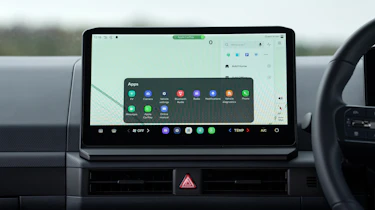
Regardless of your chosen spec, the PV5’s interior is dominated by a twin-screen set-up consisting of a 7.5-inch driver’s display and a 12.9-inch infotainment touchscreen. Both of these are easy to read with clear graphics, and there are some useful shortcut icons at the bottom that provide quick access to functions such as the climate control. Wireless Apple CarPlay and Android Auto are included, too.
We found the infotainment software quick to respond to our inputs, and it’s a good job, too, because the driver attention-monitoring system was very quick to react whenever we looked towards the central screen.
Buying and owning
The best Kia PV5 Cargo for your business will ultimately boil down to your requirements. Even the most expensive Plus variant with the larger battery sits well below the £40,000 mark, so it’s a relative bargain compared with most of the competition. If you do opt for the fancier Plus trim, we would recommend going all out and investing a little bit of extra cash in the optional heat pump, which will help with efficiency.
Kia PV5 Cargo alternatives
If you’ve been bowled over by the PV5’s quirky styling but want to look at alternatives, the Farizon SV offers some of the biggest carrying capacities in the class. The new Renault Trafic E-Tech is also a head-turner, and it even boasts a very healthy claimed battery range of 279 miles.
If functionality and familiarity are top of your wish list, the established brands also have you covered with the likes of the Volkswagen ID. Buzz Cargo, Ford E-Transit Custom and Vauxhall Vivaro Electric.
Frequently Asked Questions
The Kia PV5 Cargo is surprisingly capable considering that it’s the brand’s very first van to hit UK roads. Some rivals have it pipped for outright carrying capacity, but it’s good to drive, suitable for most business needs and affordable to buy.