Ford E-Transit Custom review
The top-selling Ford Transit van remains very appealing in EV form

Our opinion on the Ford E-Transit Custom
Ford has played things rather safe with the electric E-Transit Custom. Don’t be too disappointed, though, as this is actually a good thing. After all, the combustion model with which this EV shares its DNA is one of the brand’s best-sellers for some very good reasons.
Just like its piston-powered sibling, the fully-electric Custom is surprisingly good to drive and even the least-powerful variant is more than capable of spirited overtaking manoeuvres and motorway driving. When it comes down to the most crucial aspects, there’s decent battery range across the lineup while cargo and passenger space can be found in abundance, too.
About the Ford E-Transit Custom
The electric van sector is growing at a healthy rate, and there are plenty of newcomers vying for this increasingly lucrative market. However, Ford has opted to stick to a proven formula rather than take any drastic actions.
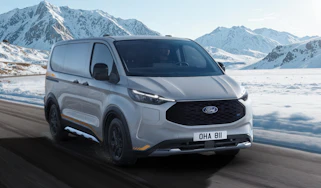
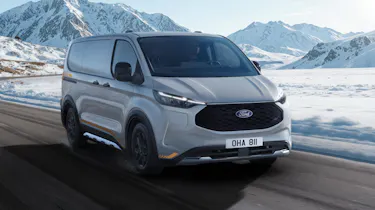
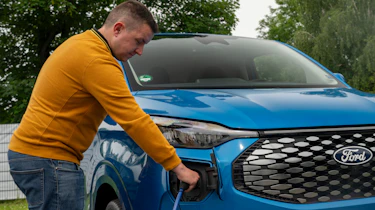
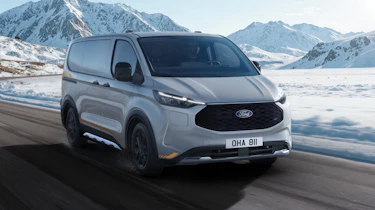
Take one look at the Ford E-Transit Custom, and you’ll notice it looks very similar to the combustion version. In fact, you’ll have to look very closely to notice anything is different, with the charging port door, ‘E’ badging and, of course, the lack of exhaust pipes being the few obvious giveaways.
Just like the regular Ford Transit Custom, the E-Transit Custom comes in a number of sizes and body styles. As well as being a regular panel van, it can also be set up as a double-cab with six passenger seats, a Kombi with up to eight seats or a Multicab with a two-seat second row and L-shaped bulkhead. There are also two wheelbases to choose from: the standard length L1 or extended L2. The only thing that can’t be changed is the roof height, as the E-Transit Custom is only available as the 1,968mm tall H1.
Range, charging & running costs
Pros |
|
Cons |
|
Following a series of updates in 2026, each version of the Ford E-Transit Custom is now powered by the same 71kWh battery, and this has a claimed maximum range of 232 miles on the WLTP combined cycle.
While this does make the E-Transit Custom suitable for longer motorway trips, it fails to lead the class. The Volkswagen ID. Buzz Cargo, for example, is capable of up to 276 miles. However, this rival only comes with an optional heat pump, whereas one is fitted to every E-Transit Custom as standard.
When it’s time to plug in, the charging port is located at the front so it doesn’t impede access to the van. Peak DC rapid charging capacity sits at 125kW, which means a 10 to 80 per cent top-up takes around 34 minutes. A full charge from a 7.4kW home wallbox charger should take around nine and a half hours.
Load space and practicality
Pros |
|
Cons |
|
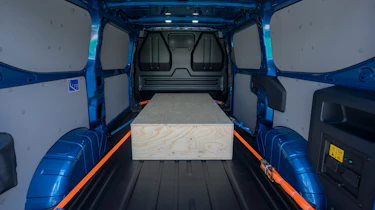
The E-Transit Custom provides the same amount of load volume as its combustion counterparts. The short wheelbase L1 offers 5.8 cubic metres of space, and this increases to 6.8 cubic metres for the extended L2. There’s 1,932mm of space between the wheel arches on both variants, and the rear doors open up to 90- or 180-degrees to reveal a 1,400mm wide opening. If you’re entering from the side, a hands-free power-assisted sliding door is included as standard with the Limited, Sport and MS-RT trims.
There is, however, a penalty to pay when it comes to maximum payload. The EV can’t carry as much weight as the diesel van and payload capacities decrease as you work your way upwards through the line-up. The E-Transit Custom’s highest payload capacity sits at 1,088kg, but this is only in the Trend variant. Moving up to the Limited spec drops this figure slightly to 1,066kg, the Sport drops further still to 1,054kg, while the top-spec MS-RT can only handle 1,036kg. In comparison, the diesel Custom offers up to 1,384kg of payload capacity, although this can dip as low as 891kg in the less-powerful models.
The electric Custom’s flat floor means there’s a bit more space up front in the cab area, making it easier to move around the cabin, and you can store a bit more cargo if you need to. Opting for Ford’s load-thru bulkhead means you can feed longer items through from the cargo area, too.
If you’ve filled the E-Transit Custom to the brim and need to bring a trailer, every version has a braked capacity of 2,300kg, which makes it one of the most capable electric vehicles for towing duties.
Reliability, safety and security
Pros |
|
Cons |
|
The standard Ford Transit Custom continues to prove itself as a dependable workhorse, and we’re not hearing any too many qualms about the E-Transit Custom, either. The fact that it has fewer moving components should also be rather reassuring.
Euro NCAP has awarded the Custom with its coveted platinum medal for commercial van safety, and this comes as little surprise when you look at the sheer level of safety tech that comes as standard. Even base Trend trim models get pre-collision assist, adaptive cruise control, lane-keeping assist, road sign recognition, wrong way alert, a reversing camera and front and rear sensors as standard.
On the move, these systems are supportive rather than intrusive, particularly the lane-keeping assist. The speed-limit detection system is also quick to chime at you if you’re straying over the limit, which can become a bit annoying. If you prefer to drive without assistance, most of these functions can be switched off via a button on the steering wheel or via the touchscreen.
An electronic rear-view camera is added in place of a traditional mirror, and this takes the guesswork out of figuring out if there’s someone behind you, not to mention reversing. If you’re not too keen on tech, the doors still have traditional two-piece mirrors for monitoring the sides of the van and its blind spots. Visibility is decent overall, but we did have to lean forward at some trickier junctions.
To deter thieves, Ford offers a remote monitoring service that alerts owners or fleet managers to vehicle defects and security issues in real time. Upgraded door locks are also available.
Driving and performance
Pros |
|
Cons |
|
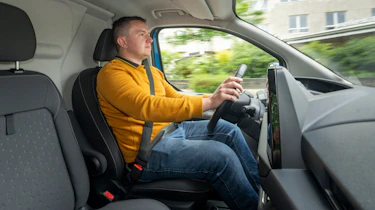
Long gone are the days of the noisy and sluggish Transit van. The diesel Ford Transit Custom was already one of the more refined offerings in the medium van class, not to mention one of the best to drive, and electric power only improves things further.
The Ford E-Transit Custom does an admirable job of remaining composed for its size, the extra ballast of the battery helping here. Even at slower speeds, the ride remains mostly bounce- and crash-free, with only the biggest road imperfections causing any real upset to the ride quality. Even when this does occur, it’s only for a brief moment.
The least powerful motor produces 134bhp, or you can opt for a 214bhp setup. In rear-wheel drive form, both of these pump out the same 415Nm of torque, hence a strong initial punch when you plant the right pedal.
All-wheel drive is also available, adding an extra motor to the equation. The power outputs remain the same here, but torque is increased to 435Nm and 615Nm, respectively.
If you really want the most performance out of your E-Transit Custom, there’s always the option of the 281bhp MS-RT. This version is certainly a bit quicker, but it’s difficult to see the advantage of spending a significant amount more for it unless you desperately want the brighter paint and bold exterior add-ons.
Town driving, visibility and parking
In town, the E-Transit Custom’s steering and throttle are easy to manage and shouldn’t prove very intimidating for a van-driving newbie. However, the brakes aren’t as responsive as we’d hoped, and there’s quite a lot of travel in the middle pedal that can make things feel a bit disconnected at times. Using the auto-hold function also results in an unceremonious shunt every time you set off, so we’d suggest turning it off for smoother starts, and only use auto-hold for when setting on steep hills.
On the plus side, the transition between regenerative and mechanical braking is pretty smooth, while the regen itself is reasonably strong without being overbearing. There’s also the option of one-pedal driving.
Motorway driving and long-distance comfort
No variant of the E-Transit feels sluggish when getting up to motorway cruising speeds, and wind and tyre roar are kept well under control. There is a noticeably loud whine from the electric motor, though, particularly when setting off and coming to a stop.
Cab interior and technology
Pros |
|
Cons |
|
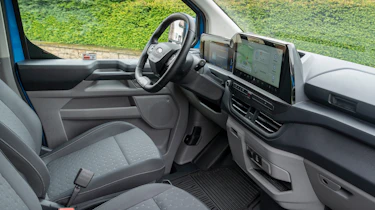
The E-Transit Custom’s cabin is very similar to the one you'll find in the combustion-powered van, though the EV does have a couple of advantages. The gear selector is a simple steering column stalk, while the electronic parking brake switch is located between the centre air vents. This means there are no floor-mounted controls whatsoever, which makes it far easier to move around the cabin.
While there are some physical buttons for functions like the heated windscreen, these are all stamped onto a single strip of plastic so they aren’t very ergonomic. Unless you have particularly good muscle memory, you will still need to look away from the road ahead to find the switch you want. Unfortunately, you’ll also need to venture onto the infotainment system to access the climate controls, although there are some shortcuts at the bottom of the screen.
One feature that may catch your eye is the unusual oblong-shaped steering wheel. This may remind some classic car enthusiasts of the Austin Allegro, but there is some method to Ford’s apparent madness here. Opt for the optional Mobile Office pack and this wheel can be tilted for use as a tablet stand or even a lunch tray. There’s a plastic topper that slots onto the wheel, should you wish to eat your meal on the go, which saves you from carrying your own tray or eating off your lap. The downside is that the wheel feels a bit strange when you actually need it for steering.
If you’re covering mega miles, the seats are adequate but not the most comfortable we’ve tried. The backrests are rather thin, and there’s little lumbar support. Opt for Limited trim or above, and you’ll get heated seats, while the Sport and MS-RT get electronic driver’s seat adjustment, too.
Infotainment, sat-nav and stereo
The dashboard features the same twin-screen setup as the combustion models, with a 13-inch SYNC 4 infotainment system at the centre. This system is responsive to the touch, but it does look a little bit bland compared to some rivals. If you prefer, Apple CarPlay and Android Auto are included as standard.
Buying and owning
As with any van, the best powertrain and body setup for the Ford E-Transit Custom will depend on how much you need to carry regularly. However, we’d stick to the lower end of the trim levels to keep the price under control. To be frank, this isn’t a cheap van with its starting price of over £45,000 excluding VAT. However, this price can surpass £80,000 if you get too carried away on the configurator.
Ford E-Transit Custom alternatives
The Ford E-Transit Custom faces some familiar electric foes in the shape of the Citroen E-Relay, Fiat E-Scudo, Peugeot E-Expert and Vauxhall Vivaro Electric. There's also a fifth member of this family, the Toyota Proace Electric. Elsewhere, two of the more unique entries in the medium electric van sector are the retro Volkswagen ID. Buzz Cargo and the futuristic Kia PV5 Cargo.
Ford E-Transit Custom pictures
Key updates of the Ford E-Transit Custom review
25 August 2026: Information about midlife model updates.
Frequently Asked Questions
Ford’s commercial vehicles are covered by a three-year/100,000-mile warranty. The E-Transit Custom’s battery is also protected by a separate plan lasting eight years or 100,000 miles.
| Van dimensions | |||
| Body style | Height | Width | Length |
| SWB low roof (L1H1) van | 1,968mm | 2,032mm (2,275mm inc mirrors) | 5,050mm |
| LWB low roof (L2H1) van | 1,966mm | 2,032mm (2,275mm inc mirrors) | 5,450mm |
| Load area dimensions | ||||
| Body style | Height | Width | Length | Volume |
| SWB low roof (L1H1) van | 1,322mm | 1,392-1,777mm | 2,602mm | 5.8m3 |
| LWB low roof (L2H1) van | 1,822mm | 1,392-1,777mm | 3,002mm | 6.8m3 |