New Mercedes S-Class 2026 review: good, but no longer the luxury car pinnacle
Merc’s iconic luxury saloon has never been more competent, but does it move the needle enough in 2026?


Verdict
The Mercedes S-Class is synonymous with luxury motoring, and so it remains in its new and heavily revised form. This is a sumptuous, elegant and serene way of moving about, especially from the privileged position in one of its back seats. But for those wanting to drive themselves, newer and more expressive forms of luxury cars have more appeal, and a wider range of talents.
The Mercedes S-Class has set the standard in luxury saloons for most of the model’s history – a symbol of success, wealth, and taste. But the world keeps moving at breakneck speed and large, traditional saloons appear to be standing still.
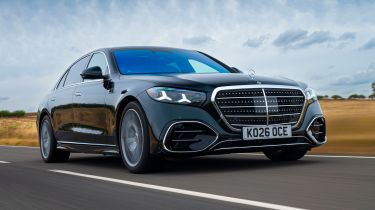
Looking from the outside, it’s easy to think this is true of Merc’s new S-Class too; it’s largely the same vehicle as the one launched back in 2020. Some small exterior changes – including updated headlights with a double-star motif and a larger, deeper grille – do a solid job of aligning the ageing design with newer models.
Yet Mercedes asserts this is now a whole new entity under that familiar skin. The company offers a curated collection of engine options in the UK, and by and large, they are excellent units that match the general requirements of Merc’s exacting customers. At the entry-point is the S 350d, a large six-cylinder diesel engine that might sound old-fashioned in practice, but perfectly suits the car’s relaxed demeanour. Its 650Nm of torque underpins this feeling of calm, while helping the car sprint to 62mph in 5.4 unbothered seconds.
Used - available now

2024 Mercedes
S Class
46,774 milesAutomaticPetrol3.0L
Cash £61,290
2019 Mercedes
S Class
15,811 milesAutomaticDiesel2.9L
Cash £35,975
2019 Mercedes
S Class
76,680 milesAutomaticPetrol3.0L
Cash £29,795
2017 Mercedes
S Class
66,000 milesAutomaticDiesel3.0L
Cash £17,494The S 580e plug-in hybrid is still available, packing a combined 577bhp, which is good for a rapid 4.4-second 0-62mph sprint. However, new for 2026 is a lower-cost S 450e PHEV. This has a reduced output of 428bhp, but it still posts a perfectly reasonable 5.7 seconds for the benchmark acceleration run.
Both have a 21.96kWh usable battery, capable of 60kW DC charging and up to 60 miles of on-paper electric range. When the six-cylinder petrol engine needs to get involved, it is both smooth and isolated enough so that you rarely notice it. The odd powertrain among Merc’s offering is the 442bhp S 500 mild-hybrid petrol, which lacks the effortless low-down grunt of the diesel.
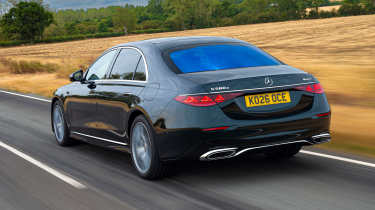
Of all the dynamic attributes an S-Class must be judged against, ride quality is paramount. This is something that certain variants of the previous generation model struggled with, because they simply didn’t ride smoothly enough when fitted with 21-inch wheels. Mercedes UK has realised this error and now sensibly fits 20-inch wheels across the range. Helping this further is a new set of technology, such as smart air suspension that recognises and stores data on speed humps and potholes to prepare the car for your next pass over them.
The S-Class is a superb motorway cruiser with incredible high-speed refinement. However, when you try to get a hurry on along country roads, it doesn’t feel interested in driving at speed. At best, it holds its own; at worst, it’s a bit soggy.
A Mercedes S-Class is never going to be a cheap car to run, but considering the tech and luxury it offers, it could be worse. Diesel and PHEV powertrains do the heavy lifting here, thanks to efficiency that defies the car’s sheer size. S 350d variants are rated to 44.2mpg in the WLTP combined cycle; while that figure is hard to match in urban environments, it is very achievable if a majority of time is spent on motorways.
The plug-in S 450e and S 580e’s consumption rates vary greatly depending on battery usage. While they claim a combined electric range of 60 miles, 30-40 miles is more realistic in everyday use. Weighted consumption figures of around 97.5mpg can be achieved if most of your driving is electric, but once the power pack is depleted, expect 25-30mpg. The mild-hybrid petrol S 500 is more consistent with a WLTP figure of 33.7mpg, which you’ll likely beat on motorway runs. For business buyers, the plug-in hybrids offer a highly appealing 10 per cent BiK rate.
Inside, the cabin is mostly new, but rather than looking a generation ahead, it borrows heavily from the lesser E-Class. The previous rectangular central screen is gone, replaced by the 'Superscreen'. The biggest part is a 14.4-inch display that acts as the main interface, incorporating almost all of the car’s key functions within the latest MBUX infotainment system. It genuinely feels like a set-up designed to be used while driving.
This is joined by a 12.3-inch traditional driver’s display and a matching 12.3-inch passenger display that can stream videos or access a plethora of other in-car functions. The cabin’s materials are typical of a modern Mercedes, offering opulent finishes and top-tier Nappa leather seats, though the new plastic scroll wheels on the steering wheel feel a little flimsy.
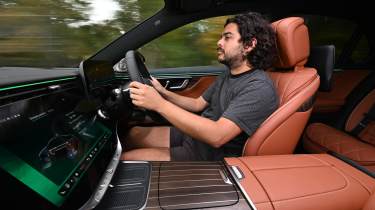
Only the long-wheelbase version is offered in the UK, bringing its total length to 5,304mm. The seats are brilliantly comfortable, offering heating, cooling and massage functions, plus adjustable bolsters. There is even a world-first option for heated seatbelts.
However, for many potential S-Class customers, the second row will be more important, and in this respect Mercedes has hit the mark. There’s masses of space for the outer seats, and depending on the rear-seat layout chosen – be that a standard bench or wider outer seats with cooling and massage functions, plus built-in footrests.
For the full luxury experience with a centre console, you’ll need to upgrade to the Maybach variant, but all S-Classes offer a top-notch rear-seat experience. If you need to carry three on the bench, though, a large hump in the floor does make the middle-seat passenger less comfortable.
The boot is rated at an average 350-litre capacity; it is square and wide enough for two large cases side-by-side, but it is noticeably tight in the plug-in hybrid models thanks to where the battery is fitted.
If you actually drive your luxury car, though, the S-Class just doesn’t have quite as wide a spread of capability as some rivals. A modern luxury SUV such as a Range Rover or Bentley Bentayga is just as luxurious, but their greater versatility explains why those cars outsell the S-Class to such an extent in the UK.
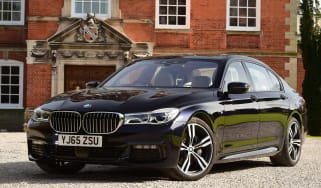
If you’re willing to sit a little lower to the ground, cars such as the Porsche Panamera give considerably more engagement and game-changing innovations including Active Ride alongside a more personalised interpretation of luxury. It’s also impossible to overlook the BMW 7 Series, which is a similarly traditional saloon but with more tech, more toys and the option of an electric version with none of the packaging quirks of Merc’s EQS.
With this in mind, if an S-Class precisely matches your requirements, or more specifically the requirements of your driver, it’s hard to beat. But if you’re looking for the latest and greatest luxury car experience, greater innovation lies elsewhere.
| Model: | Mercedes S 580e AMG Line Premium Plus |
| Price: | £130,675 |
| Powertrain: | 3.0-litre inline-6 petrol PHEV |
| Power/torque: | 577bhp/750Nm |
| Transmission: | Nine-speed auto, all-wheel drive |
| 0-62mph: | 4.4 sec |
| Top speed: | 155mph |
| Economy/CO2: | 97.5mpg, 66g/km |
| EV range | 60 miles |
| Size (L/W/H): | 5,304/1,921 (no mirrors)/1,503mm |
| On sale: | Now |