New Mercedes VLE takes the luxury car experience to new heights, in a van
Big families, shuttle providers and claustrophobic business tycoons will have lots to like with Merc’s latest model

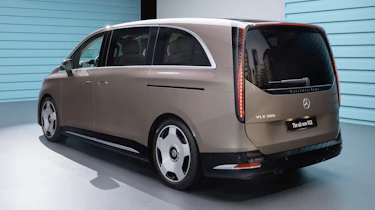
The all-new Mercedes VLE might have a broadly brick-like shape, sliding doors and a short bonnet, but what you’re looking at is the latest and potentially most convincing modern interpretations of the ultimate luxury car.
Yet the VLE is just the first of a whole new generation of high-end electric models that prioritise space and luxury over traditional premium saloon car proportions. The basis of this is a brand new and totally bespoke electric architecture, rather than one based on a commercial vehicle, and as such the VLE has the stats to back up its claims – this is now a match for any traditional high-end luxury electric car.
Platform, range and performance
The platform – ironically called VAN.EA – shares its all-new 800V architecture with the new GLC and CLA, both of which introduce their own next-gen Mercedes platforms: MB.EA and MMA.
The VLE300 will launch the ‘VL’ range, and pairs the platform’s biggest 115kWh battery option with a single, front-mounted motor. Mercedes quotes a maximum WLTP range of up to 434 miles. This is more than double the previous Mercedes EQV’s figure, but doesn’t just come from the big battery, but major improvements to the car’s aero and electric motor efficiency.
Mercedes quotes a drag coefficient of 0.25; the same as new-age EVs such as the latest Nissan Leaf, Audi A6 e-tron Avant or Porsche Macan Electric. This is especially impressive considering the VLE’s comparatively enormous dimensions of 5.3 metres long, two metres wide and nearly two metres tall.
The VLE’s charging performance is also on another planet compared with the last EQV, with a peak DC rate of 315kW on an 800V charger. This will see a 10-80 per cent top-up take 25 minutes, with more than 150 miles of range added in just 10 minutes. The current EQV tops out at 110kW.
The VLE300’s front-mounted electric motor produces 262bhp, with a 9.5-second 0-62mph time and a 112mph top speed. A VLE250 will arrive with a smaller 80kWh battery pack in the near future, along with a dual-motor VLE400 version that will pack 409bhp and crack the 0-62mph time in 6.5 seconds.
Interior space and luxury features
The VLE’s luxury-car aspirations don’t rely just on a refined electric powertrain, though, because Mercedes will offer high-end chassis hardware on a vehicle of this shape for the first time. Depending on grade, the VLE can be specified with adaptive air-suspension, rear-wheel steering and wheel sizes of up to 22 inches.
A variety of seating layouts will be available. The basic seven-seater set-up will have a 2-2-3 layout, with the second and third rows adjustable on a set of rails and rollers. The middle row can be swivelled around to face the third row, or removed entirely if required.
More opulent six-seater variants – including those with full reclining, massaging and temperature-controlled seats – can also be specified. In this format, the seats are all electrically-powered and can be rearranged via the VLE’s touchscreen or a Mercedes smartphone app.
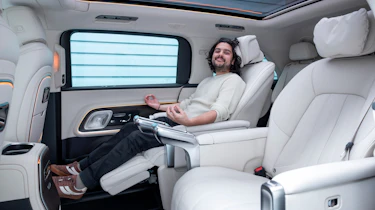
Certain models can also be equipped with a huge 30-inch retractable screen, similar to that in the BMW i7. This displays all forms of content, such as Netflix or a web browser. There’s also an integrated camera that facilitates video calls, turning the VLE into a tiny boardroom for executives.
During our brief time with the VLE just outside Merc’s Stuttgart HQ, the overwhelming sense was of a distinct ‘Mercedes’ feel to all the materials and controls. However, the cabin doesn’t feel quite as large as the previous EQV. This is largely down to the higher floor and smaller windows, but those wanting more space will be served by the upcoming long-wheelbase VLE that’s due in the next 12 months.
The tailgate is split into two pieces, with the glass section still able to open independently, allowing for access to the cabin in tight spaces.
Specific boot capacity is hard to rationalise given the variable seat layout, but Mercedes quotes a 4,078-litre space with the second and third row seats removed. With the chairs all in place, the luggage space is still long enough to fit a carry-on suitcase end-on.
What about interior tech?
The front seats are as plush as any you’ll find on an E-Class saloon, and are paired with a tech-heavy dashboard with lots of digital real estate. The glossy dash integrates a 14.5-inch touchscreen and a 10.25-inch driver’s display as standard, plus an optional 14.5-inch passenger display. All run the same MBUX interface as Merc’s other new-age models. This is also built on a new Mercedes-designed hardware set-up, making it a true software-defined vehicle.
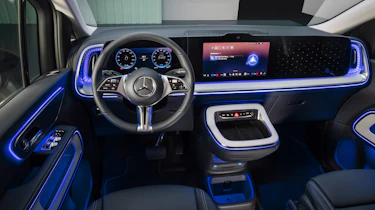
As with the seating layouts, buyers also have options of different centre-console options between the front seats. These vary from a largely open set-up, right through to a wide-set console design with integrated fridges that can be accessed from both the front seats and the second row.
Design and variants
The VLE will be available in a range of exterior design packages including a base model, sporty AMG-Line and luxurious Exclusive model. Each has a different face, although all feature the same glowing star motif in the headlights, plus a full-width light bar.
AMG-Line models add a large three-pointed star in the grille, while Exclusive models instead mount their star on the bonnet upright, with a simpler grille insert.
The car’s basic shape is slab-sided, but to the benefit of aerodynamics, the roofline does subtly fall away towards the rear end. Here you’ll find a three-sided light bar looping around much of the huge tailgate, with three-dimensional internal graphics inside.
This rear light casing is a critical part of the aero-package, too, as it creates a sharp edge for the air to detach from, helping reduce turbulence at high speeds. While the wheel designs extend up to 22 inches, the range starts with a more sensible 19-inch rim option.
Pricing and availability
Pricing has yet to be confirmed by Mercedes, but the mid-spec VLE300 should start at around £100,000, and go quite a bit higher than that with all the interior toys fitted. The VLE250 will slip below that threshold. Orders in the UK can be taken later this year, with deliveries due to commence a few months’ later.
Did you know you can sell your car through Auto Express? We’ll help you get a great price and find a great deal on a new car, too.