Omoda 9 review
The Omoda 9 promises premium SUV features and comfort at mainstream prices - but can it deliver?

Our opinion on the Omoda 9
The Omoda 9 SHS-P is a good-value family car that takes aim at models costing quite a bit more. Its badge may prove one challenge too far for those used to shopping for Volvos or Range Rovers, but mainstream buyers who want extra kit or more space could do a lot worse than giving the Chinese newcomer their attention. It’s no sports car, but the clever powertrain and comfortable ride make it a solid cruiser, plus its long EV range has the potential to cut costs for private buyers and company-car drivers alike.
About the Omoda 9
Omoda, which has brought us the petrol and electric 5 and E5 SUVs along with the mid-sized 7, has now raised its profile further with its flagship product: the Omoda 9 SHS-P. That acronym stands for ‘Super Hybrid System plug-in’. As the name suggests, this Volvo XC60-sized SUV isn’t electric, but instead runs a PHEV set-up powered by a huge 34.5kWh battery. Omoda claims it offers up to 93 miles of zero-emissions range, while DC fast charging can top up the battery from 30 to 80 per cent in 25 minutes.
That comparison with the XC60 is an interesting one. For context, the Omoda is not far off the Volvo’s size, yet it’s priced alongside slightly smaller models such as the Skoda Kodiaq and Volkswagen Tiguan. Omoda clearly has strong aspirations for the 9, then.
Used - available now

2022 MINI
Countryman
25,481 milesAutomaticPetrol2.0L
Cash £25,420
2027 Audi
A5
7,450 milesAutomaticDiesel2.0L
Cash £27,495
2023 BMW
X2
69,200 milesAutomaticDiesel2.0L
Cash £14,495
2007 Ford
Fiesta
106,000 milesManualPetrol1.6L
Cash £1,999And in some ways, it has every right to. This is a car that, on face value, has plenty of desirable ingredients – including a high-quality and spacious cabin, loads of standard equipment, and a clever hybrid powertrain. We’ve driven the car extensively on UK roads, and included it in our Chinese hybrid mega test, where we were impressed with the long electric driving range and premium feeling interior. We didn’t like its grabby brakes, though.
Performance & driving experience
Pros |
|
Cons |
|
As you’ll hear us mention repeatedly in this review, the Omoda 9 is a car unashamedly geared towards comfort rather than sporty handling. It’s quick but soft, feeling most at home on faster roads and motorways.
It’s a shame, therefore, that some of the ergonomics are a little off; there’s not enough adjustment in the steering wheel for our liking, and we’d prefer it if the driver’s seat would go a little lower. Still, visibility is good, and the ADAS systems work well.
There are three main modes that affect how the powertrain operates. ‘Initial’ prioritises electric running and keeps things nice and quiet, while ‘Smart’ utilises both the electric motor and the petrol engine as the car sees fit. We found this setting worked well, juggling the two power sources almost imperceptibly; the engine only really made itself known at a standstill, when we found it tended to emit a low-end drone, otherwise disrupting the peace of the well insulated interior.
The final mode is called ‘Force’, meaning the petrol engine uses a little more fuel to top up the battery for use later in your journey. Omoda bosses reckon this is perfect for owners and drivers who can’t charge at home, but given how well the car can switch between petrol and electric on the fly, we’d leave the system to its own devices.
On top of this, there are the usual Eco, Normal and Sport driving modes, plus a few off-road (Sand and Snow, for example) settings. These are controlled via a big rotary dial below the touchscreen – but beware, there will be no sneaking the car into Sport while the family takes a snooze; an unexpected (and unwanted) voice will announce your chosen drive mode to all occupants, every time you switch the dial.
| Model | Power | 0-62mph | Top speed |
| Omoda 9 1.5T SHS-P Noble | 443bhp | 4.9 seconds | 112mph |
| Omoda 9 1.5T SHS-P Black Noble | 443bhp | 4.9 seconds | 112mph |
Performance, 0-60mph acceleration and top speed
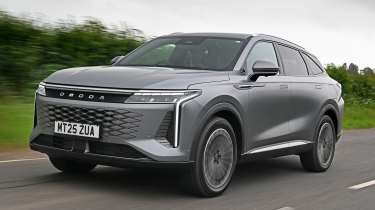
Despite appearances, the Omoda 9 SHS-P is a quick car. Perhaps the only thing signalling its prodigious straight-line speed is the four exhausts nestled within the bumper. Just don’t look too closely; the pipes are completely fake, with a single outlet hidden underneath the rear valance.
Still, with a combined 443bhp (449PS), the Omoda 9 can accelerate from 0-62mph in just 4.9 seconds (top speed stands at 124mph), and feels every bit as fast as those figures suggest. The likelihood is that you’ll use that power sparingly, most probably to fire away from a junction or roundabout, or in the occasional traffic-light drag race; this is a large SUV that can very nearly keep pace with a bog-standard Porsche 718 Boxster off the line.
Town driving, visibility and parking
The Omoda 9 feels reassuringly solid from the moment you set off. In our (admittedly brand-new) test car, there were absolutely no rattles or creaks at low speeds, with good sound insulation around town.
Visibility is fine to the front, but the narrow rear window compromises the driver’s view to the rear. Thankfully, the 360-degree parking cameras are excellent, and project an image of the car onto the central screen, negating potential blind spots.
Country road driving and handling
While the Omoda 9 won’t embarrass itself on an A or B-road, it’s a car quite clearly geared to comfort. As such, we didn’t spend too much time fiddling with the drive modes. This big SUV rarely feels unwieldy, but the steering is light and a little vague, and the car can wallow about a bit through tighter bends. Furthermore, putting the power down too early – especially on greasier roads – can cause the car to wash wide into understeer. But take things more sedately, and it’ll smother all but the very worst road imperfections just as well as its premium rivals.
There are three levels of regenerative braking, controlled via a sub-menu on the central touchscreen. However, there’s little discernible difference between the settings, which is a shame. Especially as we found the brake pedal on our car was a little grabby; being able to lean on the regen more heavily would all but eliminate the sometimes sharp braking at low speeds.
Motorway driving and long-distance comfort
The Omoda 9 is an excellent motorway car. Its comfort-oriented suspension, which can make the car feel a little wishy-washy on rural roads, comes into its own on the motorway, where the SUV settles into a nice rhythm. It’s relatively quiet, and you’ll rarely feel the engine or electric motor shuffling power beneath your backside.
Better still, this is arguably the first Chinese car we’ve driven that feels like its advanced driver-assistance systems (ADAS) have been truly tuned for European tastes and UK roads. We didn’t once feel the need to switch off the lane-keeping assist, for example, and only on one occasion did the car flash up a warning for its autonomous emergency braking system.
Add this to a promised 700-plus-mile combined petrol and electric range, and the Omoda 9 is a very relaxing car to drive long distances.
“The Omoda is definitely the car with the chance of pulling premium prospects away from European stalwarts such as Audi, BMW and Mercedes. It feels heavy, stable and well engineered – aside from the grabby brake pedal.” - Richard Ingram, deputy editor.
MPG & running costs
Pros |
|
Cons |
|
The big 34.5kWh battery will do the Omoda 9 a lot of favours when it comes to keeping a lid on running costs. The company claims it’ll return around 40mpg even if you don’t plug it in. During our Chinese hybrid mega test, the Omoda 9 achieved 44.8mpg, which was the same figure as the MG HS.
| Model | MPG | CO2 | Insurance group |
| Omoda 9 1.5T SHS-P Noble | 166.2mpg | 38g/km | 47 |
| Omoda 9 1.5T SHS-P Black Noble | 166.2mpg | 38g/km | 47 |
Electric range, battery life and charge time
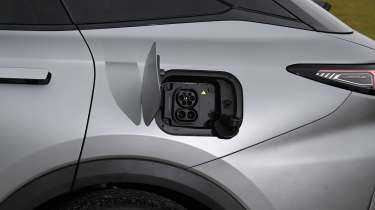
The Omoda 9 SHS-P boasts a large capacity 34.5kWh battery for a plug-in hybrid, which is good for up to 93 miles of electric running, the maker claims. That makes it one of the longest-range plug-ins on sale, and very appealing for those looking for a stepping stone towards fully electric motoring.
It’s hard to say how many miles it’ll do in the real world, due to the way its various drive modes work. ‘Initial’ prioritises electric running, while ‘Smart’ mixes the petrol engine and electric motor in what the car deems the most efficient way.
However, we found that when the car's range is below 10 miles, a warning message appears, indicating that the engine needs to be run to prevent the high-voltage battery from running too low. It’ll then default to ‘Smart’ mode and charge the battery while driving. Our dynamic dash read-out claimed that a 20 per cent battery charge was equivalent to around 12 miles of range, suggesting that 60 miles would be a realistic estimate on a full charge.
The Omoda 9’s DC rapid-charging capability is a strong selling point. We’re seeing more and more PHEVs fitted with DC charging capability, but the Omoda boasts speeds of up to 70kW, which can return a 30 to 80 per cent charge in only 25 minutes. When we plugged it into a rapid charger, the 9 maintained close to 70kW, but it made a sharp drop to just 13kW when it reached a 78 per cent state of charge.
As with most PHEVs and EVs, we expect the majority of owners will plug in at home overnight using a 7.4kW home wallbox charger. Oddly, Omoda quotes a 30 to 80 per cent charge time when plugging into a wallbox. According to the manufacturer, it'll take 5.5 hours to recharge, and since that's 50 per cent of the battery capacity, it's not a stretch to assume that in a worst-case scenario, it'll take 11 hours to fully recharge an Omoda 9 from flat. However, considering Omoda says the battery is never allowed to go flat, it shouldn't take that long.
With a petrol engine to fall back on, we don’t expect to see many owners taking advantage of this tech, especially considering how costly rapid charging is compared with a cheap-rate overnight electricity tariff, but it’s good to know it’s there if you need it.
| Model | Battery size | Range | Insurance group |
| Omoda 9 1.5T SHS-P Noble | 34.5kWh | 93 miles | 47 |
| Omoda 9 1.5T SHS-P Black Noble | 34.5kWh | 93 miles | 47 |
Insurance groups
The Omoda 9 SHS-P sits in insurance group 47 out of 50, which is very high. In fact, the Volvo XC60 dips as low as group 34, but that will cost you a lot more to buy outright.
For those needing less pricey insurance, the similarly sized plug-in hybrid Skoda Kodiaq iV starts in group 24 – although its less powerful hybrid system is likely to have contributed towards this much lower ranking.
Tax
With a list price of over £40,000, both variants of the Omoda 9 comfortably exceed the £40k threshold for the combustion-powered luxury car tax. This means a £440 supplement will be added every time the car is taxed for the first five years.
Company car drivers should benefit from the over 90 miles of electric-only range, which puts the Omoda 9 in the five per cent Benefit-in-Kind company car tax band. However, fully electric cars offer the very biggest savings. The Omoda E5 is the only electric option that’s currently offered by the manufacturer in the UK, and this is quite a bit smaller than the Omoda 9. Alternatively, you may wish to look towards the MGS6, Geely EX5 or Skoda Enyaq.
One thing to be aware of is that plug-in hybrids like the Omoda 9 might be subject to an eVED pay-per-mile tax surcharge if that comes into force in 2028.
Depreciation
The Omoda 9 should maintain 47 per cent of its original value after three years/36,000 miles, according to our market data. That's on par with the far pricier Volvo XC60, and also a little bit ahead of the Skoda Kodiaq, which is expected to maintain between 42 to 46 per cent over the same period.
To get an accurate valuation for an Omoda 9, check out our free car valuation tool…
Interior, design & technology
Pros |
|
Cons |
|
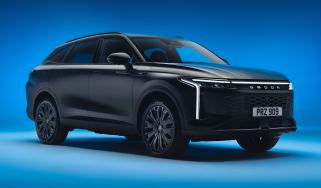
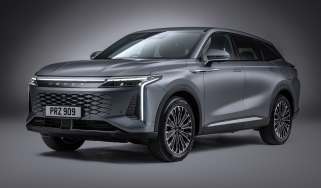
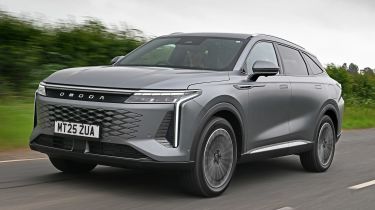
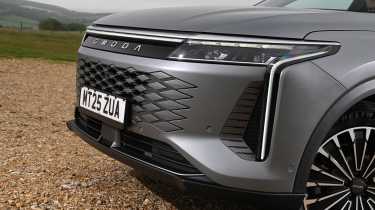
Design-wise, the Omoda 9 is certainly more distinctive than some of its Chinese brethren. Its coupe-SUV shape is in vogue right now, while the sharp LED lights, 20-inch wheels, matte grey paint (a £750 option) and quad tailpipes give it an almost European appearance at first glance.
It’s a similar story inside, where the twin-screen layout looks modern – and the materials used feel both plush and durable enough to stand the test of time. The tech itself isn’t always the most intuitive, however, and we take issue with some of the ergonomics. Neither is significant enough to be a dealbreaker, though.
For an additional £1,500, you can opt for the Noble Black trim. This adds exclusive matt black cosmetic touches to the Omoda 9, but it remains pretty much identical kit-wise.
Interior and dashboard design
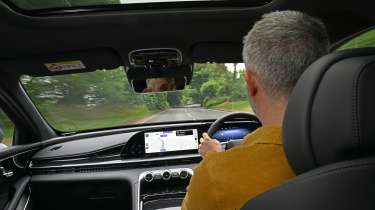
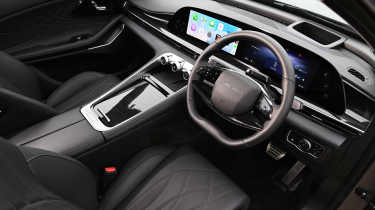
The Omoda 9’s interior design is pretty contemporary, with a large, twin-screen display comprising two 12.3-inch screens fused together in a single panel. There are dual wireless charging pads, and a head-up display, while beneath the central monitor sits a row of chunky, rotary controls for the drive modes, temperature and fan speed. These work well and have a lovely, tactile feel.
There’s no physical volume knob for the Sony stereo, only a set of haptic buttons on the steering wheel. While we’d prefer proper switches, we didn’t find ourselves brushing these unintentionally while driving, like you might in a Volkswagen ID.5.
The one area we’re not so happy with is the lack of adjustment for the seats and steering wheel; some of the ergonomics just didn’t fit our frame – that of a six-foot driver who normally prefers the wheel closer to their chest. We’d like the wheel to extend further out, and for the seat to go a little lower. It often feels as if you’re perched on top of the Omoda 9, rather than within it.
Materials and build quality
Perceived quality is good, with plenty of soft-touch plastics and vegan leather alternatives for the doors and dashboard. We’d probably sacrifice the novelty switches used to open the doors; there’s a conventional handle within the armrest anyway, rendering the electrically operated button all but useless.
Some of the materials on the centre console feel a bit cheaper, but overall, it’s a pleasant place to spend time. It’s easily a match for mainstream rivals, if not quite as plush inside as a Volvo XC60 or Range Rover Velar.
Infotainment, sat-nav and stereo
The infotainment system looks great, and has plenty of functionality hidden within – including the now-expected wireless Apple CarPlay and Android Auto. However, while that works well and fills the entire screen, the lack of a fixed ‘home’ button makes returning to the main menus to adjust the car’s myriad settings more challenging than it perhaps needs to be.
Find your way there (by clicking the ‘Omoda’ logo on the main CarPlay screen), and you’re confronted with a tile-based layout that isn’t as intuitive as you’d find in a BMW or Audi. The Omoda’s regenerative braking settings are hidden in a sub-menu, for example, rather than being easily accessible on a button or switch.
The standard-fit Sony stereo is excellent. It has speakers built into the headrests and can apparently play different media for different passengers. It can even allow the driver to take a call, while the kids listen to the radio.
“The Omoda 9 is a cool-looking car with a clean interior, though I do wish the infotainment system was a little easier to operate.” - Richard Ingram, Deputy Editor.
Boot space & practicality
Pros |
|
Cons |
|
Pitched against larger, more expensive premium SUVs like the Volvo XC60 and Range Rover Velar, the Omoda 9 may lure potential buyers with its roomy cabin and big boot – for a price more closely aligned with an entry-level Volkswagen Tiguan e-Hybrid.
The trade-off is that the Omoda does feel like quite a big car on the road; it’s not necessarily unwieldy, but it is wide – especially on tight country roads or narrow city streets. Still, it’ll carry five adults relatively comfortably, with enough room for their luggage in the 660-litre boot.
Dimensions and size
At nearly 4.8 metres long, Omoda pitches the 9 as a D-segment SUV – rivalling models like the lengthy Range Rover Velar and Volvo XC60. At 1,920mm wide, the Omoda is a similar width, too.
As such, the Omoda 9 feels like quite a big car – especially on our test route, which immediately had us navigating some tight urban and rural roads along the south coast of England. It’s never cumbersome, but drivers trading up from a conventional mid-size SUV may find its dimensions a challenge – at least to begin with. That said, the high-resolution cameras and screens make parking much easier than it would be otherwise.
| Dimensions comparison | |||
| Model | Omoda 9 | Volvo XC60 | Range Rover Velar |
| Length | 4,775mm | 4,708mm | 4,806mm |
| Width | 1,920mm | 1,999mm | 1,930mm |
| Height | 1,670mm | 1,660mm | 1,685mm |
| Wheelbase | 2,800mm | 2,870mm | 2,870mm |
| Boot space | 660 litres | 468 litres | 503 litres |
Seats & passenger space
The driving position is one area we take great issue with in the Omoda 9. For our frame (a six-foot-tall male with a long torso) we simply couldn’t lower the seat enough to sit completely comfortably, and there isn’t enough adjustment in the steering wheel to pull it out as much as we’d like.
We also found our left elbow resting awkwardly in between the cushioned centre armrest and the hard materials surrounding the front cup-holders and storage area. This could become tiresome on longer journeys.
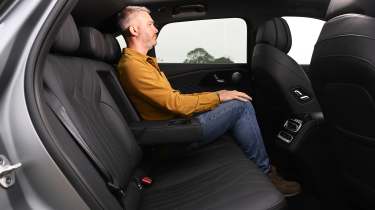
On the flip side, there’s generous room in the back seats of the Omoda 9, with the completely flat floor enabling three adults to sit comfortably side-by-side. The seats recline electrically, and the materials feel as plush here as they do up front.
Our only real gripe is the way the (otherwise glorious) opening panoramic roof eats into headroom on the outer rear seats. But this is only likely to be an issue for particularly tall adults.
Boot space
Behind the rear seats, Omoda claims a whopping 660 litres of boot space. While we don’t doubt that’s true on paper, the high lip and lack of under-floor storage may make it less useful than some rivals in day-to-day life. Factor in the coupe-style roofline, and a Volvo XC60 is likely to be slightly more practical.
Those rear seats fold in a 60:40 split to reveal (again, claimed) 1,783 litres of outright carrying capacity. That’s pretty competitive, whichever way you look at it, but if you need something with greater Ikea furniture swallowing capacity, the Skoda Kodiaq in five-seat plug-in hybrid form has 745 to 1,945 litres of luggage space available.
Towing
The Omoda 9 SHS-P can pull a 1,500kg braked trailer, which is a decent figure, but is beaten by the plug-in hybrid Skoda Kodiaq that can manage a caravan or trailer of up to 1,800kg.
Thanks to that chunky 34.5kWh battery, you might even be able to do some of your towing without using the petrol engine in the Omoda 9 at all. The electric motor’s extra torque should help with particularly hefty loads, too.
“It’s a big car, and you can occasionally feel it on tighter roads. But the pay-off is a roomy cabin with space for the whole family. Just beware of that sloping roofline – boxier rivals might pip the Omoda for outright carrying capacity.” - Richard Ingram, deputy editor.
Reliability & safety
Pros |
|
Cons |
|
It’s difficult to give any concrete reliability data on Omoda, or the 9 specifically, because both the brand and the car are so new. Saying that, the maker clearly has confidence in its products, offering a standard seven-year, 100,000-mile warranty – matching many of its Chinese rivals, and hands-down beating its premium European competitors for aftersales cover.
The independent safety organisation Euro NCAP has awarded the Omoda 9 a five-star crash test rating. It's a little ahead of the Kodiaq in the adult, child, and safety assistance technology categories, whereas the Kodiaq marginally beat the Omoda 9 for protecting vulnerable road users. The list of standard safety kit – including lane-departure warning and emergency lane-keep assist, plus rear cross-traffic alert and a multiple collision-defence system, should stand it in good stead.
One particularly positive point is that this is one of only a handful of Chinese-built models with advanced driver-assistance systems (ADAS) tuned to European tastes. We’ve driven countless cars from the Far East that have overly intrusive driver aids, but the Omoda 9 isn’t one of them. Further to this, company bosses told us that they’ll be “aggressively” updating and fine-tuning their systems with feedback from users, meaning they’re only likely to get better and more useful over time.
| Euro NCAP safety ratings | |
| Euro NCAP safety rating | 5 stars (2025) |
| Adult occupant protection | 90% |
| Child occupant protection | 85% |
| Vulnerable road user protection | 81% |
| Safety assist | 80% |
Buying, prices and deals
- Best buy: Omoda 9 SHS-P Noble
While there are two trim levels to choose from for the Omoda 9, the only real differences between the two are some cosmetic enhancements and a £1,500 premium. Unless you really are obsessed with the colour black, we’re not sure it’s worth chucking the extra money at the Black Noble. The standard Noble trim comes with plenty of equipment, and it starts from £45,000.
Whichever model takes your fancy, you can save by building your new Omoda 9 with the Auto Express Buy A Car service. We also have a range of Omoda 9 leasing deals as well as new Omoda 9 models in stock. We can also help you to sell your car.
Omoda 9 alternatives
As mentioned already, Omoda is targeting larger, premium SUVs with its flagship model. The company discusses models like the Volvo XC60 and Range Rover Velar in the same sentence as the Omoda 9, despite the latter costing between £10,000 and £20,000 less when fitted with a comparable plug-in hybrid powertrain.
You might, therefore, think it’d be better to compare it to considerably smaller, C-segment SUVs such as the Volkswagen Tiguan. The Omoda is certainly priced more closely to cars like these, but you won’t get the same level of kit, and nor can they compete when it comes to electric range or power from the petrol-electric PHEV set-up.
The pick of the large SUV class is our reigning champion, the Skoda Kodiaq. It's roughly the same size as the Omoda 9, but it packs a bigger boot, a more user-friendly interior, superior handling, and lower running costs. Although it's not as quick, doesn't have the same battery capacity or electric range, or as high a level of standard equipment, the mid-range SE L comes with everything you'll need for similar money to the Omoda.
Omoda 9 pictures
Key updates of the Omoda 9 review
10 August 2026: Latest driving impressions and line-up information.
Frequently Asked Questions
The Omoda 9 gets a generous seven-year, 100,000-mile warranty – among the very best of any mainstream manufacturer.
Deals on the Omoda 9 and alternatives