Long-term test: Skoda Fabia 130
Final report: Does our experience of warm hatch match our sister title’s?



Verdict
As confirmed after it was corroborated with a colleague, the Skoda Fabia 130 isn’t greater than the sum of its parts, although many are very good. It’s costly, the drive won’t set your pulse racing and it’s dated in some areas. But it’s easy to live with, surprisingly frugal and a tempting used buy: cars with less than 3,000 miles cost from under £22,000 on our Buy A Car service.
- Mileage: 7,184
- Efficiency: 49.7mpg
I had already spoken with colleagues at our sister title evo about the Skoda Fabia 130’s positives and negatives following their initial first drive, agreeing that the price is too high for the performance on offer, although it’s noticeably more fun than a standard Fabia. Our other sister outlet, Carwow, has also been running a Fabia 130 on their fleet for several months, so I couldn’t miss out on another opportunity to compare notes and see how similar our experiences were.
When I met Carwow news editor Jamie, the first thing I noticed is that his Fabia 130 is in the same specification as the car Auto Express has been running. That says a lot about the level of customisation – or the lack of it – available to buyers.
Used - available now

2023 Skoda
Fabia
26,000 milesManualPetrol1.0L
Cash £13,156
2021 Skoda
Fabia
55,974 milesManualPetrol1.0L
Cash £8,701
2023 Skoda
Fabia
19,184 milesManualPetrol1.0L
Cash £13,430
2025 Skoda
Fabia
49,553 milesAutomaticPetrol1.5L
Cash £14,480If we look at the back catalogue of sporty Fabias, the original vRS had a choice of six exterior paint options, while the second-generation model had eight. With our Fabia, we were limited to three: red, white and blue. When you’re paying this much over the standard car, we think you’ll want to stand out more – or at least have the option to.
What we both agreed on was that the additions, including the small splitter at the front, bespoke rear spoiler fins, black bar across the bootlid, 18-inch wheels and the unique twin-pipe exhaust tips are all pretty tasteful. We still think the badges denoting the 130 years of Skoda are a bit weird, although I suppose any birthday beyond a centenary is worth celebrating.
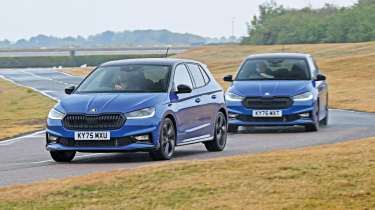
Like me, Jamie says he rarely takes the Fabia out to drive just for the sake of it. This could be down to spiralling petrol prices, but really the Skoda doesn’t thrill enough to make you count down the hours to the weekend to take it on your favourite roads. While the engine has enough punch, we both agree it’s a little flat and unrewarding to properly lean on.
A positive consequence of this, though, is that we’re both seeing average economy of around 50mpg, having been in the low 40s to begin with. In fact, we’re only a couple of mpg off the economy of a 1.0-litre three-cylinder Fabia we ran a few years ago.
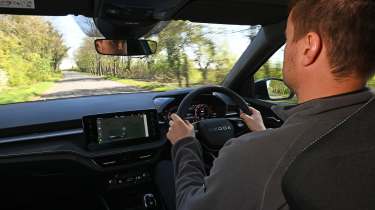
Another positive we’ve both really enjoyed – with our jobs exposing us to too many baffling touchscreen and infotainment set-ups – is how easy the Skoda’s system is to use. Sure, it’s not exclusive to the Fabia 130, but this older-generation Skoda dash with physical climate controls and a super-simple, if a little dated-looking, touchscreen means that after hopping in and out of many new test cars, the Skoda Feels as simple as slipping on a glove – ergonomically speaking.
Unsurprisingly, given our record-breaking hot summer, neither of us used the umbrella in the door, or the ice scraper in the fuel-filler cap. But one of Skoda’s ‘Simply Clever’ features Jamie did use was the blue cap for the windscreen wash, which is shaped like a funnel when open. Sadly, it didn’t quite work as intended, with a fair amount of splashback.
For both of us, the Fabia 130 has been an easy-going companion that never quite hit the heights of its hot hatch predecessors.
Skoda Fabia 130: third fleetwatch report
Skoda's hottest Fabia comes with a few surprises
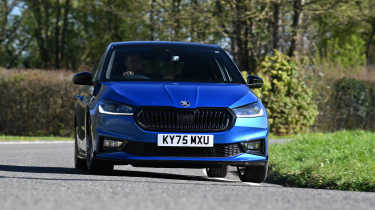
Even after five months in my hands, the Skoda Fabia 130 is still throwing a few small, but welcome, surprises my way. In one of the recent sweltering heatwaves, I thought it best to lower the windows of the Fabia 130 so it wouldn’t cook me alive on the way to the shops.
Remembering my 20-year-old BMW could lower all four windows if you held down the unlock button on the key, I tried it on the Skoda – and it turns out it does the same. Result! I then attempted it on a MINI Cooper, but alas that didn’t work. Another ‘hack’ on the Skoda is the removable cup-holder tray in the centre cubby. It makes cleaning the Fabia 130’s interior so much easier and provides better access to lost change and house keys…
Skoda Fabia 130: second report
Our man considers his wish list for Czech hot hatchback
- Mileage: 5,603
- Efficiency: 47.8mpg
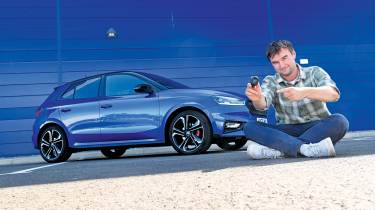
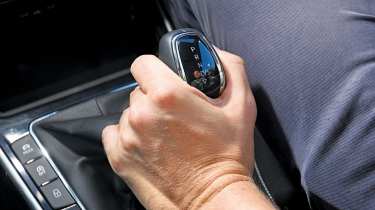
The Skoda Fabia 130 had a tall order trying to fill the boots of my previous fleet car, the MINI JCW. Sure, they target the same hot-hatch sector with a similar recipe – a turbocharged four-cylinder engine powering the front wheels through an automatic gearbox, chuckable supermini handling and loads of equipment considering their size. But one area where the Fabia 130 could have had an edge is that gearbox.
I’ve said in previous reports that while the standard-fit, seven-speed DSG automatic transmission is excellent in daily life and has allowed me to finesse my left-foot braking, it’s not what I’d ideally have in this relatively underpowered hot hatchback. I’d much prefer the Volkswagen Group’s six-speed manual gearbox, which I can only think has not been offered as an option because of emissions regulations, production costs, customer demand or a mix of all three.
The manual box would fit the character of the Fabia 130 so much better, allowing me to try to squeeze out all of its performance – and likely succeed, given the Skoda’s forgiving nature. The Fabia with the lesser 114bhp 1.0-litre engine is offered with the manual, but you can’t get it with the 148bhp 1.5-litre unit – despite the fact that this engine has been paired with the six-speed unit in other cars such as the VW Golf and Skoda Octavia. You’d think it would be possible in the Fabia 130; it’s certainly not a case of it having too much torque, because the 130’s 250Nm output is the same as in its sister cars.
While we’re on the subject of things I’d change about the Fabia 130, I wouldn’t mind the spring and damping set-up from the 2023 Volkswagen Polo GTI Edition 25 to do a better job of containing the body roll. Oh, and the seats – I wonder how much of a challenge it would be to fit those from the Octavia vRS?
Away from dreaming up modifications, I’ve also thought about something a little more real-world: residual values. The Fabia 130 now starts at £30,010 and that price looks almost ridiculous when you can buy a used example with 2,000 miles on the clock from less than £24,000 on the Auto Express Buy A Car service. Our valuation experts also say that the 130 is the worst model in the Fabia range when it comes to retaining its value; it holds on to 41.9 per cent compared with an average of 43.4 per cent across the line-up.
This Fabia certainly isn’t perfect and it might make a lot more sense as a used buy, but the 130 will be missed when it leaves the fleet. It’s become better throughout my stewardship too; the annoying dash rattle of the first few weeks has seemingly fixed itself, the fuel economy has dramatically improved, and I’ve had no more issues since an unfortunate flat battery/flat tyre incident.
Petrol hot hatches are an increasingly rare breed these days and while it would have been tempting to elevate the Fabia 130 into a full-fat hot hatchback, what we’re left with is – in my opinion – a slightly frustrating example of what might have been.
Skoda Fabia 130: second fleetwatch report
Fabia 130’s simple but well executed features are making the Skoda a pleasure to live with
Before taking on our Skoda Fabia 130, I ran another hot hatch, the MINI JCW. As well as a similar price tag, they share a useful array of kit. The Skoda’s £560 Winter Premium pack – comprising dual-zone climate control and heated seats, steering wheel and windscreen – isn’t getting much use now, but the umbrella in the door has doubled as a parasol during the recent heatwave. And when I forgot my phone charger, the Skoda’s wireless charger didn’t bake my smartphone, as other inductive charging pads have done.
Skoda Fabia 130: second report
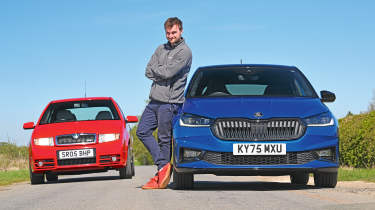
Our supermini squares up to its hot-hatch forebear
- Mileage: 2,550
- Efficiency: 43.2mpg
This is the fourth Skoda Fabia we’ve had on the Auto Express test fleet – the first was the Mk1 Fabia vRS, more than 20 years ago. My driving licence, let alone my employment at Auto Express, was still several years away then and as a result I never got to experience the original hot Fabia.
When the Fabia 130 was revealed last year, I remember wondering whether it could be a new vRS in all but name. However, Skoda quickly put the dampeners on my theory; they told me that the Fabia 130 was never meant to be a vRS. Instead, it was a special edition celebrating 130 years of the brand. Despite this, Skoda did say the Fabia 130 “pays tribute to this rich heritage, combining everyday usability with authentic motorsport DNA”.
So, I thought there’s no better way to get a greater sense of that heritage and DNA than finally trying out Skoda UK’s Fabia vRS Mk1, complete with its torquey diesel engine.
The fact you could buy a diesel-powered hot hatch back then shows how broad the push was for diesel cars in general in the 2000s. And on top of its great fuel economy (although during our original long-term test of the vRS we experienced similar efficiency to what the petrol-engined Fabia 130 is returning now) the Fabia vRS held plenty of appeal.
The 1.9-litre, four-cylinder diesel in the vRS produced 130bhp, way off the 174bhp in the Fabia 130. However, the engine, as we hinted, was all about its torque, which at 310Nm, is 60Nm more than the 130 develops.
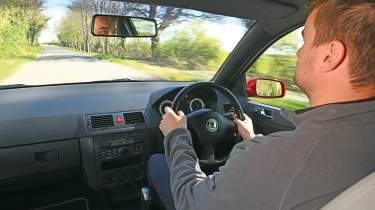
The two cars’ engines have a very different character, so while the Mk2 Fabia vRS switched to ‘twin-charged’ (turbo and supercharged) petrol power, you can see why the 130 hasn’t been bestowed with the vRS name.
I said in my first report that I was hoping the Fabia 130 would be more than the sum of its parts and that’s exactly what the original Fabia vRS is. The diesel engine sounds like a van on idle – lumpy and unrefined – and the suspension, while a little lower and stiffer than on the regular model, has an ordinary MacPherson front and torsion-beam rear.
Yet the car is an absolute hoot to drive. Despite its age, I found the vRS genuinely eager on a B-road, with part of its appeal based on its pronounced body roll (that you can just about keep in check) along with accessible surges of old-school torque steer bringing a big, stupid grin to my face.
The example we’re driving is completely as it left the showroom, whereas most versions of the Mk1 Fabia vRS in the UK now pump out black smoke from their chromed exhausts thanks to some fairly extensive and easy-to-achieve remaps. We actually did this to our own Fabia vRS back in 2005 and upped its output to 160bhp and 383Nm of torque.
Might we see owners take their Fabia 130 to engine-tuning specialists to extract more power from that already fettled unit in the same way we did many years ago? Probably not, because unlike the vRS where the main USP is its engine, the joy of the 130’s drive lies more in its balance of comfort and handling. It’s perhaps no surprise to hear the Fabia 130 is a much more precise and composed offering than its hot predecessor.
Should you feel the need to test the limits of the Fabia 130’s grip in the bends, you’ll find the body movement is manageable thanks to the well weighted and quick steering. Although the Fabia 130 is auto-only, hot Skodas (and Volkswagens for that matter) have never had the slickest manual gearshift, so it’s not a huge shame one isn’t available here – but we’d still like to have the option. Less so than the old vRS, the 130 also has a tendency to bob around if you’re really gunning it into a bend – but again everything happens in a predictable manner.
Is the Fabia 130 perhaps too sedate? Volkswagen’s axing of the Polo GTI recently opened a space within the VW Group stable for a hot hatch to sit below the likes of the Golf GTI and Cupra Leon. Sadly the Fabia 130 isn’t that car, though it certainly shows potential. The best compliment I can pay the car is that I would have loved to see more Skodas gain a mildly sportier 130 variant last year.
Skoda Fabia 130: first fleetwatch report
The Skoda Fabia 130 is proving to be an understated and practical companion
This summer, a bunch of Skoda Superb Estates will be used as support vehicles for the Tour de France, and while I can’t endorse a supermini for the same job, our Fabia 130 has been able to accommodate mine and my partner’s bikes. I’ve also come to appreciate how understated the Fabia 130 is, because we can leave it in countryside car parks without it getting much unwanted attention.
Skoda Fabia 130: first report
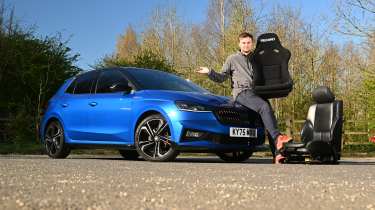
Our man takes a seat to ponder the fastest Skoda Fabia to date
- Mileage: 1,300
- Efficiency: 42.3mpg
You can tell a lot about a car from its driver’s seat. I’m not talking about cigarette burns or flakes from a pastry, but its design and the way it feels.
Sitting down in the new Skoda Fabia 130’s seat, which has a decent amount of bolstering and bespoke colouring, there’s a sense that it hugs you without feeling uncompromising. With more than 1,300 miles to cover this month over a mix of long journeys and the odd B-road blast, I knew that finding that balance between comfort and support was absolutely key from the outset.
The seats – the front ones at least – set the tone for the Fabia 130. Yet when I realised they were the same as in the lesser Monte Carlo models in not just the Fabia range, but the Scala and Kamiq, too, I felt a little disappointed. The 130 does have some unique cosmetic touches though: there’s fake carbon-fibre detailing on the dashboard and some red trim, but less than in the Monte Carlo, which also gets a Monte Carlo badge on the steering wheel; it’s blank on the Fabia 130.
The 130’s exterior tweaks are pretty subtle, including a small gloss-black splitter, a rear wing and new back bumper trim, along with black decals between the rear lights, twin exhaust tips and a couple of 130 decals. The grey 18-inch alloys that contrast with the red brake calipers certainly fill out the wheelarches nicely, but again, it’s a shame that the Monte Carlo can be had with these rims, too.
The 130 is currently the sportiest Fabia. Skoda didn’t bring back the vRS badge to its supermini, but that’s not to say there aren’t performance-related modifications. The 130’s stance is improved by its 15mm lower ‘sport’ suspension, which has been specifically tuned for a new steering calibration and the model’s standard-fit larger wheels.
The ride is still on the soft side, which I’ve appreciated on frequent long jaunts from my home in Lincolnshire to Heathrow and back. But the larger rims don’t result in a brittleness over rough roads, which is impressive. The flip side is noticeable body roll when you’re pushing on; the car telegraphs what it’s going to do with a decent amount of communication through the wheel, but those looking for vRS levels of poise might be a little disappointed.
When our spy photographers first caught the Fabia 130 testing on the Nürburgring in late summer 2025, our minds were whirring as to what could power this sporty new Skoda hatchback. The turbocharged 2.0-litre EA888 engine from Volkswagen Polo GTI (detuned from the version in the Golf GTI) seemed like a good bet, given that the Polo and Fabia sit on the same MQB A0 platform.
What we didn’t expect was Skoda tuning the EA211 1.5-litre unit from the standard Fabia. Among the bespoke parts are hardened rocker arm pins, new air pipes and a more heat-resistant intake manifold, plus heat-resistant plastics, a chunkier vibration damper and changes to the engine’s ECU to provide additional boost from the variable-turbine-geometry turbocharger.
It sounds pretty involved, but the result is a mere 174bhp rather than the standard engine’s 148bhp. The torque output is the same, at 250Nm, for a 0-62mph time of 7.4 seconds – 0.6 quicker than the next-fastest Fabia. On paper at least, the pay-off for what must have been some costly development work seems to be minimal.
The Fabia 130 has a seven-speed DSG auto gearbox, which is excellent in its own right and gets bespoke mapping for quicker shifts, but it’s a shame there’s no manual option.
We’ll delve more deeply into how the Fabia 130 drives in the coming months, but at first glance the Skoda appears to be a mildly sportier version of the marque’s humble supermini, rather than what I was hoping for: something more than the sum of its parts.
| Model: | Skoda Fabia 130 |
| On fleet since: | March 2026 |
| Price new: | £30,010 |
| Engine: | 1.5-litre turbocharged four-cylinder |
| Power/torque: | 174bhp/250Nm |
| CO2/tax: | 126g/km/31% |
| Options: | Charging Package (£360), Winter Premium Package (£560) |
| Insurance*: | Group: 22 Quote: £1,102 |
| Mileage/mpg: | 7,184/49.7mpg |
| Any problems? | Flat tyre/flat battery |
*Insurance quote for a 42-year-old in Banbury, Oxon, with three points.
Buy a car with Auto Express. Our nationwide dealer network has some fantastic cars on offer right now with new, used and leasing car deals to choose from...
Don't miss the best of Auto Express on Google! Make us a preferred source. Click here...