Suzuki e Vitara review
The Suzuki e-Vitara is Suzuki’s first EV, offering competitive pricing and the option of four-wheel drive

Our opinion on the Suzuki e Vitara
With genuine off-road ability in dual-motor trim, the Suzuki e Vitara offers something a little different in the increasingly congested electric crossover market. Unfortunately for Suzuki, it’s a segment with very strong competition and the e Vitara’s range and charging performance let it down in that regard, as does its cheap-feeling cabin. It’s a good thing that Suzuki has kept the e Vitara looking attractive with some tempting offers.
About the Suzuki e Vitara
Suzuki is keeping things simple with its first electric car. There’s no sub-brand or wacky naming structure, just a little ‘e’ that prefixes the familiar Vitara name. The range is straightforward, with a choice of two battery sizes, two trim levels and two drive configurations – front- or four-wheel drive. It’s a similar size to the existing Suzuki Vitara, and this model will remain on sale alongside the e Vitara for the time being.
The e Vitara is the latest in a series of joint ventures between Suzuki and Toyota, with Suzuki taking the development lead with the e Vitara, creating an all-new ‘Heartect-e’ architecture rather than just using a shrunken version of the Toyota bZ4X’s e-TNGA platform. Built specifically for electric cars, Heartect-e supports single- and dual-motor configurations, ensuring Suzuki’s Allgrip four-wheel drive technology lives on into the electric era.
Used - available now

2016 Suzuki
Vitara
61,464 milesManualPetrol1.6L
Cash £7,295
2020 Suzuki
Vitara
40,884 milesManualPetrol1.4L
Cash £11,295
2020 Suzuki
Vitara
9,824 milesManualPetrol1.4L
Cash £16,495
2022 Suzuki
Vitara
48,906 milesAutomaticPetrol1.5L
Cash £15,295We've tested both front- and four-wheel drive versions of the e Vitara, and pitted a range-topping Suzuki e Vitara Allgrip Ultra against a Ford Puma Gen-E in a twin test.
Performance & driving experience
Pros |
|
Cons |
|
Suzuki hasn’t forgotten the Vitara’s roots with the new EV. Instead of going after the nimble Ford Puma Gen-E or the pacey Volvo EX30, the mild-mannered e Vitara covers similar bases to the Vitara Hybrid - whether that’s on or off-road. It’s comfortable and capable but not quick by modern EV standards, and offers little flair in its driving experience.
There are two battery capacities offered in the e Vitara – 49kWh and 61kWh – made up of compact ‘blade’ batteries that are sourced from Chinese firm BYD. There’s a premium to upgrade Motion trim to the larger pack, while the smaller 49kWh battery isn’t offered in Ultra trim at all.
Performance, 0-60mph acceleration and top speed
The smaller 49kWh battery comes with a 142bhp/193Nm electric motor and manages 0-62mph in 9.6 seconds, while the 61kWh unit has a more powerful 172bhp electric motor as standard, but has the same 193Nm torque figure as the less powerful model. That doesn't stop it from accelerating to 62mph in a swifter 8.7 seconds, though. Cars with Allgrip-e have four-wheel drive and a dual-motor set-up with 181bhp and a healthier 307Nm of torque, both of which contribute to it being the quickest in the range, posting a 0-62mph time of 7.4 seconds.
However, while the four-wheel-drive model has rapid figures on paper, it still doesn’t deliver the kind of ‘shock and awe’ acceleration that some family-oriented EVs offer these days. In day-to-day driving that’s perfectly fine, though, possibly even preferable.
There are three driving modes: Eco, Normal and Sport. The biggest change between them is a sharper throttle pedal in Sport mode, which makes for a more responsive drive. There’s nothing untoward about the Suzuki’s driving character, but then there’s not much fun, either. It simply gets on with the job of going from A to B.
| Model | Power | 0-62mph | Top speed |
| e Vitara 49kWh 2WD | 142bhp | 9.6 seconds | 93mph |
| e Vitara 61kWh Allgrip-e | 181bhp | 7.4 seconds | 93mph |
| e Vitara 61kWh 2WD | 142bhp | 8.7 seconds | 93mph |
Town driving, visibility and parking
A tall driving position gives you a good view of your surroundings, although the narrow windows and thick C-pillars do limit rearward visibility a little. A reversing camera is fitted as standard, while Ultra models have a 360-degree system, but the picture quality is poor and fuzzy. Light steering and a 10.4-metre turning circle help with manoeuvrability at lower speeds, while the ride is, on the whole, comfortable.
Country road driving and handling
As with many small electric SUVs, the e Vitara prioritises comfort over sharp handling, so it won’t put a smile on your face in faster bends, but the handling is vice-free and secure. The ride has a soft edge, though the suspension can get unsettled by mid-corner bumps, causing the car to bob up and down on its springs. At 1,800kg, the e Vitara is heavier than cars such as the Ford Puma Gen-E and Citroen C3 Aircross, but it feels nimble enough.
Motorway driving and long-distance comfort
High-speed driving is pretty straightforward in the e Vitara, with the powertrains able to get the car up to speed without fuss. The ride is largely smooth, although bigger bumps and expansion joints will see the car bounce a little on its springs.
However, one significant change with the introduction of electric drive is increased tyre and wind noise – with no petrol engine to drown out background noise, these other sound sources become far more noticeable.
"The Vitara, and Suzuki as a whole, has a reputation for off-road capability, and that hasn’t been ignored with the all-electric model. The car’s ride height isn’t particularly tall, but the Allgrip model features hill descent control to help with slippery slopes, while a bespoke Trail mode – selected via a button on the centre console – helps to send power to the axle and tyres with the most grip. We reckon with a set of knobbly off-road tyres the e Vitara might show up some much larger and more expensive 4x4s on the rough stuff." – Dean Gibson, senior test editor
Range, charging & running costs
Pros |
|
Cons |
|
Electric range, battery life and charge time
Suzuki quotes a range of 213 miles for the e Vitara with the 49kWh battery, while upgrading to the 61kWh pack sees another 50 miles added to the official range. Add Allgrip-e four-wheel drive, and the figure drops a little to 245 miles.
We tested the top-spec Allgrip car in chilly autumn weather and saw a disappointing return of 2.8 miles per kWh, which gives the big-battery model a range of 171 miles. In comparison, the Ford Puma Gen-E we tested in the same conditions returned an impressive 4.4 mi/kWh, and didn’t even dip below 4.1mi/kWh on the motorway. So while the Ford has a smaller battery, its better efficiency means it can travel further on a charge.
When it comes to charging, the e Vitara’s 61kWh pack will take five and a half hours to fully charge from a home wallbox, while the smaller battery takes an hour less. Suzuki claims that maximum charging speeds of 150kW are possible from a DC source, so the large battery can be taken from 10-80 per cent in 45 minutes. However, when we topped up the car, we never saw a charging speed of more than 60kW – we’d need to spend more time charging to show if it was the car or infrastructure that was limiting the current.
| Model | Battery size | Range | Insurance group |
| Suzuki e Vitara 49kWh | 49kWh | 214 miles | 21 |
| Suzuki e Vitara 61kWh | 61kWh | 264 miles | 24 |
| Suzuki e Vitara 61kWh Allgrip-e | 61kWh | 245 miles | 28 |
Insurance groups
High group ratings are typical of Suzuki, but the e Vitara is much more competitive with its rivals. It starts in group 21 for the base model, rising to 24 for the larger-battery model and 28 for the Allgrip models, likely due to the added complexity of the twin electric motor set-up.
For comparison, the Ford Puma Gen-E starts off in a lower group ranking of 18 and goes up to group 20 for the range-topping BlueCruise Edition. Meanwhile, the Skoda Elroq starts in group 23 and goes up all the way to group 36 – although the latter is for the high-performance 335bhp vRS model.
Tax
Low prices and all-electric drive mean that the Suzuki e Vitara will be attractive to business users. Lower-rate taxpayers can expect bills of less than £250 a year, thanks to its four per cent BiK rating for '26/'27.
Even the best-equipped e Vitara sits well below the £50,000 luxury car threshold for all-electric vehicles, so there are no worries there. You will still have to pay the standard rate of annual vehicle excise duty (VED), because EVs are no longer exempt from it, and EVs will be subject to a pay-per-mile eVED fee from April 2028 onwards.
Depreciation
Residual values data from CDL reveals that the e Vitara will be worth around 42 per cent of its list price after three years and 36,000 miles. This is marginally better than the Ford Puma Gen-E (38 to 40 per cent), but the Citroen e-C3 Aircross is ahead (45 to 49 per cent), as is the Skoda Elroq (46 to 50 per cent).
To get an accurate valuation for a specific model, check out our free car valuation tool...
Interior, design & technology
Pros |
|
Cons |
|
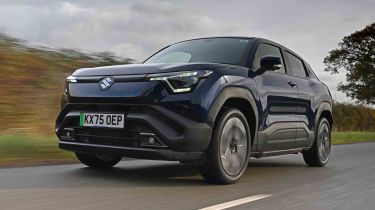
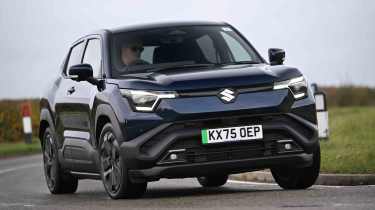
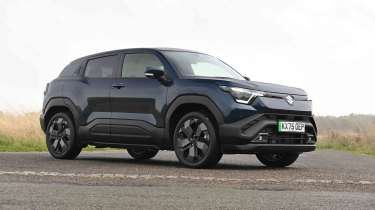
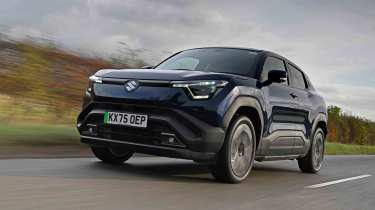
We first saw the Suzuki e Vitara as the eVX concept back in 2023. The exterior of the production car sticks close to the eVX’s chunky design, with straight edges and chunky plastic cladding giving the exterior of the e Vitara a look that ties in nicely with the rest of the Suzuki line-up, and while it looks a little plain, it does stand out in a world where rounded SUVs are becoming ever more common.
Interior and dashboard design
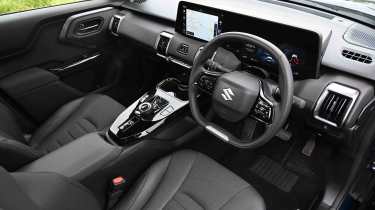
Digital displays and squared-off air vents trimmed in gunmetal grey plastic continue the chunky theme inside, but we’d suggest opting for the black and tan interior (even though it’s only available with silver or green metallic paint), just to bring some colour to the drab cabin. For the same reason, the fixed sunroof that’s standard on the Ultra spec cars is a good idea. A large digital screen, an oddly shaped steering wheel and a high-set centre console complete the layout.
Materials and build quality
The console is trimmed in piano-black plastic on Ultra cars, but we fear that this will scratch easily and look worn over time. Still, everything seems well put together, but the material quality inside is merely average, with some harder plastics lower down.
Infotainment, sat-nav and stereo
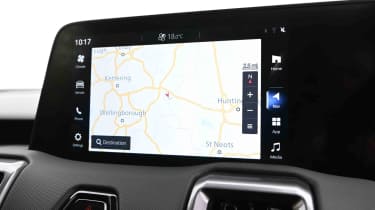
Perhaps the most frustrating part of the Suzuki is its infotainment. It’s simply too slow and relies on too many menus to be easy to use, with slow animations and multiple screen presses to get to where you want to go.
Take the heated seats. While some cars have a physical switch, the Suzuki needs at least three screen presses to access the function, which can be distracting. Connecting to Apple CarPlay is frustratingly long-winded, but once connected, you can bypass most of the built-in systems.
Unfortunately, most of the e Vitara’s functions are controlled via the main touchscreen, and there’s just a small bank of six climate control toggles for fan, temperature, air-con, recirculation and screen heating in between the centre air vents. A volume knob sits next to those, while four buttons that select drive mode, energy recovery and the hill descent control flank the drive selector.
The driver’s display is a 10.25-inch screen that can show a range of information, including mapping and economy data, and it’s controlled via the multifunction wheel. Next to that is the touchscreen system, which is based on a 10.1-inch display.
The 360-degree camera system on Ultra cars insists on performing a start-up sequence that pans around the whole vehicle, but also locks out the screen while it runs. We wouldn’t mind so much if the images were any good, but it highlights the low resolution of the cameras.
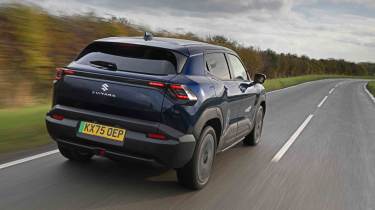
“The Suzuki e Vitara looks stocky thanks to its narrow windows, short overhangs and squared-off wheelarches, although fitting the rear doors with handles located in the C-pillars seems like a styling cue that’s been cribbed straight from the early 2000s.” – Dean Gibson, senior test editor
Boot space & practicality
Pros |
|
Cons |
|
Passenger space is reasonable in the e Vitara, but its boot is small next to rivals. A long wheelbase makes for decent legroom that beats most rivals.
Dimensions and size
The Suzuki e Vitara matches up closely to rivals like the Ford Puma Gen-E and Renault 4 in size. It’s taller than both, befitting its more off-road oriented focus, and it also has a usefully longer wheelbase – the benefits of which can be felt in the cabin.
| Dimensions comparison | |||
| Model | Suzuki e Vitara | Ford Puma Gen-E | Renault 4 |
| Length | 4,275mm | 4,313mm | 4,144mm |
| Width | 1,800mm | 1,805mm | 1,808mm |
| Height | 1,640mm | 1,555mm | 1,552mm |
| Wheelbase | 2,700mm | 2,588mm | 2,440mm |
| Boot space | 244-562 litres | 556-1,283 litres | 420-1,405 litres |
Seats & passenger space
The e Vitara’s driving position takes a little getting used to, because the seats feel as if they’re mounted quite high and the dashboard is low in front of you.
If you like your steering wheel in a high position, this can cause issues because the driver-attention sensor located on top of the steering column can obscure the lower part of the display. We think the instruments could’ve been positioned higher in the binnacle so that this doesn’t happen.
The front seats are firm, so they might become uncomfortable on longer trips, but there is a wide range of adjustment and a decent amount of space. The high centre console has a deep-sided storage tray below, and there are two USB sockets down there, too.
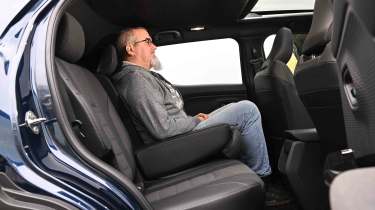
The e Vitara isn’t unique in the class for having a sliding rear bench, but it adds to its versatility. In its rearmost setting, there’s good legroom for all three seats, although the middle seat is on the narrow side and the centre console (which features two USB sockets and a small shelf) comes a little way back and encroaches on kneeroom. The floor is flat, but it’s set high, so the seat bases don’t offer much in the way of leg support.
Boot space
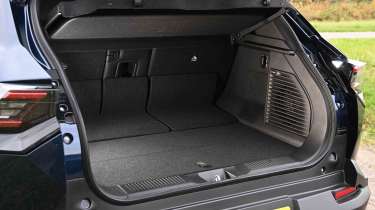
The biggest compromise with the e Vitara is its rather small boot. There’s a high floor that meets the sill, so loading items is easy, but at 306 litres in capacity, it’s well behind class leaders. That figure is with the sliding bench fully forward – if you want to maximise legroom, then the boot shrinks to 238 litres. Under-floor storage is tight, too, with just enough space for a charging cable and tyre repair kit.
There are still some handy touches in the boot. The seat back splits three ways, and there’s no risk of losing items in the void between the boot and back seats because Suzuki provides carpeted panels that cover the gap as soon as the seats are folded.
Towing
Even though you can get all-wheel drive on the e Vitara, every version comes with a fairly limited 750kg towing weight restriction.
“The Suzuki e Vitara might come with a small boot, but the existing Vitara Hybrid only has 289 litres, so existing Suzuki customers looking to make the switch won’t feel especially hard done by.” - Alastair Crooks, senior news reporter
Reliability & safety
Pros |
|
Cons |
|
The e Vitara didn’t score a full five stars from Euro NCAP, but its results are fairly good across the board with no drastically poor areas of performance, resulting in a four-star rating. Safety assist was the worst-scoring part of the test, which is a shame considering it comes loaded with standard tech, including blind-spot monitoring, rear cross-traffic alert, lane-keep assist and lane-departure prevention. We found the latter to work in a gentle fashion and isn’t intrusive.
If you want the systems set up to your liking, it’s a rather drawn-out process. You have to use the touchscreen, and every function, such as the road-sign detection, opens with an animation that takes time to run through.
The e Vitara is too new to have been included in the 2026 Driver Power survey, but the brand came 15th out of 30 manufacturers, with Suzuki owners praising their car's ride and handling, safety systems and overall reliability. They did criticise boot space, interior design, and interior fit and finish, though.
| Euro NCAP safety ratings | |
| Euro NCAP safety rating | Four stars (out of five) |
| Adult occupant protection | 77 per cent |
| Child occupant protection | 85 per cent |
| Vulnerable road user protection | 79 per cent |
| Safety assist | 72 per cent |
Buying, prices and deals
Best buy: Suzuki e Vitara Allgrip-e Ultra
With batteries coming from China’s BYD and the e Vitara being built in India, Suzuki hasn’t managed to secure the government-backed Electric Car Grant for its compact SUV. However, the brand has adjusted the price of the e Vitara to make it far more competitive with rivals that do get this discount.
The e Vitara starts at just under £25,000 for the 49kWh Motion, around £28,000 for the front-wheel drive 61kWh Motion and close to £30,000 for the four-wheel drive All Grip Motion. The range-topping Ultra trim comes only with the bigger battery and costs less than £31,000 for the front-wheel drive model, and less than £33,000 for the four-wheel drive All Grip version. It significantly undercuts the equivalent Toyota Urban Cruiser, but our favourite small SUV, the Renault 4, remains a more affordable choice.
The main reason you’d choose the Suzuki over its rivals is its rather unique use of dual-motor technology, which really helps off-road and provides a useful boost in performance. We’d definitely recommend getting the tan interior too, which is only offered on the top-spec Ultra trim.
You can save plenty when you build your ideal Suzuki e Vitara with our Buy a Car service. We also have a wide range of Suzuki e Vitara leasing deals to choose from.
Suzuki e Vitara alternatives
The small electric SUV market is a highly competitive one. The Renault 4 has an edge due to its spacious interior, particularly for rear-seat passengers, eye-catching design and efficient powertrain.
The Ford Puma Gen-E is based on the petrol car, helping to make it the best to drive in the segment. It isn't quite as spacious as the original because of the battery placement, and Ford’s range isn’t the best either. The MINI Aceman is another great drive, although that comes at the expense of ride comfort.
Elsewhere, the Toyota Urban Cruiser will be hard to separate from the e Vitara, while our former Car of the Year, the Skoda Elroq is a very strong contender to consider.
Deals on the Suzuki e Vitara and alternatives
Suzuki e Vitara pictures
Key Suzuki e Vitara review updates
2 October 2026: Updated to reflect the e Vitara price-drop announcement
17 September 2026: General update with the current 2026 Driver Power manufacturer ratings
Frequently Asked Questions
While the e Vitara is too new to confirm service details, you can expect maintenance to cost less than the petrol Vitara, courtesy of the fewer moving parts than an EV has.